
Chapter 1: Relationship-Based Professional Learning
Summary
This is the first of four chapters examining how to support the learning of early childhood
teachers based on fostering responsive and respectful interactions over time. The four chapters
are grouped together under the first section of the book titled, Relationship Based Professional
Development.
Chapter 1 explores what it takes to have a successful professional-mentoring relationship. The
chapter poses the question, “How does mentoring fit into professional development that
strengthens early-childhood teaching and program practices?” This chapter examines this
Relationship
Based
Professional
Learning
model the
power of
reflection
understand
terms &
purposes
clarify roles
& functions
identify
goals &
ground
rules
value RB
qualities &
characteristics
consider
RBPD
competencies
Outline
This chapter supports the adult’s growing capacity to
• experience the power of reflection;
• define the terms and purposes of relationship-based (RB) professional development (PD);
Learner outcomes
• Students will experience the process of reflection in order to consider
how they learn best and how they might support others to learn.
Suggested group discussion and teaching activities
The following questions and discussion topics may be used face-to-face or in an online
discussion board. If the course is a hybrid of the two modalities, it is effective to begin with a
1. Model the Power of Reflection
Listening to others is a powerful activity. Read this quote describing a group PD session on child
guidance from the beginning of the first chapter.
“With a focus on building relationships and learning, teachers were more willing to
2. Clarify Roles and Functions of Mentoring
Ask the group to brainstorm their own group ground rules from the list in this chapter. The
reason to do this after a few other discussions have occurred is that the participants may now feel
more comfortable to share what is important to them.
Next, compare your brainstormed lists with Table 1.1 in chapter 1 and consider the following
questions:
• What did you write that should be included in the table?
• Do you disagree with anything in the table? Why?
• What are the areas that you excel in? What do others notice about you that would support
the role of mentor?
• Which ideas in Table 1.1could you use more information about or more practice in
doing?
3. Mentors and Supervisors
Ask the group to turn to another person and discuss the characteristics of mentors and
4. Mentoring Qualities and Characteristics, Goals and Ground Rules
Support students to apply what they read about mentoring qualities and characteristics, goals and
ground rules to this scenario involving a crisis in a child care center. Read and debrief it
afterward.
____________________________________________________________________________
Silence falls over the group of 10 teachers at the monthly staff meeting as they see the early-
childhood education coach enter the room.
Hi, everyone. As you know, your director invited me here today to discuss some issues identified
during your program’s annual performance review. I know these are not the conditions that you
wanted to see me about. In the past, you have chosen the professional development areas to
focus on.
The goal for our meeting tonight and for the follow-up coaching sessions in the next several
weeks is to create and then implement a written plan with these sections:
2. Proposed timeline to meet all health and safety requirements.
4. Documentation plan to address the changes that will put the program in
compliance with health and safety standards.
But before we get started, does anyone have any comments or suggestions?
Mary: Yes. I think they are way too picky about these things, but I am willing to learn.
Sue: I agree, but since I want the parents to know that we are doing everything we should, I
think this will be helpful. You can never be too safe when young children are involved.
—————————————-——————–——————————————————-
Ask the group in class or assign them to journal about the following:
• How did this coach set the boundaries (ground rules) on planned learning goals while still
respecting these teachers as adult learners who need choices?
5. Relationship Based Professional Development Competencies
Arrange the group or ask them to arrange themselves into seven groups and read the directions
below.
Directions: Jot down the competencies you feel you currently have in one of the following
areas described in the chapter. Next put a check mark next to the ones you want to learn
more about. Finally add any competencies you feel are also important for promoting teacher
learning in a professional learning relationship.
Assessment and Planning
Professional Development
Professional Relationships

6. Mentoring Goal Statement
Optional: An advanced activity to support a student group who already has experience
mentoring and coaching other adults is to plan to use the mentor competencies discussed in this
Scenario
• Tell the group they are mentors assigned to work with an early childhood teacher
preschool teacher to increase her or his skills in child guidance (or choose another area of
your choice).
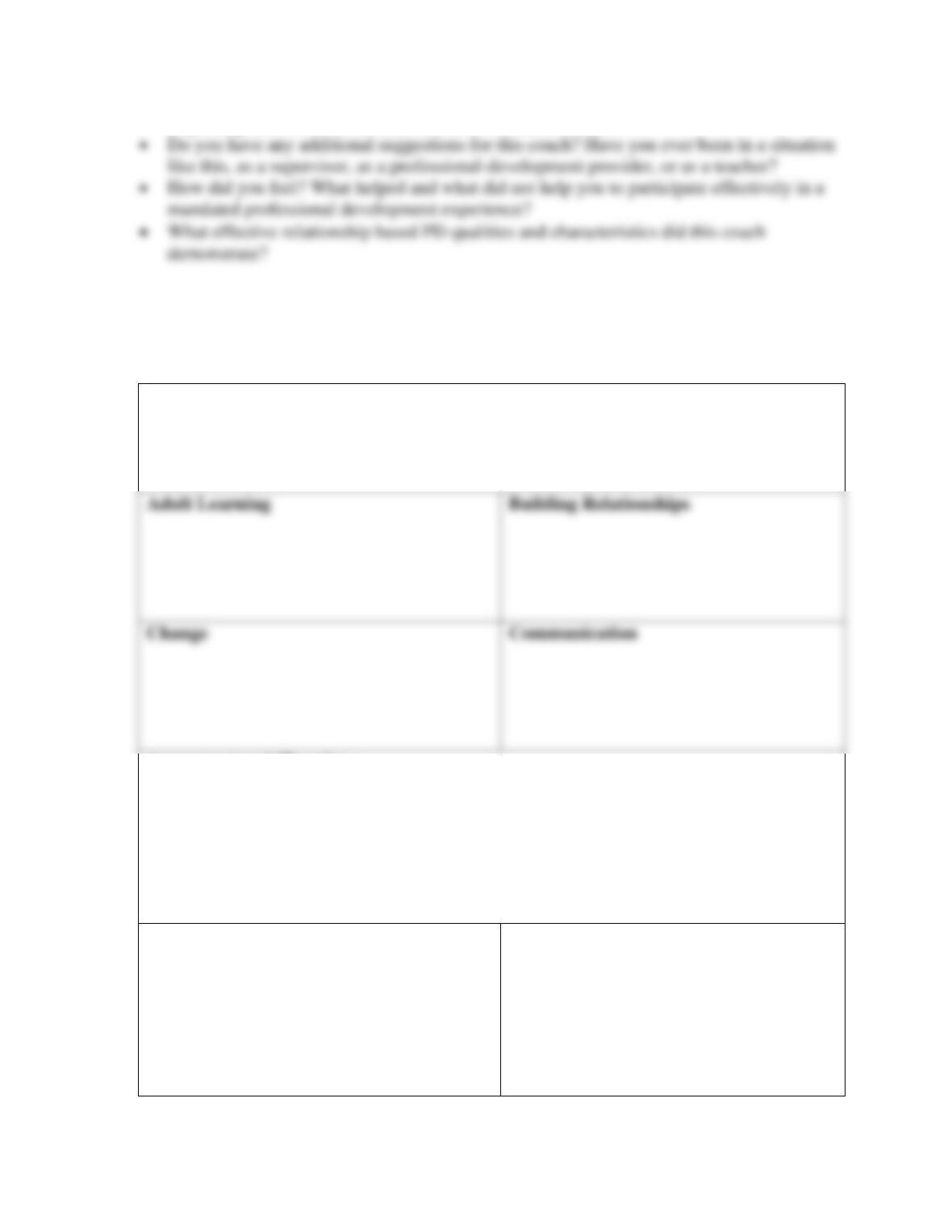
o Relationship-based PD competency area to focus on (for example: adult learning,
building relationships, the process of change, communication, assessment, etc.)
o a specific activity such learning what the teacher goal is very specifically
Read this example of a mentoring goal statement that would fit this scenario:
The mentor is able to demonstrate the ability to build relationships (competency area)
through goal setting (specific activity)
by taking anecdotal notes (way to gather evidence)
of the weekly dialogue with the teacher and director (observable behaviors).
Debrief with the students the rationale for your choices by sharing:
• “build relationships” was chosen because it was a first visit.
• “goal setting” was chosen as a mentor-teacher activity because before any plans are
made, the mentor must understand what the teacher want to learn.

If the group has some experience working with adults, then encourage participants to work
together in small groups to try to plan for the second visit of this same scenario by choosing to
fill in the mentor goal statement blanks with:
• another competency area (adult learning, building relationships, the process of change,
communication, assessment, etc.)
The mentor or coach is able to demonstrate the ability to _________________(competency area)
______________________________________________________________ (specific activity)
by _______________________________________________________(way to gather evidence)
of ________________________________________________________(observable behaviors).
Debrief the exercise
Debrief to explain that it is important to plan for their mentoring activities and to document
how they are able to demonstrate these abilities. By planning and documenting the
More suggested reading
Lindsey, D. B., Martinez, R. S., & Lindsey, R. B. (2007). Culturally proficient coaching:
Supporting educators to create equitable schools. Thousand Oaks, CA: Corwin Press.
Lutton, A. (Ed.). (2012). Advancing the profession: NAEYC standards and guidelines for
professional development. Washington, DC: NAEYC.
Nabobo-Baba, U., & Tiko, L. (2009). Indigenous Fijian cultural conceptions of mentoring and