Chapter 1: Human Resource Management in Organizations
Chapter 1
Human Resource Management in
Organizations
Learning Objectives
After students have read this chapter, they should be able to:
• Define human capital.
• Identify where employees can be used as a core competency.
Chapter Overview
This chapter provides an overview of Human Resource Management by describing seven
important considerations:
• HR as Organizational Core Competency
• HR Management as Organizational Contributor
• Organizational Ethics and HR Management
Chapter 1: Human Resource Management in Organizations
• Equal employment opportunity
• Staffing
HR can contribute to organizational results in many ways. Some of the areas of
contribution include organizational culture; organizational productivity; social
responsibilities; customer service and quality; and employee engagement. HR
management’s contributions to each of these areas are explored.
Managing HR in organizations is discussed next. All managers engage in HR management
but they are not expected to know the details about HR regulations and HR systems that
one would expect from an HR professional. Smaller organizations (less than 100) typically
do not have an HR department and the owner or another manager usually takes care of HR
issues. It is important that there is cooperation between the operating managers and the HR
staff for HR efforts to succeed. Some of the common negative and positive views of HR
are discussed.
Chapter Outline
Chapter 1: Human Resource Management in Organizations
I. What is Human Resource Management?
Human resource (HR) management is the design of formal systems in an organization to
manage human talent for accomplishing organizational goals. Whether a big company or a
small nonprofit organization, those employees must be paid, which means an appropriate
A. Why Organizations Need HR Management
Despite the obvious differences between large and small organizations, the same HR
issues must be managed in every organization. In a sense every manager in an
organization is an HR manager. However, it is unrealistic to expect every manager to
HR Headline: Human Resources Management Done Well
Dow Corning is a giant company with over 10,000 employees in 40 locations
world-wide. The company needs engaged employees working every day to turn
its strategy into reality. To help that happen, the company’s Human Resources
Department is a member of the company’s Executive Council. The company
believes it cannot reach its’ potential unless investment is made in its people.
Hiring the right people and getting them in the correct jobs, communicating with
Chapter 1: Human Resource Management in Organizations
efforts to succeed. In many cases, the HR department designs processes and systems
that the operating managers must help implement. The exact division of labor between
the two varies from organization to organization.
B. Human Capital
Organizations must manage four types of assets:
• Physical assets—Buildings, land, furniture, computers, vehicles, equipment, etc.
• Financial assets—Cash, financial resources, stocks, bonds or debt, etc.
All these assets are important to varying degrees in different organizations. But the
human assets are the “glue” that holds all the other assets together and guides their use
to achieve results. Effective use of the firm’s human capital may explain a significant
part of the difference in higher market value between one company and another.
Human capital is the collective value of the capabilities, knowledge, skills, life
experiences, and motivation of an organizational workforce. Sometimes human capital
is called intellectual capital to reflect the thinking, knowledge, creativity, and decision
making that people in organizations contribute. However, unlike intellectual property
which the organization does own (patents for example) it does not own its human
capital.
C. Managing Human Resources in Organizations
Human Resources/human capital that work in organizations may have valuable
contributions they can make to the organization’s mission, only if they have the
opportunity to contribute in a sensible way. Employees must be fit into the right job, be
trained, and given feedback if they are to do well. It is not just the HR department that
Chapter 1: Human Resource Management in Organizations
Human Resource in Smaller Organizations
In the United States and worldwide, small businesses employ more than half of all
private-sector employees and generate many new jobs each year. In surveys over
several years by the U.S. Small Business Association (SBA), the issues identified as
significant concerns in small organizations were consistent:
• Not having enough qualified workers
• The rapidly increasing costs of employee benefits
How Human Resource is Sometimes Seen in Organizations
HR departments have been viewed in different ways, both positive and negative. HR
management is necessary, especially to deal with the huge number of government
regulations enacted over the past decades. However, the role of protecting corporate
assets against the many legal issues often puts the HR function an enforcement role,
which may be seen as negative, restrictive, and not focused on getting the business of
the organization done.
Chapter 1: Human Resource Management in Organizations
strategic success if done well.
D. Human Resources as a Core Competency
The development and implementation of specific strategies must be based on the areas
of strength in an organization. Referred to as core competencies, those strengths are the
II. Where Employees Can Be a Core Competency
The possible areas for using employees for a core competency are many, but the focus in
this chapter is on three common areas—productivity, quality/service, and organizational
culture (Figure 1-2).
A. Productivity
In its most basic sense, productivity is a measure of the quantity and quality of work
done, considering the cost of the resources used. A useful way to measure the
productivity of a workforce is to determine the total cost of people required for each
unit of output.
Improving Productivity
Productivity at the organizational level ultimately affects profitability and
competitiveness in a for-profit organization and total costs in a not-for-profit
organization. Perhaps of all the resources used in organizations, the ones most
Chapter 1: Human Resource Management in Organizations
layoffs, and early retirement buyout programs.
• Redesigning work often involves having fewer employees who perform
multiple job tasks. It may also involve replacing workers with capital
equipment or making them more efficient by use of technology or new
processes.
B. Customer Service and Quality
In addition to productivity, customer service, and quality significantly affect
organizational effectiveness and can be an HR focus for employees as a core
Customer Service
Unfortunately, overall customer satisfaction has declined in the United States and
other countries.
Quality
C. Organizational Culture
Organizational culture consists of the shared values and beliefs that give members of
Chapter 1: Human Resource Management in Organizations
an organization meaning and provide them with rules for behavior. These values are
inherent in the ways organizations and their members view themselves, define
opportunities and plan strategies.
Culture is important because it tells people how to behave (or not to behave). It is
relatively constant and enduring over time. Newcomers learn the culture from the senior
employees; hence, the rules of behavior are perpetuated. These rules may or may not be
beneficial, so culture can either facilitate or limit performance.
Managers must consider the culture of the organization before implementing HR
strategies; otherwise, excellent strategies can be negated by a culture that is
incompatible with the strategies.
core competency.
III. HR Management Functions
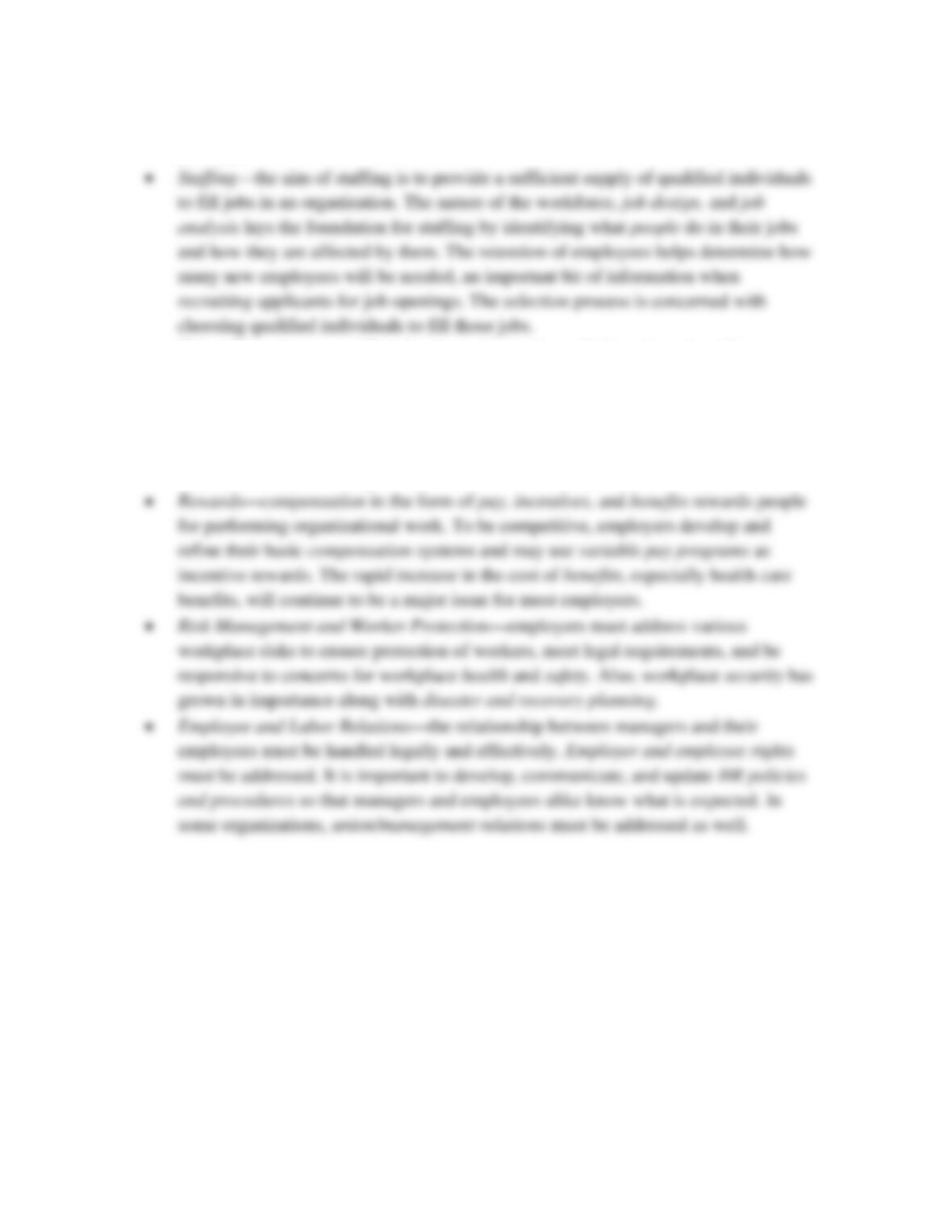
HR management is designing the formal systems that are used to manage people in a work
organization. Usually, both HR managers and line managers usually both provide input
into the policies, regulations, and rules that give guidance on HR matters. Such systems
need to be formal, that is agreed upon and written down for all to see.
Chapter 1: Human Resource Management in Organizations
• Equal Employment Opportunity—Compliance with federal, state, and even local
equal employment opportunity (EEO) laws and regulations affects all other HR
activities.
• Talent Management and Development—beginning with the orientation of new
employees, talent management and development includes different types of training.
HR development and succession planning for employees and managers is necessary
to prepare for future challenges. Career planning identifies paths and activities for
individual employees as they move within the organization. Assessing how well
employees are performing their jobs is the focus of performance management.
Chapter 1: Human Resource Management in Organizations
IV. Roles for Human Resource Departments
If an organization has a formal HR group there are typically three different roles that group
might play in the organization. The potential mix of roles is shown in Figure 1-5:
• Administrative—focusing on clerical administration and recordkeeping, including
essential legal paperwork and policy implementation.
While administrative role traditionally has been the dominant role for HR, the emphasis on
HR Perspective: What Do HR Managers Do?
The reality of what HR managers do on a weekly basis can be seen by looking at
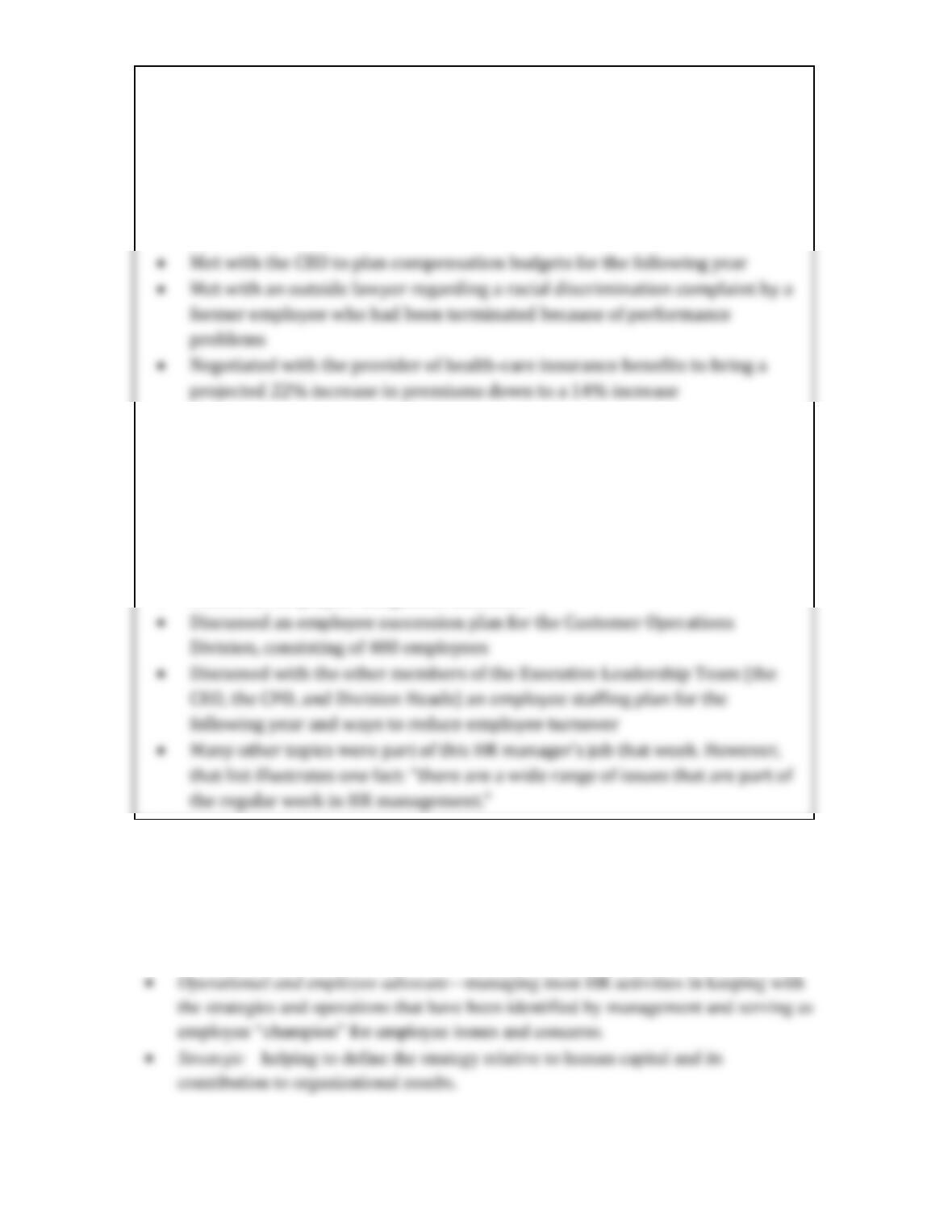
the diary of one manager. Here is some of what an HR manager in a 700-employee
firm dealt with during one week:
• Resolved an employee complaint about “offensive” pictures being shown by
a co-worker
• Reviewed an employee performance appraisal with a supervisor and
discussed how to communicate both positive feedback and problem areas
• Advised an executive on the process for terminating a sales manager whose
sales performance and management efforts were significantly below the
sales goals set
• Addressed a manager’s report of an employee’s accessing pornographic Web
sites on his company computer
• Hosted an employee recognition luncheon
Chapter 1: Human Resource Management in Organizations
the operational and employee advocate role is growing in most organizations. The strategic
role requires the ability and orientation to contribute to strategic decisions and recognition
by upper management of those skills. This practice is less common but growing.
A. Administrative Role for Human Resource
Technology and Administrative Human Resource
More HR functions are becoming available electronically or are being done using
Web-based technology. Technology has changed most HR activities, from
Outsourcing Administrative Human Resource
Some HR administrative functions can be outsourced to vendors. This outsourcing of
HR administrative activities has grown dramatically in HR areas such as employee
B. Operational and Employee Advocate Role for Human Resource
HR has been viewed as the “employee advocate” in some organizations. Employee
advocacy helps ensure fair and equitable treatment for employees regardless of personal
background or circumstances. Sometimes the HR advocate role may create conflict with
operating managers. However, without the HR advocate role, employers could face
even more lawsuits and regulatory complaints than they do now.
Chapter 1: Human Resource Management in Organizations
efforts require making certain that HR activities match with the strategies of the
organization.
C. Strategic Role for Human Resources
The strategic role means that HR is proactive in addressing business realities, focusing
on future business needs, and understanding how the need for human capital fits into
Part of strategy for HR should know what the true cost of human capital is for the
employer. Turnover is something HR can help control, and if it is successful in saving
the company money with good retention and talent management strategies, those may
be important contributions to the bottom line of organizational performance.
Some examples of areas where strategic contributions can be made by HR are:
• Evaluating mergers and acquisitions for organizational “compatibility,” structural
changes, and staffing needs
• Conducting workforce planning to anticipate the retirement of employees at all
levels and identify workforce expansion in organizational strategic plans
V. Human Resources Management Challenges
As the field of HR management evolves a challenging environment provides pressure for
even more and faster change. Challenges are to be found in economic changes leading to
Chapter 1: Human Resource Management in Organizations
cost pressures/job changes, globalization, changes in the workforce, and technology
advancement.
A. Competition, Cost Pressures, and Restructuring
An overriding theme facing managers and organizations is to operate in a “cost–less”
mode, which means continually looking for ways to reduce costs of all types—financial,
operations, equipment, and labor. Pressures from global competitors have forced many
U.S. firms to:
• Close facilities
Job Shifts
HR Perspective: Competition, Bankruptcy and Restructuring
When American Airlines finally declared bankruptcy it helped American to cut
costs. At the time of filing bankruptcy, American’s annual labor costs were at least
$800 million higher than rivals. Its rivals had used their previous bankruptcies to
get their labor (and other) costs down well below American’s. However,
bankruptcy did not allow American to eliminate the advantages held by its biggest
rivals.
Chapter 1: Human Resource Management in Organizations
Projections of growth in some jobs and decline in others illustrate the shifts
occurring. Figure 1-6 lists occupations that are expected to experience the greatest
growth in percentage and numbers for the period ending in 2020. Most of the fastest-
growing occupations percentage-wise are related to health care.
Skill Shortages
Various parts of the United States face significant workforce shortages due to an
inadequate supply of workers with the skills needed to perform the emerging new
jobs. It may not be that there are too few people—only that there are too few with
many of the skills being demanded.
B. Globalization
The globalization of business has shifted from trade and investment to the integration of
global operations, management, and strategic alliances, which has significantly affected
Wage Comparisons across Countries
Critics of globalization cite the extremely low wage rates paid by some international
firms and the substandard working conditions that exist in some underdeveloped
countries. Various advocacy groups have accused global firms of being “sweatshop
Chapter 1: Human Resource Management in Organizations
in the host countries, which allows them to improve their living standards.
Legal and Political Factors
Compliance with laws and company actions on wages, benefits, union relations,
worker privacy, workplace safety, and other issues illustrates the importance of HR
Common Challenges for Global Human Resource
While countries do not all conduct HR the same way, there is commonality in how
successful companies handle global HR. Those successful approaches include
increasing productivity, cutting costs, and investing in local talent while increasing
retention rates. Although individual companies do not all necessarily respond to all
HR challenges exactly the same way, research suggests that all must face and
overcome a common set of difficulties with an organization’s global performances.
The areas of difficulties are as follows:
C. A Changing Workforce
The U.S. workforce is more diverse racially and ethnically, more women are in it than
ever before, and the average age of its members is increasing. As a result of these
demographic shifts, HR management in organizations has had to adapt to a more varied
labor force both externally and internally. The changing workforce has raised employer
concerns, and requires more attention to resolve these concerns.
Racial/Ethnic Diversity
Chapter 1: Human Resource Management in Organizations
force, with the percentage of Hispanics roughly equal to or greater than the
percentage of African Americans. Immigrants will continue to expand that growth.
An increasing number of individuals characterize themselves as multiracial,
suggesting that the American “melting pot” is blurring racial and ethnic identities.
Gender in the Workforce
Women constitute about 50% of the U.S. workforce, but they may be a majority in
certain occupations. Numerous women workers are single, separated, divorced, or
widowed, and therefore are “primary” income earners. A growing number of U.S.
households include “domestic partners,” who are committed to each other though not
married, and who may be of the same or the opposite sex.
Aging Workforce
In many of the more economically developed countries, the population is aging,
resulting in a significantly older workforce. Replacing the experience and talents of
longer-service workers is a challenge facing employers in all industries. This loss of
Growth in Contingent Workforce
Contingent workers (temporary workers, independent contractors, leased employees,
and part-timers) represent about one-fourth of the U.S. workforce. The number of
contingent workers has grown for many reasons. One reason is the economic factor.
Temporary workers are used to replace full-time employees, and many contingent
workers are paid less and/or receive fewer benefits than regular employees.