x
PART I: Structures and Strategies
An Introduction to Thinking and Writing in College
Before delving into the specific skills and strategies of college-level writing, The “Introduction to Thinking and
Writing in College” takes a step back to answer questions many new college students have: What is college for?
What do college students write about? What does learning to write in college mean? This chapter considers these
questions and more through an examination of a topic incoming college students think they know something
about: money. Relying on numerous graphics, the Introduction illustrates key components of college-level
thinking and writing through a discussion of an extended example: how money comes to have its value. The topic
forms the basis of the model explanatory synthesis in chapter 4.
SUMMARY
What is Academic Thinking and Writing?
Differing from personal writing, business writing, or creative writing, academic writing emerges (builds)
from careful study of topics and sources. Academic writing requires significant reading, evaluating, and
thinking. Writing for college and academic careers requires more work than simply putting pen to paper (or
fingers to keyboard).
Academic thinking and writing serves to fulfill basic writing course requirements, but is far more robust in
meeting the critical thinking and curiosity challenges of other disciplines and courses. Sociologists, artists,
economists, and anthropologists all investigate topics with a critical lens in order to:
Explore similarities and differences
WRITING/CRITICAL THINKING ACTIVITIES
Note: Internet sources are generally transitory, so if a link given for an activity is no longer available, do a search
for the source to see if it is elsewhere or find another suitable source for the activity.
Activity 1
Visit the Opposing Viewpoints website at http://www.opposingviews.com/ and select two arguments: one you
agree with and one you disagree with. For the argument you agree with, list the ways you would offer support.
Write a sentence or two about why you agree. For the argument you disagree with, list the reasons that position is
flawed. What parts of the argument are the weakest? Why?
Activity 2
Find a piece of academic writing on one of the topics below by visiting scholarly journal databases offered by the
xi
library of your college or university:
Money
Food
Death
Higher Education
Illicit drugs
Social media
After reading the piece, answer the following questions:
What academic or career field is this piece written in or for?
How can you tell?
How would the piece differ if written for an audience in a different field? (if the piece is written for
sociologists, how would it differ if it were written for economists?)
How would your anticipated career or academic field write about this topic?
STUDENT WEB RESOURCES
WHAT IS ACADEMIC WRITING?
This site from SUNY Empire State College presents writing resources including a definition of academic
writing, key terms to know, and types of academic writing.
ACADEMIC WRITING AND CRITICAL THINKING
1
Chapter 1
Summary, Paraphrase, and
Q
u
ot
a
t
i
on
This chapter introduces students to the use of summary, paraphrase, and quotation—vital skills for many different
kinds of writing, both in college and in business. Writing a summary is the first assignment.
The chapter begins with the basics of summary by focusing on a relatively accessible article, “External
Enhancements of Memory May Soon Go High-Tech” by Jyutika Mehta. Students are introduced to
techniques for summarizing more difficult texts by reading Paul Bloom’s essay “The Baby in the Well: The Case
Against Empathy.” This essay addresses the role of empathy in history and politics. Students are taken step by step
through Bloom’s argument and shown how to break an argument down into stages of thought, even when there are no
thematic headings.
After reading the examples presented in the textbook and studying the Guidelines for Writing Summaries, students
should be encouraged to read the material to be summarized at least twice in order to identify the author’s central idea
before breaking the article into sections and writing a one-sentence summary of each section. Refer to the textbook
examples in order to demonstrate how to break down an argument into sections, and to show what a thesis statement
looks like and how it works with topic sentences. Point out to students the necessity of transitions that clarify for the
reader that this is a summary of someone else’s ideas. Again, help students to distinguish between accessible and
less-accessible texts and to adopt strategies for summary accordingly.
In summarizing, students must identify the author’s main idea and then restate it in their own words. In some cases,
students may attempt to summarize by only describing the content of the article, rather than by capturing the author’s
ideas. Stress the difference between what the author does in the article (e.g., the author might narrate or explain or
describe something) and what the author says or claims. Additionally, have students examine their topic sentences to
see if there is a dependence on “and then” types of transitional phrases. Such phrasing may indicate that the summary
is merely describing what subjects the author addresses and not capturing the author’s meaning.
2
only a single parenthetical citation will be needed at the end of the summary or paraphrase to give a page number or
numbers. If you allow direct quotations to be used in the summary, those quotations should be limited in number and
length. Make sure that students understand the use of ellipses and brackets and that quotations should be used
sparingly rather than as substitutes for summary. Quoted material should also be smoothly and grammatically
3
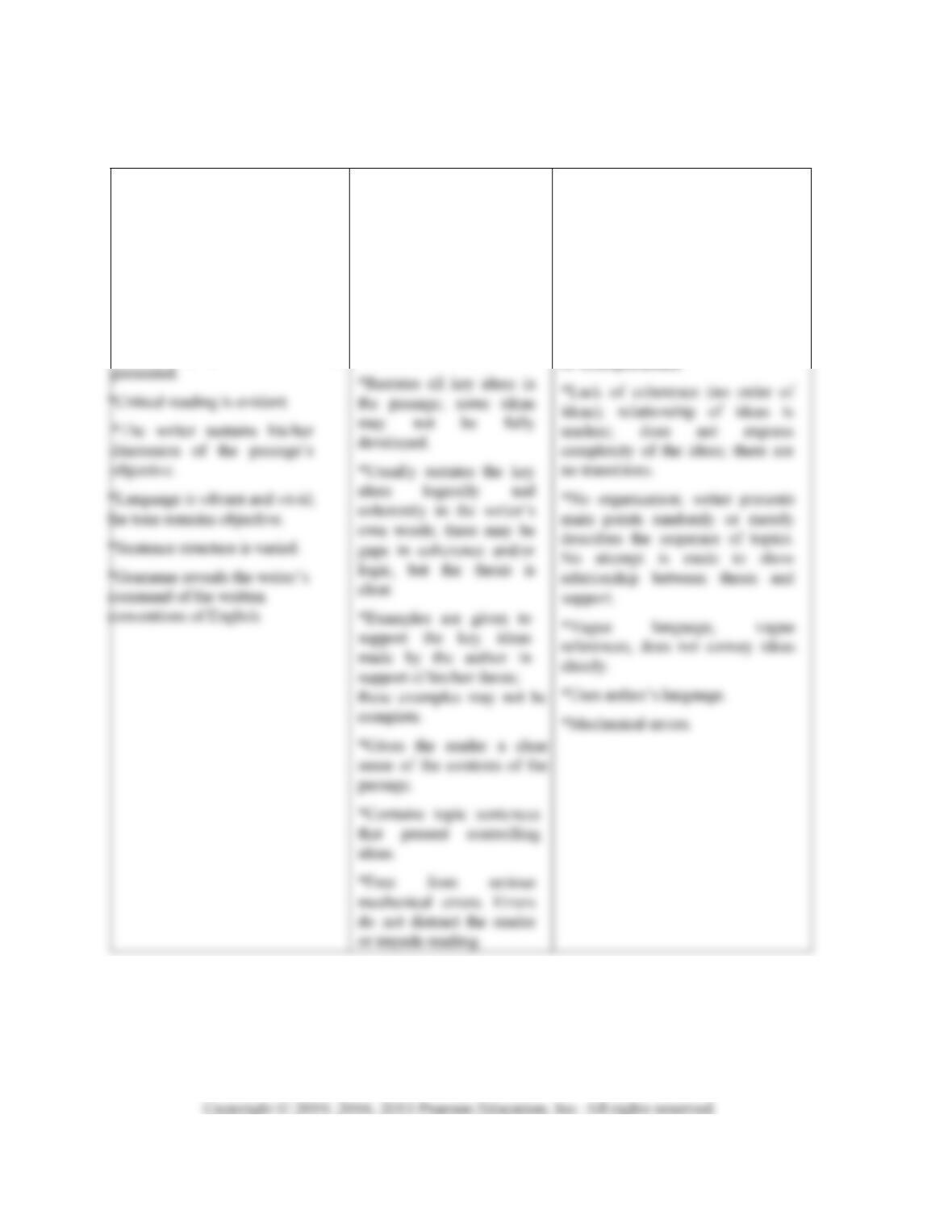
ASSESSMENT GUIDE FOR S
UMMARIES
Very Competent Competent Incompetent
*Summary is titled.
*Author, title, thesis clearly
stated at the beginning of the
summary.
*Author’s purpose is clearly
conveyed and restated in
writer’s own words.
*Author’s purpose is accurately
*Summary is titled.
*States the author and
title, the thesis is
accurately addressed
(restated); perhaps an
implied part of the thesis is
missing; the author’s
thesis is restated in the
writer’s own words.
*No title.
*Author and title never stated; no
indication this is a summary.
*Reacts to content.
*Misreads the author’s thesis.
*Ideas are unclear; does not refer
to key ideas; key ideas misquoted
or misrepresented.
4
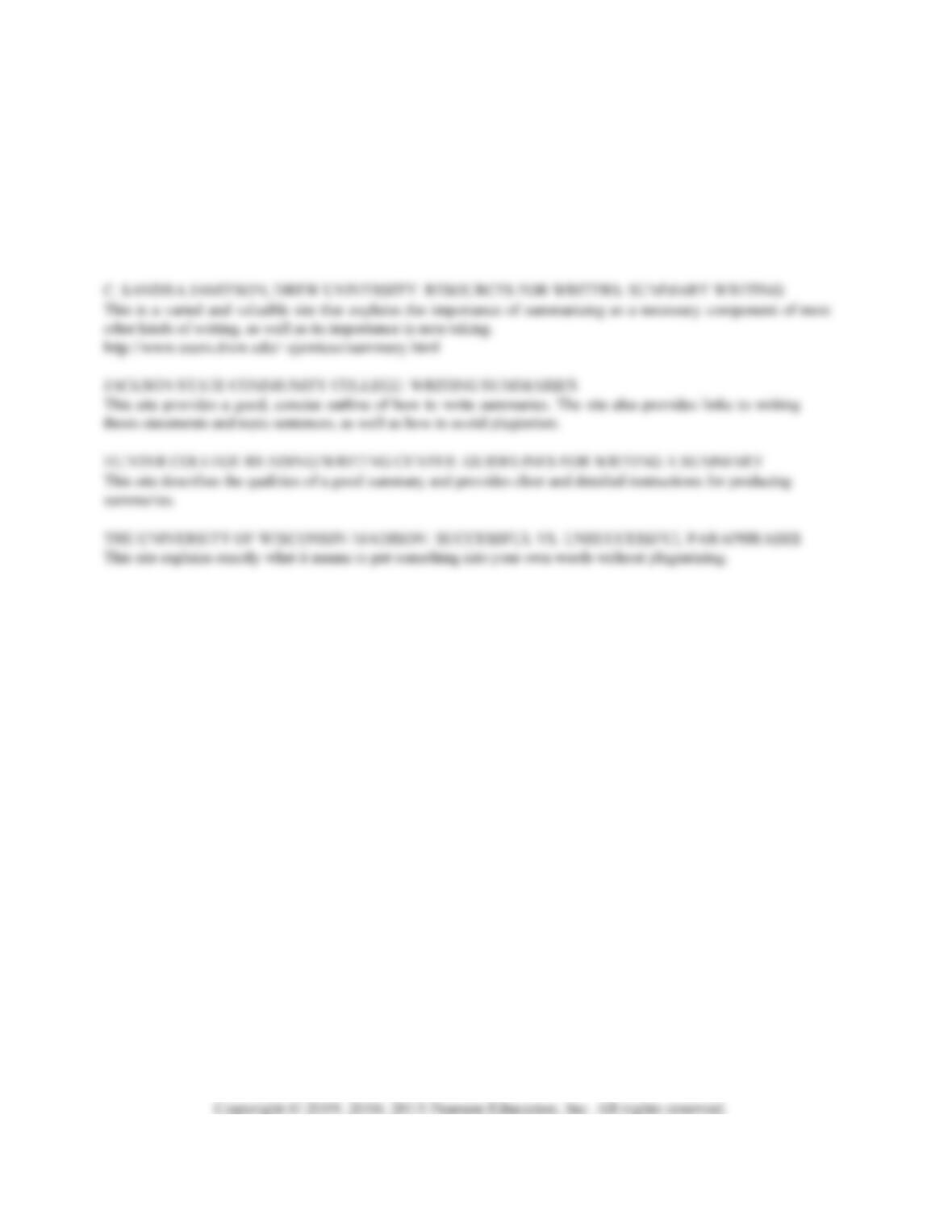
STUDENT WEB RESOURCES
UNIVERSITY OF VICTORIA ENGLISH DEPARTMENT: THE UVIC WRITER’S G
UIDE
This site provides instructions on writing summaries and includes samples.
PURDUE UNIVERSITY ONLINE WRITING LAB: QUOTING, PARAPHRASING, AND S
UMMARIZING
This site discusses quotations, paraphrases, and summaries, including definitions of the terms. A practice exercise is
included as well.