Accounting Information Systems, 10e 1
SOLUTIONS FOR CHAPTER 1
Each end-of-chapter question in the Solutions Manual is tagged to correspond with AACSB, AICPA
and CISA standards, allowing professors to more easily manage the task of reporting outcomes to these
professional and accrediting bodies. Please see the corresponding spreadsheet file for the tagging
information.
Discussion Questions
DQ 1-1 “I just want to be a good accountant, technology does not interest me.”
Comment on this statement, considering today’s technology environment.
ANS. Possible points that could be made:
a. Distinguish between an accountant and a bookkeeper. An understanding of
accounting software and related technology would enable one to advance
beyond entry-level positions.
2 Solutions for Chapter 1
DQ 1-2 Examine Figure 1.1. Based on any work experience you have had, with which
elements are you least comfortable? With which are you most comfortable?
Discuss your answers.
DQ 1-3 Examine Figure 1.1. Based on your college education to date, with which
elements are you comfortable? With which are you least comfortable? Discuss
your answers.
ANS. The point of both of these questions (DQ 1-2 and DQ 1-3) is to get the students to
see the breadth of coverage of the AIS course and to see how the course will help
DQ 1-4 Why might you have more trouble assessing the success of a not-for-profit
organization or federal government entitlement program than you would have
judging the success of a business organization?
ANS. The purpose of this question is to get the students to understand the relationship of
“success” and “accomplishing specific objectives.”
Accounting Information Systems, 10e 3
DQ 1-5 Why must you have knowledge of a system’s objectives to study that system?
ANS. With this question, we try to establish the connection between a system’s purpose
and its procedures.
Understanding and evaluating a system’s procedures must be studied in light of
DQ 1-6 Do you think your accounting education is preparing you effectively to practice
accounting? Why or why not? Discuss, from both a short-term (i.e., immediately
on graduation) and a long-term (i.e., 5 to 10 years after beginning your career)
standpoint.
ANS. This question is a follow-up to Discussion Questions 1-2 and 1-3. The purpose is
to see that some of the skills and areas of study in Figure 1.1 are short-term in
4 Solutions for Chapter 1
DQ 1-7 Examine Figure 1.9. Discuss the importance of horizontal information flows and
vertical information flows to the daily operations of a manufacturing entity.
ANS. An information system captures and records data as business operations take
place. This business event processing or horizontal information flow is the very
DQ 1-8 Examine Figure 1.9. Discuss how vertical information flows may be important to
the executive director of an organization that is a public charity.
ANS. To provide direction to a public charity, the executive director needs to know
vertically accumulated/aggregated information to provide guidance and
DQ 1-9 Give several examples not mentioned in the chapter of potential conflicts between
pairs of information qualities.
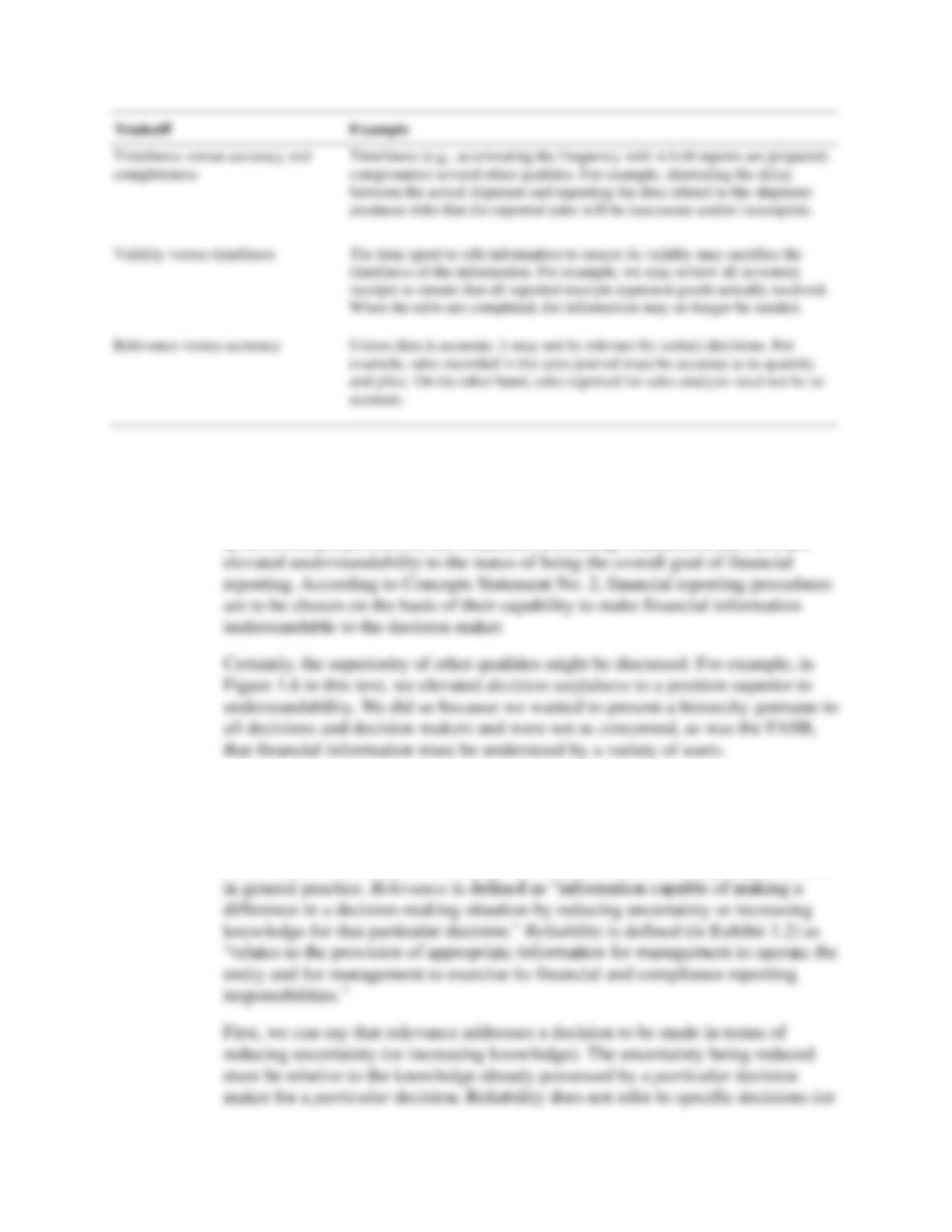
ANS. Note: Pairs discussed in the text include completeness and timeliness, and
accuracy and timeliness. This question is open-ended and presents almost
Accounting Information Systems, 10e 5
DQ 1-10 Regarding financial reporting, which quality of information do you think should
be superior to all other qualities? Discuss your answer.
ANS. In Statement of Financial Accounting Concepts No. 2: Qualitative Characteristics
of Accounting Information, the Financial Accounting Standards Board (FASB)
DQ 1-11 Comparing relevance and reliability, which information quality is most
important? Support your answer with examples.
ANS. Note: To answer this question, first review the definitions given in the chapter to
make sure to use the terms as they are defined here and not as they might be used
6 Solutions for Chapter 1
DQ 1-12 Describe two structured decisions and two unstructured decisions. Discuss the
relative amount of structure in each decision.
ANS. Structured decisions: a. Approving credit. b. When and how much inventory to
DQ 1-13 “To be of any value, a modern information process must assist all levels of
management.” Discuss.
ANS. This question addresses the value of an information process. An information
process can be of value at each and every level in the organization by providing
Short Problems
SP 1-1 ANS
1. A Note: Data on some of the picking tickets is incorrect.
Accounting Information Systems, 10e 7
2. E Note: Without a customer order a shipment is not authorized and not genuine.
3. B Note: Not all shipments are entered.
4. A Note: Every order is recorded (so completeness is achieved) but every order
is not recorded correctly (so accuracy is not achieved).
5. C, D Note: Caroline is attempting to accomplish timeliness but is working with
a report that lacks relevance because it is out of date.
SP 1-2 ANS Efficiency of a retailer can be reduced if any of the listed qualities are missing.
Time can be lost through searching for nonexistent inventory when the system
information is not updated in a timely manner, completely entered, or inaccurately
Problems
P 1-1 ANS. Regarding the quote by Robert K. Elliott, the following points could be made:
• As discussed in this chapter, identifying relevant information requires
understanding the decision maker and the decision being made.
8 Solutions for Chapter 1
P 1-2 ANS. First, to be qualified to perform such services, the accountant must be familiar
with the nonfinancial information being reviewed. To perform an audit of
financial statements, for example, the accountant must be familiar with financial
accounting theory and practice. To be qualified to perform assurance services, an
accountant must be familiar with the subject matter of the engagement. Subject
areas may include risk assessment, strategic planning, quality control, process
improvement, and customer and product productivity.
P 1-3 ANS. For Sarbanes-Oxley–related work within the accountant’s own organization,
answers should address documenting systems, performing risk assessment,
evaluating internal controls, and so on. For work outside the accountant’s
organization (e.g., for clients), answers should address the assistance given to
prepare clients for the Section 404 review. Accountants can do such work for their
P 1-4 ANS.

Accounting Information Systems, 10e 9
Note: This solution assumes that the daily and monthly reports are prepared by
the central information services function, are provided by software developed and
Quality
Inquiry
Daily
Monthly
Understandability
User can control format.
User may not be able to
control format.
User may not be able to
control format.
Relevance
Information may be tailored for
the user.
Information may be
intended for a number of
users.
Information may be
intended for a number of
users.
Timeliness
Most timely.
Second most timely.
May not be timely for
some decisions.
Predictive
value/feedback
value
User may be able to modify each
analysis and to incorporate his/her
own earlier expectations.
May not provide for
may not incorporate the
May not provide for
may not incorporate the
personal prior
expectations.
Comparability
Because one user has prepared
this information for
himself/herself and with little, if
any, central control, the
information may not be
comparable to other information.
Information centrally
controlled and provided to
a number of users may be
comparable to other
information.
Information centrally
controlled and provided
to a number of users may
be comparable to other
information.
Consistency
Because the manager can
formulate each query differently,
consistency is suspect.
consistent information.
consistent information.
Validity
Information may not have been
checked for validity.
Controls may increase
validity of this
information.
Controls may increase
validity of this
information.
Accuracy
Information may not have been
checked for accuracy.
Controls may increase
accuracy of this
information.
Controls may increase
accuracy of this
information.
Completeness
Least complete.
Average completeness.
Most complete.
Centrally controlled
reports that have been
tested, and change little
over time, should provide
Centrally controlled
reports that have been
tested, and change little
over time, should provide
10 Solutions for Chapter 1
P 1-5 ANS. Every student’s answer will likely be different. Many job listing sources are
available. Students may use general sites such as www.monster.com or specific
P 1-6 ANS. A wide range of answers are likely, based on the firm interviewed. Most
professional organizations have information on what is expected in general (see
P 1-7 ANS. This solution will vary based on the current listing of the top technologies.
P 1-8 ANS. This solution will vary based on the current listing of the top technologies.
P 1-9 ANS. An excellent resource for this problem is the AICPA’s report, Characteristics
and Skills of the Forensic Accountant, available at