2
A NOTE ON ETHICS, FRAUD, AND SOX QUESTIONS
The Lakeside Company: Auditing Cases, 12th edition, has been updated in
light of the accounting scandals of the early 2000s, the passage of the
Sarbanes-Oxley Act of 2002, and the renewed interest in ethics within the
accounting and auditing profession.
Sarbanes-Oxley issues have been incorporated in two ways. First, case
expansion through an initial public offering, and the resulting impact such a
3
A NOTE ON RESEARCH ASSIGNMENTS
The “Apply Your Research” and “Consulting Partner Review” assignments
included at the end of several cases do not lend themselves to definitive
solutions that could be included in an instructor’s manual. The assignments are
simply not intended to be exercises in arriving at a predetermined answer.
Rather, the applications of the suggested readings have the following objectives:
– To provide a means for improving the writing skills of students. From all
reports, accounting majors too often leave college lacking in the basic
ability to compose and construct sentences and paragraphs. Accounting
and auditing (especially as one moves up in an organization) obviously
require skills other than the purely quantitative. Memos, reports,
– To introduce students to accounting and business journals as well as
other important publications. After college, students must be able to “keep
current” or their effectiveness will quickly decline. In most cases, this
– To develop the students’ ability to derive viable solutions to auditing
problems. Unfortunately, students in college often come to the belief that
4
– To promote auditing research. In most of these library assignments,
students are provided with one or more resources as starting points for their
research. However, the instructor should always push the students to look
5
INTRODUCTORY CASE
SUGGESTED ANSWERS TO DISCUSSION QUESTIONS
(1)
The staff auditor performs many of the detailed audit procedures, such as
preparing and controlling accounts receivable confirmations. In general the work
of the staff auditor is controlled by the audit program and supervised by the
senior auditor.
(2)
The partner-in-charge of an audit is the definitive decision-making position on the
audit team. Although the manager and senior auditor make several decisions,
(3)
An accounting firm is a business like any other, and its management must
recognize that a marketing strategy is probably necessary to generate a
continual flow of sufficient operating revenues. However, in the accounting
profession, disagreement exists as to the extent that such marketing should take.
In the past, overt marketing was not permitted since it was considered to be
unprofessional. This position was supported based on the reasoning that a firm
6
(4)
A national or international CPA firm might consider acquiring Abernethy and
Chapman for several reasons:
– Although only a regional firm, Abernethy and Chapman apparently has a
client base that includes a number of large clients in several different
Abernethy and Chapman might have several reasons for viewing an acquisition
in a favorable light:
– Frequently, the purchase price will be a considerable amount of money
– The smaller firm may have trouble dealing with increased competition from
– The regional firm may also desire the additional backup services offered by
large organizations. National CPA firms usually have experts in many
Many mergers have occurred in the auditing profession during recent years.
Critics assert that this trend has reduced competition and will inevitably lead to a
(5)
Moving staff from one area of a CPA firm to another can cause the perception of
an independence problem. For example, the appearance of independence may
8
SUGGESTED ANSWERS TO EXERCISE
(1)
The question requires students to address all the elements of a quality control
system, as included in Statement on Quality Control Standards No. 2. In some
cases, students should recognize the need for additional information.
To: DeAnna Malott
From:
Date:
Re: Quality Control Standards at Abernethy and Chapman
Overview: I was employed by the firm of Abernethy and Chapman to review the
quality control standards within the firm. The following represents my evaluation of
these standards according to the six elements required by the AICPA.
Evaluation:
Standard Existing
Procedures
Recommendations Additional
Information
Needed
Leadership
responsibilities
The case does
not explicitly
The firm should have
policies in place that
What specific
policies does the
Relevant
ethical
Firm requires its
employees to
The AICPA’s
Code of
Professional
The case does
not mention
9
Acceptance
and
continuation of
This case does
not address this
contr
ol standard.
It is important to
have many controls
when considering a
Human
resources
The firm
considers
experience and
technical
competence in
assigning
personnel to
audit
engagements.
The firm hires
only college
The firm requires
This appears to be a
reasonable quality
control.
This seems to be a
more than adequate
Many states require
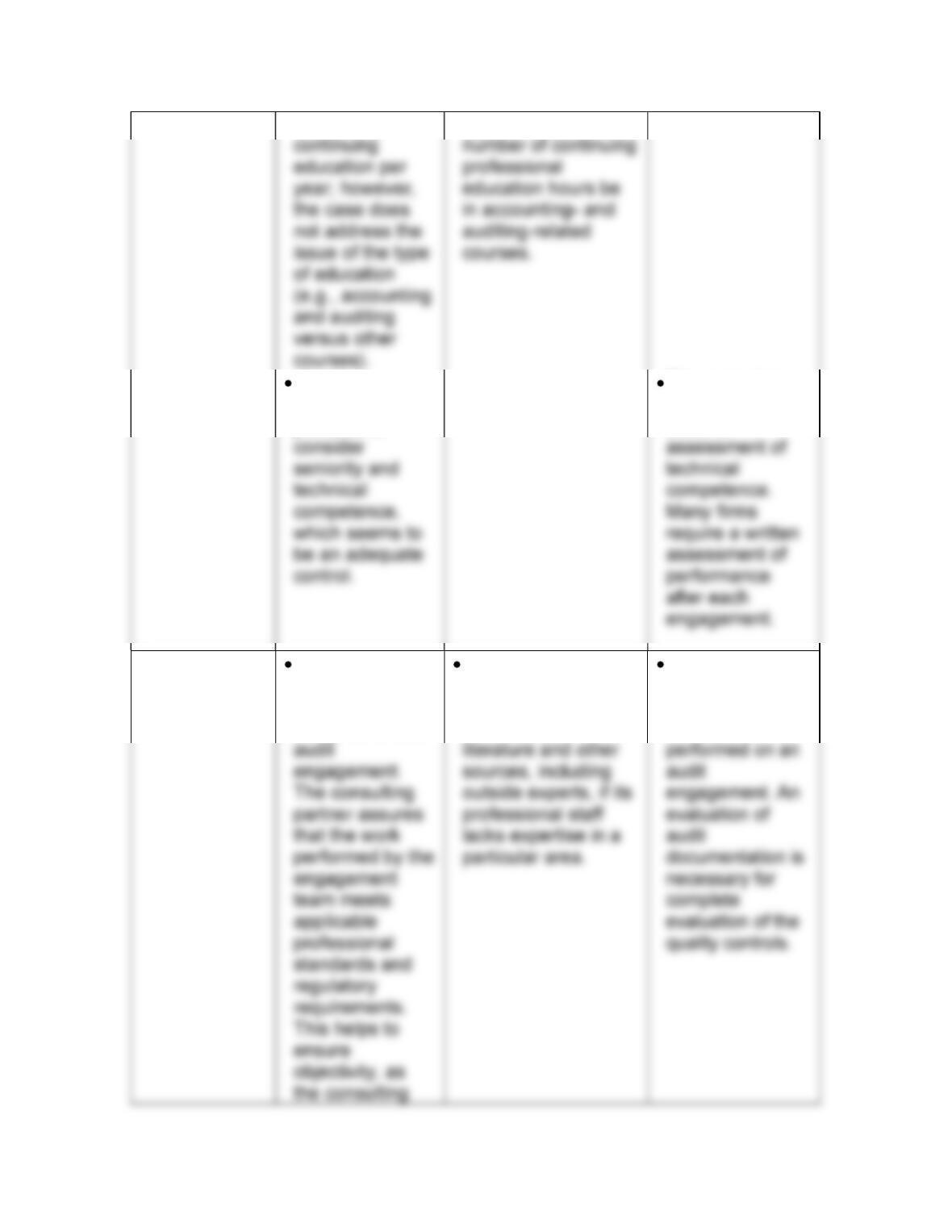
10
40 hours of
The firm
promotion
procedures
that a minimum
The case does
not address the
issue of
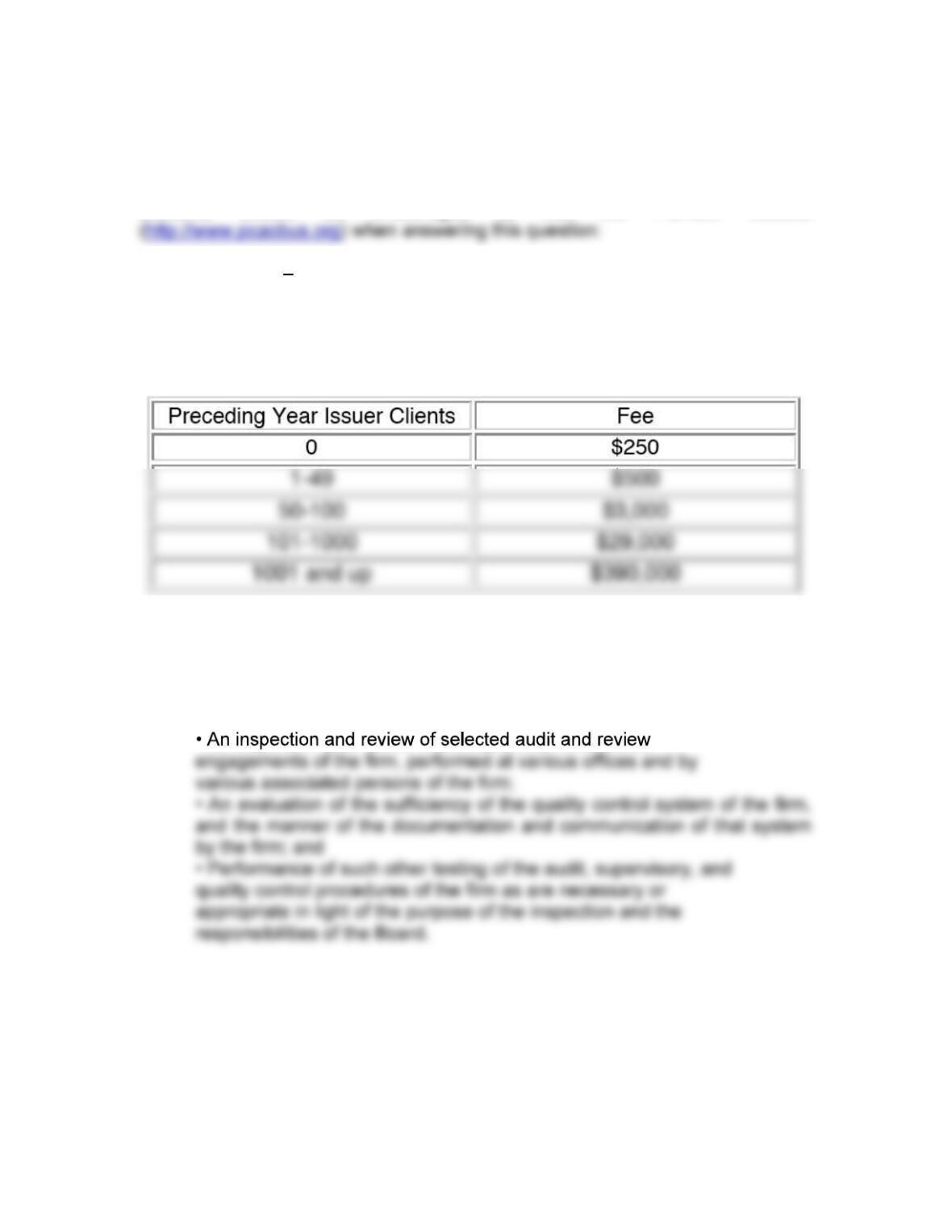
Engagement
performance
The firm requires
that a consulting
partner be
assigned to each
The firm should have
a mechanism for
consultation with
authoritative
It is not clear from
the case how the
team documents
the work

11
The firm seems
to have a clear
chain of
command and
adequate
supervision on
the audit. The
Monitoring
The firm has a
partner, DeAnna
Malott, assigned
A comprehensive
system of
documentation of the
The case does
not mention what
types of
Conclusion: The firm has many policies related to quality control standards.
However, the firm has room for improvement in many of the areas, particularly in
the acceptance and continuation of clients.
12
SUGGESTED ANSWERS TO SARBANES-OXLEY QUESTIONS
(1)
Students should be encouraged to visit the PCAOB website
– Registration CPA firms must be registered to be associated with public
companies. The application for registration is an online process. There is a fee, it
is small relative to other costs of maintaining the registered status and changing
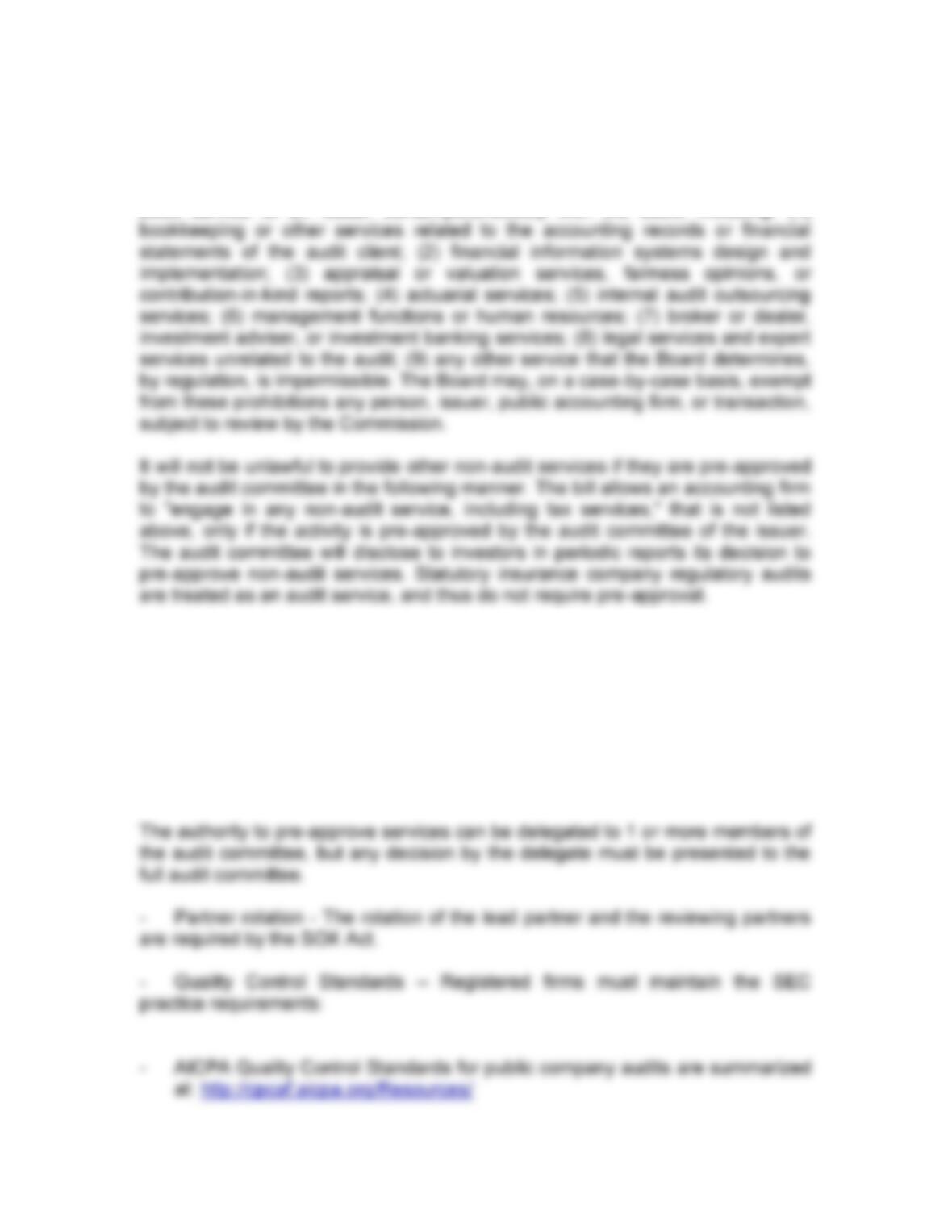
the nature of the firm to comply with PCAOB rules. Here is the fee structure from
their website:
– Inspection – The PCAOB operates a system of inspections and publicizes
the results, per its authority under the SOX Act:
– The Act provides that an inspection shall include at least the following three
general components:
– Regular inspections are on a three-year cycle, although smaller firms may
be less frequent. Special inspections can be required by the PCAOB.
– Maintenance of independence under PCAOB rules and SOX-proscribed
activities:
Proscribed activities under SOX (section 201):
13
Section 201: Services Outside The Scope Of Practice Of Auditors; Prohibited
Activities.
It shall be “unlawful” for a registered public accounting firm to provide any non–
audit service to an issuer contemporaneously with the audit, including: (1)
The pre-approval requirement is waived with respect to the provision of non-audit
services for an issuer if the aggregate amount of all such non-audit services
provided to the issuer constitutes less than 5% of the total amount of revenues
paid by the issuer to its auditor (calculated on the basis of revenues paid by the
issuer during the fiscal year when the non-audit services are performed), such
services were not recognized by the issuer at the time of the engagement to be
non-audit services; and such services are promptly brought to the attention of the
audit committee and approved prior to completion of the audit.