1
Introduction to the Third Edition
Listen to This! offers instructors extraordinary flexibility in
organizing a music appreciation/survey course because of the modular structure of the
text. Students are first introduced to seven basic elements of music through a familiar
– oundation for examining
different musical works from a variety of times and places. These same elements recur
in each chapter as appropriate to the piece under discussion. This consistent use of the
how individual pieces
incorporate common elements; it also provides for a more thorough understanding of
how music is organized. Special icons point the students to particular types of materials,
and these should be reviewed in the beginning so that students can more fully engage
with the text and MyMusicLab materials.
Every chapter of Listen to This! includes a number of illustrative items that assist
in bringing details of the music to life. Consistent in each chapter is the Listening Guide,
Expand Your Playlist (which provides suggestions of other pieces related to the chapter
topic), and Connect Your Playlist (an opportunity for students to apply what they have
learned by finding their own examples of particular musical devices). These latter two
components can be used in the classroom as a springboard for discussions that help the
while at the same time providing the students with a sense of contributing their own
ideas.
Several stand-alone online modules deal specifically with isolated content that
can be used across chapters. Students will find these helpful in understanding content
made from the online template.
Learning Objectives direct the student to key content, as do the Chapter
Highlights and Key Concepts. Most chapters include Profiles of composers and
performers that go beyond the typical biography by making historical figures come to
life by showing some of the practical issues with which they contended. Historical
Contexts, Performance, The Composer Speaks, and A Closer Look engage the student
further by adding more background on each topic. For students reading the text online,
the new Audio Glossary allows quick access to aural illustrations of essential terms that
are best expressed musically. The Journaling Prompts are designed to encourage
students to think beyond the facts presented in the text and engage the topic with a
more personal approach. They provide an outlet for creative writing in that the students
think about the music at hand in a manner that invites them to put themselves in the
place of the artist.
MyMusicLab is a key component of Listen to This! and rounds out instruction
with innovative presentations particular to each chapter as well as across the entire
book. Here students can find many tools to enhance their course experience.
2
MyMusicLab can be a tool for in-class learning or for individual study outside of the
classroom, or both. The Animated Notation feature demonstrates all the musical
examples included in the textbook so that students are not intimidated by music
The Automated Listening Guide has been redesigned for tablet use as well as PC
and includes a number of new features. To further emphasize the importance of
listening to music (implied in the title Listen to This!), students can begin their
exploration of each piece directly from the Automated Listening Guide. Here they can
also find pre- and post-tests. Students can customize the level of detail by which they
listen to each piece, or instructors can lead the pace at which a class moves through each
chapter. For example, the first time students encounter a work, they may prefer a simple
guide (based on the Listen to This First segments that begin each chapter). As they
become more familiar with the ideas explored in the chapter, they can add more detail
with a simple toggle maneuver. Colored lines demonstrate the continuity and change of
the elements across time, providing students with a visual guide to what they are
hearing, and students can choose to follow only a single element throughout.
Two other new tools added to the third edition of Listen to This!
MediaShare and Writing Space. Both of these invite students to write about their
experiences with the music in the textbook. MediaShare allows students to express their
thoughts in blogs, journals, and even online videos. Students can be encouraged to
3
Sample Syllabus Complete Textbook
The following syllabus demonstrates how to proceed through Listen to This! in the order
presented in the textbook, incorporating all chapters. It follows a schedule of
approximately five chapters per week and includes time for assessments of each of the
six parts. The final week is set aside as a time for student presentations, which would be
an excellent opportunity for students to share from their own Connect Your Playlist
choices or other self-assessment activities assigned by the instructor.
Week Chapters for Lecture MyMusicLab
Resources
1 PART I The Middle Ages 476 CE Early
Fifteenth Century
1 Hildegard von Bingen, Play of Virtues (excerpt)
2 San Ildefonso Indians of New Mexico, Eagle Dance
Elements of Music
Tutorials
Watch: History of
Music; A Tour of
Chartres Cathedral;
Omaha Nation
Powwow
A Closer Look
:
Twelfth-Century
Plainchant
Manuscript
4
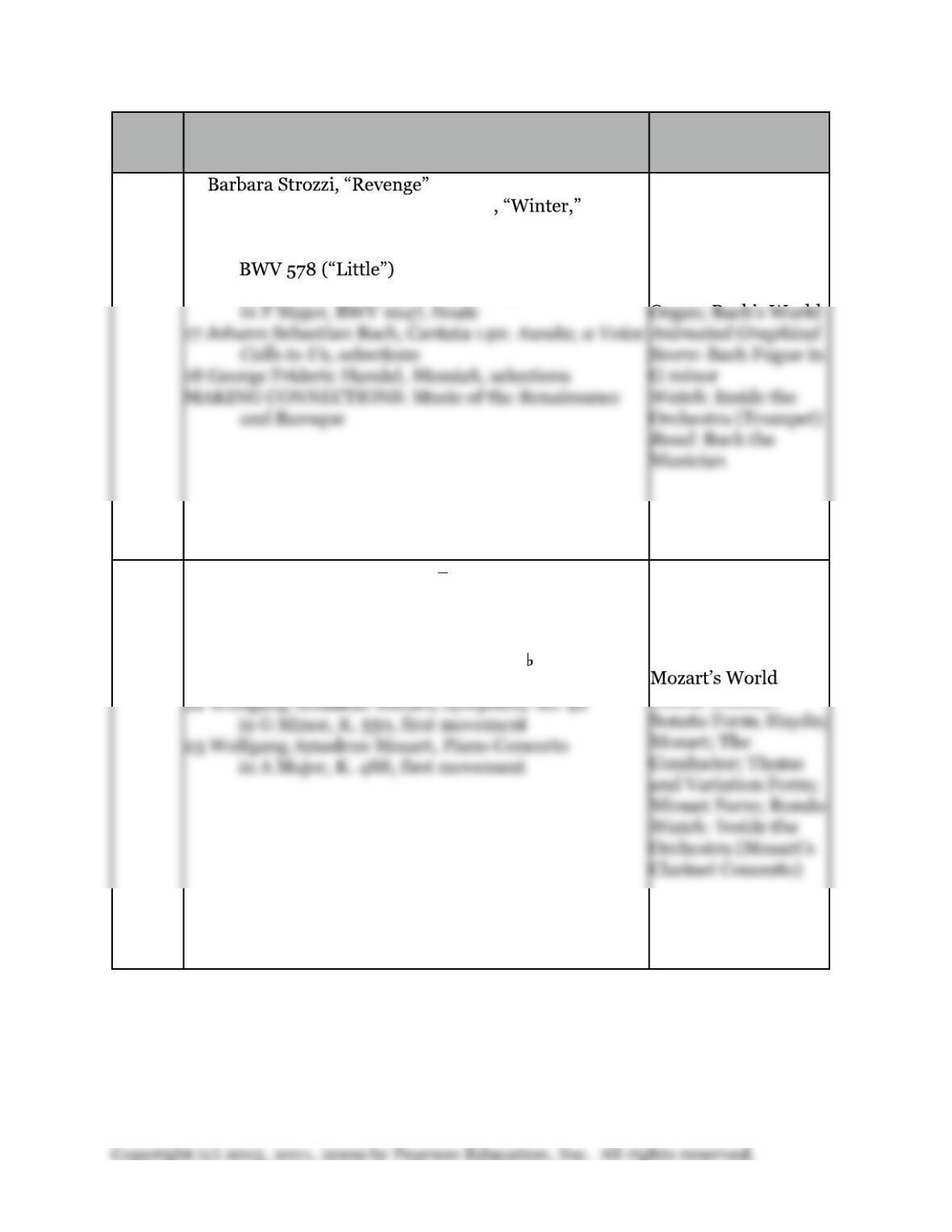
Week Chapters for Lecture MyMusicLab
Resources
2 3 Francesco Landini,
4 I Can All Too Well Compare
5 Alfonso el Sabio, Songs to the Virgin Mary, no. 249,
PART 2 The Renaissance Ca. 1425 1600
Europe; Renaissance
A Closer Look
Renaissance Printing
Animated Graphical
Read
Condemns the Ars
Watch: Inside the
Orchestra
Listen: The
Renaissance in
3
8
William Byrd,
9 Rhyming Singers of the Bahamas,
MAKING CONNECTIONS: Music of the Middle Ages
Animated Graphical
Score: William Byrd
A Closer Look
:
Baroque Opera
5
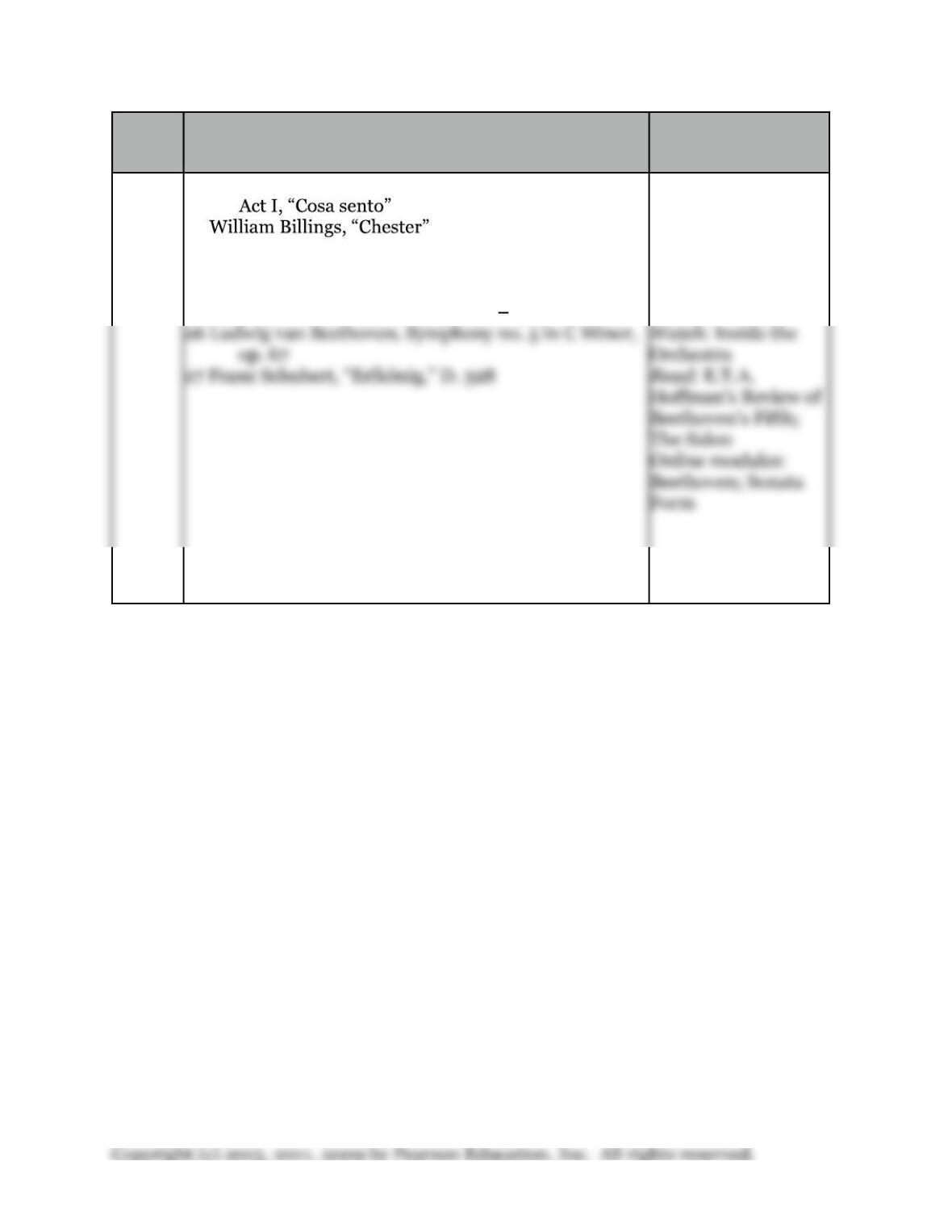
Week Chapters for Lecture MyMusicLab
Resources
4 13
14 Antonio Vivaldi, The Four Seasons
first movement
15 Johann Sebastian Bach, Fugue in G Minor,
16
Johann Sebastian Bach, Brandenburg Concerto no. 2
Animated Graphical
: Bach Fugue in
Online modules:
Women Composers
in the Baroque Era;
Bach
A Closer Look
: The
Violin; The
Baroque
5 PART 4 The Classical Era 1750 1800
19 Joseph Haydn, String Quartet in C Major, op. 76,
no. 3, second movement
20 Master Musicians of the Ikuta-ryu, Cherry Blossom
21 Joseph Haydn, Symphony no. 102 in B Major, third
and fourth movements
Animated Graphical
Score: Haydn String
Quartet
A Closer Look
: The
Chamber Orchestra;
Online module:
6
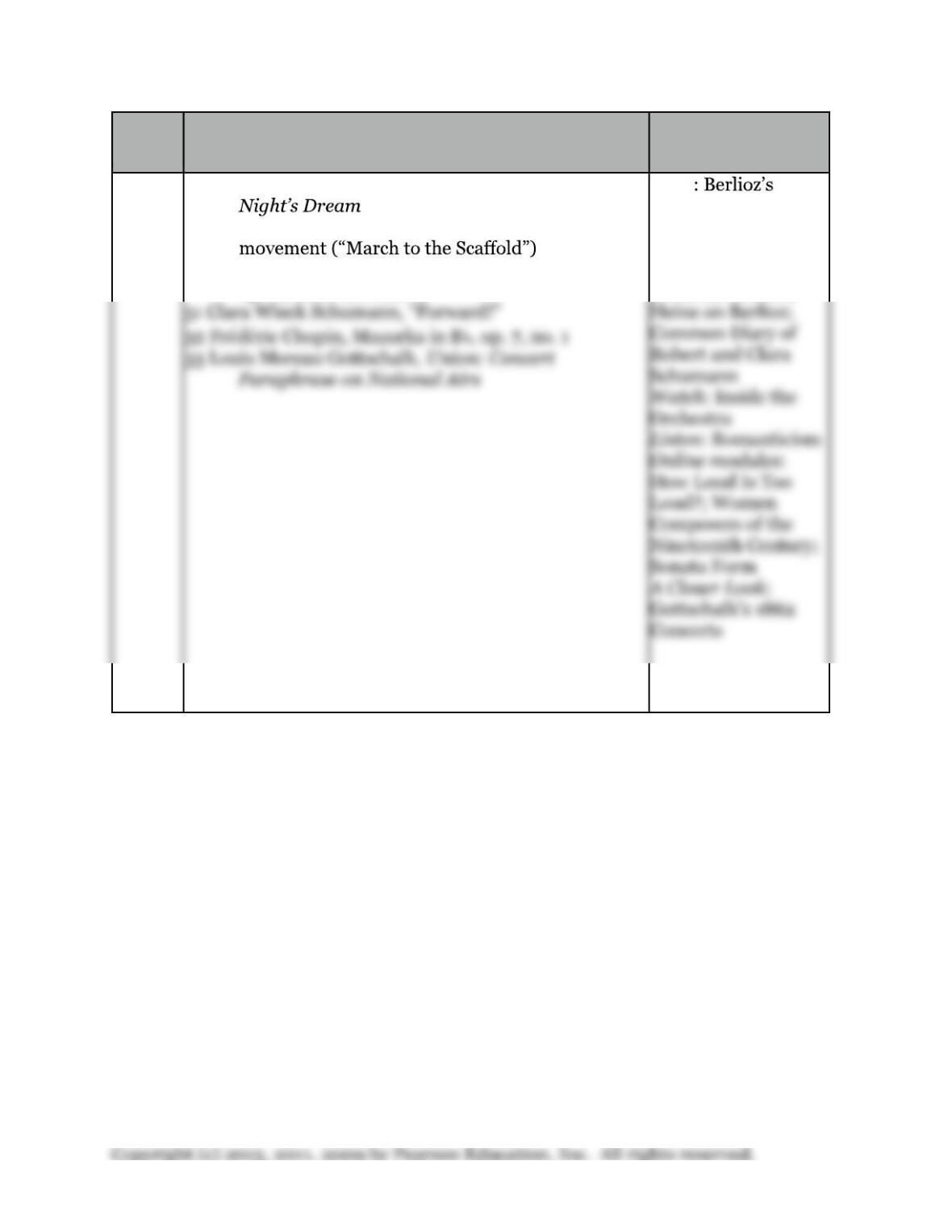
Week Chapters for Lecture MyMusicLab
Resources
6 24 Wolfgang Amadeus Mozart, The Marriage of Figaro
,
25
MAKING CONNECTIONS: Music of the Baroque and
Classical Eras
PART 5 The Nineteenth Century 1800 1900
Listen: Opera in the
Eighteenth Century
Animated Graphical
Score: Beethoven
Symphony 5
A
Closer Look
: Franz
Liszt at the Piano
7
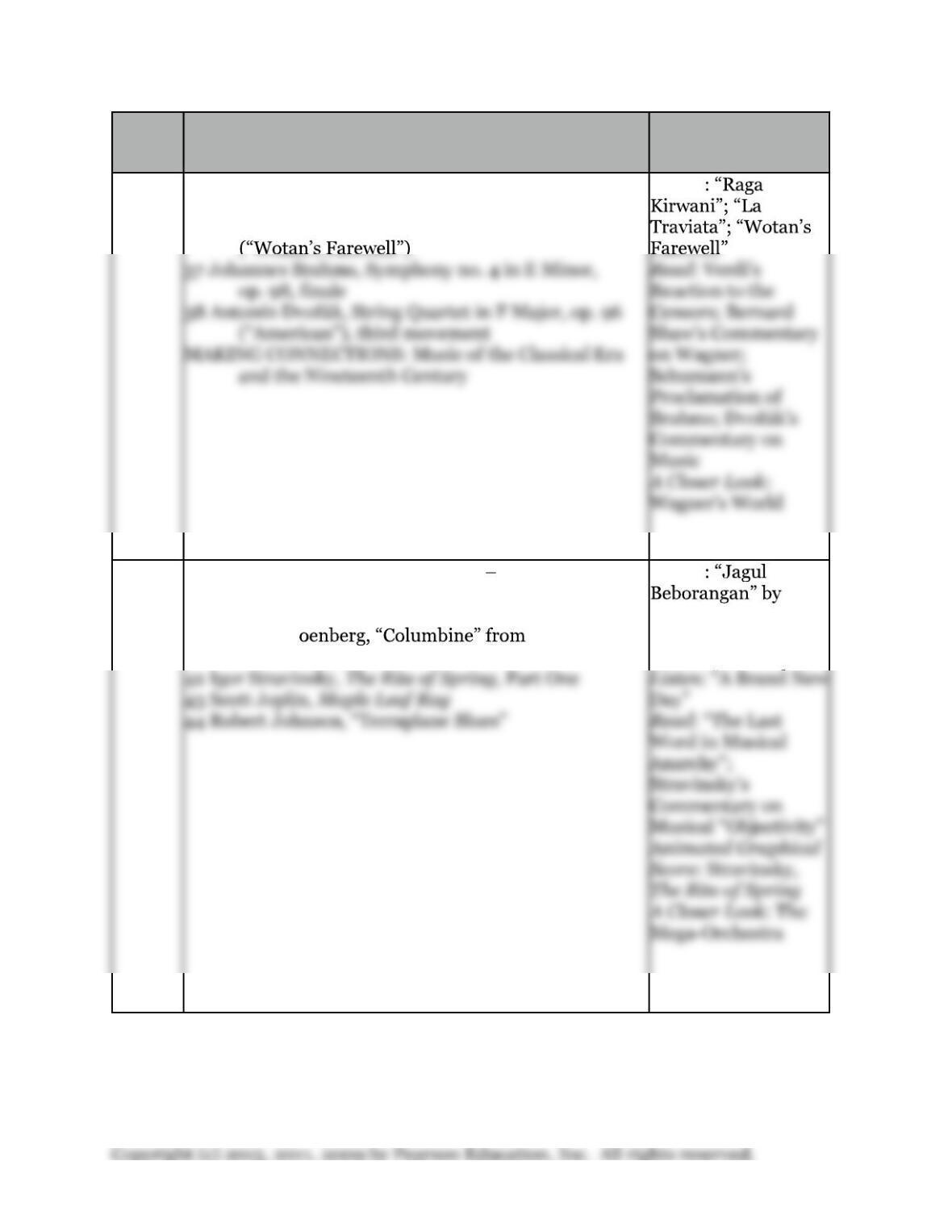
Week Chapters for Lecture MyMusicLab
Resources
7 28 Felix Mendelssohn, Overture to A Midsummer
29 Hector Berlioz, Symphonie fantastique, fourth
30 Fanny Mendelssohn Hensel, Piano Trio in D Minor,
op. 11, third movement
Read
Program for the
Symphonie
fan
tastique;
Mendelssohn in
London; Heinrich
8
Week Chapters for Lecture MyMusicLab
Resources
8 34 Ravi Shankar, Raga Sindhi-Bhairavi
35 Giuseppe Verdi, La Traviata, Act I, selection
36 Richard Wagner, The Valkyrie, Act III, selection
Watch
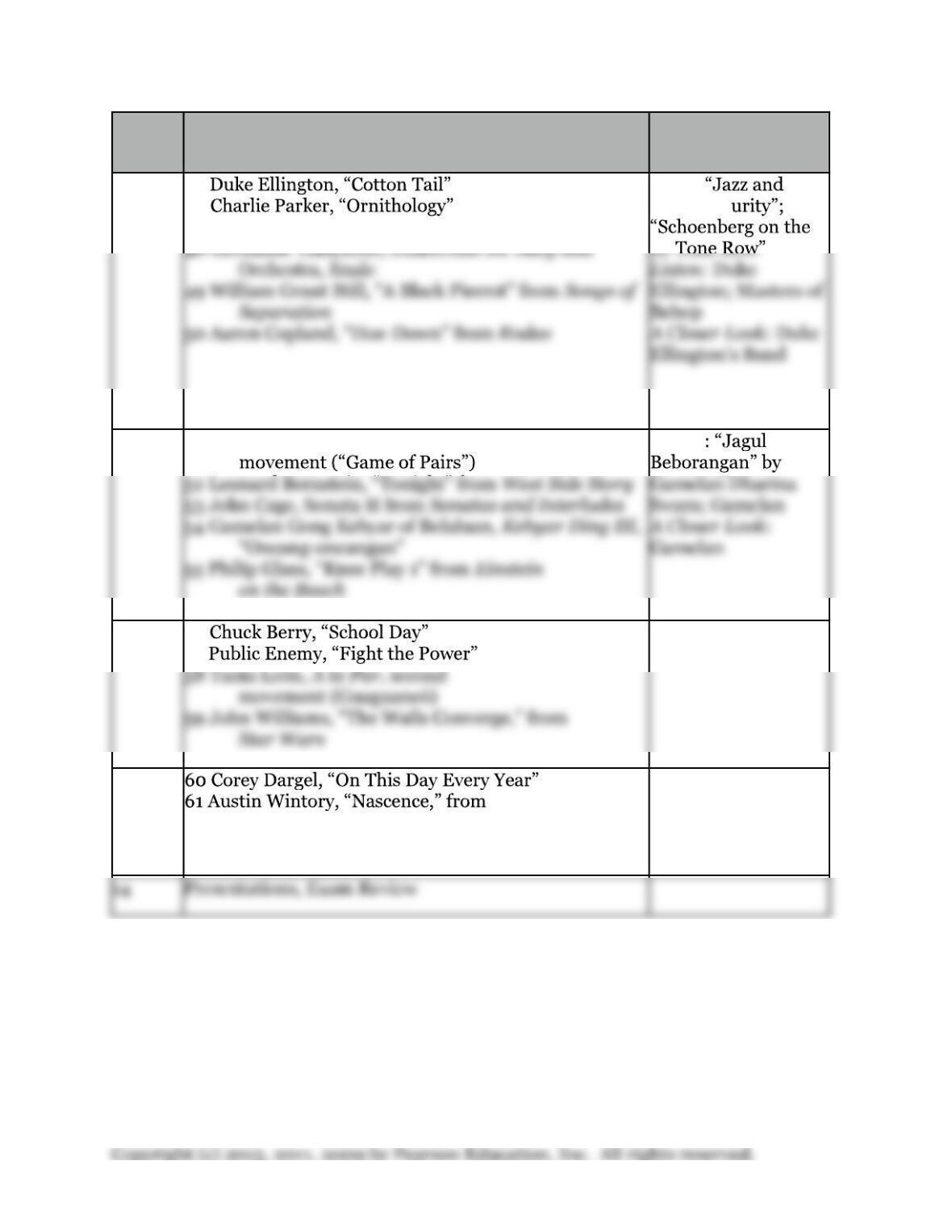
9 PART 6 The Twentieth Century 1901 2000
39 Claude Debussy, Voiles
40 Charles Ives, The Unanswered Question
41 Arnold Sch
Pierrot lunaire
Watch
Gamelan Dharma
Swara; Inside the
Orchestra
9
Week Chapters for Lecture MyMusicLab
Resources
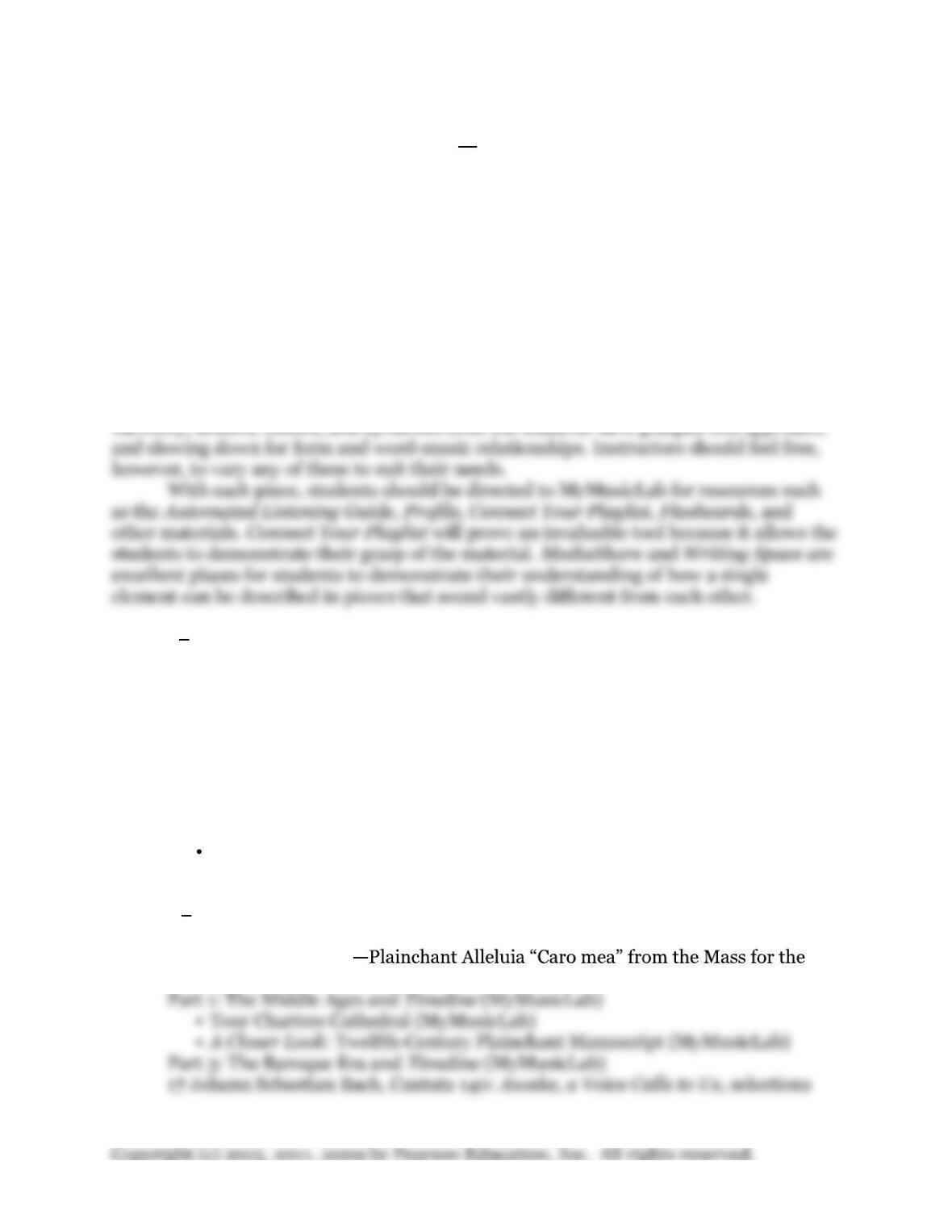
10 45
46
47 Ruth Crawford, Piano Study in Mixed Accents
Read:
Stylistic P
11 51 Béla Bartók, Concerto for Orchestra, second
Watch
12 56
57
13
Journey
MAKING CONNECTIONS: Since 1900
PART 7: Your Music
10
Sample Syllabus Alternate Version
Music across Time and Space
This syllabus is organized around the elements of music as defined in Listen to This! It
allows students to understand how music from different times and places can be
compared using the same building blocks introduced in the beginning of the book.
Approaching the elements from this point of view invites students to focus more on each
individual element. The suggested modules proceed in chronological order, but they
could also be organized so that chronology is not a factor. The pace of this syllabus has
been designed to spend more time exploring how the same elements can be heard in
contrasting musical styles early in the semester (melody and rhythm) and also to
introduce style periods as well as the concept of genre, moving quicker through
Weeks 1 2 INTRODUCTION TO CLASS AND ELEMENTS
Introduction to the class
Melody
Rhythm
Harmony
Timbre
Dynamics
Form
Word-Music Relationships
Beyond the Elements: Genre
Video: History of Music performed by String Fever
In Review: The Elements
Weeks 3 4 MELODY
Review Melody in Elements Tutorial (MyMusicLab)
eText Bonus Chapter 1
Feast of Corpus Christi
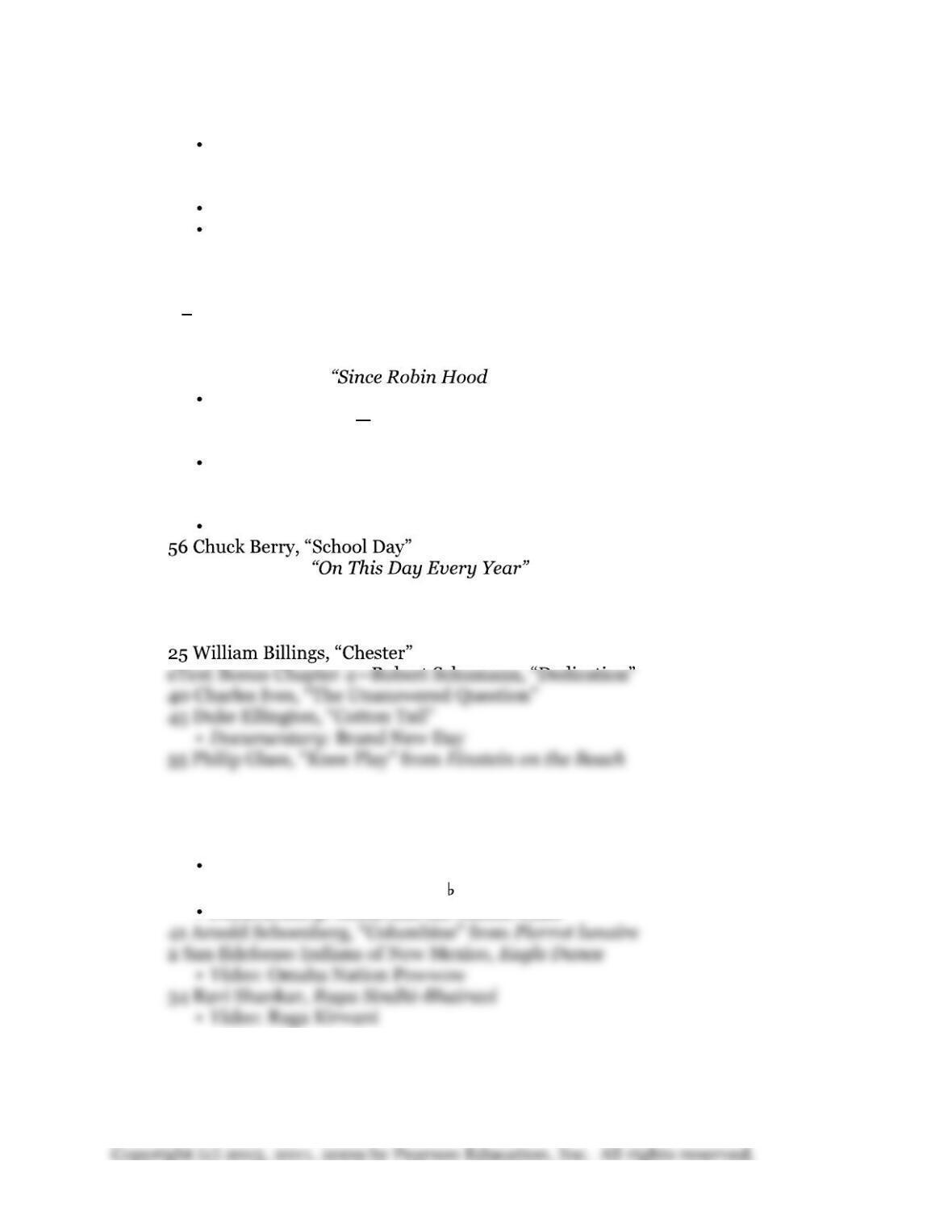
11
Documentary: Music and the Church
35 Giuseppe Verdi, La Traviata, Act I, selection
Part 5: The Nineteenth Century and Timeline (MyMusicLab)
A Closer Look: The Power of Music
Video: La Traviata
Part 6: The Twentieth Century and Timeline (MyMusicLab)
47 Ruth Crawford, Piano Study in Mixed Accents
Weeks 5 6 RHYTHM
Review Rhythm in Elements Tutorial (MyMusicLab)
Part 2: The Renaissance and Timeline (MyMusicLab)
7 Thomas Weelkes,
Documentary: The Renaissance in Europe
eText Bonus Chapter 3 Jingju, The Reunion
26 Ludwig van Beethoven, Symphony no. 5 in C Minor, op. 67
Animated Graphical Score: Beethoven Symphony no. 5 in C Minor,
1st movement
42 Igor Stravinsky, The Rite of Spring, Part One
Animated Graphical Score: Stravinsky The Rite of Spring, Part One
60 Corey Dargel,
Week 7 HARMONY
Review Harmony in Elements Tutorial (MyMusicLab)
Week 8 TEXTURE
Review Texture in Elements Tutorial (MyMusicLab)
1 Hildegard von Bingen, Play of Virtues (excerpt)
Documentary: Life in a Medieval Monastery
32 Frédéric Chopin, Mazurka in B , op. 7, no. 1
Documentary: Music and the Middle Class
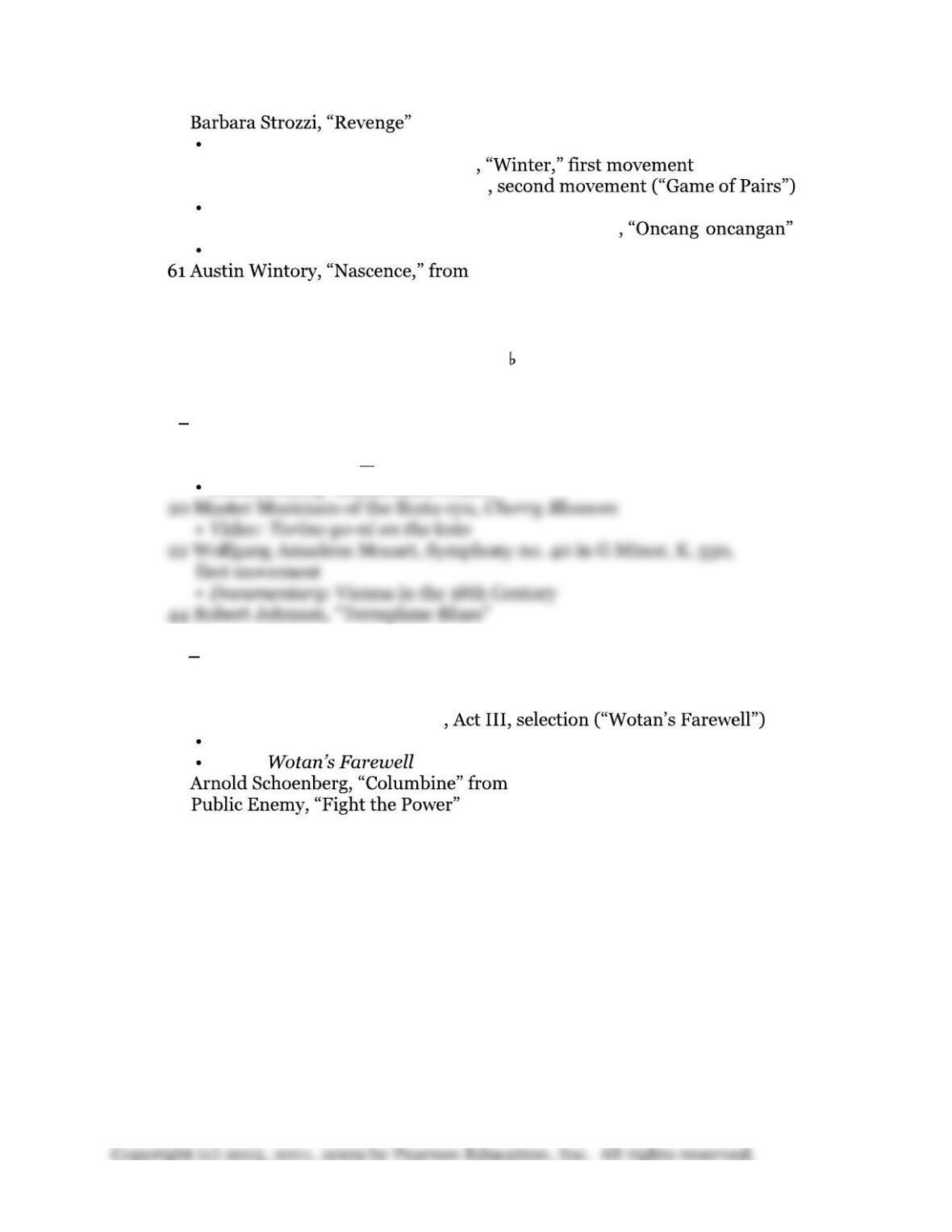
Week 9 TIMBRE
Review Timbre in Elements Tutorial (MyMusicLab)
12
13
Documentary: Rise of the Soloist
14 Antonio Vivaldi, The Four Seasons
51 Béla Bartók, Concerto for Orchestra
MyMusicLab: Instruments of the Orchestra
54 Gamelan Gong Kebyar of Belaluan, Kebyar Ding III –
Video: Gamelan
Journey
Week 10 DYNAMICS
Review Dynamics in Elements Tutorial (MyMusicLab)
21 Joseph Haydn, Symphony no. 102 in B Major, third and fourth movements
39 Claude Debussy, Voiles
Week 11 12 FORM
Review Form in Elements Tutorial (MyMusicLab)
eText Bonus Chapter 2 Tielman Susato, Moorish Dance
Documentary: Renaissance Dance
Weeks 13 14 WORD-MUSIC RELATIONSHIPS
Review Melody in Elements Tutorial (MyMusicLab)
18 George Frideric Handel, Messiah, selections
36 Richard Wagner, The Valkyrie
Documentary: Romanticism
Video:
41 Pierrot lunaire
57
13
Other Syllabus Ideas Pathways
Each chapter of this music appreciation textbook focuses on a single work or movement
of music; the repertory is wide ranging, with representative works from many eras and
places reflecting a variety of musical styles and cultures.
wide range. The following categories offer some of these possible approaches, suggesting
BY HISTORICAL ERA:
Early Music
Chapters 1 18: Plainchant through Bach and Handel
Common Practice Era
Chapters 19 38: Haydn and Mozart through Brah
Since 1900
Chapters 39 61: Debussy and Ives through Corey Dargel and Austin Wintory
BY GENRE
Sacred Music
Chapter 1 Hildegard von Bingen: Play of Virtues (excerpt)
eText Bonus Chapter 1
Feast of Corpus Christi
Chapter 5 Alfonso el Sabio: Songs to the Virgin Mary
Secular Song
Chapter 3 Francesco Landini:
Chapter 4 Guillaume de Machaut,
14
Chapter 6 Josquin des Prez:
Chapter 7 Thomas Weelkes:
Chapter 13
eText Bonus Chapter 4 Robert Schumann,
Chapter 25
Chapter 27 D. 328
Chapter 31
Orchestral Music
eText Bonus Chapter 2 Tielman Susato, Moorish Dance
Chapter 14
arr. Leopold Stokowski
Chapter 15 Antonio Vivaldi: Four Seasons,
Chapter 16 J. S. Bach: Brandenburg Concerto no. 2 in F Major,
BWV 1047, finale
Chapter 21 Haydn: Symphony no. 102, second and third movements
Chapter 22 Wolfgang Amadeus Mozart: Symphony no. 40, first movement
Chapter 23 W. A. Mozart: Piano Concerto K. 488, first movement
Chapter 26 Ludwig van Beethoven: Symphony no. 5 (complete)
Chapter 29 Hector Berlioz: Symphonie fantastique
Chapter 28 Felix Mendelssohn:
Chamber Music
Chapter 19 Joseph Haydn: String Quartet op. 76, no. 3, second movement
Chapter 30 Fanny Mendelssohn Hensel: Piano Trio, op. 11, second movement
Chapter 38
third movement
Chapter 58 Tania Léon: A la Par, second movement
Keyboard Music
Chapter 14
Chapter 32 Chopin: Mazurka in B , op. 7, no. 1
Chapter 33 Louis Moreau Gottschalk: Union
Chapter 39 Claude Debussy: Voiles from Preludes, book 1
15
Chapter 47 Ruth Crawford: Piano Study in Mixed Accents
Opera
Chapter 10 Claudio Monteverdi: Orpheus, selection from Act II
Chapter 11 Henry Purcell: Dido and Aeneas: Overture and Act I, nos. 1 4
Chapter 24 W. A. Mozart: The Marriage of Figaro, Act I, selection
eText Bonus Chapter 3 Jingju, The Reunion
Chapter 36 Richard Wagner: The Valkyrie, Act III, selection
WOMEN COMPOSERS
Chapter 1 Hildegard von Bingen: Play of Virtues (excerpt)
Chapter 13
Chapter 30 Fanny Mendelssohn Hensel: Piano Trio, op. 11, second movement
Chapter 31
Chapter 47 Ruth Crawford: Piano Study in Mixed Accents
Chapter 48 Germaine Tailleferre: Concertino for Harp and Orchestra, finale
Chapter 58 Tania Léon: A la Par, second movement
THE AMERICAN CLASSICAL TRADITION
Chapter 25
Chapter 33 Louis Moreau Gottschalk: Union
Chapter 40 Charles Ives: The Unanswered Question
Chapter 47 Ruth Crawford: Piano Study in Mixed Accents
Chapter 49 from Songs of Separation
WORLD MUSIC
Chapter 2 San Ildefonso Indians of New Mexico: Eagle Dance
Chapter 9
Chapter 12
16
Chapter 20 Master Musicians of the Ikuta-ryu (Japan): Cherry Blossom
eText Bonus Chapter 3 Jingju, The Reunion
THE STANDARD REPERTORY OF THE CONCERT HALL
Chapter 15 Antonio Vivaldi: Four Seasons,
Chapter 16 J. S. Bach: Brandenburg Concerto no. 2 in F Major,
BWV 1047, finale
Chapter 19 Joseph Haydn: String Quartet op. 76, no. 3, second movement
Chapter 21 Haydn: Symphony no. 102, second and third movements
Chapter 22 Wolfgang Amadeus Mozart: Symphony no. 40, first movement
Chapter 23 W. A. Mozart: Piano Concerto K. 488, first movement
Chapter 26 Ludwig van Beethoven: Symphony no. 5 (complete)
Chapter 27 D. 328
Chapter 28 Felix Mendelssohn:
17
The Elements of Music:
A Brief Introduction
The Elements of Music: A Brief Introduction
Melody
Performance: The Science of Melody
Rhythm
Harmony
Historical Context: Illegal Harmony?
Texture
Timbre
Dynamics
MyMusicLab Resources
Element of Music Tutorial: Dynamics
Element of Music Tutorial: Form
Element of Music Tutorial: Genre
Element of Music Tutorial: Harmony
Element of Music Tutorial: Melody
Brief Introduction at a Glance
The purpose of the Brief Introduction is to acquaint students with basic music
Star- nts that form the
backdrop for the discussion of each piece explored in Listen to This! Thus, students
18
Part 1
The Middle Ages
476 CE Early Fifteenth Century
Part at a Glance
The Middle Ages
Timeline: The Middle Ages
Music for Sacred Spaces
eText Bonus Chapter 1: Alleluia from the Mass for the Feast of Corpus Christi
Chapter 1 Hildegard von Bingen: Play of Virtues (excerpt)
Music for Entertainment
Part Objectives
After reading the part opener, students should be able to:
MyMusicLab Resources
Timeline: The Middle Ages
Architectural Panorama: Chartres Cathedral (Chartres, France; Begun 1194)
A Closer Look: Twelfth Century Plainchant Manuscript
Chapters at a Glance
Chapter 1 Hildegard von Bingen: Play of Virtues (excerpt)
Chapter 2 San Ildefonso Indians of New Mexico: Eagle Dance
eText Bonus Chapter 1: Alleluia from the Mass for the Feast of Corpus Christi
Chapter 3 Francesco Landini:
19
Part Summary
Part 1: The Middle Ages covers a longer period than any other in the textbook, but most
of the music examined here dates from the latter end of that period because that is when
notation developed. The music chosen to represent this vast period reflects the varied
social functions that required music, both sacred and secular. These include music used
in sacred establishments and music for entertainment (including dancing).
In Chapters 1 through 5, we can examine increasing textures over the period of a
few hundred years. Beginning with monophonic plainchant, students can hear the
effects of adding more parts to create new textures. The sounds of this music differ
substantially from what most students will have heard before this class: the harmonies