Chapter 1: Human Resource Management in Organizations
employers have become more wary about adding regular full-time employees.
D. Human Resource and Technology
In the 1980s most large companies used a mainframe computer to run its Human
Resource Information System (HRIS). These systems did payroll, kept track of
employees and their benefits, and ran reports for HR managers. All of this was run by
Technology’s Advantages
The rapid expansion of HR technology serves two major purposes in organizations.
One relates to administrative and operational efficiency and the other to
effectiveness:
• The first purpose is to improve the efficiency with which data on employees
and HR activities are compiled. The most basic example is the automation of
Using technology to support HR activities increases the efficiency of the
administrative HR functions and reduces costs. To maximize the value of
technology, systems should be integrated into the overall IT plan and enterprise
software of the organization.
Technology can be used to support every function within human resource
management.
• Recruiting and selection processes have changed perhaps the most dramatically
with Web-based job boards, online applications, and even online interviewing.
Chapter 1: Human Resource Management in Organizations
One of the most important ways in which technology can contribute to organizational
performance is through the collection and analysis of HR-related data. Identifying
trends and modeling future conditions help managers to plan and optimize human
resources.
Social Media
The explosive growth of the Internet has resulted in many employees and managers
using wikis, blogs, tweets, text-messaging, and other techniques.
• In a wiki, which is a widely available website for individuals to make
comments, employees can communicate both positive and negative messages
on many topics. Employers have used wikis to increase the exchange of ideas
However, individuals in an organization can also use all of this technology
inappropriately and post critical, obscene, or even harassing details. Therefore, firms
must establish policies and regulations on how all of this technology can and should
be used.
The Risks of Social Media
The risk of social media is becoming apparent to employers and some fear its use
VI. Organizational Ethics and Human Resource Management
Closely linked with the strategic role of HR is the way managers and HR professionals
influence the ethics of people in organizations. How those ethics affect work and lives for
Chapter 1: Human Resource Management in Organizations
The need for great attention to ethics has grown in the past few years, as evidenced by the
corporate scandals at numerous financial and investment firms in the United States and
globally. These scandals illustrate that ethical lapses are not just symbolic; they affect
employers and employees. The expansion of the Internet has led to more publicity about
ethical issues, including ethics, electronic job boards, and postings.
A. Ethical Behavior and Culture
Every mature organization has a culture, and that culture influences how executives,
B. Ethics and Global Differences
Differences in legal, political, and cultural values and practices in different countries
often raise ethical issues for global employers who must comply with both their home-
country laws and the laws of other countries. With the changes in the global economy in
HR Ethics: Cisco Systems Trains on Ethics
Until a few years ago, Cisco Systems did ethics training and enforcement like many
other firms by using organization-required sessions and procedures. However,
Cisco now uses a constantly available ethics program through its firm
communications, Internet, and even television programs similar to American Idol.
Chapter 1: Human Resource Management in Organizations
recommended that global multinational firms establish and implement stricter ethical
standards to aid business development.
C. Role of Human Resources in Organizational Ethics
Organizations that are seen as ethical in the way they operate have longer-term success.
Since people in organizations are making ethical decisions on a daily basis, HR
management plays a key role as the “keeper and voice” of organizational ethics. Instead
Ethical issues pose fundamental questions about fairness, justice, truthfulness, and
social responsibility. Just complying with a wider range of requirements, laws, and
regulations cannot cover every ethical situation that executives, managers, HR
professionals, and employees will face. Yet, having all the elements of an ethics
program may not prevent individual managers or executives from engaging in or failing
to report unethical behavior.
HR Ethics and Sarbanes-Oxley
The Sarbanes-Oxley (SOX) Act was passed in 2002 by Congress to make certain that
publicly traded companies follow accounting controls that could reduce the
likelihood of illegal and unethical behaviors. Many HR issues must be managed in
VII. Human Resources Management Competencies and Careers
A. Human Resource Competencies
The transformation of HR toward being more strategic has implications for the
Chapter 1: Human Resource Management in Organizations
competencies needed by HR professionals. HR professionals at all levels need the
following:
• Strategic knowledge and impact
• Legal, administrative, and operational capabilities
• Technology knowledge and usage abilities
B. Human Resource Management as a Career Field
A variety of jobs exists within the HR career field, ranging from executive to clerical.
As an organization grows large enough to need someone to focus primarily on HR
activities, the role of the HR generalist emerges—that is, a person who has
C. Human Resource Professionalism and Certification
Depending on the job, HR professionals may need considerable knowledge about
employment regulations, finance, tax law, statistics, and information systems. In most
cases, they also need extensive knowledge about specific HR activities. The broad range
of issues faced by HR professionals has made involvement in professional associations
and organizations important.
Chapter 1: Human Resource Management in Organizations
to individuals and useful to employers as they select and promote certified individuals.
The most well-known certification programs for HR generalists are administered by the
Human Resource Certification Institute (HRCI), which is affiliated with SHRM.
HRCI Certification
WorldatWork Certifications
The WorldatWork Association has certifications emphasizing compensation and
benefits. The four certifications are as follows:
• Certified Compensation Professional (CCP)
Other Human Resource Certifications
Additional certification programs for HR specialists and generalists are sponsored by
various organizations, and the number of certifications is being expanded. For
specialists, some well-known programs include the following:
• Certified Recognition Professional (CRP) sponsored by the Recognition
Professionals International
Critical Thinking Challenges
Chapter 1: Human Resource Management in Organizations
1. Discuss several areas in which HR can affect organizational culture positively or
negatively.
Organizational culture consists of shared values and beliefs giving members of an
organization meaning and providing them with rules for behavior. Central to
organizational culture are values that are inherent in the way organizations treat other
people inside and outside the organization. HR can positively or negatively affect the
way organizations treat people inside and outside the organization.
Employee Engagement and HR Culture—Employee engagement is the extent to which
individuals feel linked to organizational success and how the organization performs
positively. Engaged employees are less likely to quit, more likely to encourage others
to become employees, and to commit to activities positively outside of their
organizations. HR can play a positive or a negative role in encouraging employee
engagement.
2. Give some examples of ethical issues that you have experienced in jobs, and explain
how HR did or did not help resolve them.
3. Why is it important for HR management to transform from being primarily
administrative and operational to becoming a more strategic contributor?
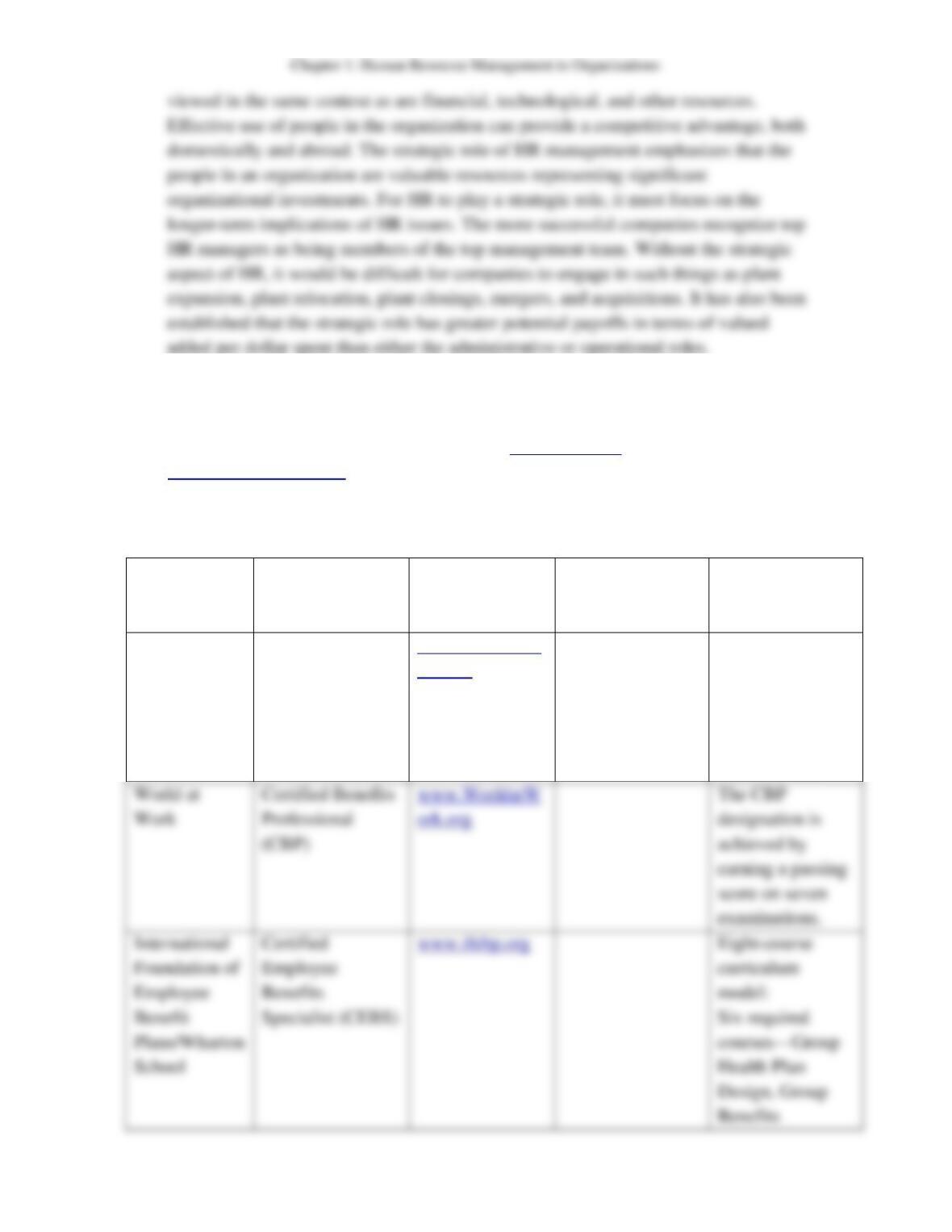
4. Assume you are an HR Director with a staff of seven people. A departmental objective
is for all staff members to become professionally certified within a year. Using
Internet resources of HR associations such as www.shrm.org and
www.WorldatWork.org, develop a table that identifies four to six certifications that
could be obtained by your staff members, and show the important details on each
certification.
Name of
Sponsoring
Organization
Name of
Certification
Web-Site
Address
Experience and
Education
Requirements
Nature of
Certification
Process
World at
Work
Certified
Compensation
Professional
(CCP)
www.WorldatW
ork.org
The CCP
certification is
achieved by
earning a passing
score on nine
examinations.

Chapter 1: Human Resource Management in Organizations
Management,
Retirement Plan
Design,
Retirement Plan
Management,
Human Resources
and
Management,
Personal Wealth
Management,
Health Care
Financing and
Economics,
Executive
Compensation
and
International
Foundation of
Employee
Benefit
Plans/Wharton
School
Group Benefits
Associate (GBA)
www.ifebp.org
Complete these
CEBS courses—
Group Health
Plan Design;
Group Benefits
Management; and
Chapter 1: Human Resource Management in Organizations
Employee
Benefit
Retirement Plan
Design and
International
Foundation of
Employee
Benefit
Plans/Wharton
School
Compensation
Management
Specialist (CMS)
www.ifebp.org
Complete these
CEBS courses—
Human Resources
and
Compensation
Management,
Compensation
Concepts and
Principles, and
Executive
Compensation
and
Compensation
Issues
Bachelor’s
degree.
4 years of
demonstrated
professional HR
experience with
less than a
Bachelor’s
degree.
based.

Chapter 1: Human Resource Management in Organizations
Human
Resource
Certification
Institute
Senior
Professional in
Human Resources
(SPHR)
www.hrci.org
4 years of
demonstrated
professional HR
experience with a
Master’s degree
or higher.
The SPHR
certification is
designed for the
HR professional
who (a) designs
and plans, rather
Human
Resource
Certification
Institute
Global
Professional in
Human
Resources
(GPHR)
www.hrci.org
2 years of
demonstrated
global
professional HR
experience with a
Master’s degree
or higher.
3 years of
demonstrated
professional HR
experience (with
The GPHR
certification is
designed for the
HR professional
who (a) has HR
responsibilities
that cross national
borders and (2)
understands the
strategies of
globalization
Chapter 1: Human Resource Management in Organizations
less than a
Bachelor’s
degree.
5. Your company, a growing firm in the financial services industry, is extremely
sensitive to the issues surrounding business ethics. The company wants to be proactive
in developing a business ethics training program for all employees both to ensure the
company’s reputation as an ethical company in the community and to help maintain
the industry’s high standards. As the HR Director and someone who values the
A. What legislative act prompted many U.S. companies to develop internal ethical
policies and procedures?
The Sarbanes-Oxley Act (SOX) is discussed in the text.
B. What are key concepts related to business ethics that should be considered in the
development of the ethics training program?
Chapter 1: Human Resource Management in Organizations
Case
Rio Tinto: Redesigning HR
1. How did Rio Tinto’s revamping of HR help with minimizing the potential problems
with the reduction in force? What role would an HRIS (also called a Human Resource
Information System) have to play in managing an RIF?
HRIS would play a very important role in the event of downsizing. The presence of
HRIS improves the efficiency with which the data on employees and HR activities are
compiled. It would help the HR department to administrate efficiently and
communicate quickly to the employees. Also, while planning a RIF, strategic HR
2. Without a consistent philosophy, policies, and approaches to reduction in force (or any
other disruptions in the future) what would the likely reactions from employees be?
When a company is downsized without proper plans, philosophy, and policies in
place, it might lead to increased workloads, loss of loyalty, morale, and motivation;
Supplemental Cases
Phillips Furniture
Chapter 1: Human Resource Management in Organizations
This case describes a small company that has grown large enough to need a full-time HR
Questions
1. On what activities would you tell Mr. Phillips you intend to focus? Why?
Student answers may vary. The issue that needs the most attention is the human capital
of the organization. Not having enough quality workers is one of the major problems
2. What would be your first actions, and why?
Student answers may vary. Since Mr. Phillips has also gained control of Martin
Comments
This case is quite useful in illustrating that personnel management is important in small
organizations, just as in large corporation. A student should recognize that the interface
concept emphasizes the need for the newly appointed personnel manager and the more
experienced operating managers to cooperate. A younger and newer person would have to
identify the appropriate “division” of personnel responsibilities that would be consistent
with maintaining the cooperation and support of the other managers in the firm.
Sysco
Chapter 1: Human Resource Management in Organizations
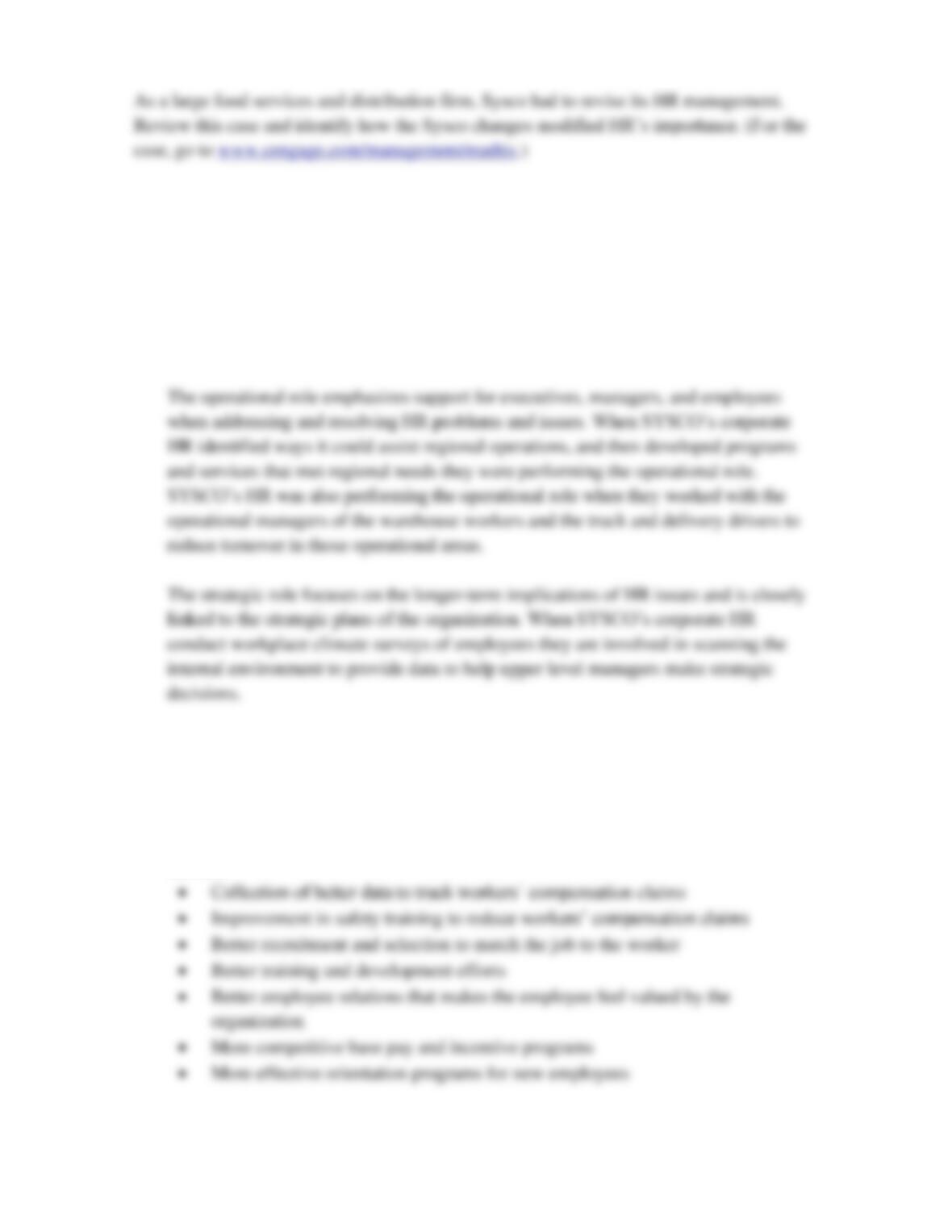
1. How does the market-driven approach illustrate that HR has strategic, operational, and
administrative roles at SYSCO?
The administrative role is heavily oriented to processing and record keeping. When
SYSCO’s HR staff enter data into the Virtual Resource Center (VRC) and when they
use technology to calculate cost/benefit analyses they are performing the
administrative role.
2. Discuss what types of HR changes could have affected reductions in workers’
compensation expenses, employee turnover, and increases in customer satisfaction.
The types of HR changes that could have affected reductions in workers’
compensation expenses, employee turnover, and increases in customer satisfaction
include:
HR, Culture, and Success at Google, Scripps, and UPS
Chapter 1: Human Resource Management in Organizations
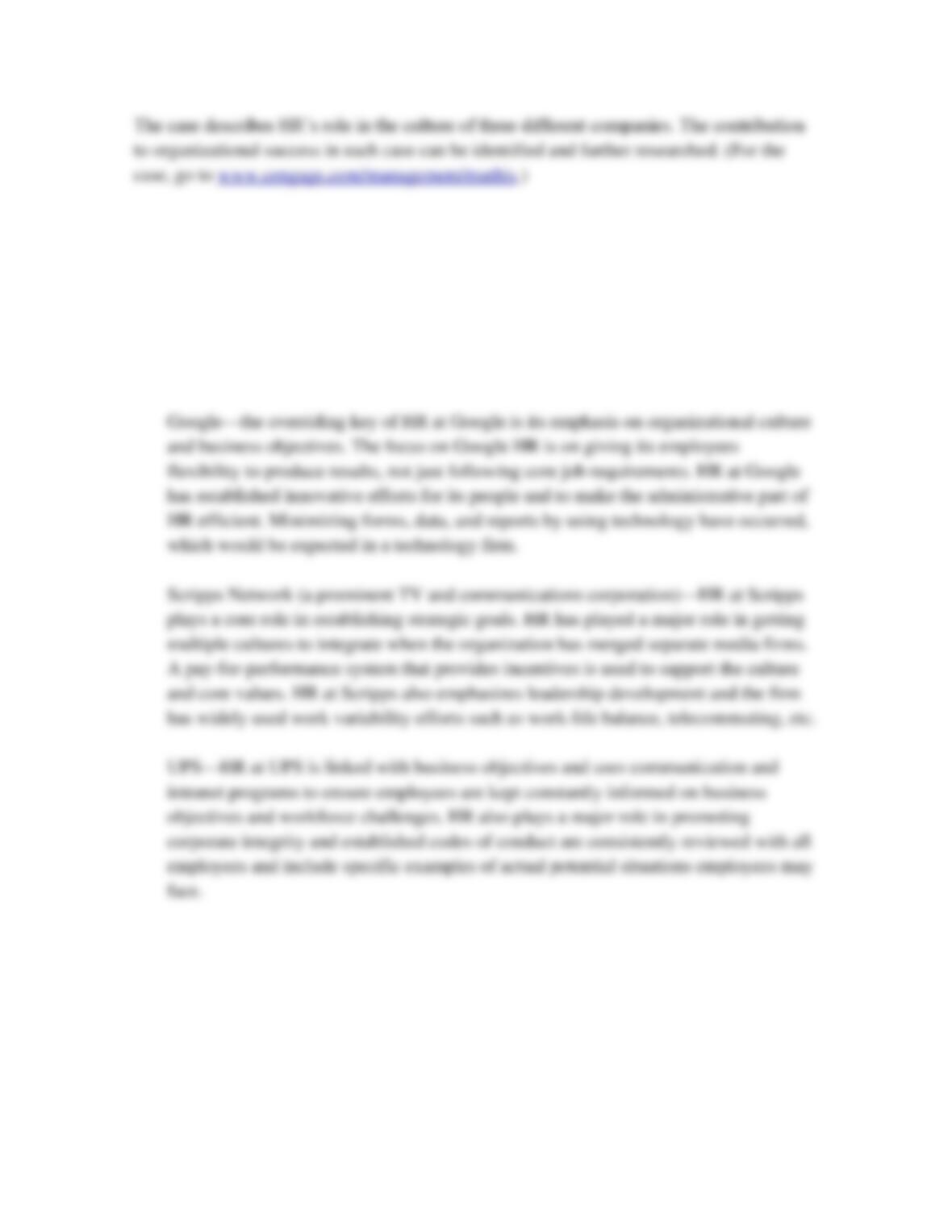
1. How does the integration of HR with the organizational culture contribute to the
success of Google, Scripps, and UPS? To find ideas, go to the appropriate corporate
website for each of them and then search for additional insights.
Overall, HR at all three of these organizations have integrated HR operations that are
in sync with the organization’s culture and HR is considered a strategic partner for the
organization to help the organization meet organizational strategic objectives.
2. Discuss how some of the culture facets mentioned compare to ones in employers you
have worked for and explain the difference in the views of those employers.
Students’ answers will vary but most students probably have not had a chance to work
for companies with the reputation of Google, Scripps, and UPS.