1.2 Convergence
1. Compute each of the following limits and determine the corresponding rate of
convergence.
(a) limn→∞ n−1
n3+2
(b) limn→∞ √n+ 1 −√n
(c) limn→∞ sin n
n
(d) limn→∞ 3n2−1
7n2+n+2
(a) For n > 1,
(b) Note that
(c) Since −1≤sin n≤1for all n, it follows that
(d) For n > 13,
2. Compute each of the following limits and determine the corresponding rate of
convergence.
(a) limx→0ex−1
x
(b) limx→0sin x
x
(c) limx→0ex−cos x−x
x2
(d) limx→0cos x−1+x2/2−x4/24
x6
(a) From Taylor’s Theorem, ex= 1 + x+1
2x2eξfor some ξbetween 0 and x.
(b) From Taylor’s Theorem, sin x=x−x3
6cos ξfor some ξbetween 0 and x.
(c) From Taylor’s Theorem, we have
Convergence 3
(d) From Taylor’s Theorem, we have
3. Numerically determine which of the following sequences approaches 1 faster, and
then confirm the numerical evidence by determining the rate of convergence of
each sequence.
lim
x→0
sin x2
x2versus lim
x→0
(sin x)2
x2.
xsin x2
x2
(sin x)2
x2
6x6cos ξ
4Section 1.2
for some ξbetween 0 and x2. Consequently,
4. Suppose that 0 < a < b.
(a) Show that if αn=α+O(1/nb), then αn=α+O(1/na).
(b) Show that if f(x) = L+O(xb), then f(x) = L+O(xa).
(a) Suppose αn=α+O(1/nb). Then, there exists a constant λsuch that for
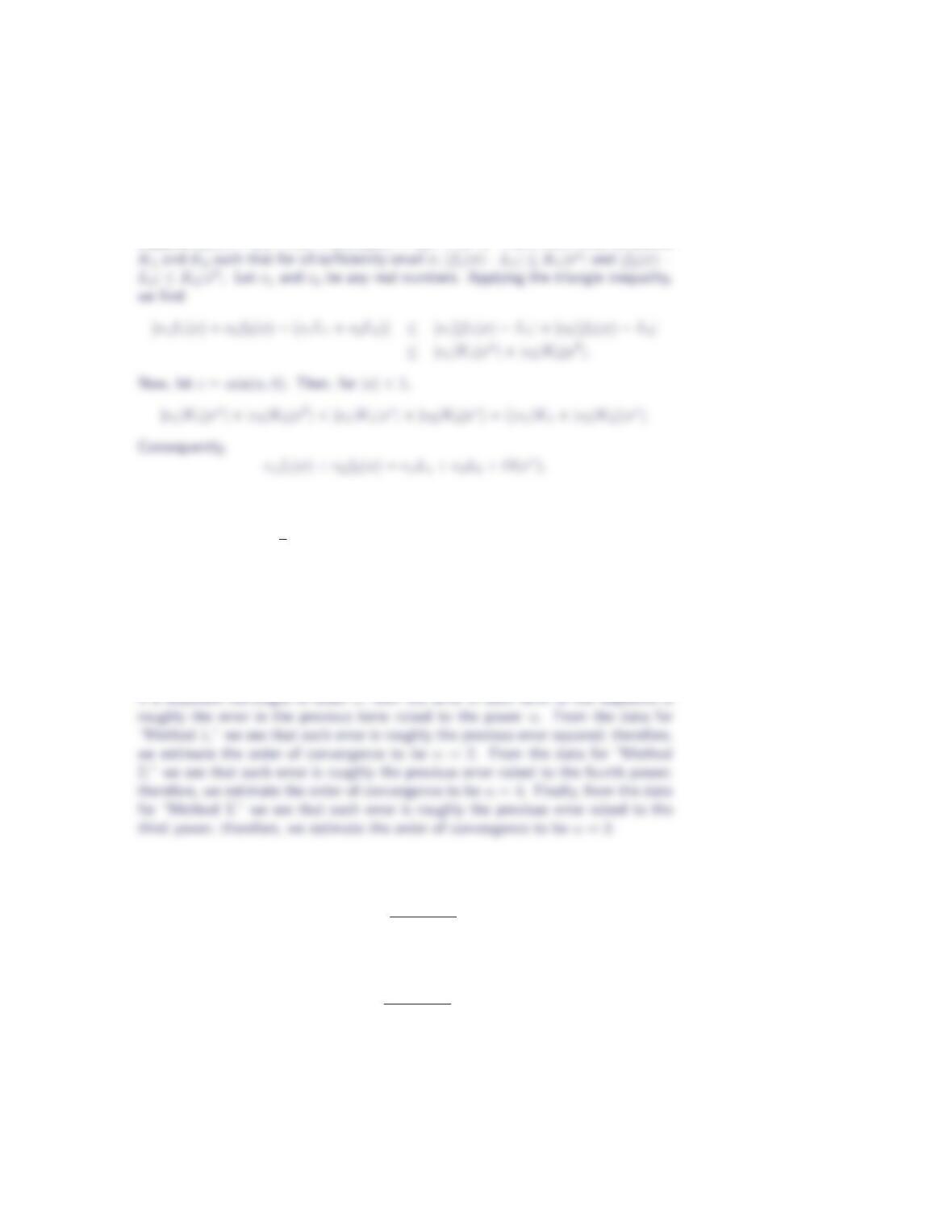
5. Suppose that f1(x) = L1+O(xa) and f2(x) = L2+O(xb). Show that
c1f1(x) + c2f2(x) = c1L1+c2L2+O(xc),
Convergence 5
where c= min(a, b).
Suppose f1(x) = L1+O(xa)and f2(x) = L2+O(xb). Then, there exist constants
6. The table below lists the errors of successive iterates for three different methods
for approximating 3
√5. Estimate the order of convergence of each method, and
explain how you arrived at your conclusions.
Method 1 Method 2 Method 3
4.0 ×10−23.7 ×10−44.3 ×10⁻³
9.1 ×10−41.2 ×10−15 1.8 ×10⁻⁸
4.8 ×10−71.5 ×10−60 1.4 ×10⁻²⁴
7. Let {pn}be a sequence which converges to the limit p.
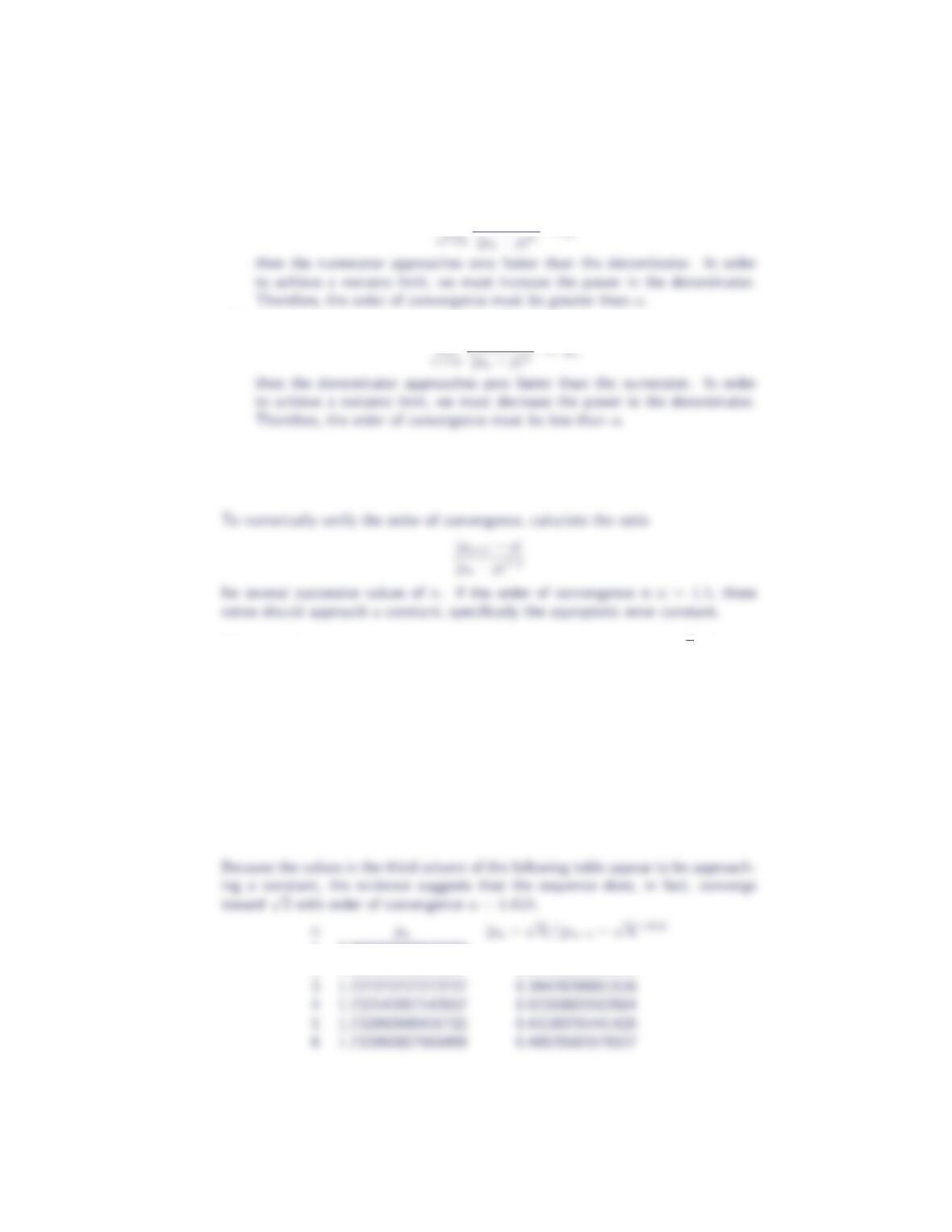
(a) If
lim
n→∞ |pn+1 −p|
|pn−p|α= 0,
what can be said about the order of convergence of {pn}to p?
(b) If
lim
n→∞ |pn+1 −p|
|pn−p|α→ ∞,
what can be said about the order of convergence of {pn}to p?
6Section 1.2
(a) If
lim
(b) If
8. Suppose theory indicates that the sequence {pn}converges to pof order 1.5.
Explain how you would numerically verify this order of convergence.
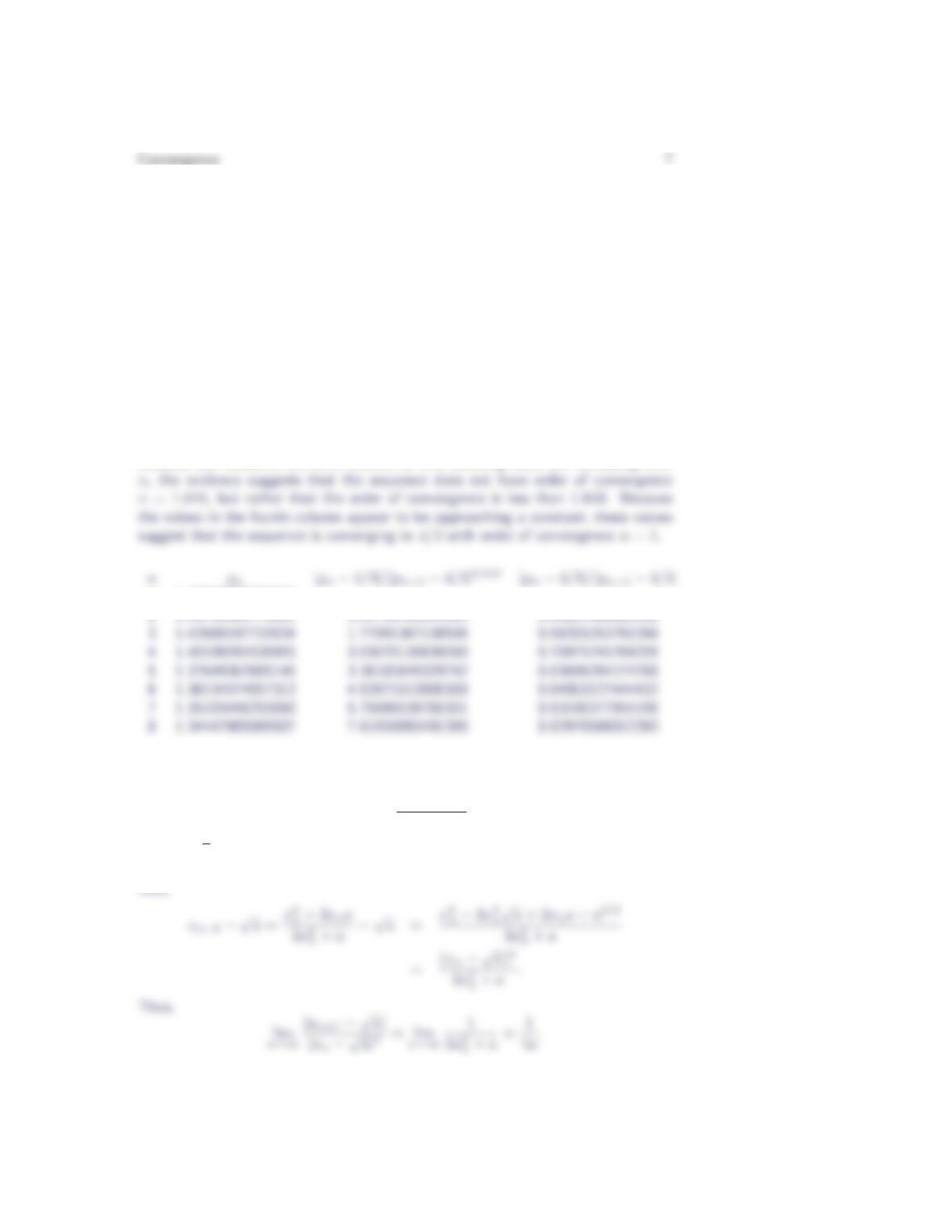
9. Theory indicates that the following sequence should converge to √3 of order
1.618. Does the sequence actually achieve an order of convergence of 1.618? If
not, what is the actual order?
npn
0 2.000000000000000
1 1.666666666666667
2 1.727272727272727
3 1.732142857142857
4 1.732050680431722
5 1.732050807565499
1 2.000000000000000
2 1.666666666666667 0.55066002953142
10. Theory indicates that the following sequence should converge to 4/3 of order
1.618. Does the sequence actually achieve an order of convergence of 1.618? If
not, what is the actual order?
npn
0 1.498664098580016
1 1.497353997792205
2 1.428801977335339
3 1.401092915389552
4 1.376493676051456
5 1.361345745573130
6 1.351034482500881
7 1.344479850695066
Because the values in the third column of the following table are increasing with
1 1.49866409858002
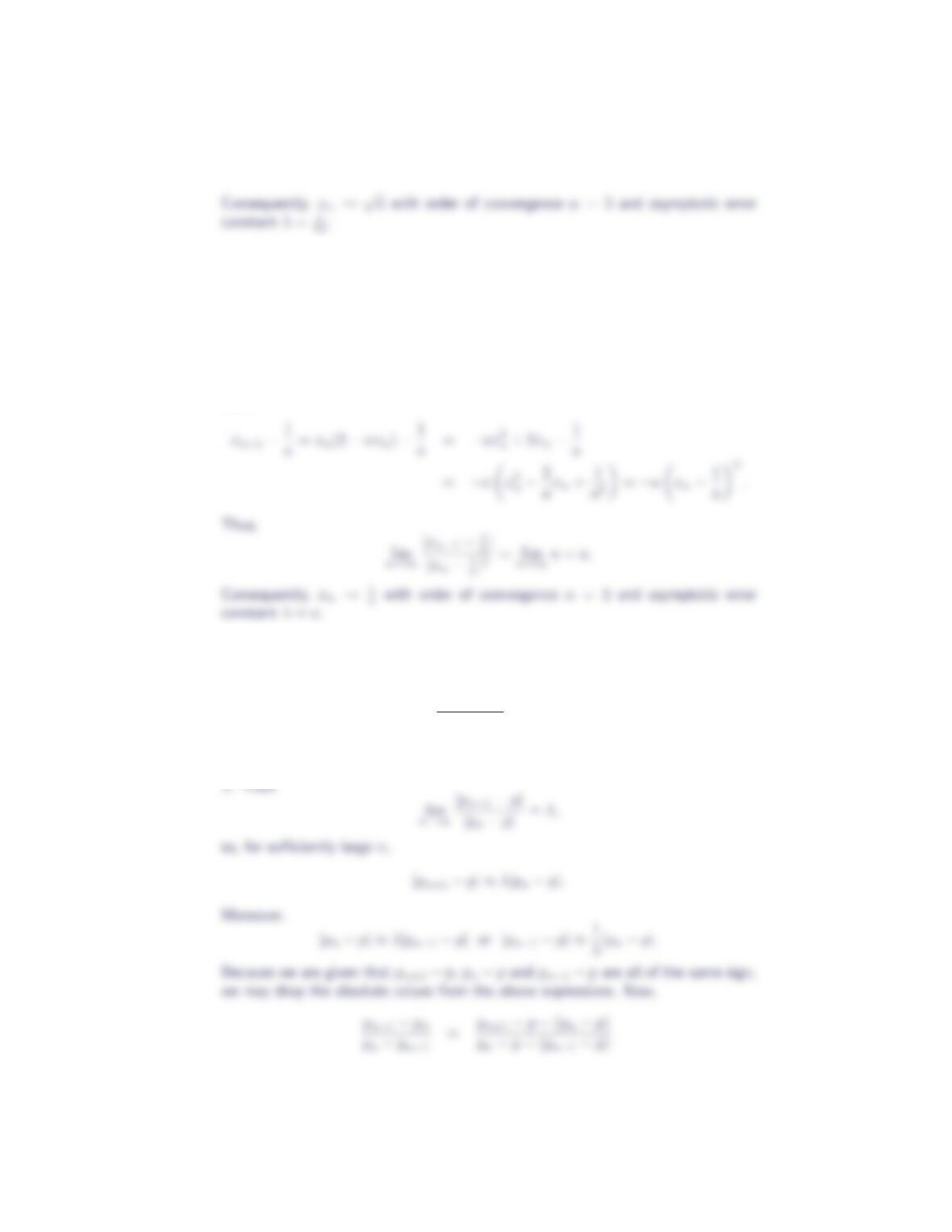
11. Show that the convergence of the sequence generated by the formula
xn+1 =x3
n+ 3xna
3x2
n+a
toward √ais third-order. What is the asymptotic error constant?
8Section 1.2
12. Let abe a non-zero real number. For any x0satisfying 0 < x0<2/a, the
recursive sequence defined by
xn+1 =xn(2 −axn)
converges to 1/a. What are the order of convergence and the asymptotic error
constant?
Note
13. Suppose that the sequence {pn}converges linearly to the limit pwith asymptotic
error constant λ. Further suppose that pn+1 −p,pn−pand pn−1−pare all of
the same sign. Show that pn+1 −pn
pn−pn−1≈λ.
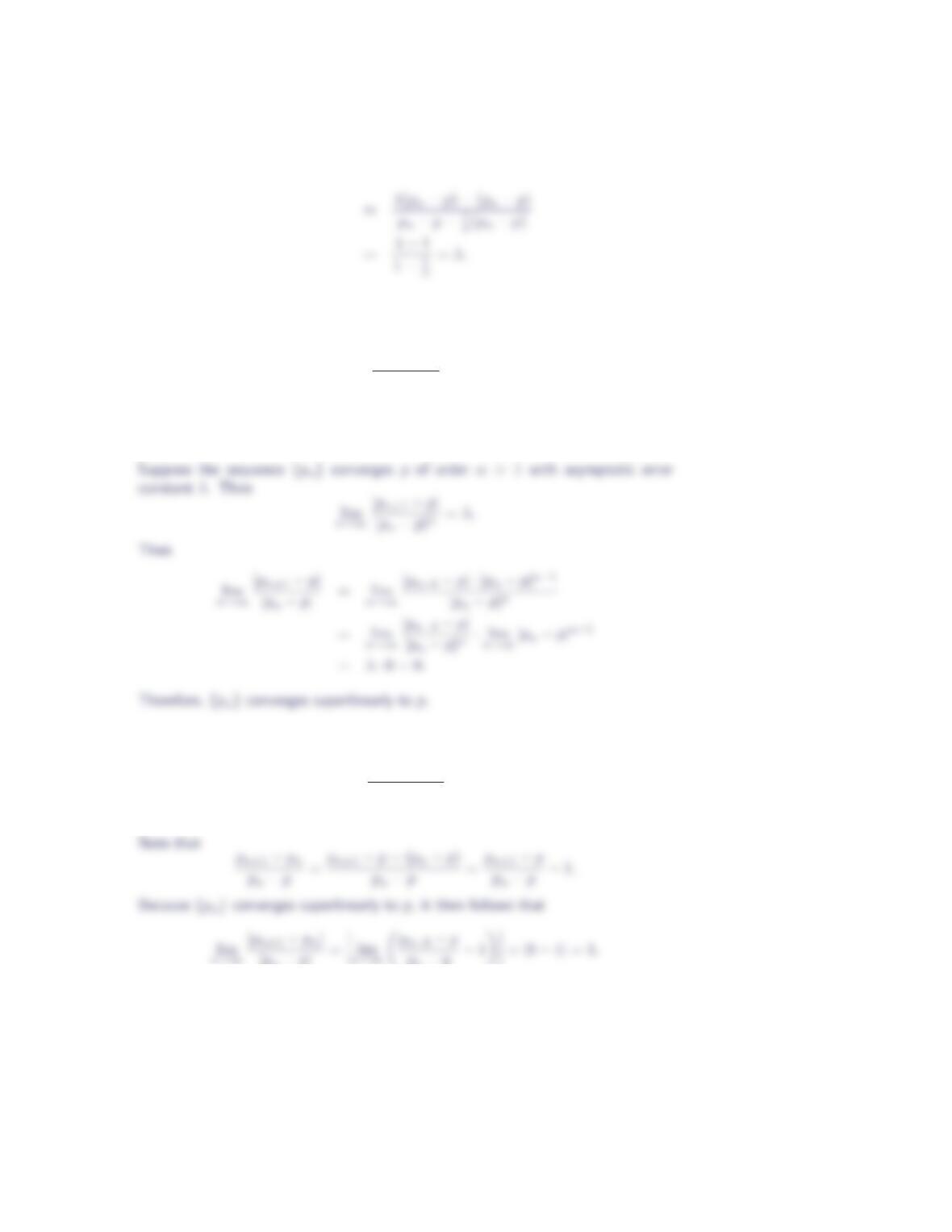
Suppose the sequence {pn}converges linearly to pwith asymptotic error constant
Convergence 9
14. A sequence {pn}converges superlinearly to pprovided
lim
n→∞ |pn+1 −p|
|pn−p|= 0.
Show that if pn→pof order αfor α > 1, then {pn}converges superlinearly to
p.
15. Suppose that {pn}converges superlinearly to p(see Exercise 14). Show that
lim
n→∞ |pn+1 −pn|
|pn−p|= 1.
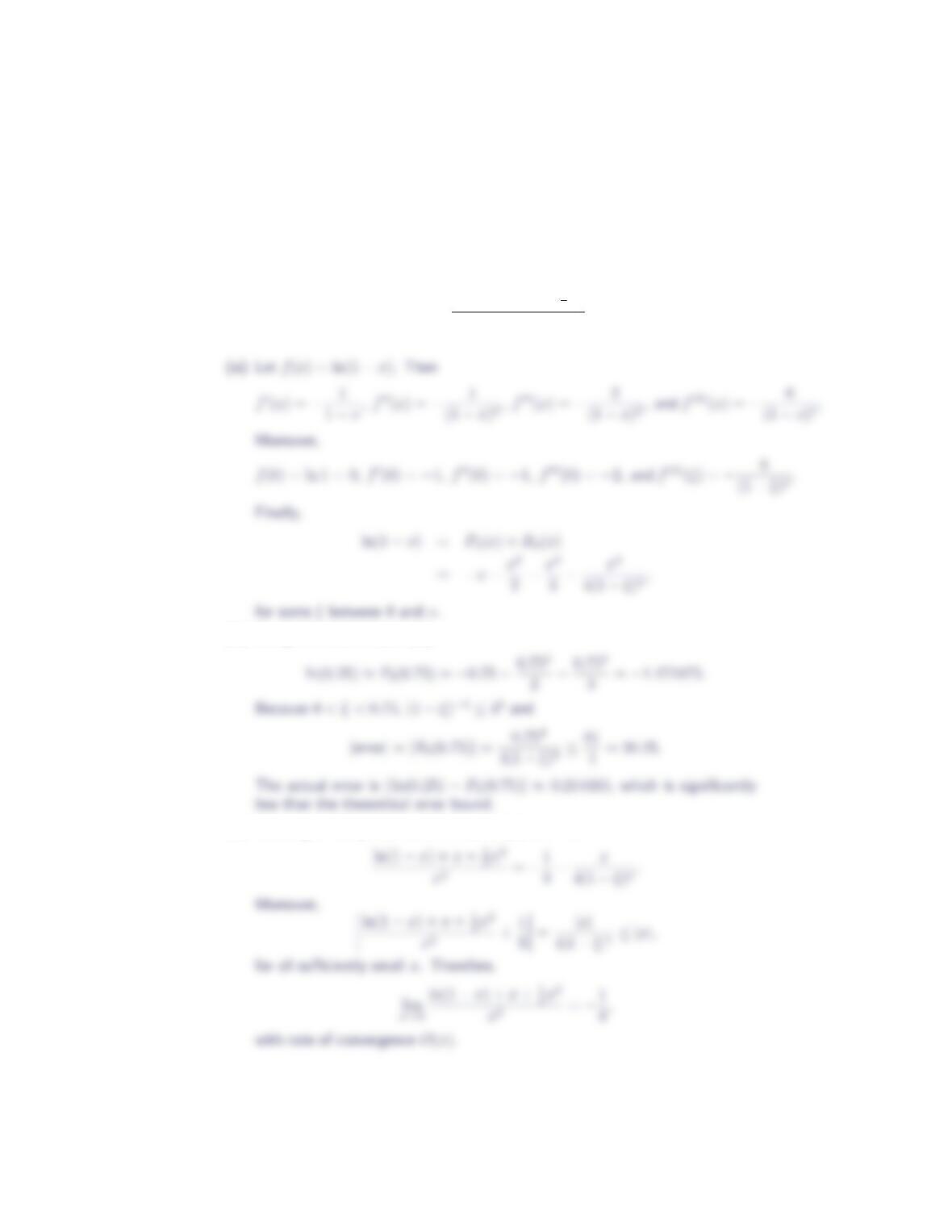
16. (a) Determine the third-degree Taylor polynomial and associated remainder
term for the function f(x) = ln(1 −x). Use x0= 0.
10 Section 1.2
(b) Using the results of part (a), approximate ln(0.25) and compute the the-
oretical error bound associated with this approximation. Compare the
theoretical error bound with the actual error.
(c) Compute the following limit and determine the corresponding rate of con-
vergence:
lim
x→0
ln(1 −x) + x+1
2x2
x3.
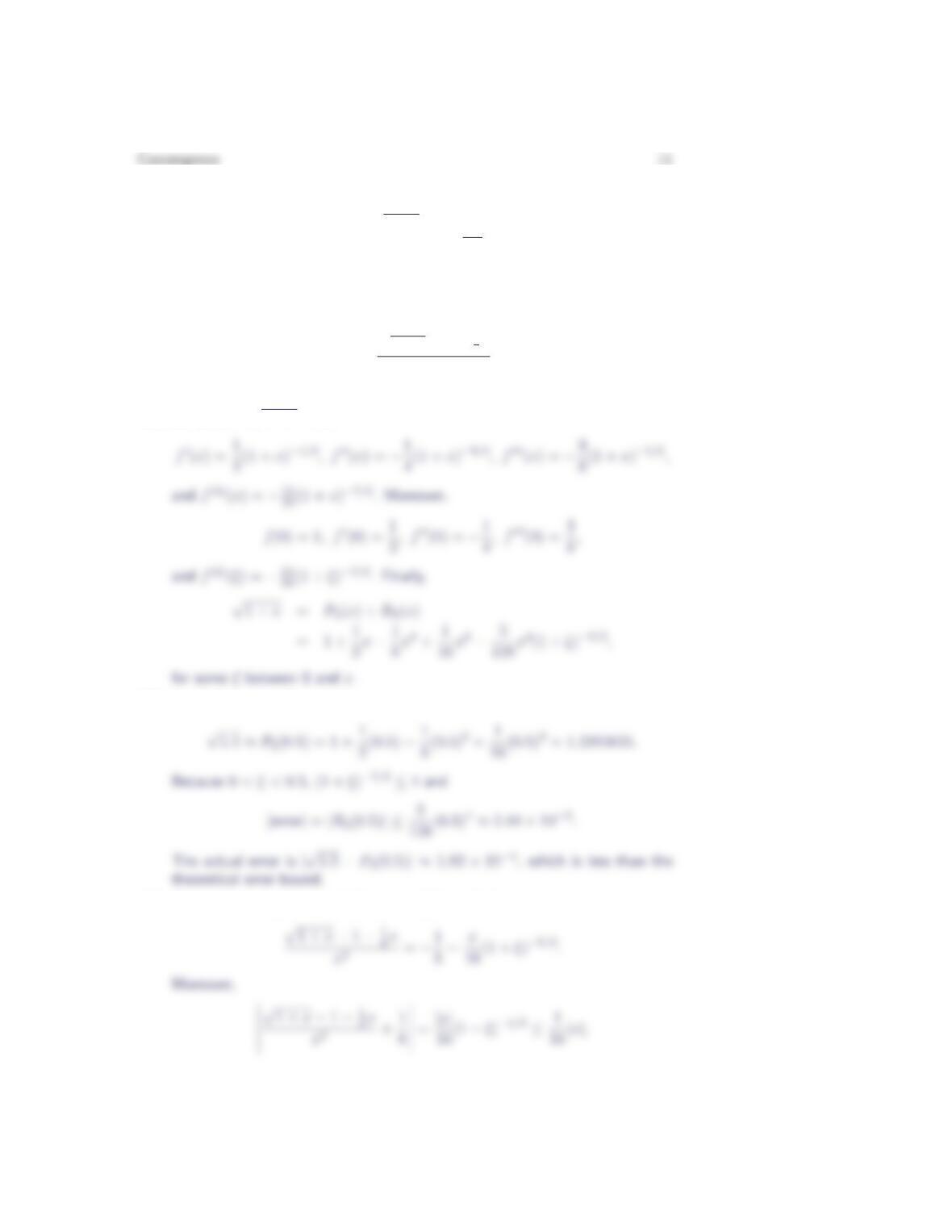
(b) Using the result of part (a),
(c) Once again using the result from part (a), we find
17. (a) Determine the third-degree Taylor polynomial and associated remainder
term for the function f(x) = √1 + x. Use x0= 0.
(b) Using the results of part (a), approximate √1.5 and compute the theoretical
error bound associated with this approximation. Compare the theoretical
error bound with the actual error.
(c) Compute the following limit and determine the corresponding rate of con-
vergence:
lim
x→0
√1 + x−1−1
2x
x2.
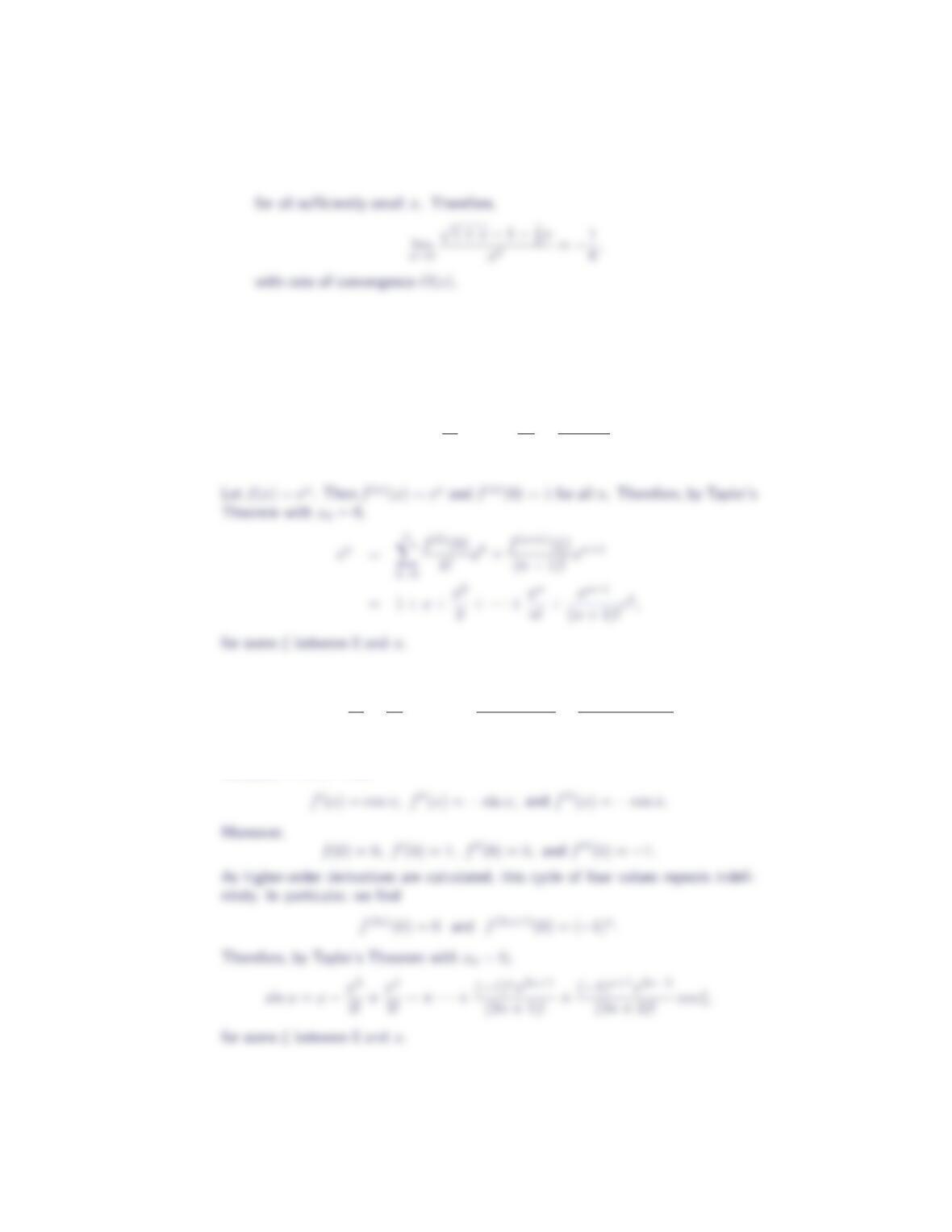
(a) Let f(x) = √1 + x. Then
(b) Using the result of part (a),
(c) Once again using the result from part (a), we find
12 Section 1.2
In Exercises 18 – 21, verify that Taylor’s theorem produces the indicated formula,
where ξis between 0 and x.
18.
ex= 1 + x+x2
2+···+xn
n!+xn+1
(n+ 1)!eξ
19.
sin x=x−x3
3! +x5
5! −+···+(−1)nx2n+1
(2n+ 1)! +(−1)n+1x2n+3
(2n+ 3)! cos ξ
Let f(x) = sin x. Then
20.
cos x= 1 −x2
2! +x4
4! −+···+(−1)nx2n
(2n)! +(−1)n+1x2n+2
(2n+ 2)! cos ξ
Let f(x) = cos x. Then
21.
1
1 + x= 1 −x+x2−+···+ (−1)nxn+(−1)n+1xn+1
(1 + ξ)n+2
Let f(x) = 1
1+x= (1 + x)−1. Then,