1.23: PROBLEM DEFINITION
Apply the grid method.
Situation:
A cyclist is travelling along a road.
P=FV.
V=24mi/h,F=5lbf.
Find:
a) Find power in watts.
b) Find the energy in food calories to ride for 1 hour.
PLAN
Follow the process for the grid method given in the text. Look up conversion ratios
in Table F.1.
SOLUTION
a)
Power
21
1.24: PROBLEM DEFINITION
Apply the grid method.
Situation:
Apumpoperatesforoneyear.
P=20hp.
The pump operates for 20 hours/day.
Electricity costs $0.10/kWh.
Find:
The cost (U.S. dollars) of operating the pump for one year.
PLAN
1. Find energy consumed using E=Pt,wherePis power and tis time.
2. Find cost using C=E×($0.1/kWh).
SOLUTION
1. Energy Consumed
22
1.25: PROBLEM DEFINITION
Situation:
Start with the Ideal Gas Law and prove that
a. Boyle’s law is true.
b. Charles’ law is true.
PLAN
Start with Ideal Gas Law
pV =nRuT
SOLUTION
a) If temperature is held constant, then
23
1.26: PROBLEM DEFINITION
Situation:
Calculate the number of moles in:
a) One cubic cm of water at room conditions
b) One cubic cm of air at room conditions
a)
PLAN
1. The density of water at room conditions is known (Table A.5 EFM10e), and the
volume is given, so:
m=ρV
2. From the Internet, water has a molar mass of 18 g/mol, use this to determine the
numberofmolesinthissample.
3. Avogadro’s number says that there are 6×10²³ molecules/mol
SOLUTION
1.
Assume conditions are atmospheric with T=20
◦Cand ρ=998kg
m3
3. Using Avogadro’s number
b)
PLAN
24
1. The density of air at room conditions is known (Table A.3 EFM10e), and the
volume is given, so:
m=ρV
2. From the Internet, dry air has a molar mass of 28.97 g/mol, use this to determine
the number of moles in this sample.
3. Avogadro’s number says that there are 6×10²³ molecules/mol
SOLUTION
1.
Assume conditions are atmospheric with T=20
◦Cand ρ=1.20 kg
m3
REVIEW
There are more moles in one cm3of water than one cm3of dry air. This makes sense,
because the molecules in a liquid are held together by weak inter-molecular bonding,
and in gases they are not; see Table 1.1 in Section 1.2 (EFM 10e).
25
1.27: PROBLEM DEFINITION
Situation:
Start with the molar form of the Ideal Gas Law, and show the steps to prove that
themassformiscorrect.
SOLUTION
The molar form is:
Where n = number of moles of gas, and the Universal Gas Constant = Ru=
8.314 J/mol ·K.
Specificgasconstantsaregivenby
26
1.28: PROBLEM DEFINITION
Situation:
Start with the universal gas constant and show that RN2=297 J
kg·K.
SOLUTION
Start with universal gas constant:
27
1.29: PROBLEM DEFINITION
Situation:
Spherical tank of CO2,doesp2=4P1?
Case1:
P=3atm
T=20
◦C
Volume is constant inside the tank
Case2:
P=?
T=80
◦C
Volume is equivelent to that in case 1
PLAN
1. Volume inside the tank is constant, as is the mass.
Mass is related to volume by density.
2. Use the Ideal Gas Law to find P2
SOLUTION
1. Mass in terms of density
2. Ideal Gas Law for constant volume
28

1.30: PROBLEM DEFINITION
Situation:
An engineer needs to know the local density for an experiment with a glider.
z=2500ft.
Local temperature = 74.3 ◦F=296.7K.
Local pressure = 27.3 in.-Hg =92.45 kPa.
Find:
Calculate density of air using local conditions.
Compare calculated density with the value from Table A.2, and make a recommen-
dation.
Properties:
From Table A.2, Rair =287 J
kg·K,ρ=1.22 kg/m3.
PLAN
Calculate density by applying the ideal gas law for local conditions.
SOLUTION
Ideal gas law
Table value. From Table A.2
REVIEW
Note: Use absolute pressure when working with the ideal gas law.
29

1.31: PROBLEM DEFINITION
Situation:
Carbon dioxide.
Find:
Density and specificweightofCO
2.
Properties:
From Table A.2, RCO2=189J/kg·K.
p=300kPa,T=60◦C.
PLAN
1. First, apply the ideal gas law to find density.
2. Then, calculate specific weight using γ=ρg.
SOLUTION
1. Ideal gas law
2. Specificweight
REVIEW
Always use absolute pressure when working with the ideal gas law.
30
1.32: PROBLEM DEFINITION
Situation:
Methane gas.
Find:
Density (kg/m3).
Specificweight(N/m3).
Properties:
From Table A.2, RMethane =518 J
kg·K
p=300kPa,T=60◦C.
PLAN
1. Apply the ideal gas law to find density.
2. Calculate specific weight using γ=ρg.
SOLUTION
1. Ideal gas law
2. Specificweight
REVIEW
Always use absolute pressure when working with the ideal gas law.
31
1.33: PROBLEM DEFINITION
Situation:
Find Dfor 10 moles of methane gas.
p=2bar=29lbf
in2=4176lbf
ft2
T=70
◦F=529.7◦R
Properties:
Rmethane =3098 ft·lbf
slug·◦R
PLAN
1. Find volume to get diameter.
2. Moles of methane can be related to mass by molecular weight.
3. Mass and volume are related by density.
4. Ideal Gas Law for constant volume.
ρ=p
RT
SOLUTION
1.
5. Solve for density, then go back and solve for volume
REVIEW
Always convert Temperature to Rankine (traditional) or Kelvin (SI) when working
with Ideal Gas Law.
32
1.34: PROBLEM DEFINITION
Natural gas is stored in a spherical tank.
Find:
Ratio of final mass to initial mass in the tank.
Properties:
patm =100kPa,p1=100kPa-gage.
p2=200kPa-gage, T=10◦C.
PLAN
Use the ideal gas law to develop a formula for the ratio of final mass to initial mass.
SOLUTION
1. Mass in terms of density
M=ρV (1)
33
1.35: PROBLEM DEFINITION
Situation:
Wind and water at 100 ◦Cand 5atm.
Find:
Ratio of density of water to density of air.
Properties:
Air, Table A.2: Rair =287J/kg·K.
Water (100oC), Table A.5: ρwater =958kg/m3.
PLAN
Apply the ideal gas law to air.
SOLUTION
Ideal gas law
For water
REVIEW
Always use absolute pressures when working with the ideal gas law.
34
1.36: PROBLEM DEFINITION
Situation:
Oxygen fills a tank.
Vtank =6ft
3,Wtank =90lbf.
Find:
Weight (tank plus oxygen).
Properties:
From Table A.2, RO2=1555ft·lbf/(slug ·oR).
p=400psia, T=70◦F.
PLAN
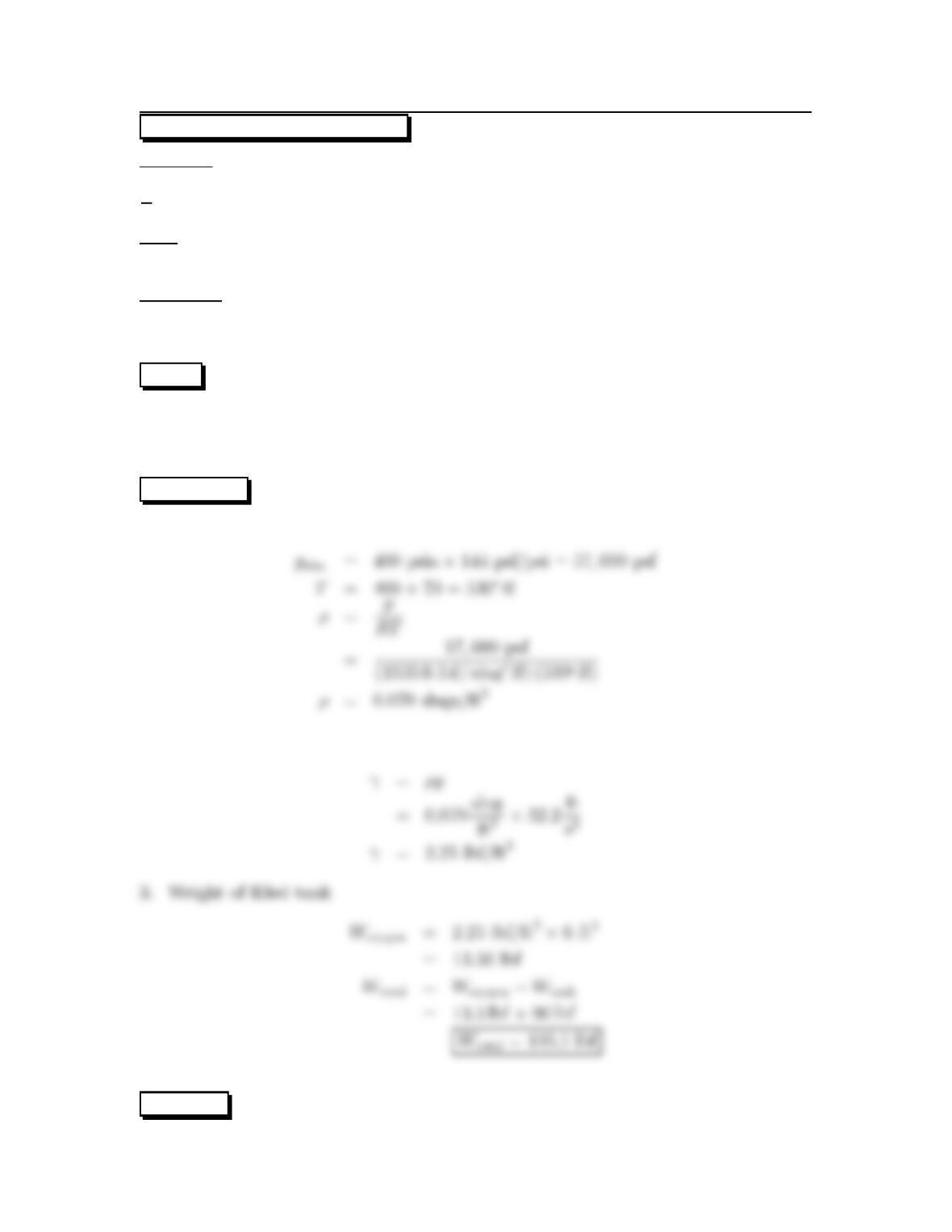
1. Apply the ideal gas law to find density of oxygen.
2. Find the weight of the oxygen using specificweight(γ)and add this to the weight
of the tank.
SOLUTION
1. Ideal gas law
2. Specificweight
REVIEW
35

1. For compressed gas in a tank, pressures are often very high and the ideal gas
assumption is invalid. For this problem the pressure is about 34 atmospheres—it is
36
1.37: PROBLEM DEFINITION
Situation:
Oxygen is released from a tank through a valve.
V=4m
3.
Find:
Mass of oxygen that has been released.
Properties:
RO2=260 J
kg·K.
p1=700kPa,T1=15◦C.
p2=500kPa,T2=20◦C.
PLAN
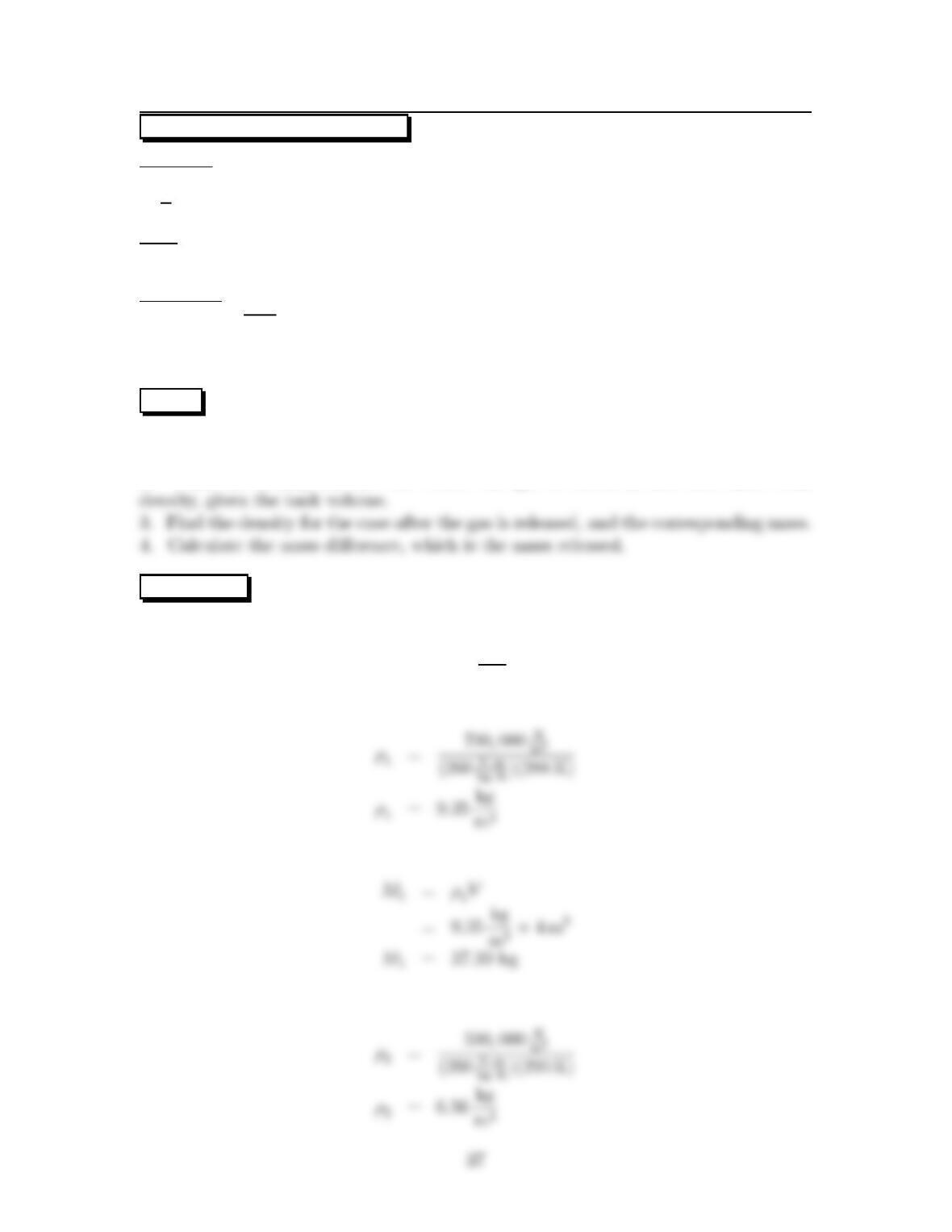
1. Use ideal gas law, expressed in terms of density and the gas-specific (not universal)
gas constant.
2. Find the density for the case before the gas is released; and then mass from
SOLUTION
1. Ideal gas law
ρ=p
RT
2. Density and mass for case 1
3. Density and mass for case 2