TVM-1
TIME VALUE OF MONEY MODULE
CONTENT ANALYSIS OF EXERCISES AND PROBLEMS
Number Content Time Range
(minutes)
EM-1
Future Value. (Easy) Single investment, compound interest.
5-10
EM-2
Future Value. (Easy) Single investment, compound interest.
5-10
EM-6
Amount of Each Cash Flow. (Moderate) Future value, interest
compounded annually.
5-10
EM-7
Amount of an Annuity. (Moderate) Various annual withdrawal
dates, interest compounded annually.
10-15
EM-8
Amount of Each Cash Flow. (Moderate) Present value,
calculate monthly installments, compound interest.
10-15
EM-13
Present Value of Leased Asset. (Easy) Lease payments. Annuity
due. Interest compounded annually.
5-10
interest.
TVM-2
Number
Content
Time Range
(minutes)
PM-3
Future Value. (Moderate) Annuity due, ordinary annuity, compound
interest.
15-30
PM-7
Compound Interest Issues. (Moderate) Future value, installment
determinations.
30-40
PM-8
Amount of an Annuity. (Moderate) Ordinary annuity, present value,
withdrawal determination, interest compounded annually.
20-30
PM-13
Purchase of Asset. (Moderate) Alternative financing plans to acquire
asset. Ordinary annuity, annuity due.
30-40
PM-14
Fund to Retire Bonds. (Moderate) Ordinary annuity, future value,
interest compounded annually.
10-20
PM-15
Asset Purchase Price. (Moderate) Given future cash inflows, compute
purchase price of asset.
10-20
ANSWERS TO QUESTIONS
QM-1 Interest is the cost of the use of money over time. Interest and the price of any
QM-2 Simple interest is interest only on the principal amount. There is no compounding of
interest on “previously earned” interest when computations are based on simple interest.
Compound interest is interest that accrues on past unpaid accrued interest, as well as on
the principal.
QM-3 The future amount of 1 tells how much one single monetary unit will accrue to in a given
QM-4 Interest Rate Frequency of Compounding
Per Period Per Year
QM-5 The future value of 1 is 1 plus the interest compounded at a given interest rate for a given
number of periods. The present value of 1 is the amount that must be invested today in
QM-6 The only difference between the future value of an ordinary annuity and the future value
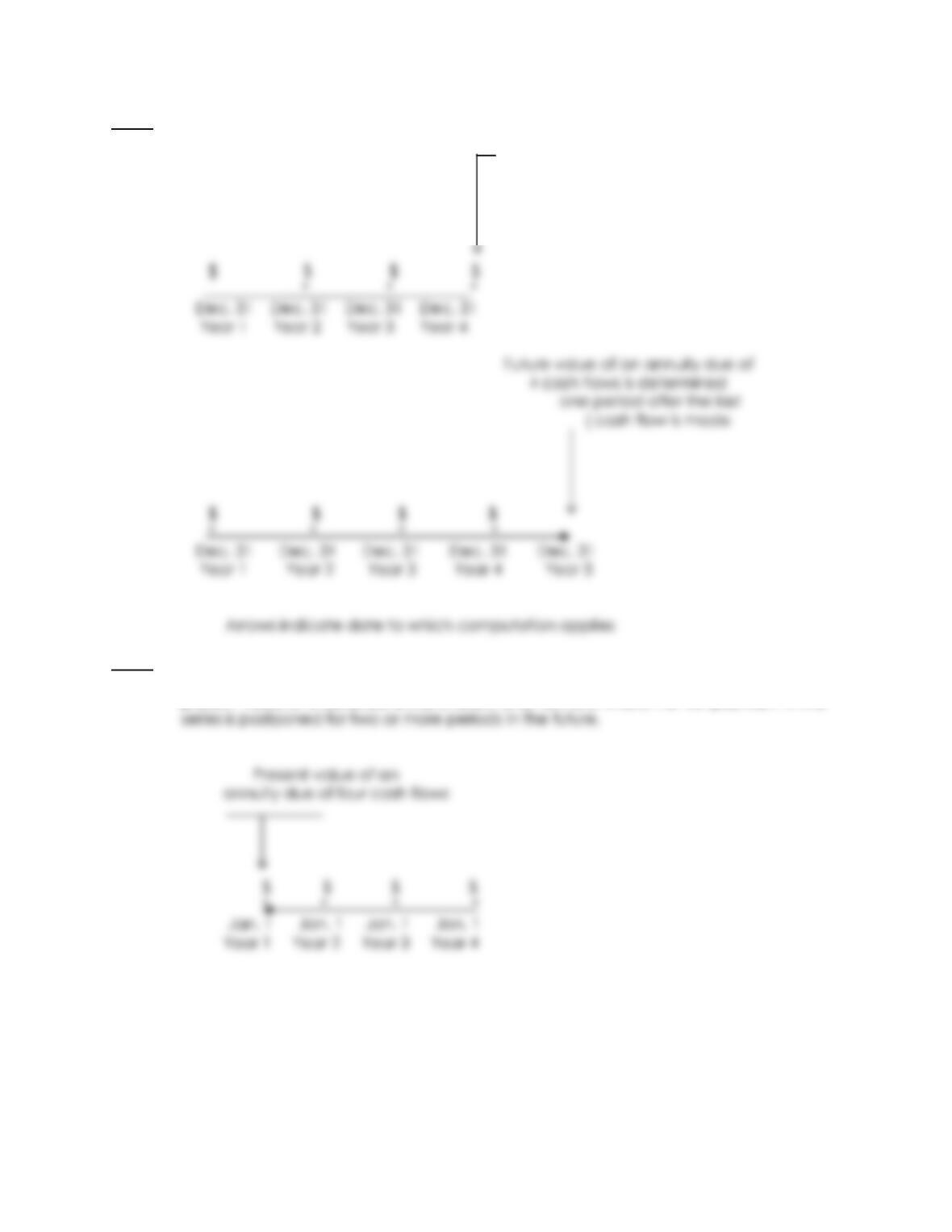
of an annuity due is the number of time periods over which interest accrues. With the
TVM-4
QM-6 (continued)
Future value of an
{ordinary annuity of 4 cash
flows is determined
immediately after the
last cash flow is made
QM-7 The present value of an annuity due is based on cash payments made at the
beginning of each period, and is determined on the date of the first payment. The
present value of a deferred annuity refers to an annuity where the first payment in the
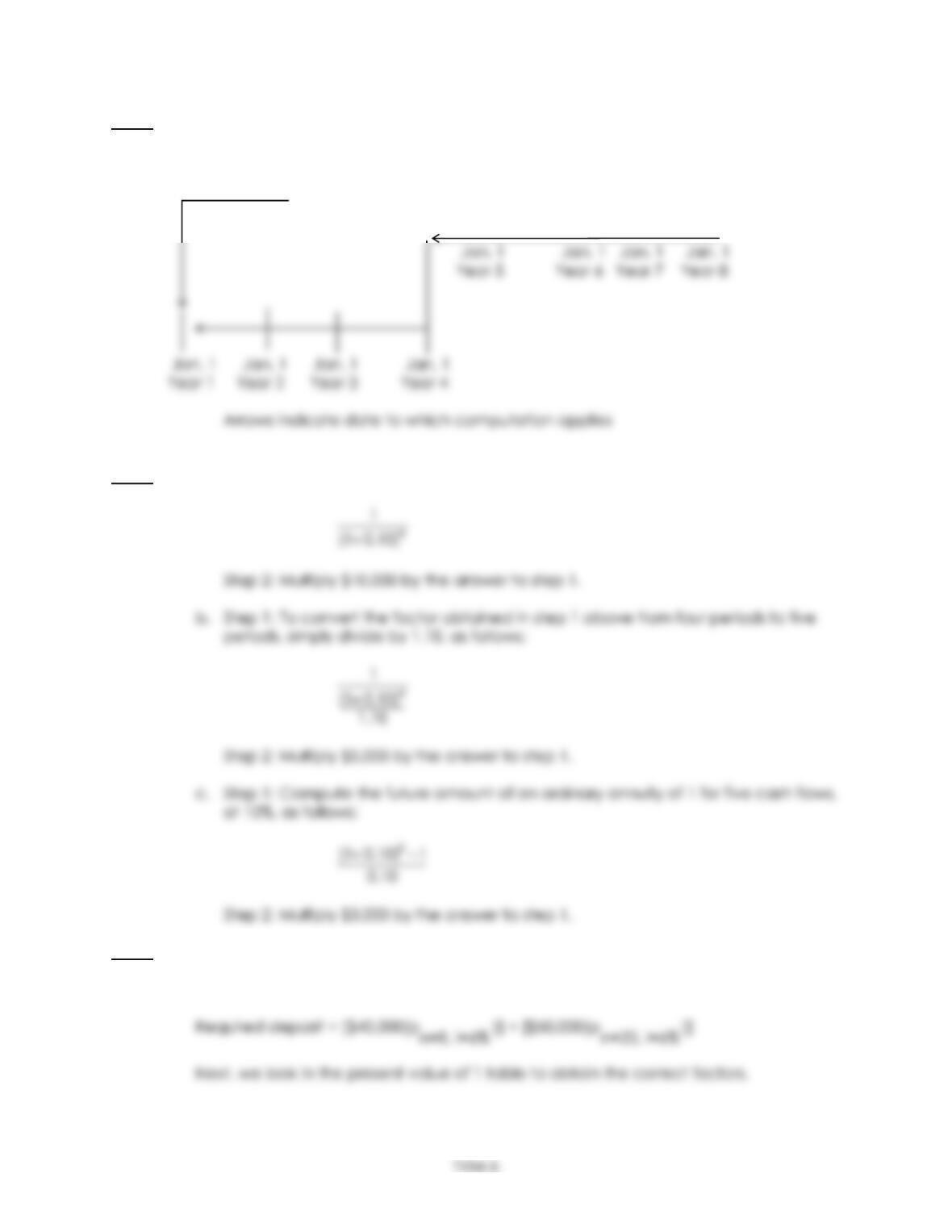
QM-7 (continued)
Present value of an annuity of
four cash flows deferred three periods
$ $ $ $
* * * *
QM-8 a. Step 1: Compute the present value of 1 at 10% for 4 years, as follows:
QM-9 First, the two desired withdrawals are discounted back to the present at 12%
compounded semiannually. The sum of the two present values of the withdrawals
equals the required deposit.
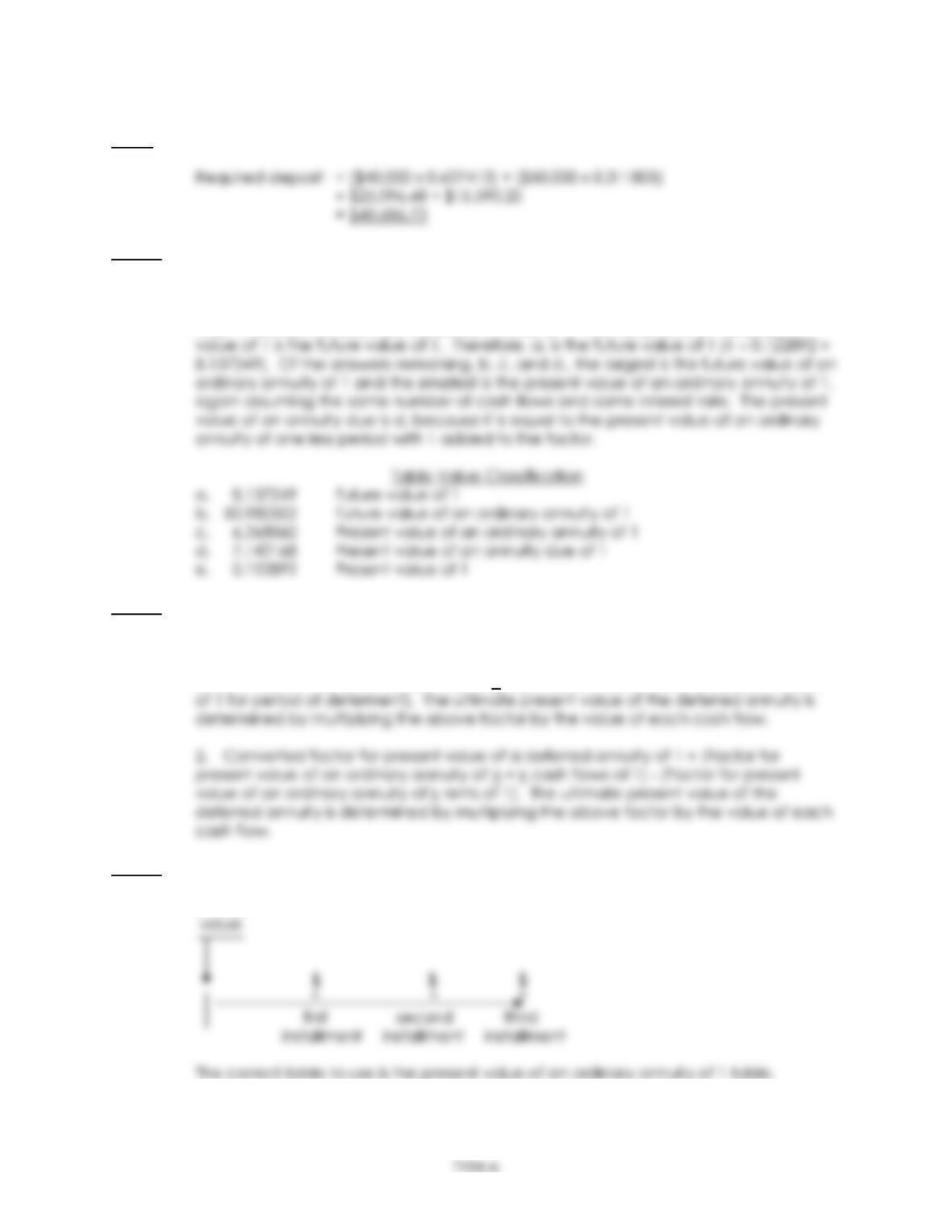
QM-9 (continued)
QM-10 All of the factors have two things in common: a 14% interest rate, and 16 periods
(cash flows). If the factors given have the same number of time periods and/or cash
flows for the same interest rate, the table value classification can be determined
without using the table. The number given for e. is the only table value given less
than 1. It must therefore be the present value of 1. The reciprocal of the present
QM-11 There are two approaches to the determination of the converted factor for a
deferred annuity:
1. Converted factor for present value of a deferred annuity of 1 = (Factor for
present value of an ordinary annuity of n cash flows of 1) x (Factor for present value
QM-12
$20,000
present
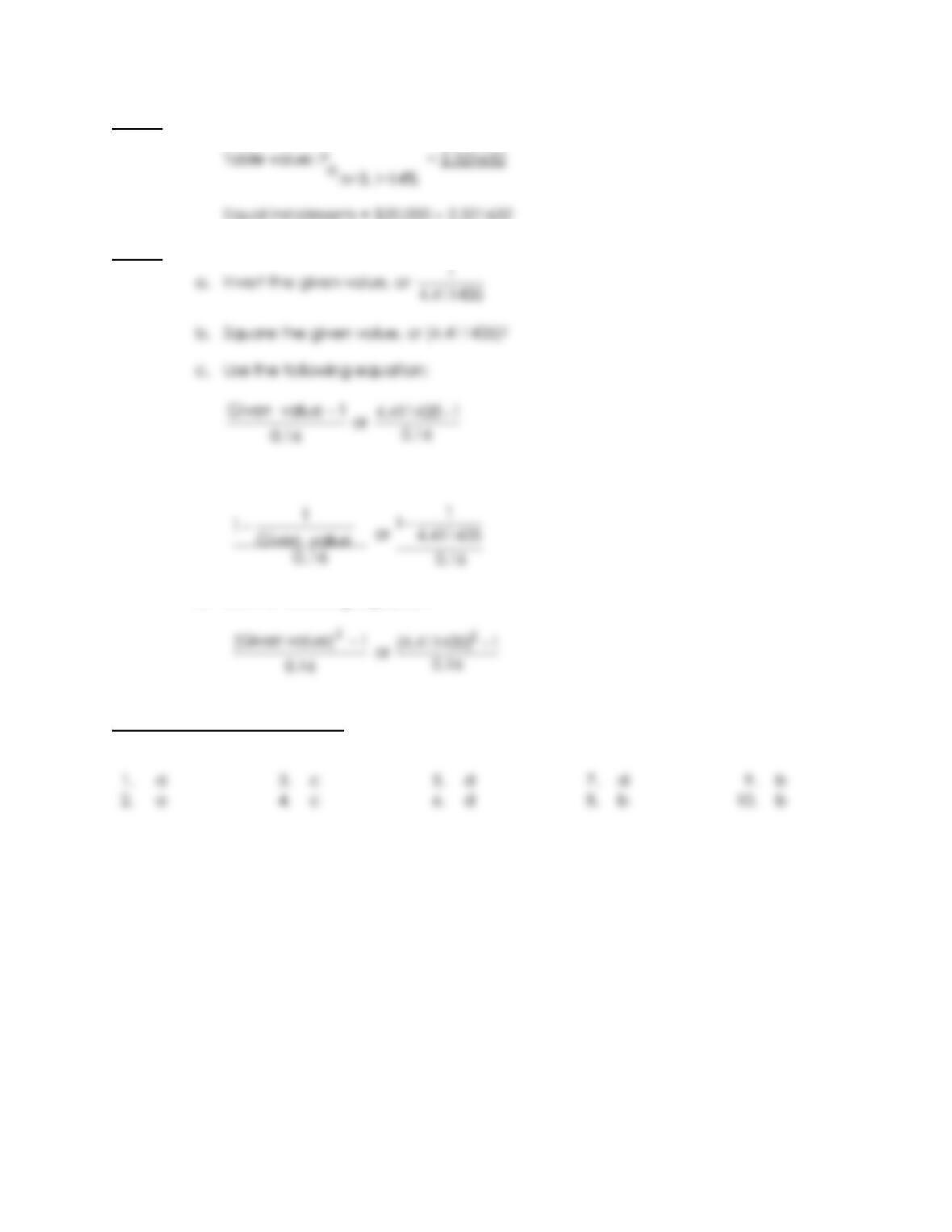
TVM-7
QM-12 (continued)
QM-13
d. Use the following equation:
e. Use the following equation:
ANSWERS TO MULTIPLE CHOICE
SOLUTIONS TO EXERCISES
EM-1
3. The compound interest equals the total interest for the 5 years, therefore,
EM-2
EM-3
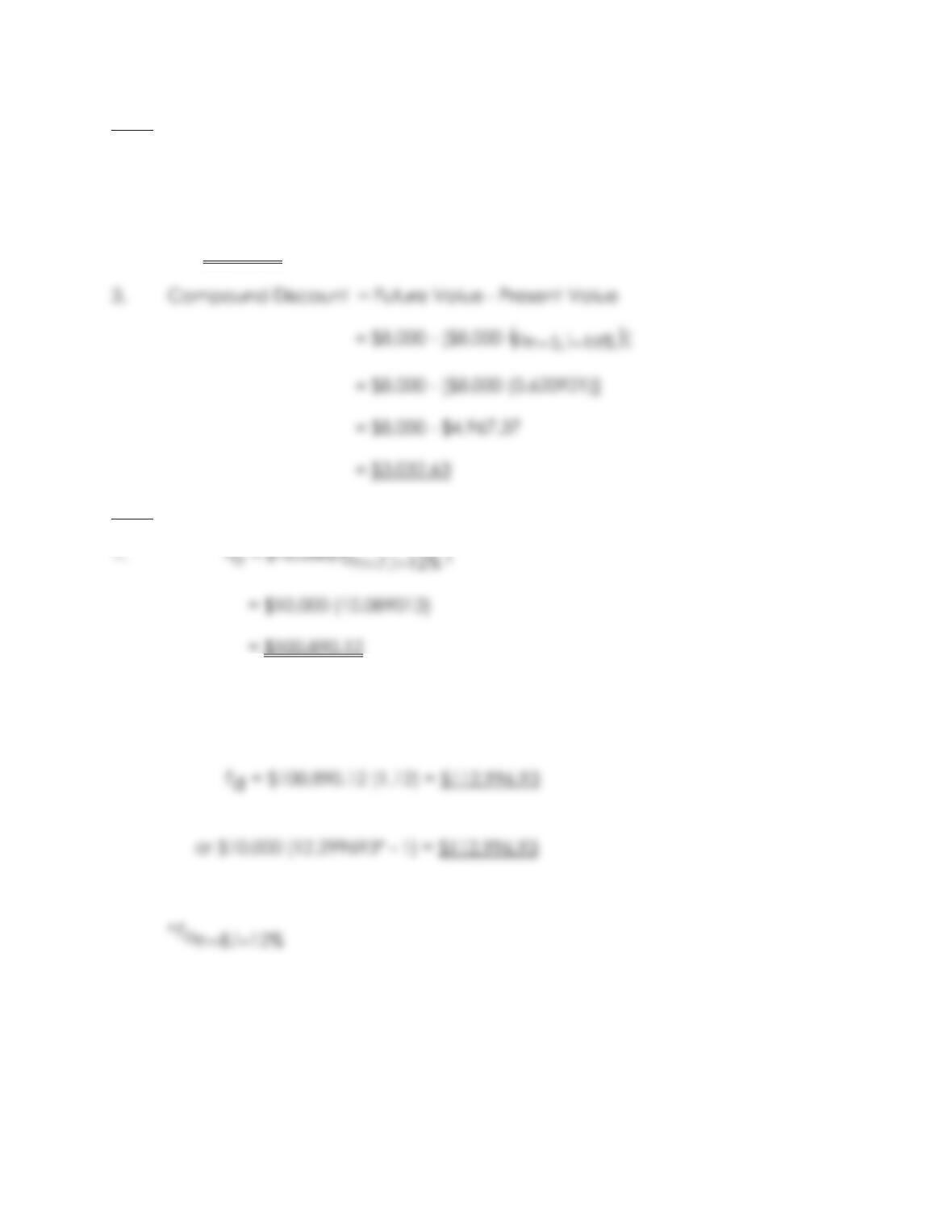
TVM-9
EM-3 (continued)
2. p = $8,000
(
)
4%i 18,n
p==
= $8,000 (0.493628)
= $3,949.02
EM-4
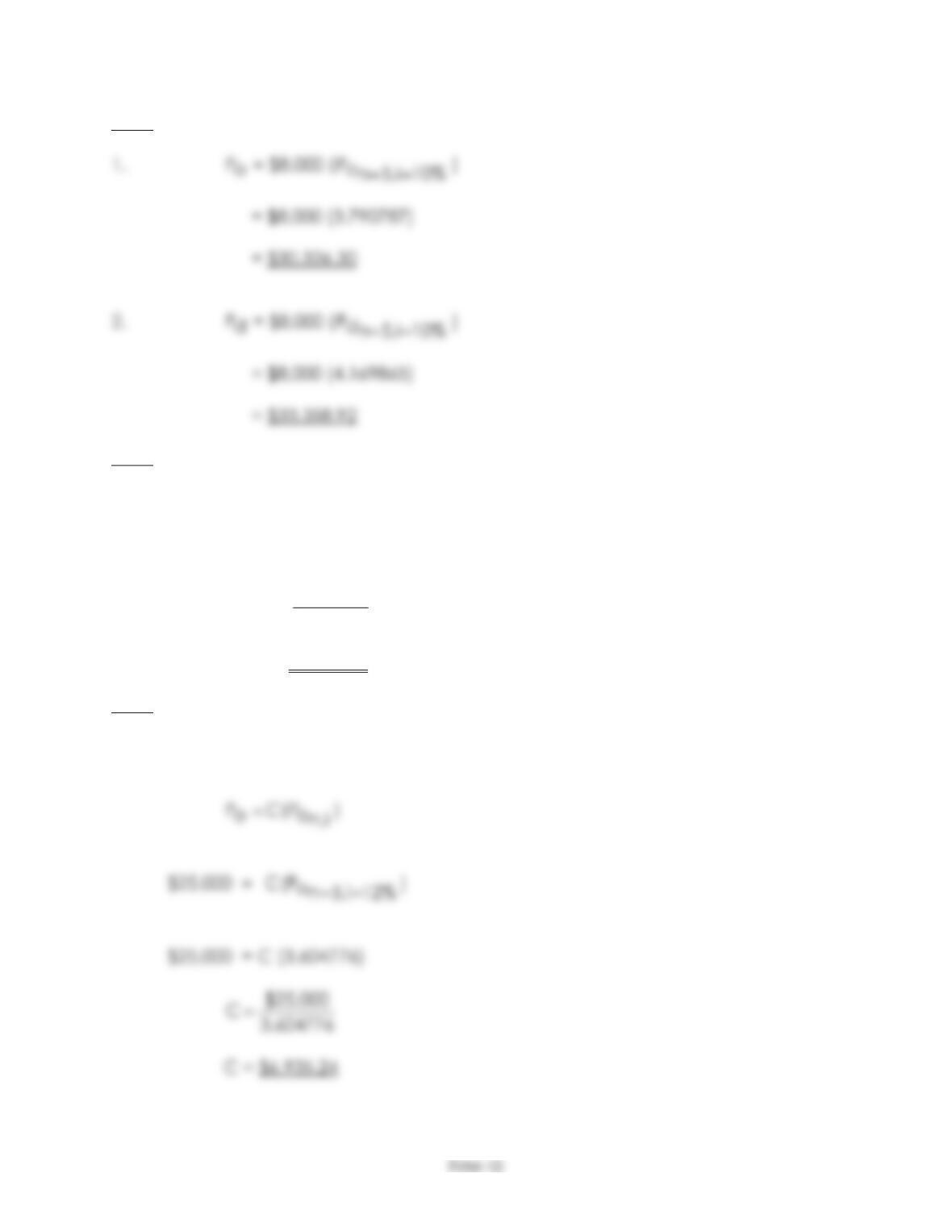
2. The future value determined in (1) accumulates interest for 1 more year
(d
F)
EM-5
EM-6
)
10%i6,n
o
(F C
o
F==
=
$30,000 = C (7.715610)
7.715610
$30,000
C=
= $3,888.22
EM-7
1. Since the $25,000 is invested one year before the first withdrawal, the
calculation is based on the Po formula:
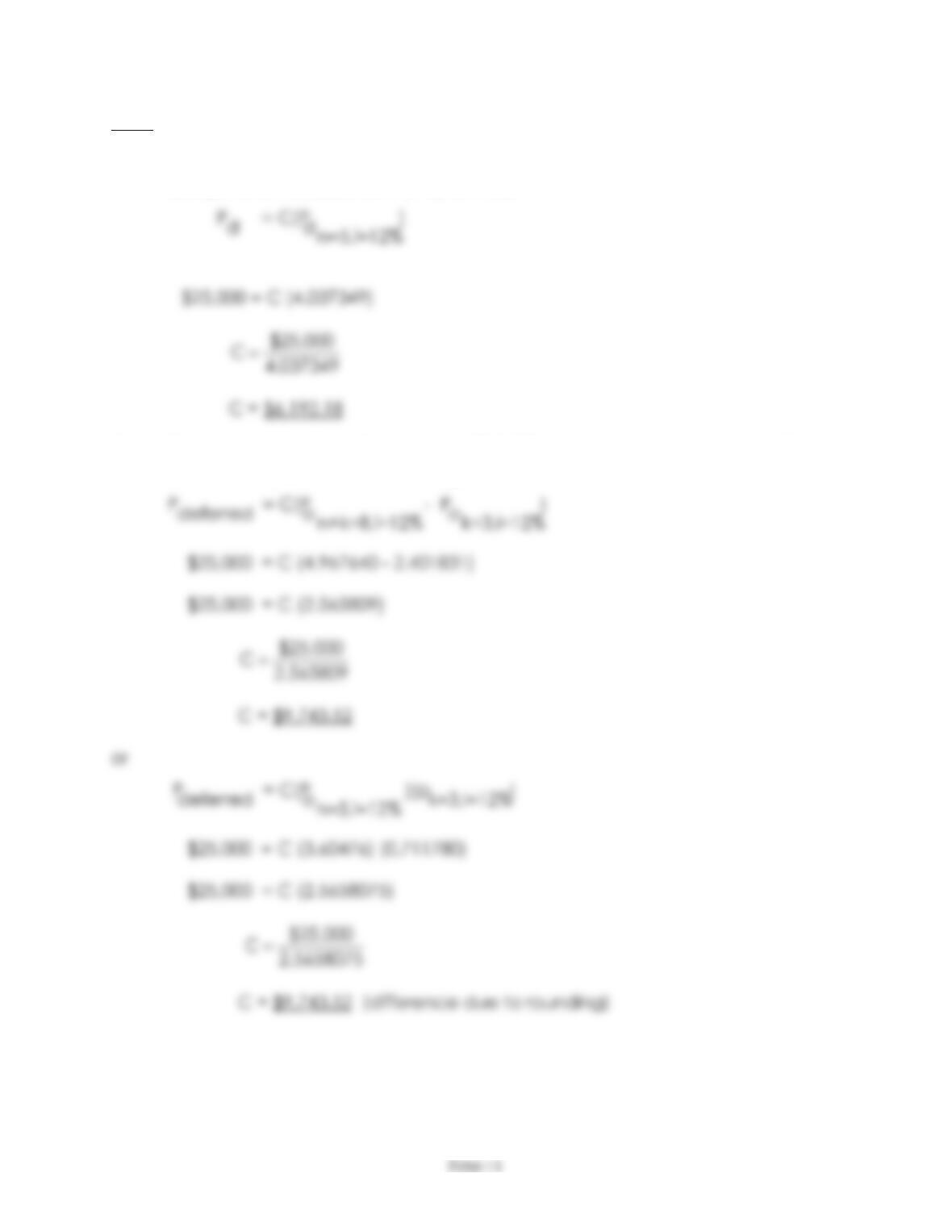
EM-7 (continued)
2. Since the deposit is made on the date of the first withdrawal, the
computation is based on the Pd formula:
3. This is a deferred annuity, since the $25,000 investment accrues interest for 4
years before the withdrawals begin.
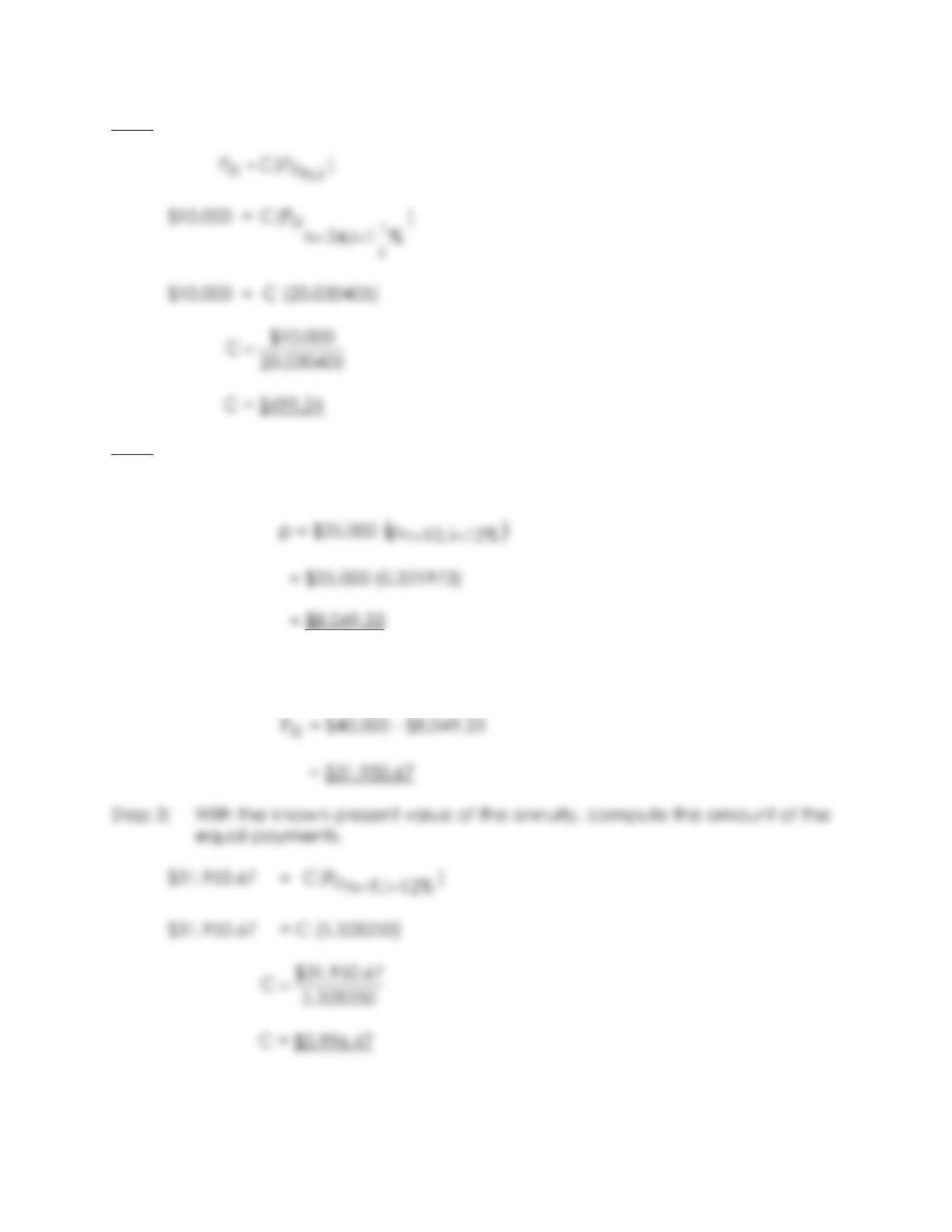
TVM-12
EM-8
EM-9
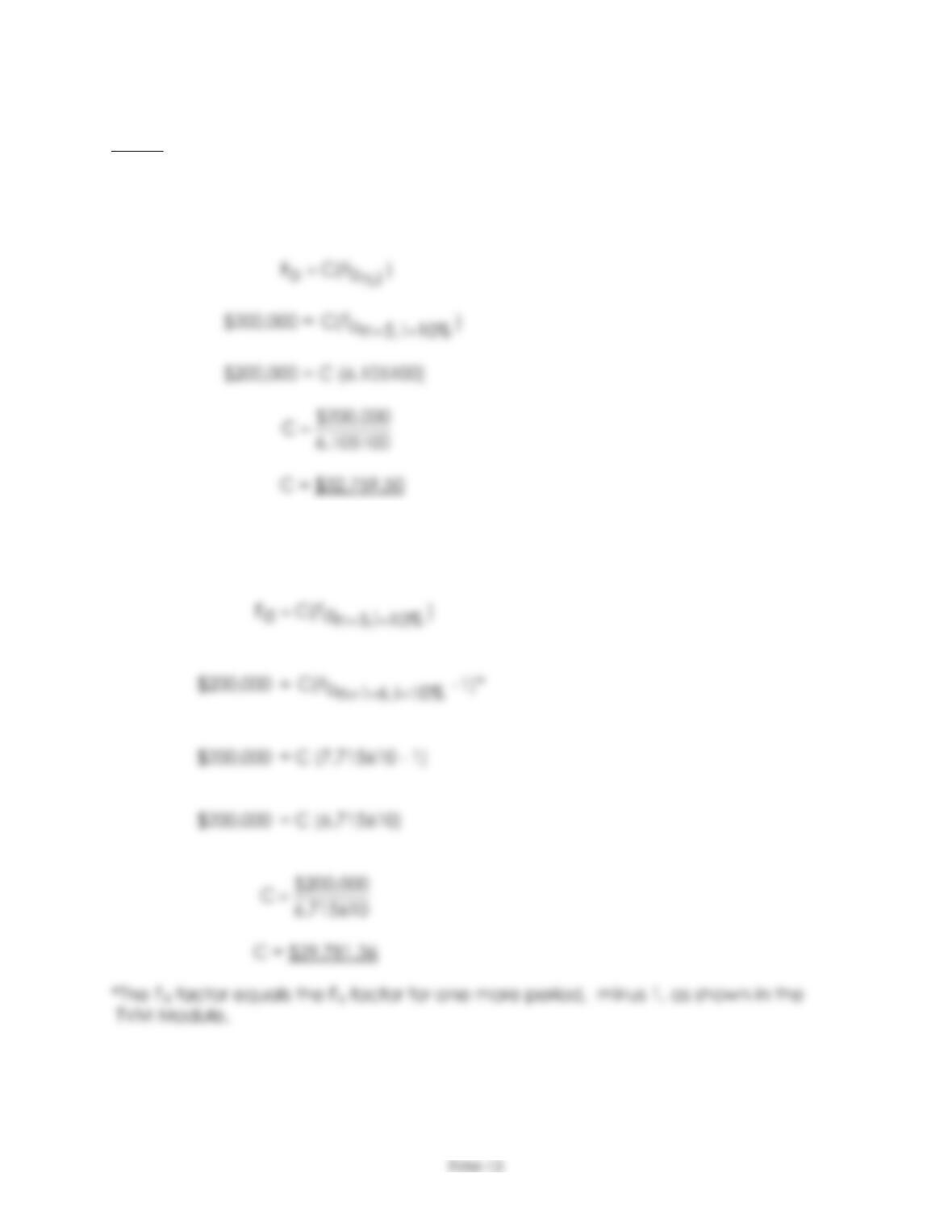
Step 1: Find the present value of the trust.
Step 2: The present value of the annual payments must equal the amount of the
loan minus the present value of the trust.
EM-10
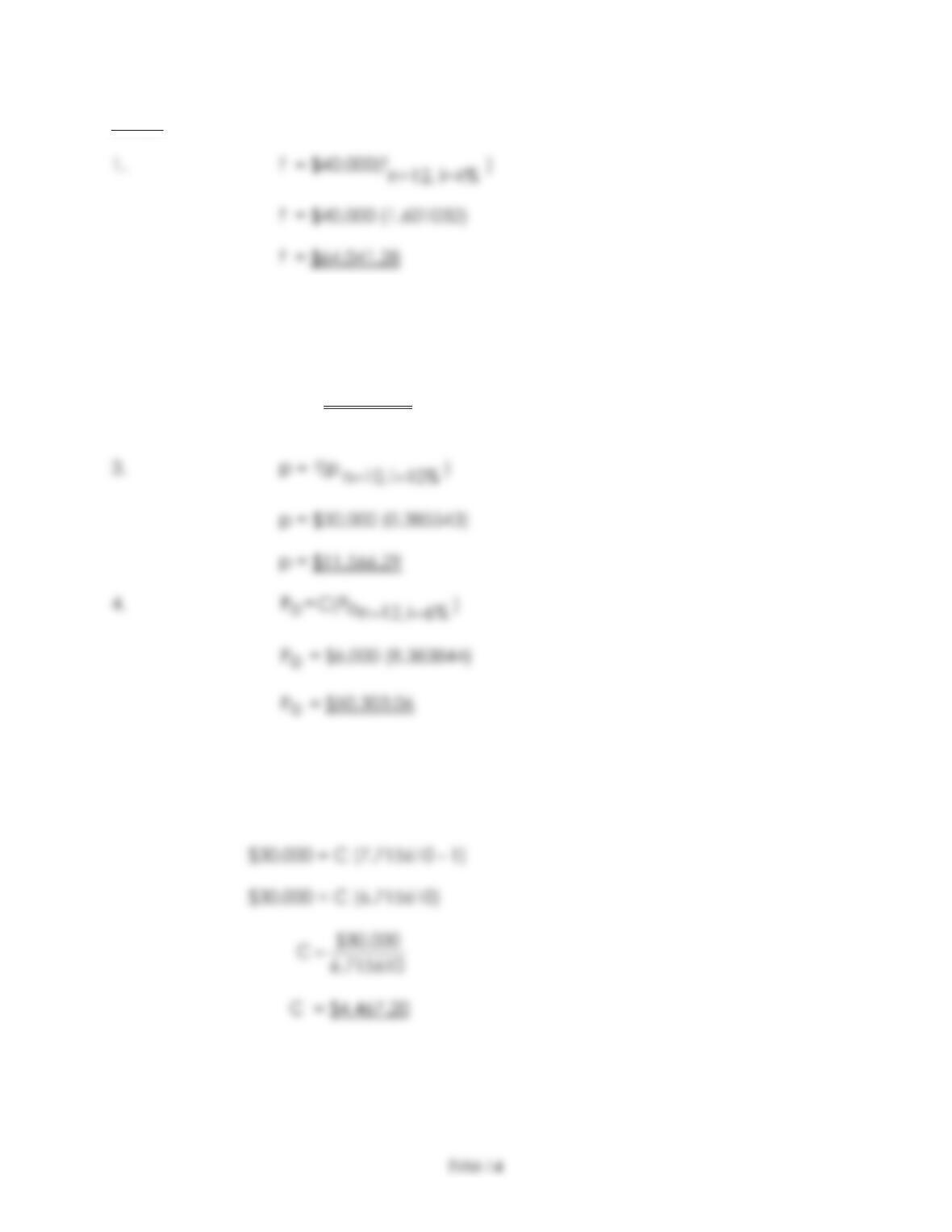
1. Since the future value is determined immediately after the last cash payment
is made (January 1, 2015), the calculation is based on the future value of an
ordinary annuity.
2. Since the future value is determined one period after the last cash payment,
the calculation is based on the future value of an annuity due.
EM-11
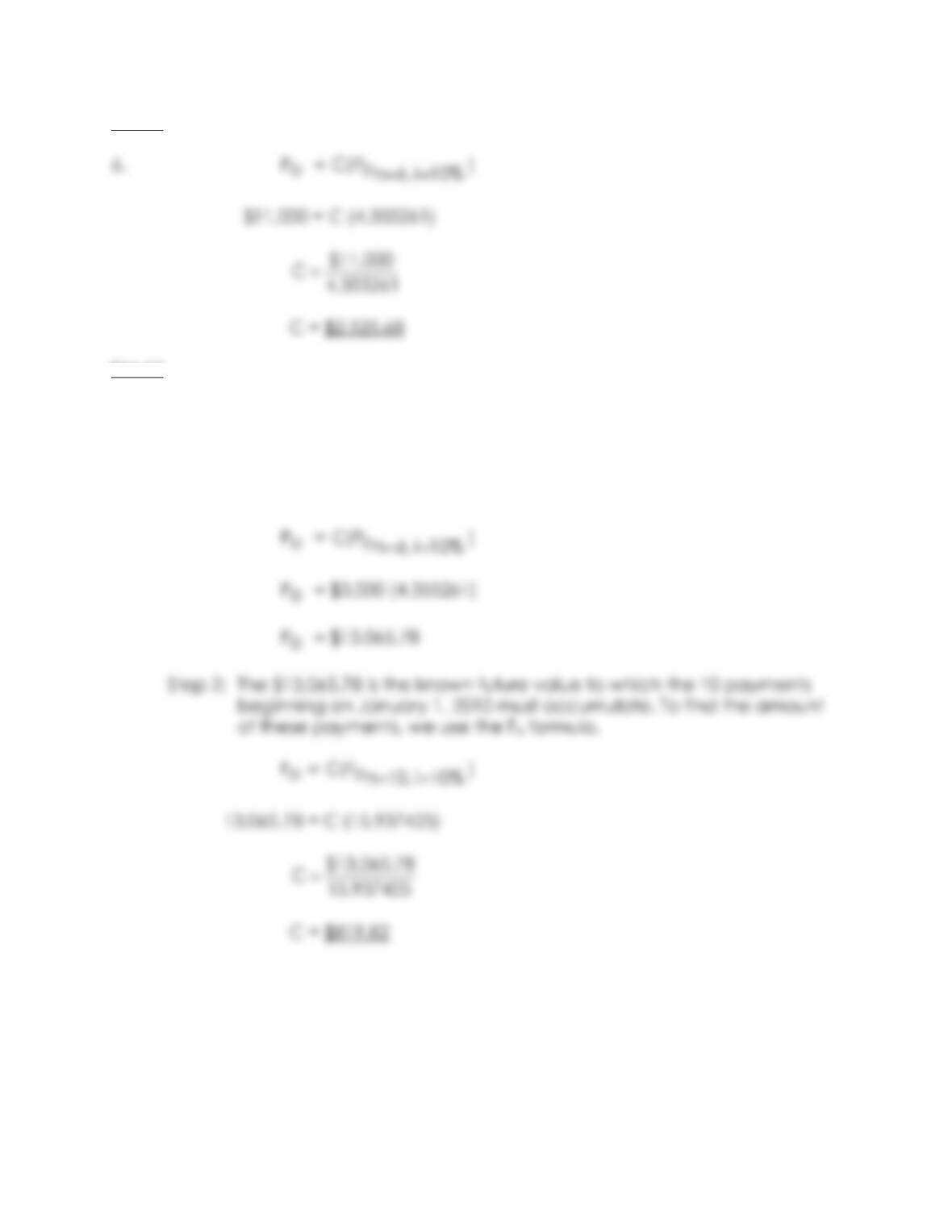
2. o
F = )
12%i 5,n
o
C(F ==
o
F = $5,000 (6.352847)
o
F = $31,764.24
5.
d
F= )
10%i 5,n
d
C(F ==
$30,000 = 1)
–
10%i 6,1n
o
C(F ==+
TVM-15
EM-11 (continued)
EM-12
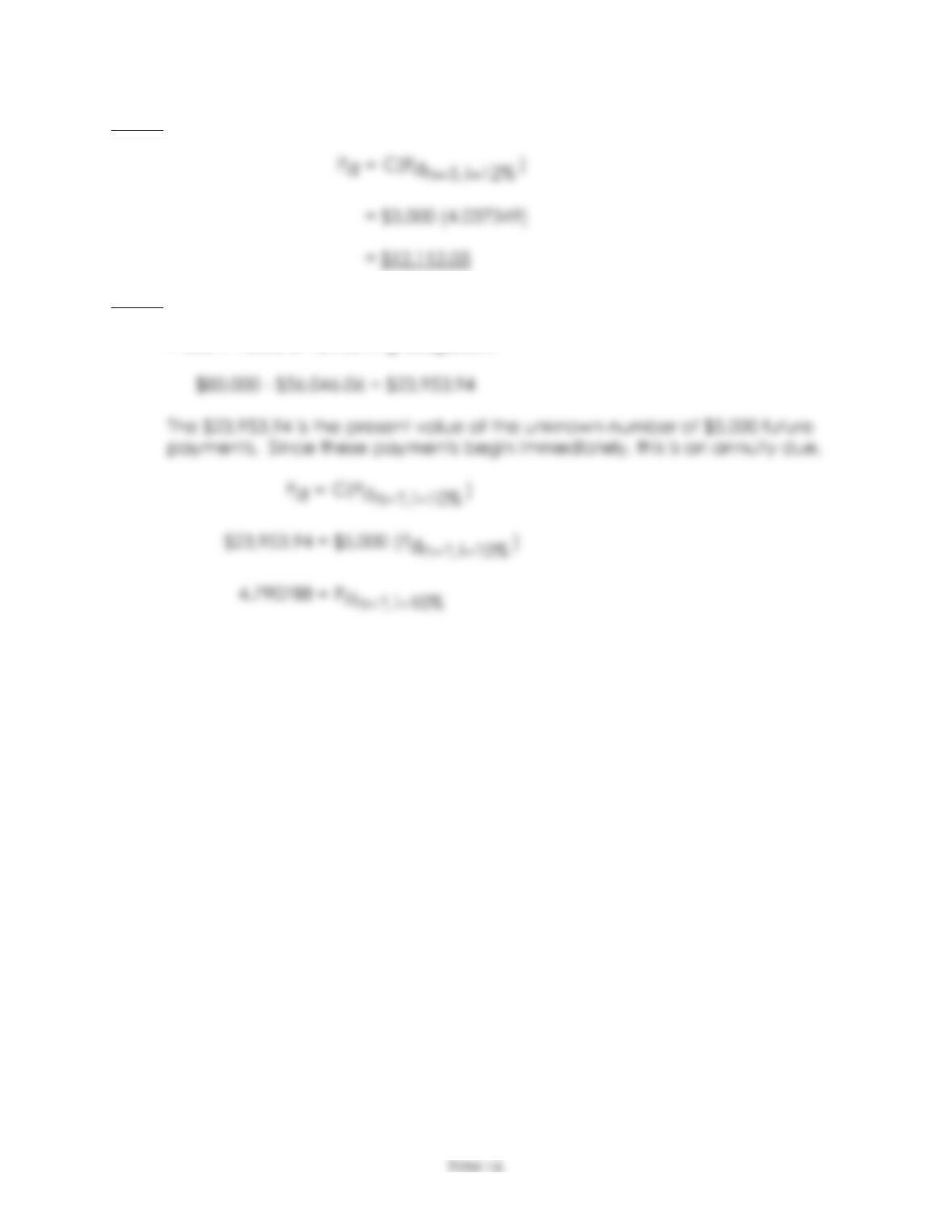
The present value of the six annual withdrawals of $3,000 is first calculated.
This present value is then used as the known future amount of the 10 annual
unknown cash flows beginning on January 1, 2010.
Step 1: The Po value of six cash flows of $3,000 at 10%:
EM-13
EM-14
Present value of remaining obligation:
Looking down the 10% column of the present value of an annuity due table,
we find that 4.790788 is the factor for six cash flows. The Boston Company
must make six payments.
TVM-17
SOLUTIONS TO PROBLEMS
PM-1
1. f = p
(
)
i n,
f
(
)
(
)
(
)
PM-2
1. p = f
(
)
i n,
p
PM-2 (continued)
2. p = f
(
)
i n,
p
(
)
(
)
PM-3
1. o
F = )
in,
o
C(F
TVM-19
PM-3 (continued)
3. d
F = )
5%i 20,n
d
C(F ==
PM-4
1. o
F = )
in,
o
C(F
2. d
F = )
12%i 6,n
d
C(F ==
TVM-20
PM-5
1. o
P = )
in,
o
C(P
3. deferred
P = )]
ik,
o
(P)
ik,n
o
C[(P
−
+
deferred
P = )]
12%i4,k
o
(P)
12%i9,kn
o
C[(P ==
−
==+