PROBLEM 1.47
KNOWN: Total rate of heat transfer leaving nacelle (from Example 1.3). Dimensions and emissivity
of the nacelle, ambient and surrounding temperatures, convection heat transfer coefficient exterior to
nacelle. Temperature of exiting forced air flow.
FIND: Required mass flow rate of forced air flow.
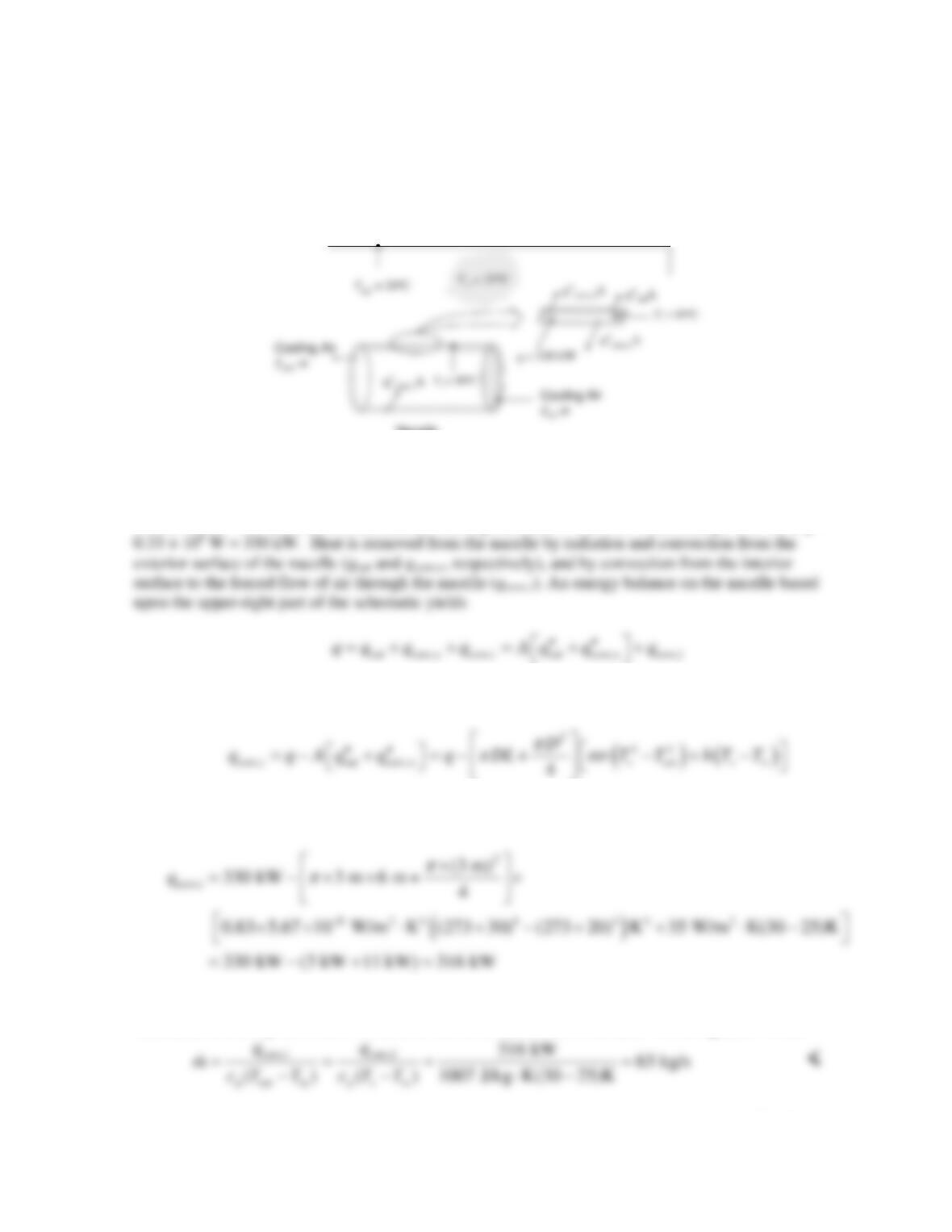
SCHEMATIC:
Nacelle
ASSUMPTIONS: (1) Steady–state conditions, (2) Large surroundings, (3) Surface of the nacelle that
is adjacent to the hub is adiabatic, (4) Forced air exits nacelle at the nacelle surface temperature.
ANALYSIS: The total rate of heat transfer leaving the nacelle is known from Example 1.3 to be q =
Thus the required rate of heat removal by the forced air is given by
In order to maintain a nacelle surface temperature of Ts = 30°C, the required qconv,i is
The required mass flow rate of air can be found by applying an energy balance to the air flowing through the
nacelle, as shown by the control volume on the lower left of the schematic. From Equation 1.12e:
Continued…

PROBLEM 1.47 (Cont.)
COMMENTS: (1) With the surface temperature lowered to 30°C, the heat lost by radiation and
convection from the exterior surface of the nacelle is small, and most of the heat must be removed by
PROBLEM 1.48
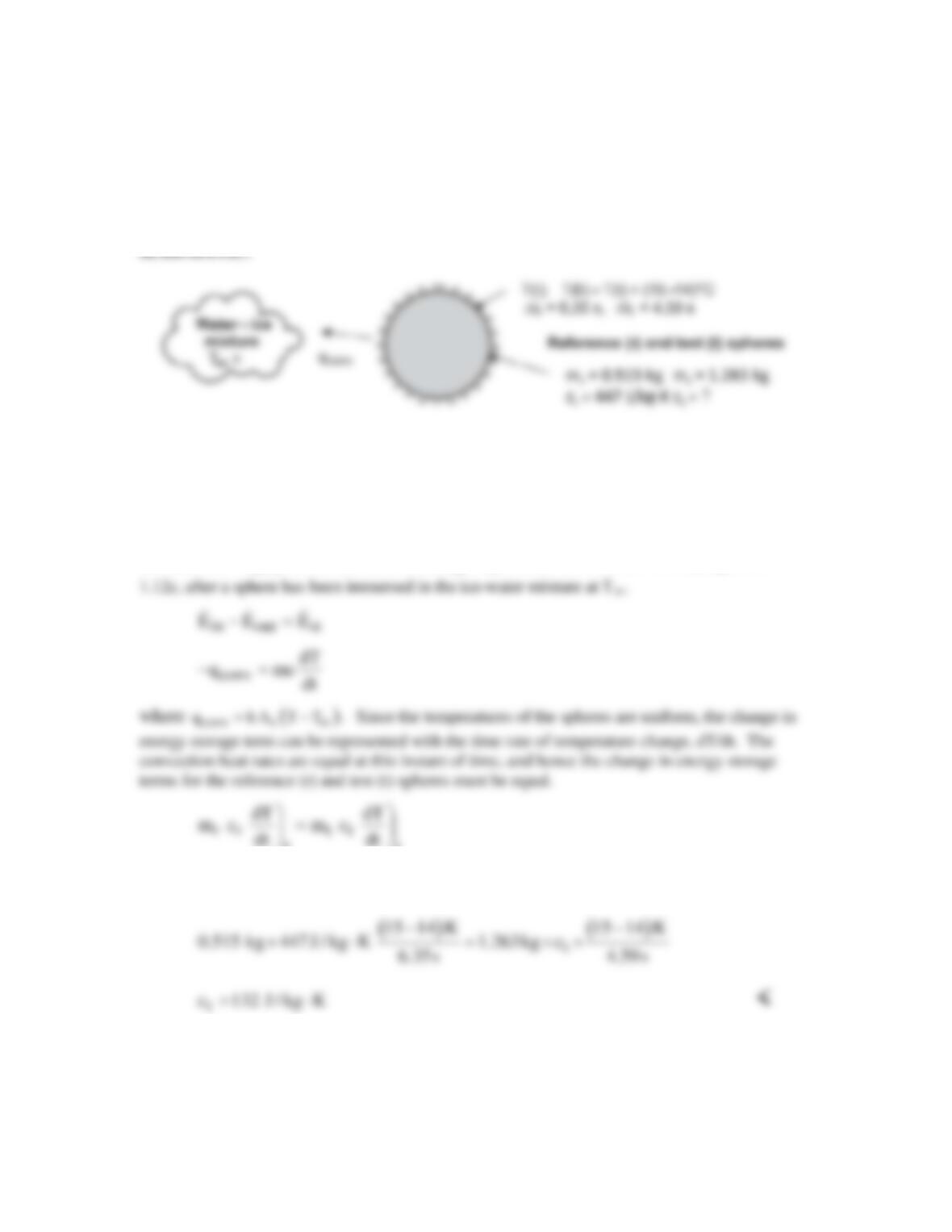
KNOWN: Elapsed times corresponding to a temperature change from 15 to 14°C for a reference
sphere and test sphere of unknown composition suddenly immersed in a stirred water-ice mixture.
Mass and specific heat of reference sphere.
FIND: Specific heat of the test sphere of known mass.
ASSUMPTIONS: (1) Spheres are of equal diameter, (2) Spheres experience temperature change
from 15 to 14°C, (3) Spheres experience same convection heat transfer rate when the time rates of
surface temperature are observed, (4) At any time, the temperatures of the spheres are uniform,
(5) Negligible heat loss through the thermocouple wires.
PROPERTIES: Reference–grade sphere material: cr = 447 J/kg K.
ANALYSIS: Apply the conservation of energy requirement at an instant of time, Equation
rt
Approximating the instantaneous differential change, dT/dt, by the difference change over a short
period of time, ∆T/∆t, the specific heat of the test sphere can be calculated.
COMMENTS: Why was it important to perform the experiments with the reference and test
spheres over the same temperature range (from 15 to 14°C)? Why does the analysis require that
the spheres have uniform temperatures at all times?
PROBLEM 1.49
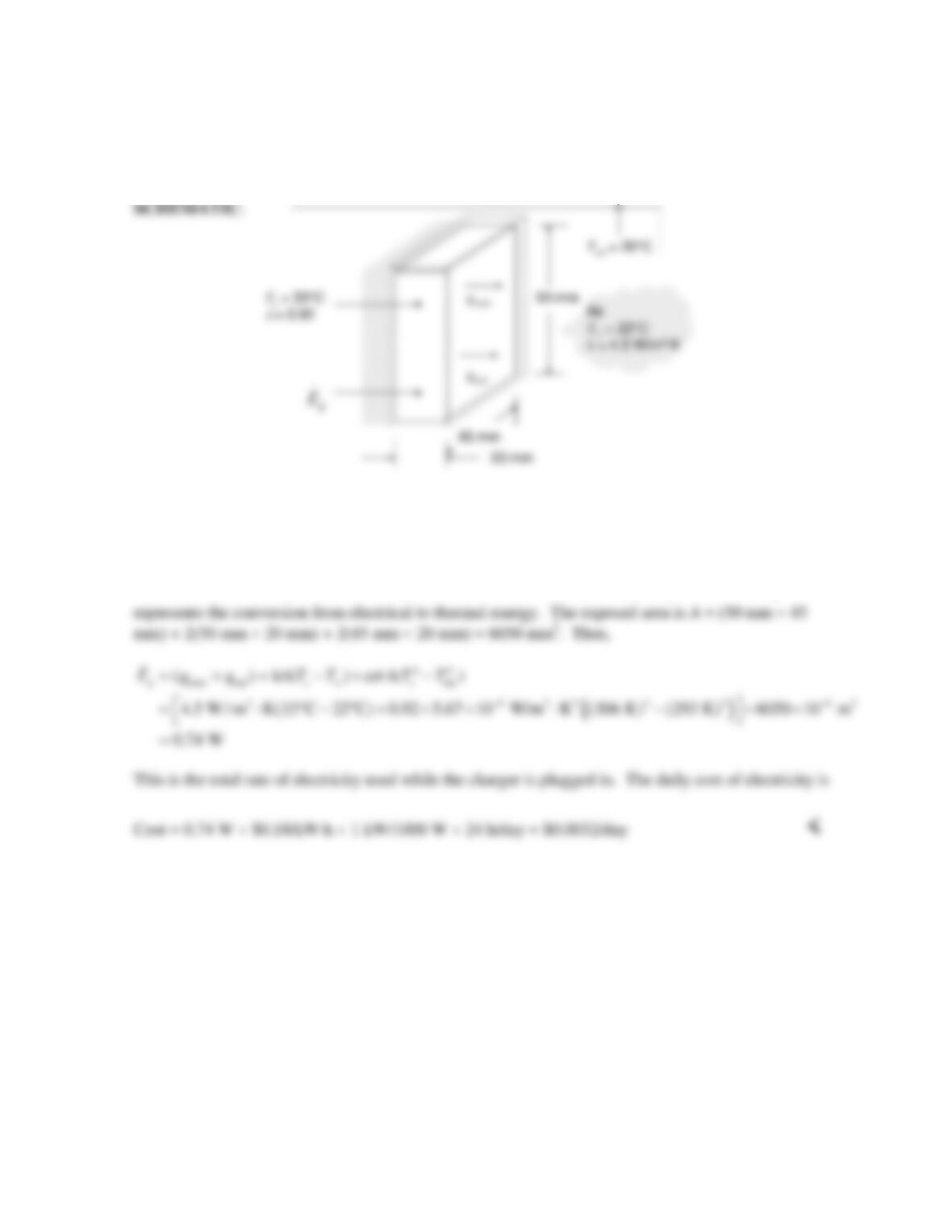
KNOWN: Dimensions and emissivity of a cell phone charger. Surface temperature when plugged in.
Temperature of air and surroundings. Convection heat transfer coefficient. Cost of electricity.
FIND: Daily cost of leaving the charger plugged in when not in use.
ASSUMPTIONS: (1) Steady–state conditions, (2) Convection and radiation are from five exposed
surfaces of charger, (3) Large surroundings, (4) Negligible heat transfer from back of charger to wall
and outlet.
ANALYSIS: At steady–state, an energy balance on the charger gives
in 0
g
EE+=
, where
g
E
COMMENTS: (1) The radiation and convection heat fluxes are 73 W/m2 and 50 W/m2, respectively.
Therefore, both modes of heat transfer are important. (2) The cost of leaving the charger plugged in
when not in use is small.
PROBLEM 1.50
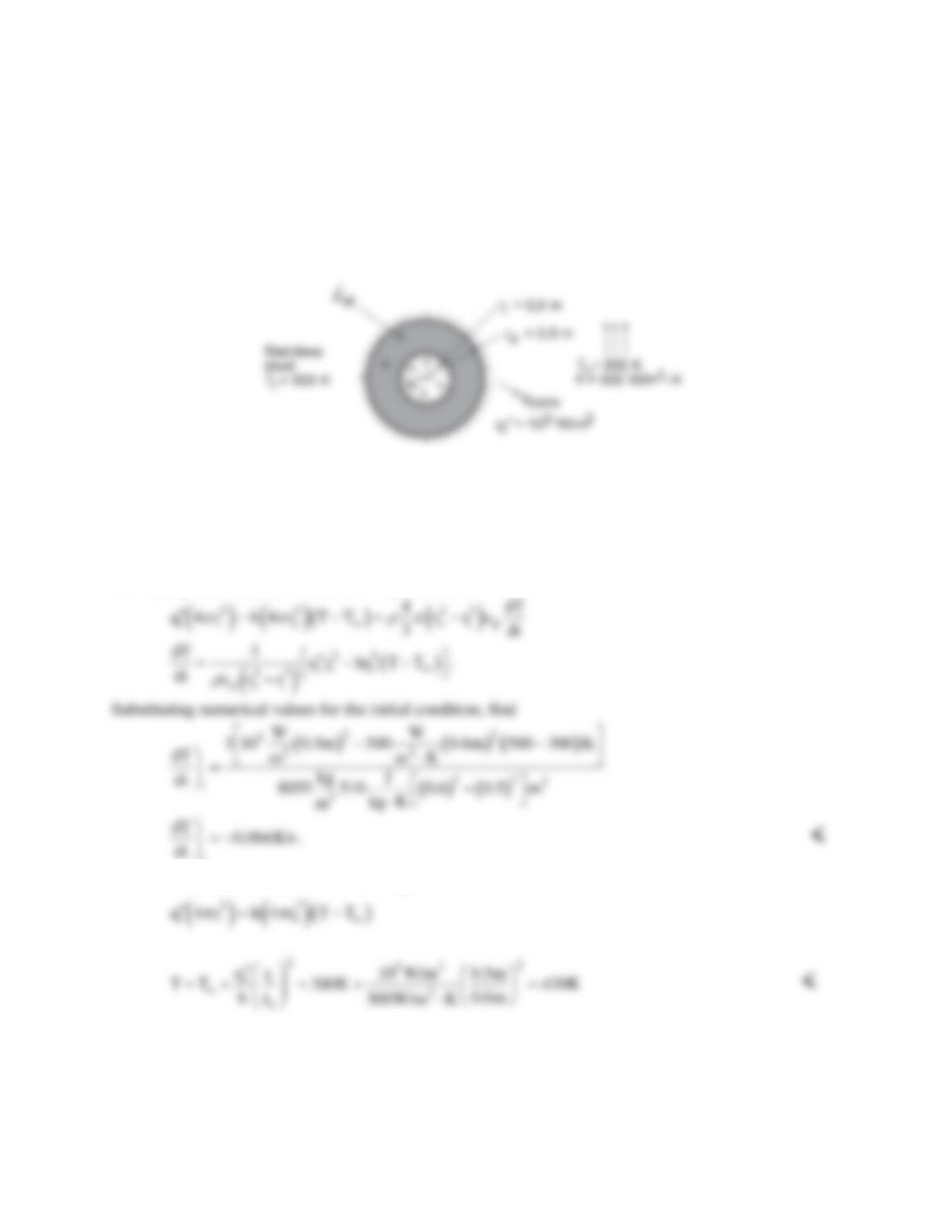
KNOWN: Inner surface heating and new environmental conditions associated with a spherical shell of
prescribed dimensions and material.
FIND: (a) Governing equation for variation of wall temperature with time. Initial rate of temperature
change, (b) Steady-state wall temperature, (c) Effect of convection coefficient on canister temperature.
SCHEMATIC:
ASSUMPTIONS: (1) Negligible temperature gradients in wall, (2) Constant properties, (3) Uniform,
time-independent heat flux at inner surface.
PROPERTIES: Table A.1, Stainless Steel, AISI 302: ρ = 8055 kg/m3,
c
p
= 535 J/kg⋅K.
ANALYSIS: (a) Performing an energy balance on the shell at an instant of time,
in out st
EE E−=
.
Identifying relevant processes and solving for dT/dt,
i
(b) Under steady-state conditions with
st
E
= 0, it follows that
Continued …..
PROBLEM 1.50 (Cont.)
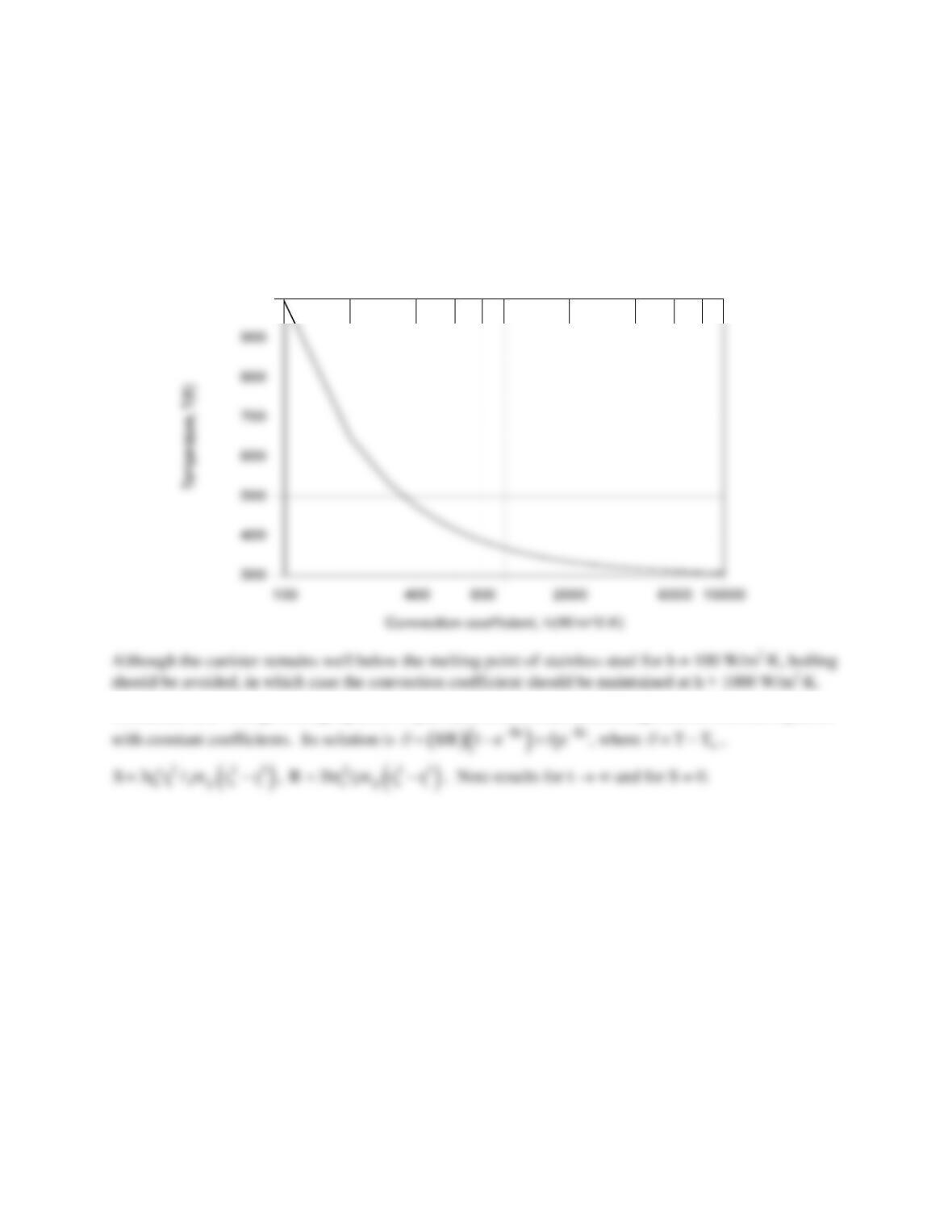
(c) Parametric calculations were performed using the IHT First Law Model for an Isothermal Hollow
Sphere. As shown below, there is a sharp increase in temperature with decreasing values of h < 1000
W/m2⋅K. For T > 380 K, boiling will occur at the canister surface, and for T > 410 K a condition known
as film boiling (Chapter 10) will occur. The condition corresponds to a precipitous reduction in h and
increase in T.
1000
COMMENTS: The governing equation of part (a) is a first order, nonhomogenous differential equation
PROBLEM 1.51
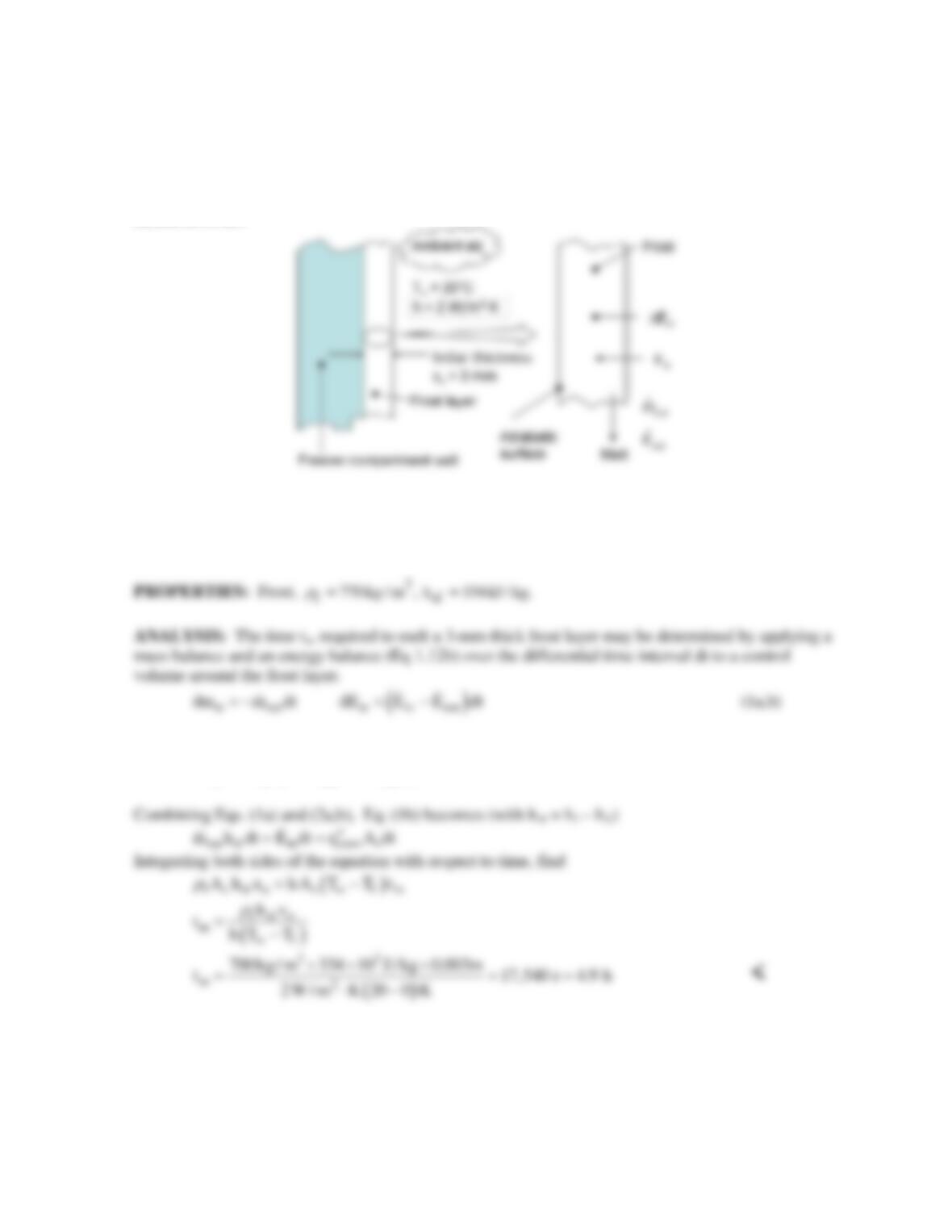
KNOWN: Frost formation of 3-mm thickness on a freezer compartment. Surface exposed to
convection process with ambient air.
FIND: Time required for the frost to melt, tm.
SCHEMATIC:
ASSUMPTIONS: (1) Frost is isothermal at the fusion temperature, Tf, (2) The water melt falls away
from the exposed surface, (3) Frost exchanges radiation with surrounding frost, so net radiation
exchange is negligible, and (4) Backside surface of frost formation is adiabatic.
With hf as the enthalpy of the melt and hs as the enthalpy of frost, we have
st st s out out f
dE dm h E dt m h dt= =
(2a,b)
COMMENTS: (1) The energy balance could be formulated intuitively by recognizing that the total
heat in by convection during the time interval
( )
m conv m
tq t
′′ ⋅
must be equal to the total latent energy
for melting the frost layer
( )
o sf
xh
ρ
. This equality is directly comparable to the derived expression
above for tm.
PROBLEM 1.52
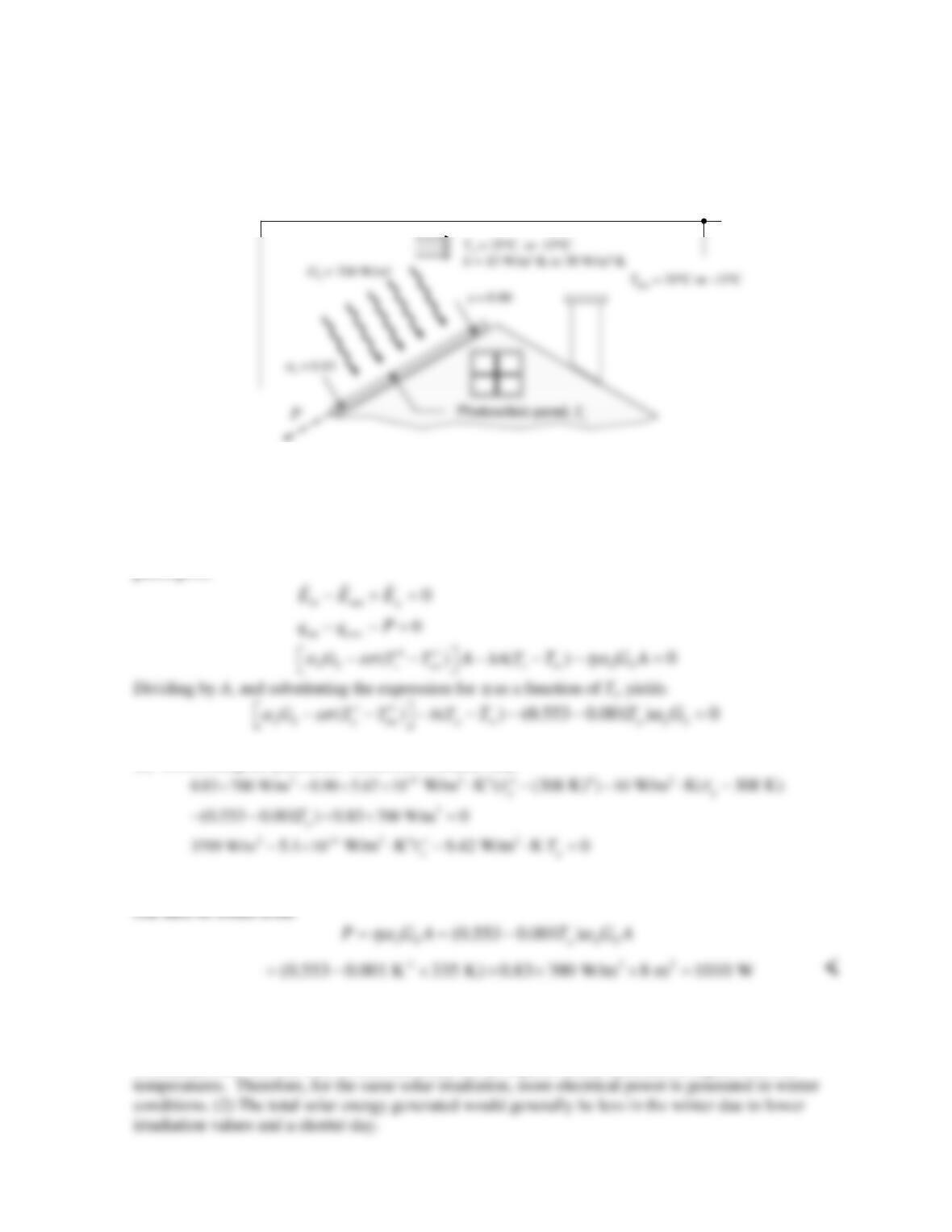
KNOWN: Dimensions, emissivity, and solar absorptivity of solar photovoltaic panel. Solar
irradiation, air and surroundings temperature, and convection coefficient. Expression for conversion
efficiency.
FIND: Electrical power output on (a) a still summer day, and (b) a breezy winter day.
SCHEMATIC:
ASSUMPTIONS: (1) Steady–state conditions, (2) Lower surface of solar panel is insulated, (3)
Radiation from the environment can be treated as radiation from large surroundings, with
a
=
ε
.
ANALYSIS: Recognize that there is conversion from thermal to electrical energy, therefore there is a
negative generation term equal to the electrical power. Performing an energy balance on the solar
panel gives
(a) Substituting the parameter values for a summer day:
Solving this equation for Tp using IHT or other software results in Tp = 335 K. The electrical power
(b) Repeating the calculation for the winter conditions yields Tp = 270 K, P = 1310 W. <
COMMENTS: (1) The conversion efficiency for most photovoltaic materials is higher at lower
PROBLEM 1.53
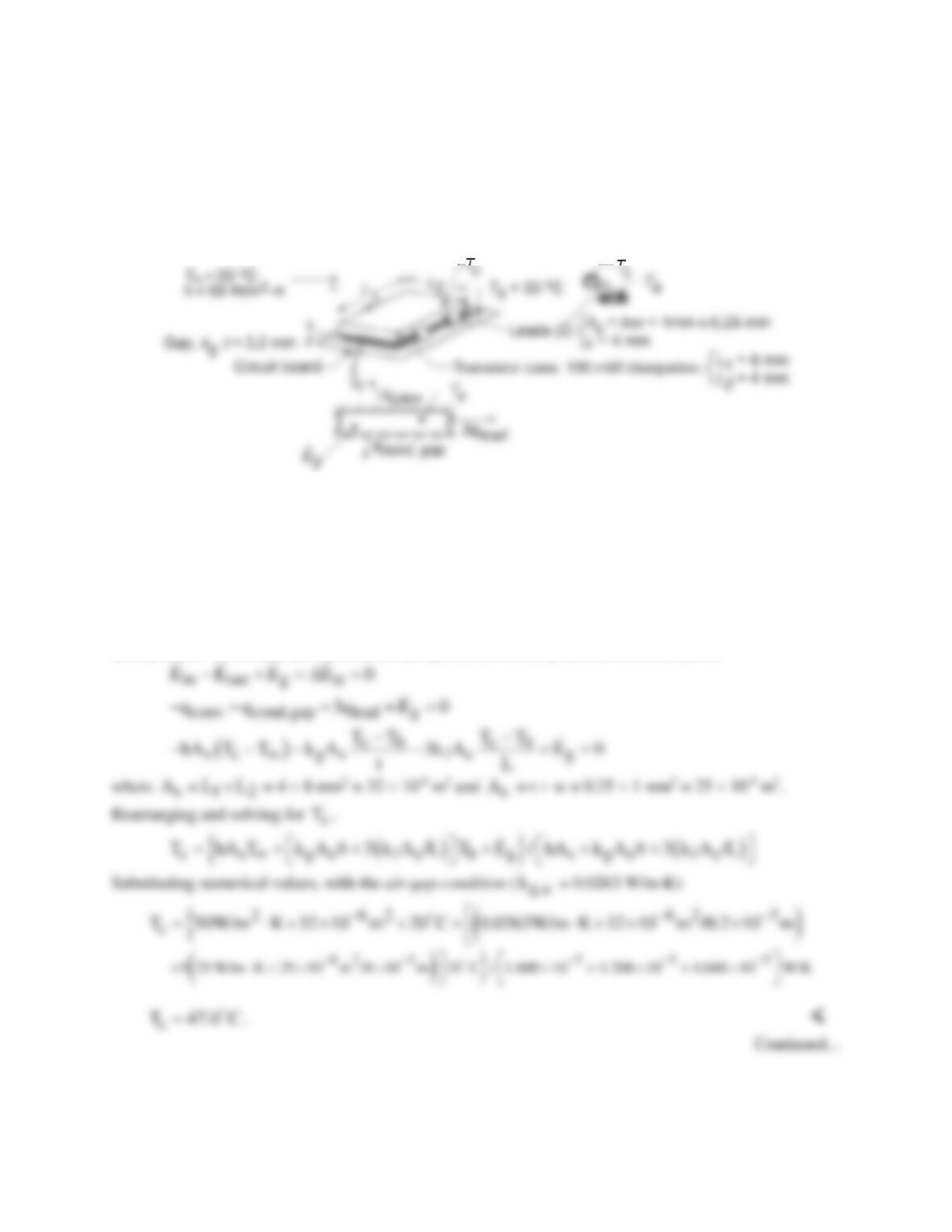
KNOWN: Surface-mount transistor with prescribed dissipation and convection cooling conditions.
FIND: (a) Case temperature for mounting arrangement with air–gap and conductive paste between case
and circuit board, (b) Consider options for increasing
g
E
, subject to the constraint that
c
T
= 40°C.
SCHEMATIC:
ASSUMPTIONS: (1) Steady-state conditions, (2) Transistor case is isothermal, (3) Upper surface
experiences convection; negligible losses from edges, (4) Leads provide conduction path between case
and board, (5) Negligible radiation, (6) Negligible energy generation in leads due to current flow, (7)
Negligible convection from surface of leads.
PROPERTIES: (Given): Air,
g,a
k
= 0.0263 W/m⋅K; Paste,
g,p
k
= 0.12 W/m⋅K; Metal leads,
k
=
25 W/m⋅K.
ANALYSIS: (a) Define the transistor as the system and identify modes of heat transfer.
A
c
T
PROBLEM 1.53 (Cont.)
With the paste condition (
g,p
k
= 0.12 W/m⋅K),
c
T
= 39.9°C. As expected, the effect of the conductive
paste is to improve the coupling between the circuit board and the case. Hence,
c
T
decreases.
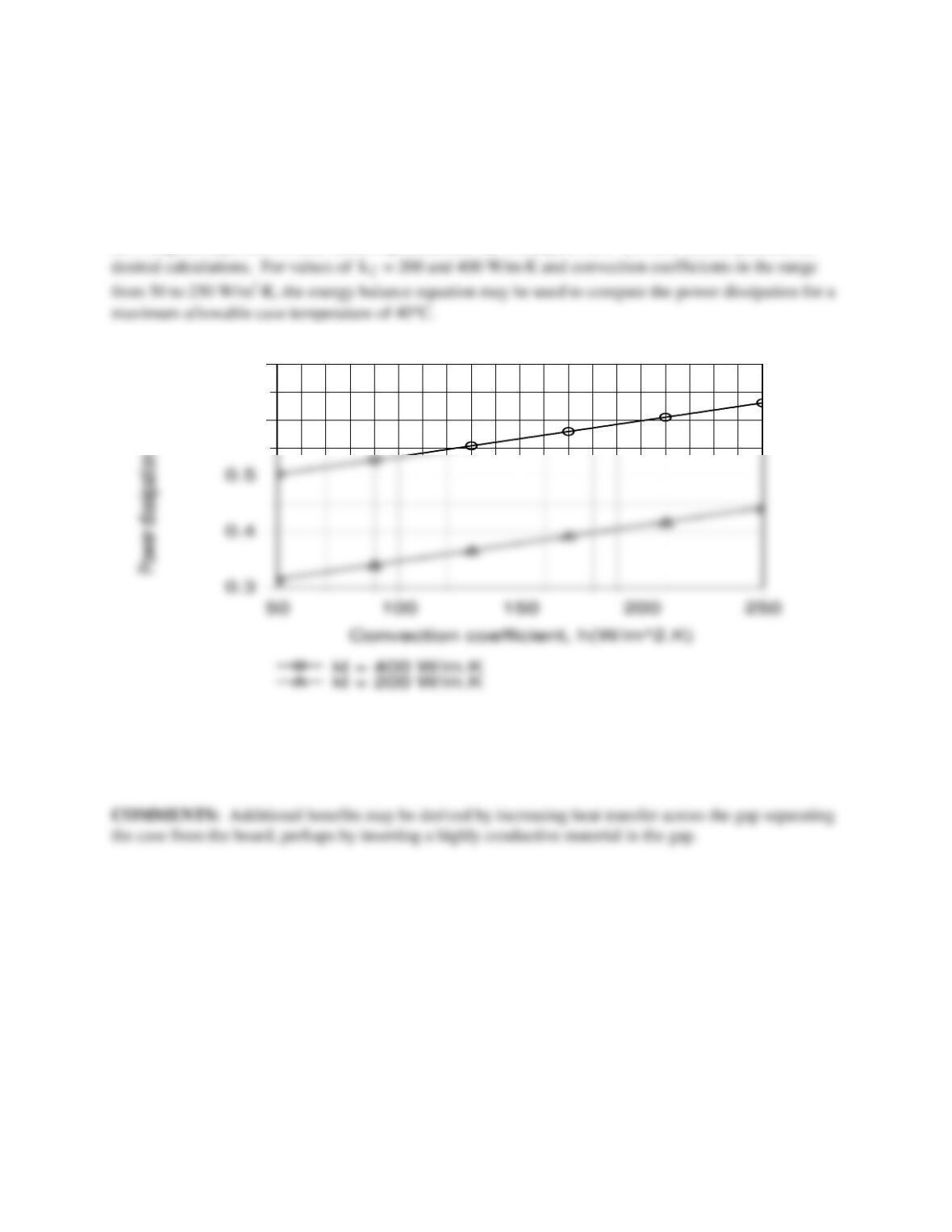
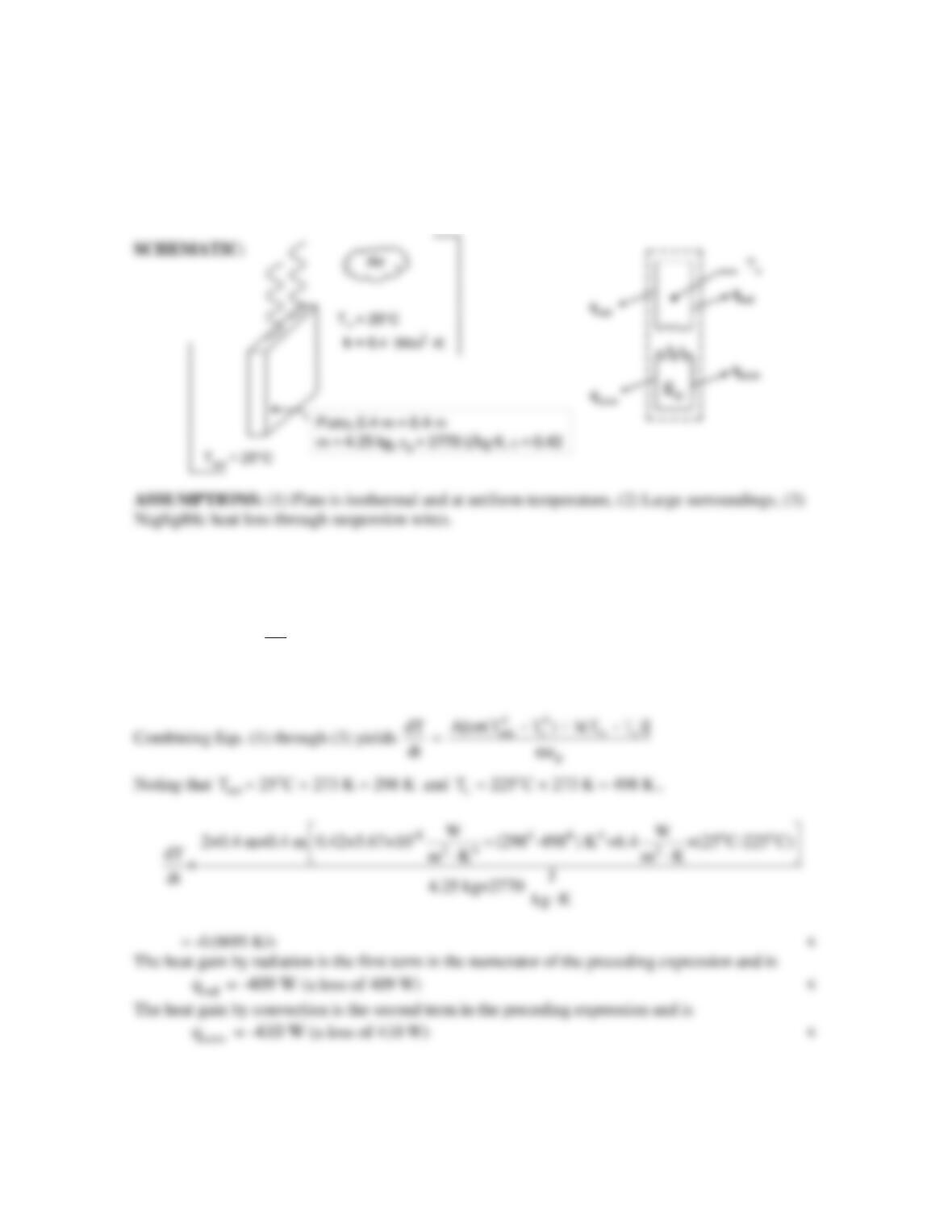
(b) Using the keyboard to enter model equations into the workspace, IHT has been used to perform the
0.6
0.7
As indicated by the energy balance, the power dissipation increases linearly with increasing h, as well as
with increasing
k
. For h = 250 W/m2⋅K (enhanced air cooling) and
k
= 400 W/m⋅K (copper leads),
the transistor may dissipate up to 0.63 W.
PROBLEM 1.54
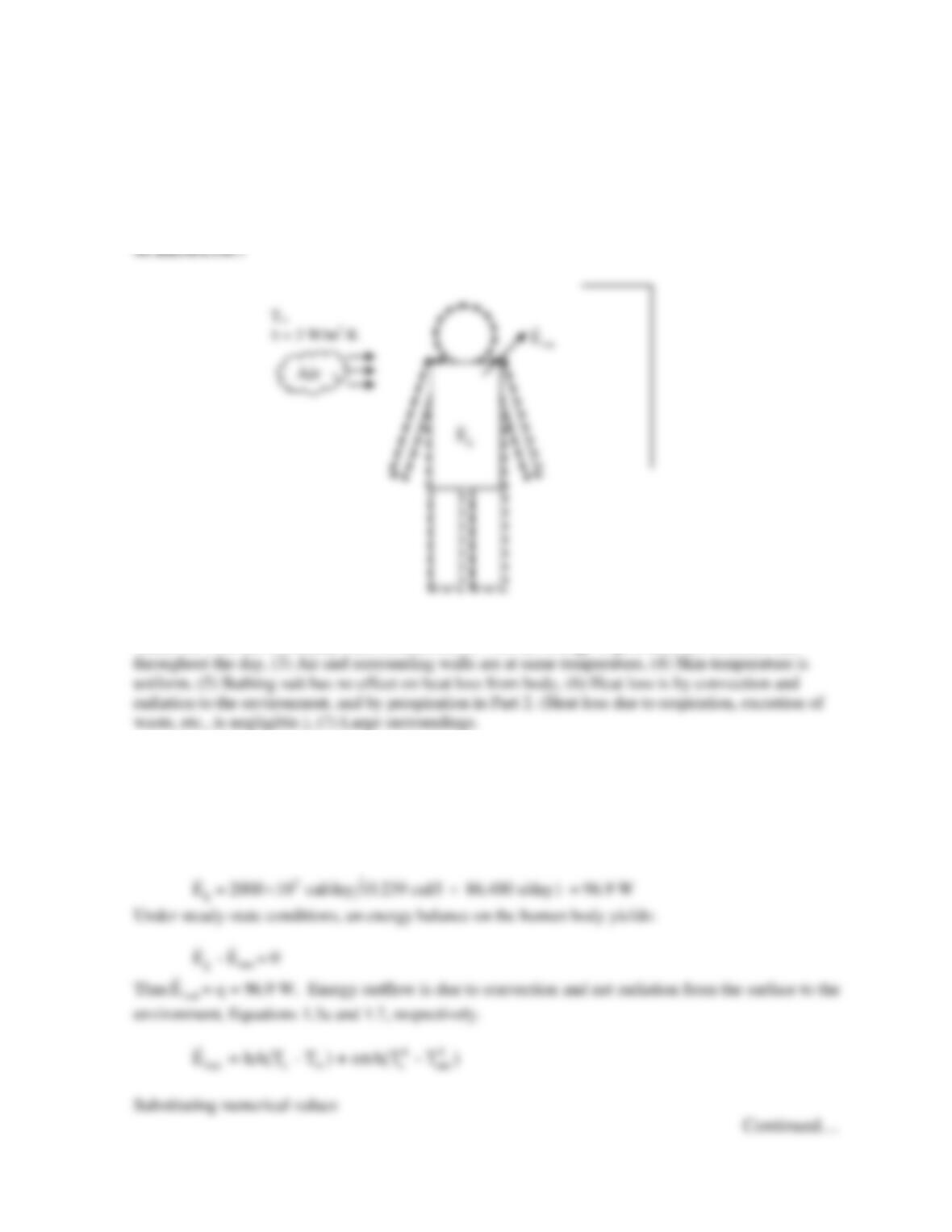
KNOWN: Hot plate suspended in a room, plate temperature, room temperature and surroundings
temperature, convection coefficient and plate emissivity, mass and specific heat of the plate.
FIND: (a) The time rate of change of the plate temperature, and (b) Heat loss by convection and heat
loss by radiation.
ANALYSIS: For a control volume about the plate, the conservation of energy requirement is
in out st
E – E = E
(1)
where
st p
dT
E = mc dt
(2)
and
44
in out sur s s
E – E = εAσ(T – T ) + hA(T – T )
∞
(3)
COMMENTS: (1) Note the importance of using kelvins when working with radiation heat transfer.
(2) The temperature difference in Newton’s law of cooling may be expressed in either kelvins or
degrees Celsius. (3) Radiation and convection losses are of the same magnitude. This is typical of
many natural convection systems involving gases such as air.
PROBLEM 1.55
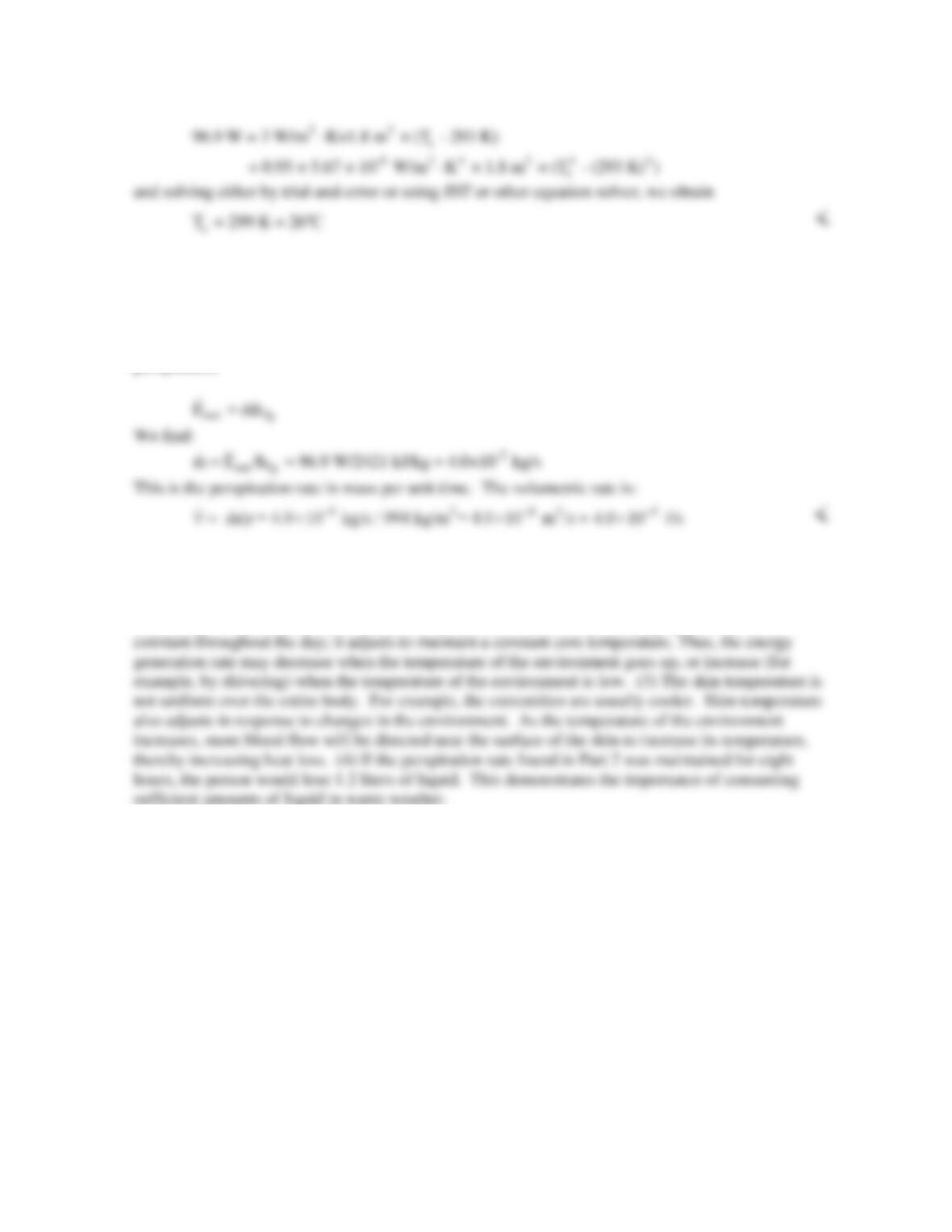
KNOWN: Daily thermal energy generation, surface area, temperature of the environment, and heat
transfer coefficient.
FIND: (a) Skin temperature when the temperature of the environment is 20ºC, and (b) Rate of
perspiration to maintain skin temperature of 33ºC when the temperature of the environment is 33ºC.
ASSUMPTIONS: (1) Steady–state conditions, (2) Thermal energy is generated at a constant rate
PROPERTIES: Table A.11, skin: ε = 0.95, Table A.6, water (306 K): ρ = 994 kg/m3, hfg = 2421
kJ/kg.
ANALYSIS:
(a) The rate of energy generation is:
PROBLEM 1.55 (Cont.)
Since the comfortable range of skin temperature is typically 32 – 35ºC, we usually wear clothing
warmer than a bathing suit when the temperature of the environment is 20ºC.
(b) If the skin temperature is 33ºC when the temperature of the environment is 33ºC, there will be no
heat loss due to convection or radiation. Thus, all the energy generated must be removed due to
perspiration:
COMMENTS: (1) In Part 1, heat losses due to convection and radiation are 32.4 W and
60.4 W, respectively. Thus, it would not have been reasonable to neglect radiation. Care must be
taken to include radiation when the heat transfer coefficient is small, even if the problem statement
does not give any indication of its importance. (2) The rate of thermal energy generation is not
PROBLEM 1.56
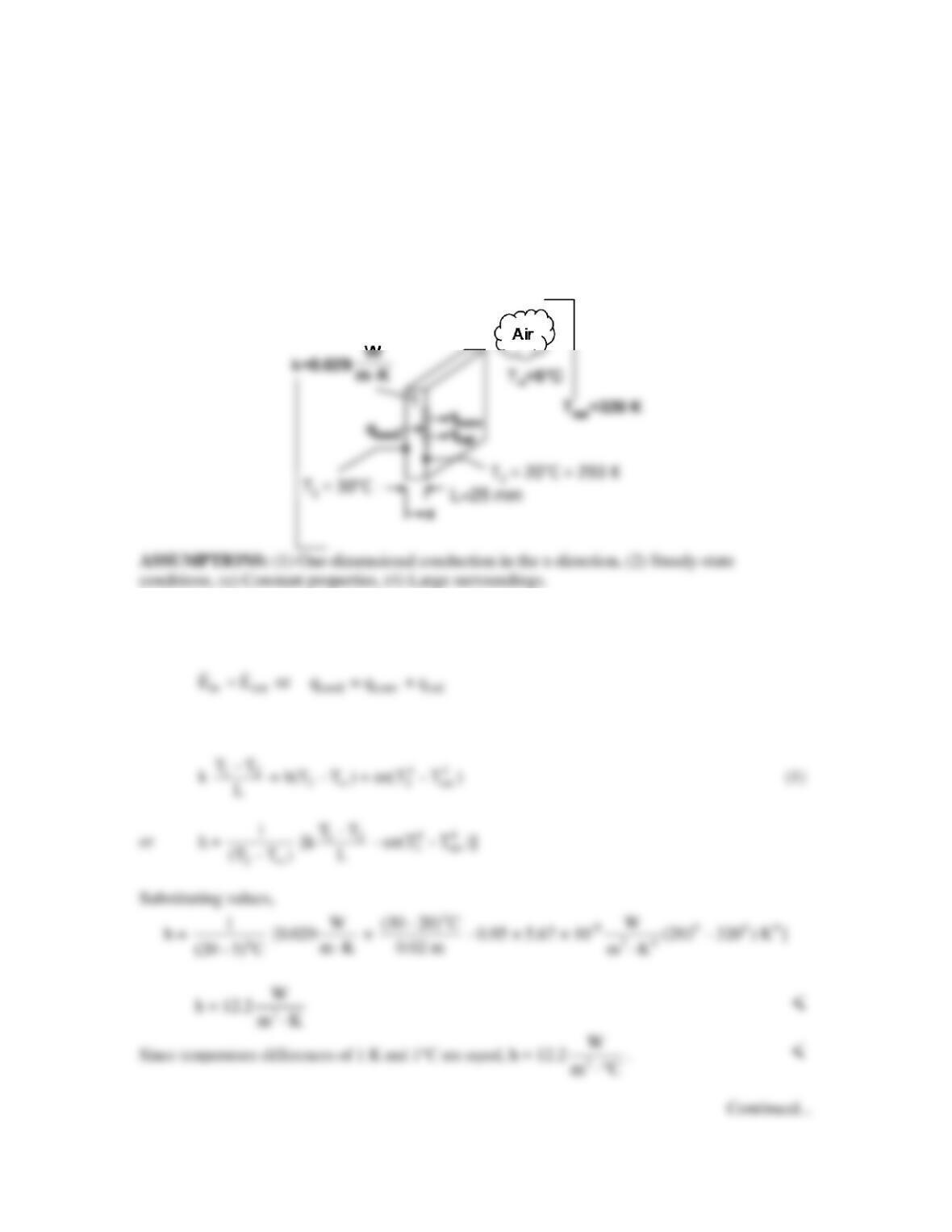
KNOWN: Thermal conductivity, thickness and temperature difference across a sheet of rigid
extruded insulation. Cold wall temperature, surroundings temperature, ambient temperature and
emissivity.
FIND: (a) The value of the convection heat transfer coefficient on the cold wall side in units of
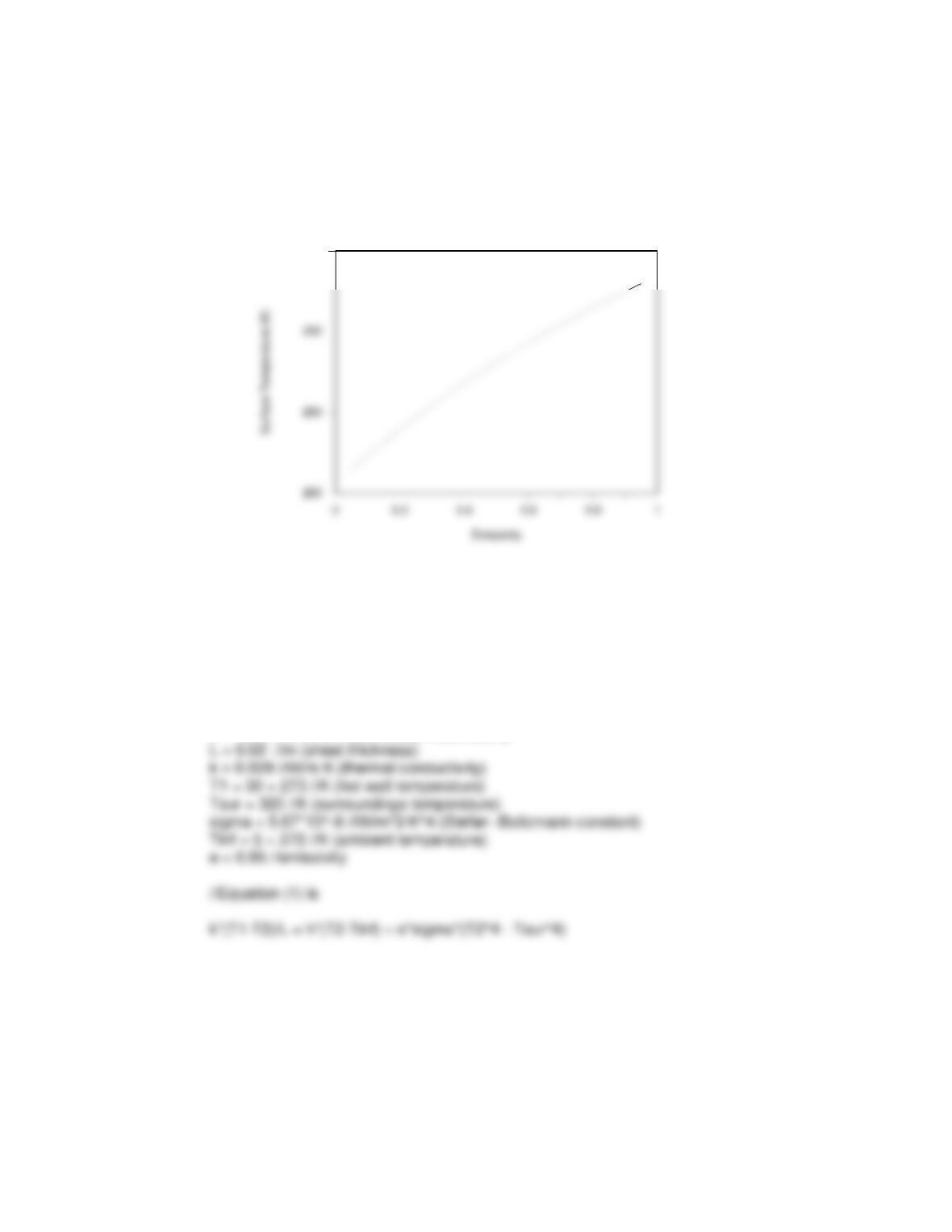
W/m2⋅°C or W/m2⋅K, and, (b) The cold wall surface temperature for emissivities over the range
0.05 ≤ ε ≤ 0.95 for a hot wall temperature of T1 = 30 °C.
SCHEMATIC:
ANALYSIS:
(a) An energy balance on the control surface shown in the schematic yields
Substituting from Fourier’s law, Newton’s law of cooling, and Eq. 1.7 yields
PROBLEM 1.56 (Cont.)
(b) Equation (1) may be solved iteratively to find T2 for any emissivity ε. IHT was used for this
purpose, yielding the following.
Surface Temperature vs. Wall Emissivity
295
COMMENTS: (1) Note that as the wall emissivity increases, the surface temperature increases
since the surroundings temperature is relatively hot. (2) The IHT code used in part (b) is shown
below. (3) It is a good habit to work in temperature units of kelvins when radiation heat transfer is
included in the solution of the problem.
//Problem 1.56
h = 12.2 //W/m^2∙K (convection coefficient)
PROBLEM 1.57
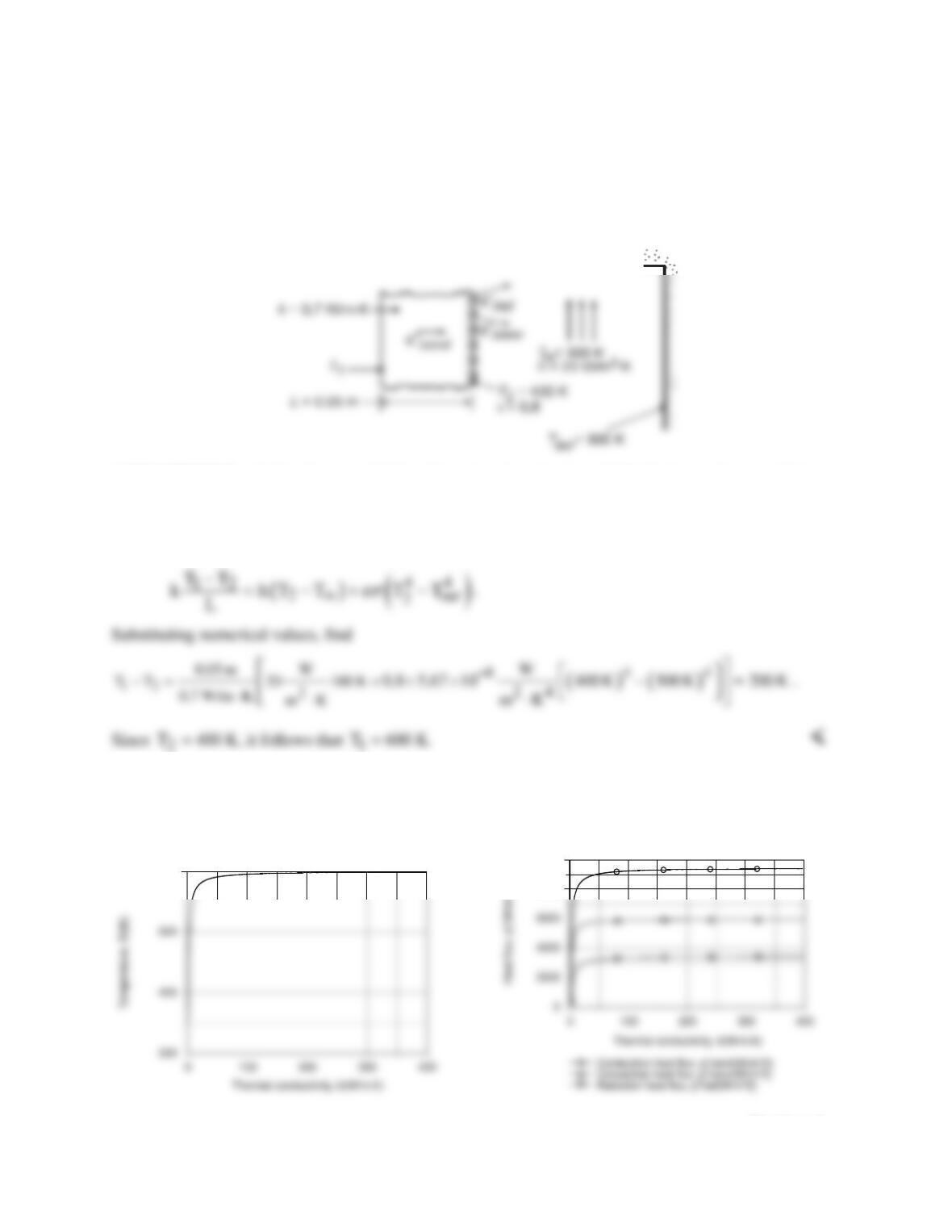
KNOWN: Thickness and thermal conductivity, k, of an oven wall. Temperature and emissivity, ε, of
front surface. Temperature and convection coefficient, h, of air. Temperature of large surroundings.
FIND: (a) Temperature of back surface, (b) Effect of variations in k, h and ε.
SCHEMATIC:
ASSUMPTIONS: (1) Steady-state, (2) One-dimensional conduction, (3) Radiation exchange with large
surroundings.
ANALYSIS: (a) Applying an energy balance, Eq. 1.13 to the front surface and substituting the
appropriate rate equations, Eqs. 1.2, 1.3a and 1.7, find
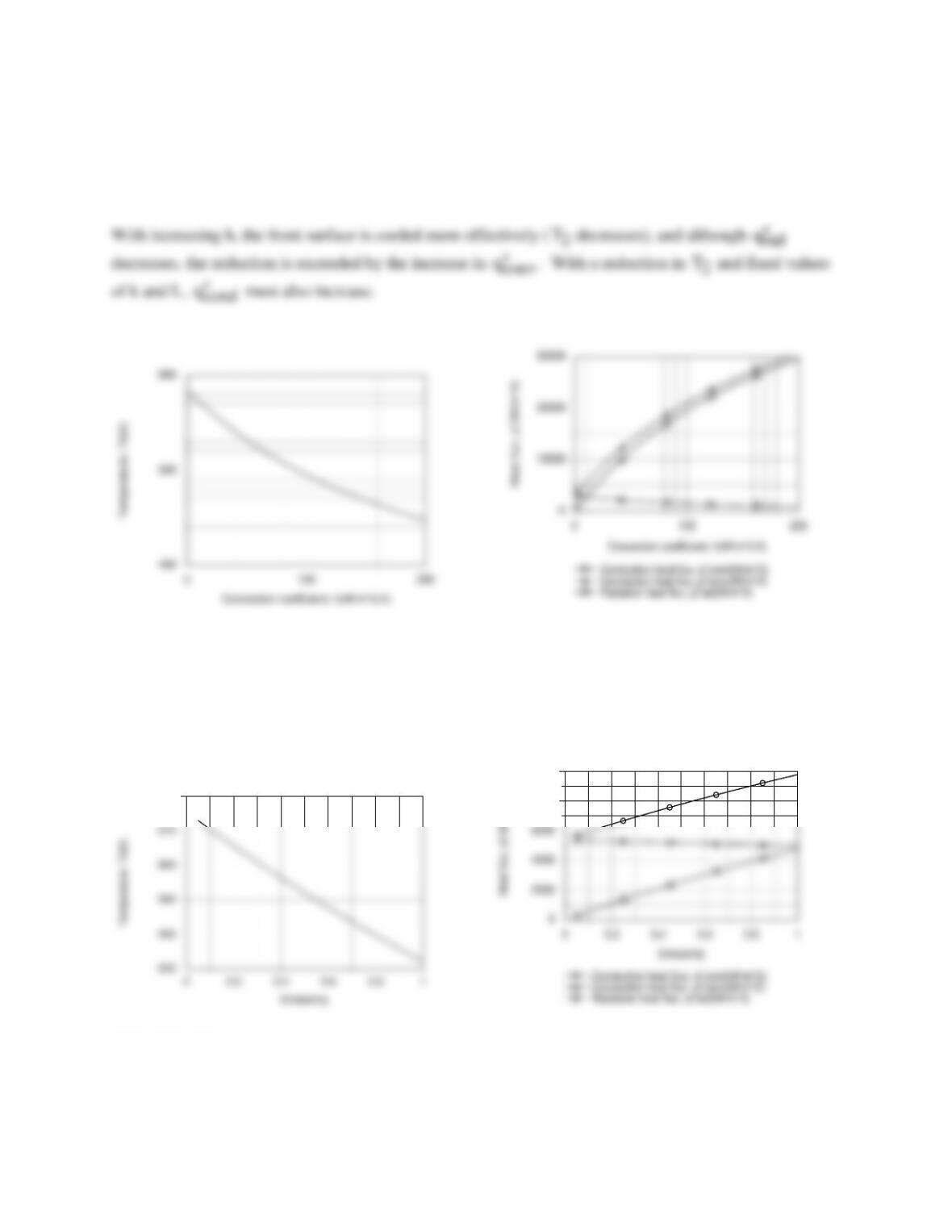
(b) Parametric effects may be evaluated by using the IHT First Law Model for a Nonisothermal Plane
Wall. Changes in k strongly influence conditions for k < 20 W/m⋅K, but have a negligible effect for
larger values, as
2
T
approaches
1
T
and the heat fluxes approach the corresponding limiting values
600
8000
10000
Continued…
PROBLEM 1.57 (Cont.)
The implication is that, for k > 20 W/m⋅K, heat transfer by conduction in the wall is extremely efficient
relative to heat transfer by convection and radiation, which become the limiting heat transfer processes.
Larger fluxes could be obtained by increasing ε and h and/or by decreasing
T
∞
and
sur
T
.
The surface temperature also decreases with increasing ε, and the increase in
rad
q′′
exceeds the reduction
in
conv
q′′
, allowing
cond
q′′
to increase with ε.
575
8000
10000
COMMENTS: Conservation of energy, of course, dictates that irrespective of the prescribed conditions,
cond conv rad
q qq
′′ ′′ ′′
= +
.
T
rad
T