Problem 1.83
Standard air flows past a flat surface, and velocity measurements near the surface indicate
the following distribution:
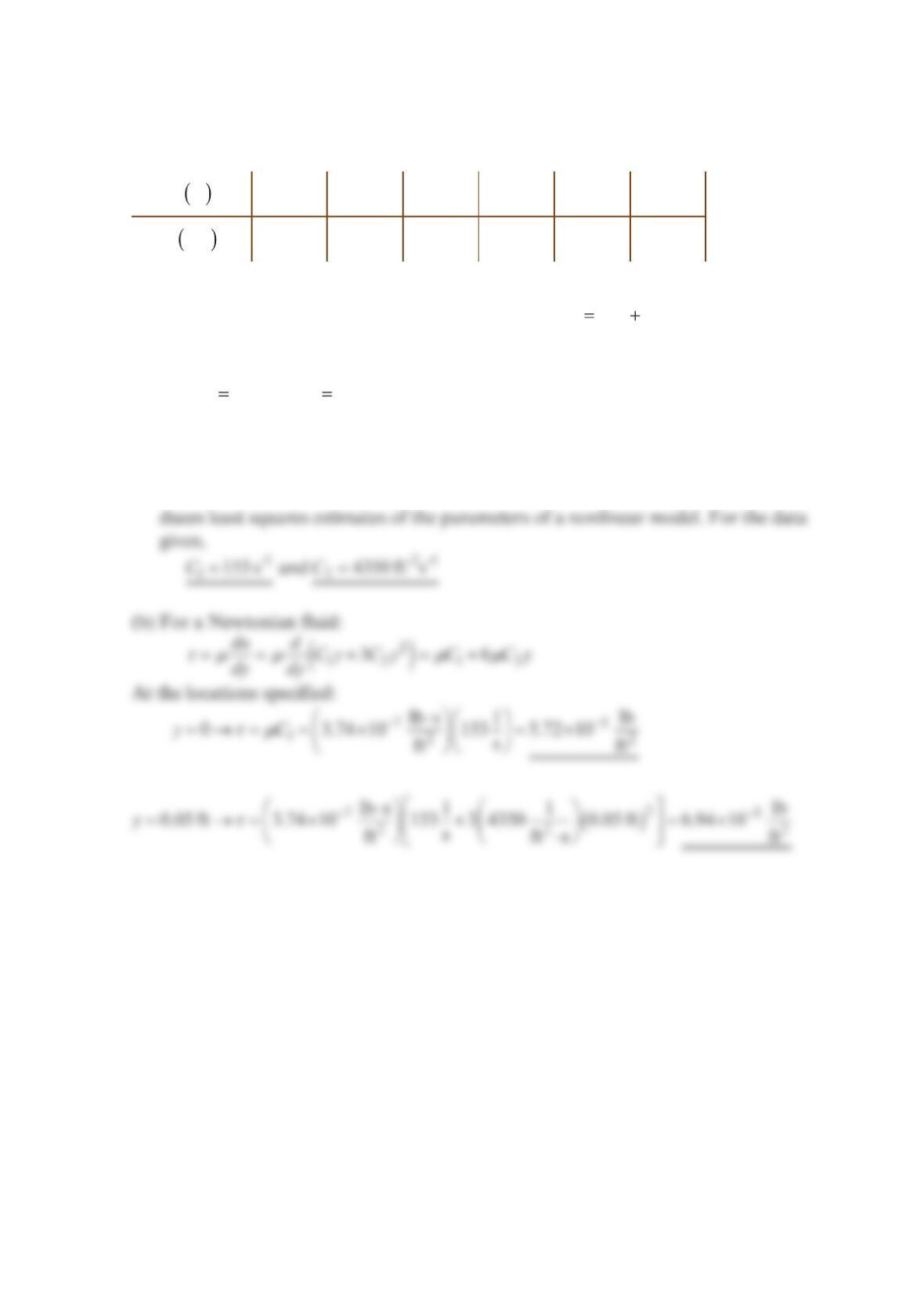
fty0.005 0.01 0.02 0.04 0.06 0.08
ft/su0.74 1.51 3.03 6.37 10.21 14.43
The coordinate
y
is measured normal to the surface and u is the velocity parallel to the sur-
face. (a) Assume the velocity distribution is of the form 3
12
uCyCy
and use a standard
curve-fitting technique to determine the constants 1
C
and 2
C
.
(b) Make use of the results of part (a) to determine the magnitude of the shearing stress at
the wall ( 0
y
) and at 0.05 ft
y
.
Solution 1.83
(a) Use nonlinear regression program to obtain coefficients 1
C
and 2
C
. The program pro-
Problem 1.84
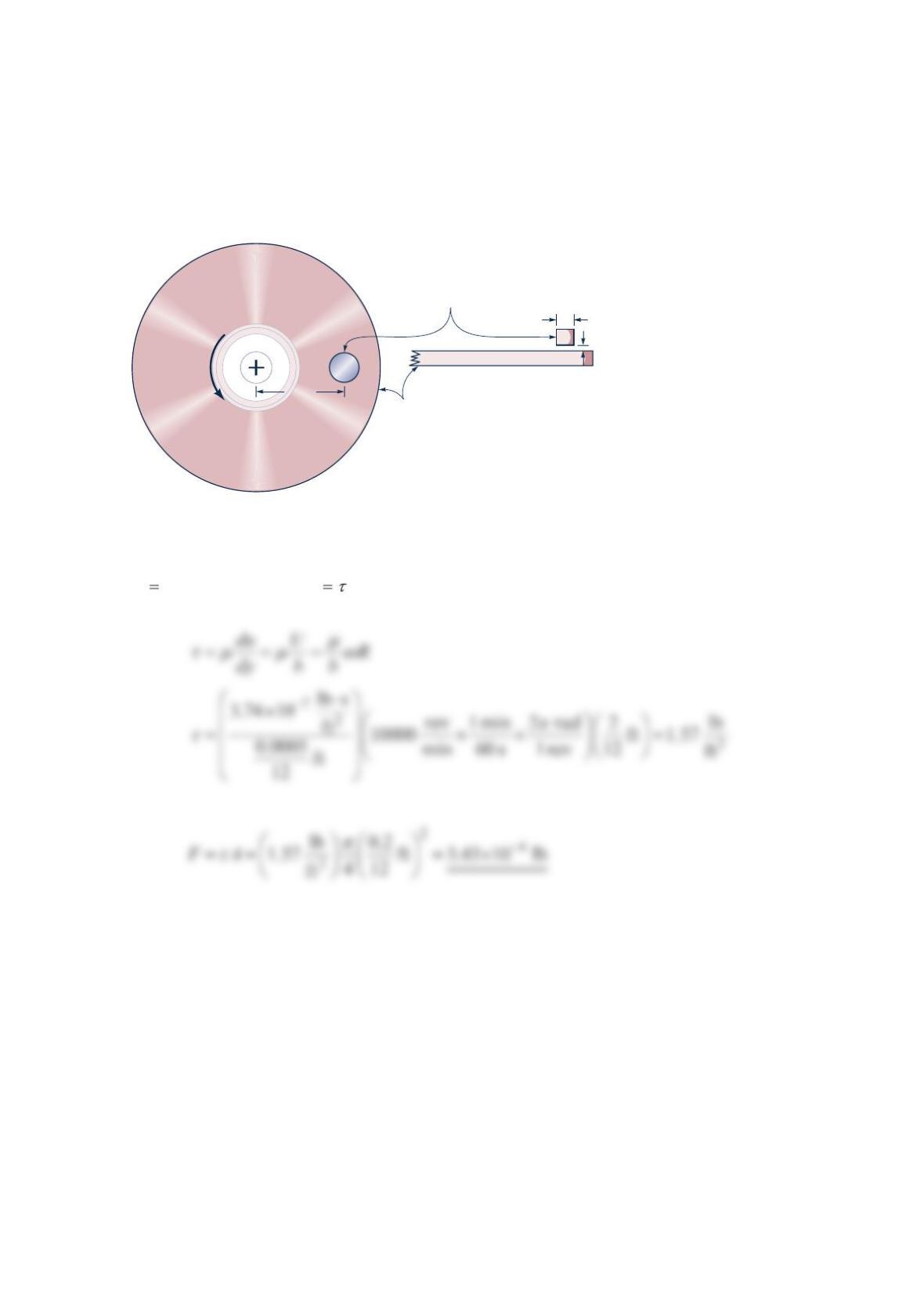
A new computer drive is proposed to have a disc, as shown in the figure below. The disc is
to rotate at 10,000
r
pm, and the reader head is to be positioned 0.0005 in. above the surface
of the disc. Estimate the shearing force on the reader head as a result of the air between the
disc and the head.
Solution 1.84
shear force on head
F
A
Assuming a uniform and linear velocity profile:
10,000 rpm
0.0005 in.
Rotating disc
2 in.
0.2-in.dia.
Stationary reader head
Liquid
Fixed
outer
cylinder
𝒯
Problem 1.85
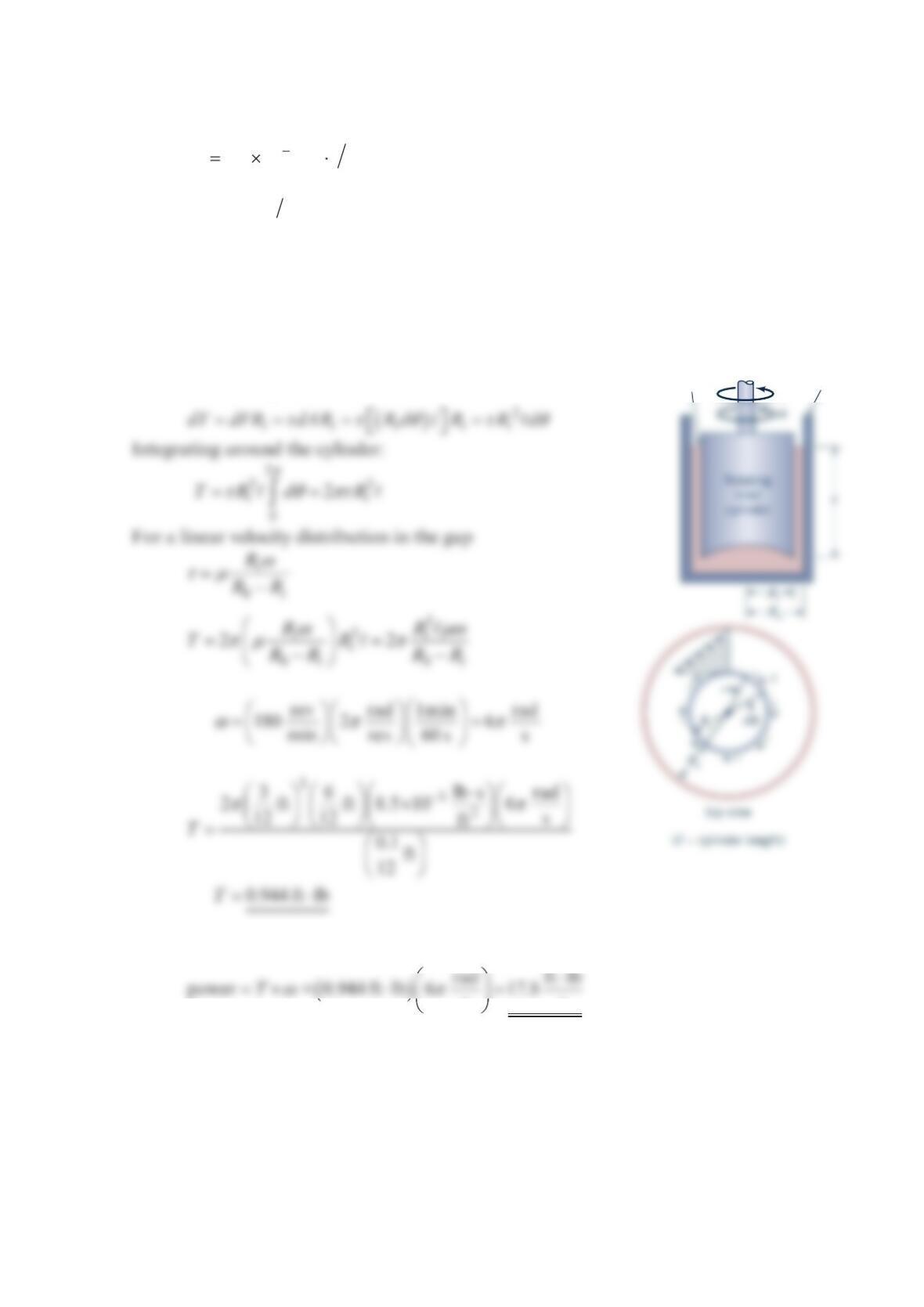
The space between two 6-in.-long concentric cylinders is filled with glycerin
(32
v
iscosity 8.5 10 lb s ft ). The inner cylinder has a radius of 3 in. and the gap width
between cylinders is 0.1 in. Determine the torque and the power required to rotate the inner
cylinder at 180
r
ev mi
n
. The outer cylinder is fixed. Assume the velocity distribution in the
gap to be linear.
Solution 1.85
The torque on a sector of the cylinder surface corresponding
to an included angle of dq is:
To compute power requied:
p
ss
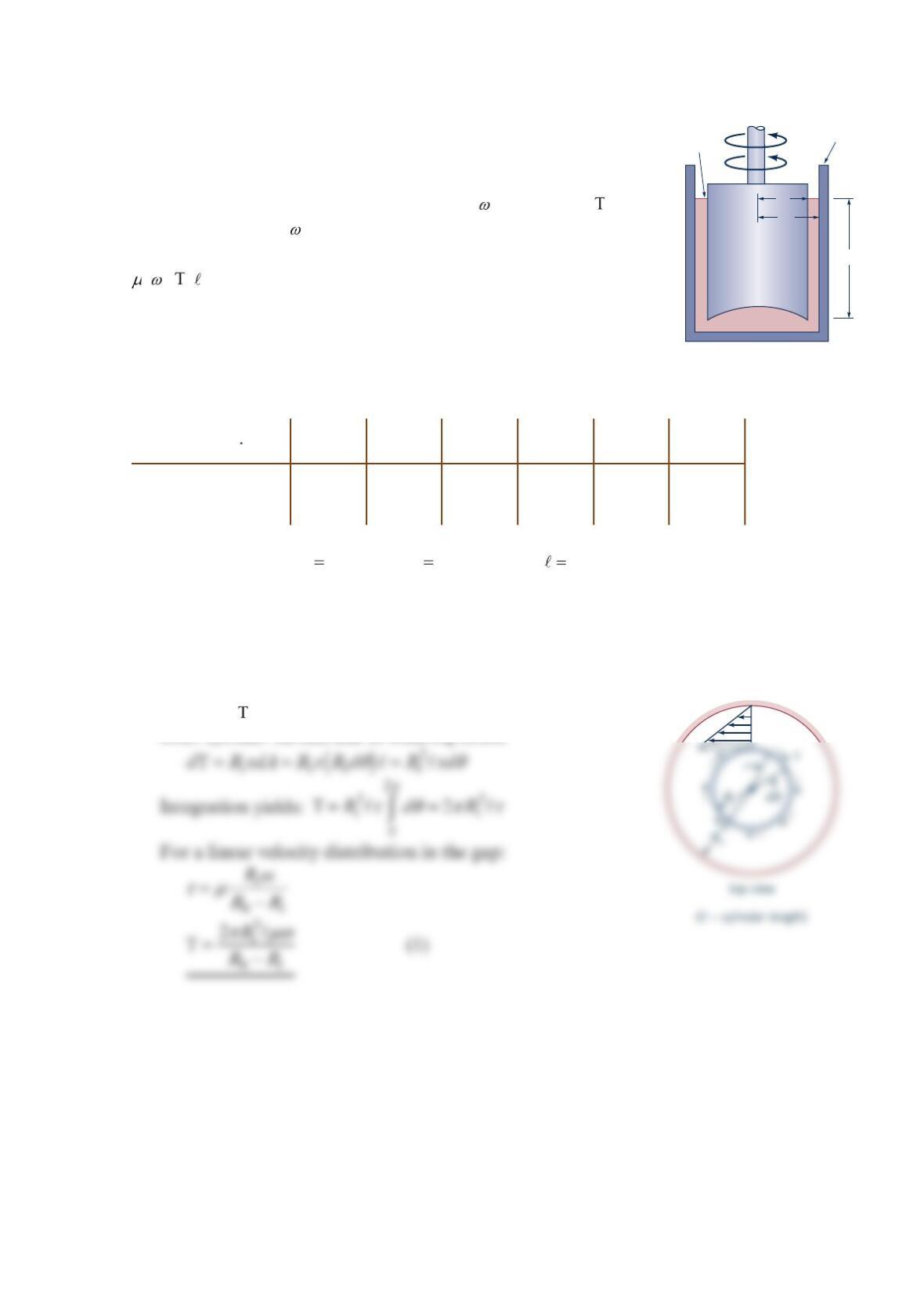
Problem 1.86
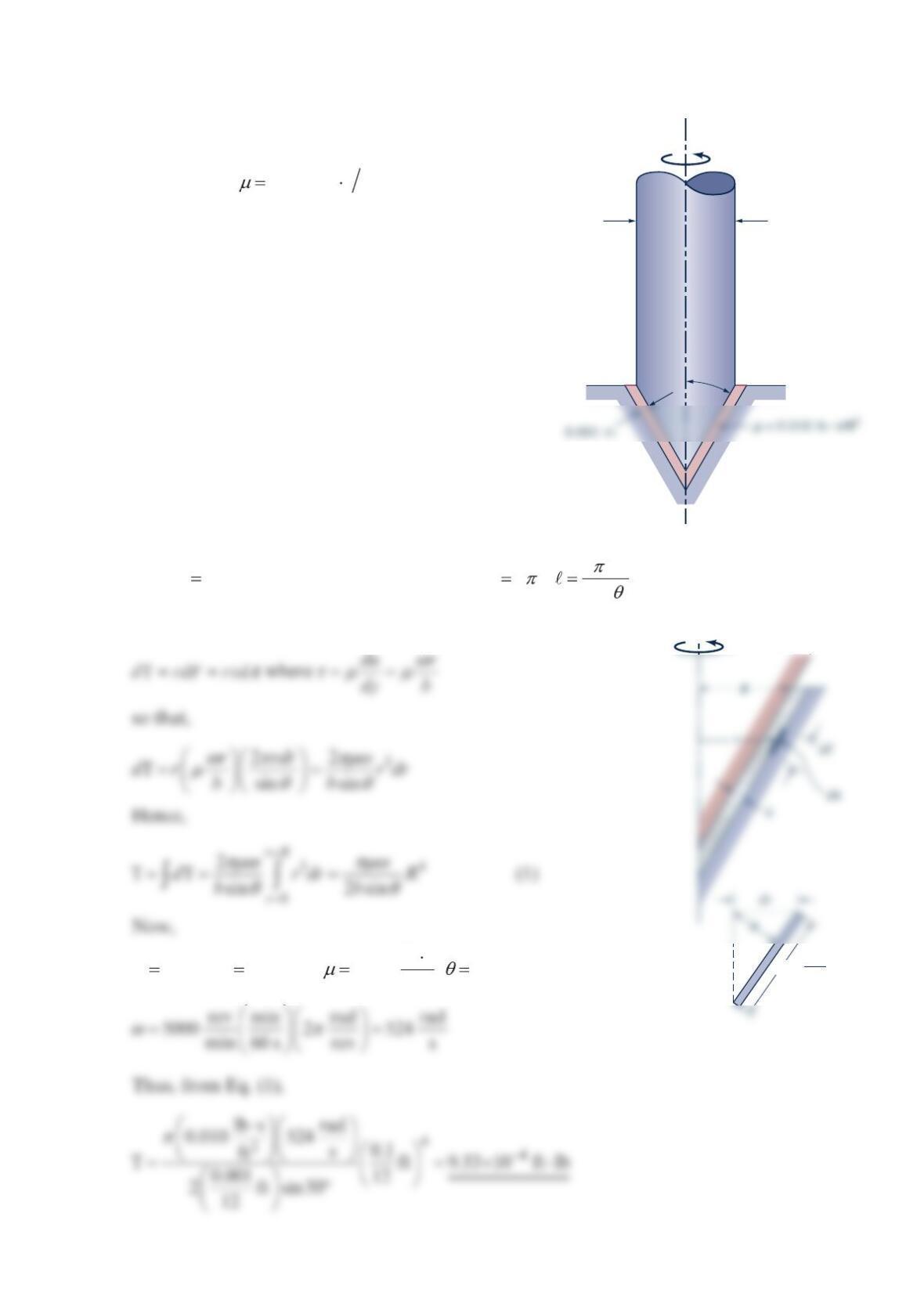
A pivot bearing used on the shaft of an electrical
instrument is shown in the figure below. An oil with
a viscosity of 2
0.010 lb s ft fills the 0.001-in.
gap between the rotating shaft and the stationary
base. Determine the frictional torque on the shaft
when it rotates at 5000
r
pm.
Solution 1.86
Let torque on area element
d
Td
A
, where 2
2sin
rdr
d
Ard
Thus,
2
lb s
0.1 in., 0.001 in., 0.010 , 30 deg
ft
R
b, and
=
d
ℓ
dr
ω
sin
θ
0.2 in.
5000 rpm
30°
Problem 1.87
The viscosity of liquids can be measured through the use of a
rotating cylinder viscometer of the type illustrated in the figure
below. In this device the outer cylinder is fixed and the inner
cylinder is rotated with an angular velocity, . The torque
required to develop is measured and the viscosity is calculated
from these two measurements. (a) Develop an equation relating
, , , , 0
R
, and i
R
. Neglect end effects and assume the velocity
distribution in the gap is linear. (b) The following torque-angular
velocity data were obtained with a rotating cylinder viscometer of
the type discussed in part (a).
Torque (ft lb) 13.1 26.0 39.5 52.7 64.9 78.6
Angular velocity
(rad/s) 1.0 2.0 3.0 4.0 5.0 6.0
For this viscometer 02.50 in.
R
, 2.45 in.
i
R
, and 5.00 in. Make use of these data and
a standard curve-fitting program to determine the viscosity of the liquid contained in the
viscometer.
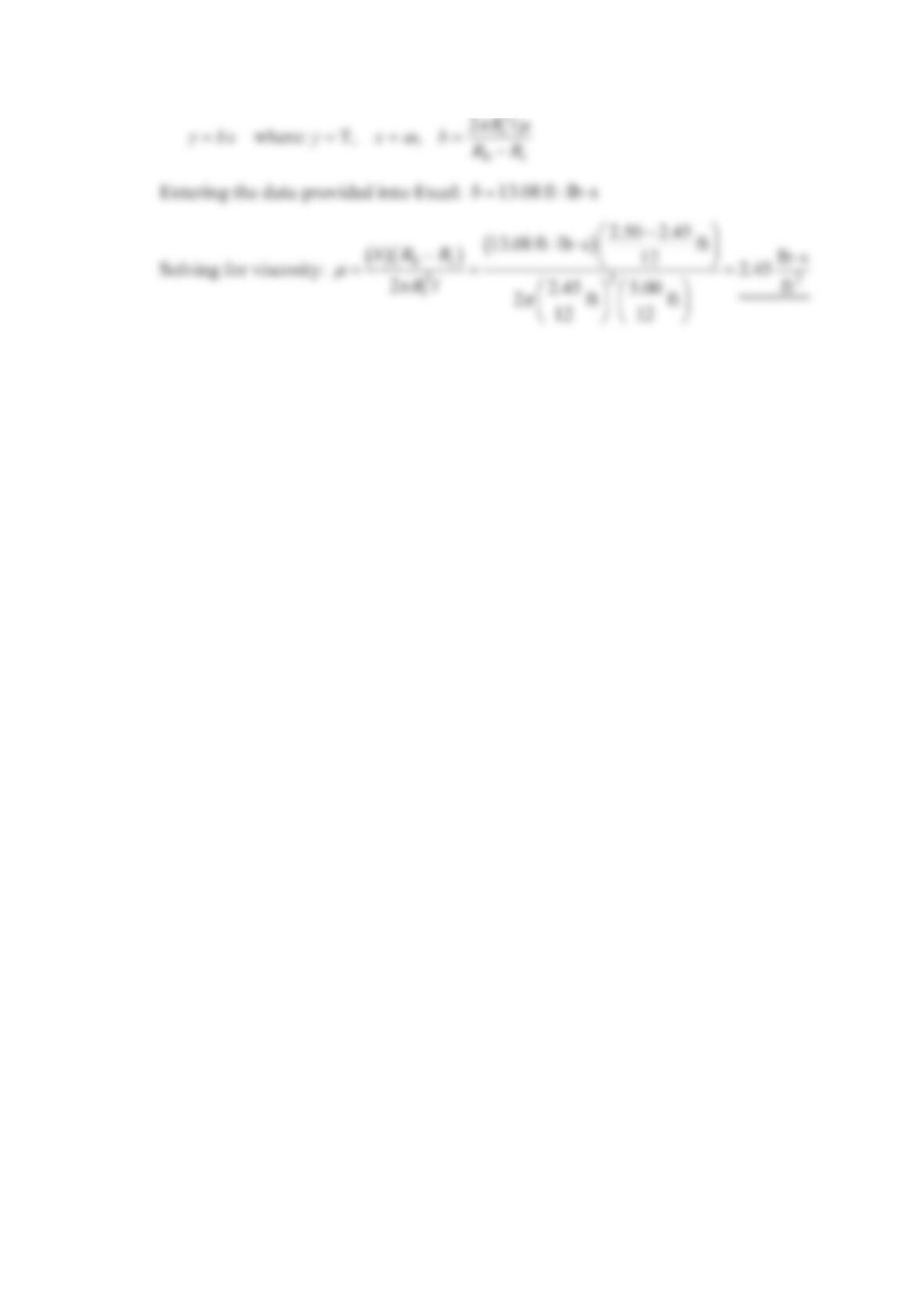
Solution 1.87
(a) Torque,
d
, on infinitesimal-size axial strip on the
inner cylinder surface due to shearing stress:
Liquid
Fixed
outer
cylinder
𝒯
ω
ℓ
Rotating
inner
cylinder
R
i
R
o
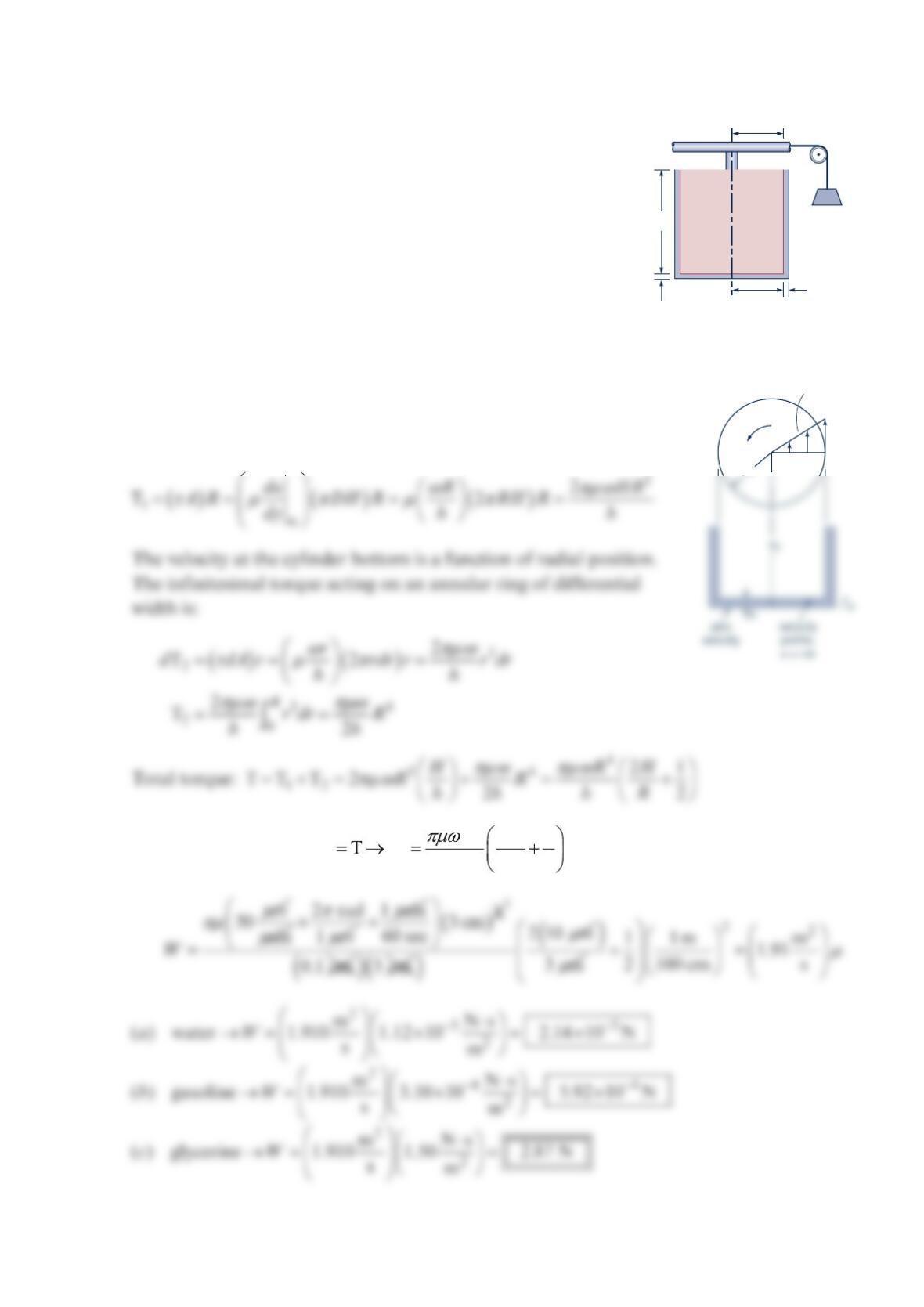
(b) For a fixed geometry and a given viscosity, Eq. (1) is of the form
Problem 1.88
The concentric cylinder viscometer shown in the figure
below has a cylinder height of
1
0.0 cm, a cylinder radius
of
3
.0 cm, and a uniform gap between the cylinder and
the container (bottom and sides) of
0
.10 cm. The pulley
has a radius of
3
.0 cm. Determine the weight required to
produce a constant rotational speed of
3
0 rp
m
if the gap
is filled with: (a) water, (b) gasoline, (c) glycerin.
Solution 1.88
Resisting torque is due to shear stress acting on cylinder surfaces.
Assuming a linear velocity profile across the narrow gaps, the torque
on the cylinder wall is:
Neglecting friction:
421
2
p
p
RH
WR W hR R
H
= 10.0 cm
3.0 cm
0.10 cm 0.10 cm
𝒲
R
ω
ω
u
=
r
0.1-in. gap
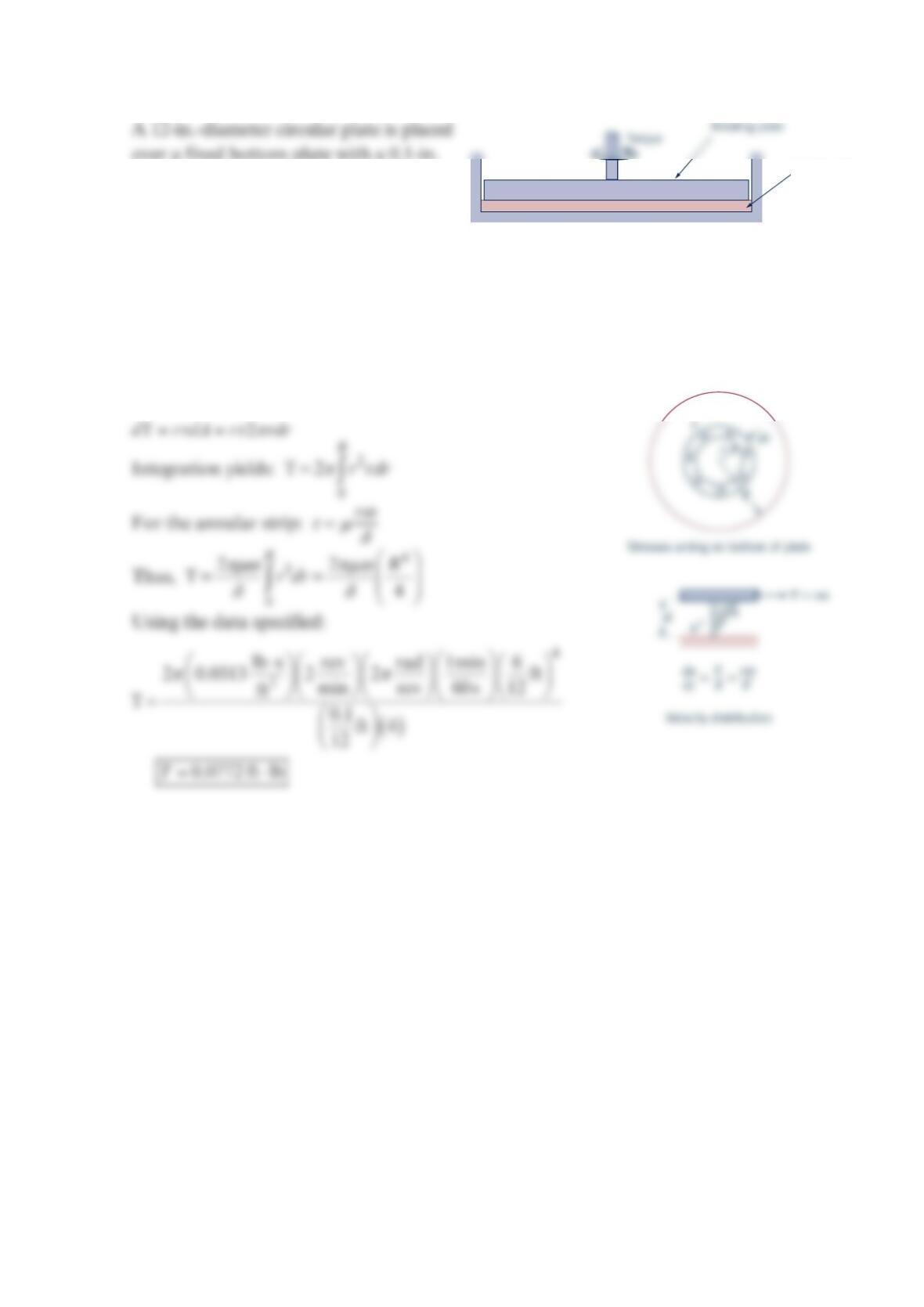
Problem 1.89
gap between the two plates filled with
glycerin as shown in the figure below.
Determine the torque required to rotate
the circular plate slowly at 2
r
pm. Assume that the velocity
distribution in the gap is linear and that the shear stress on the edge of the rotating plate
is negligible.
Solution 1.89
As shown, considering an annular ring of differential width
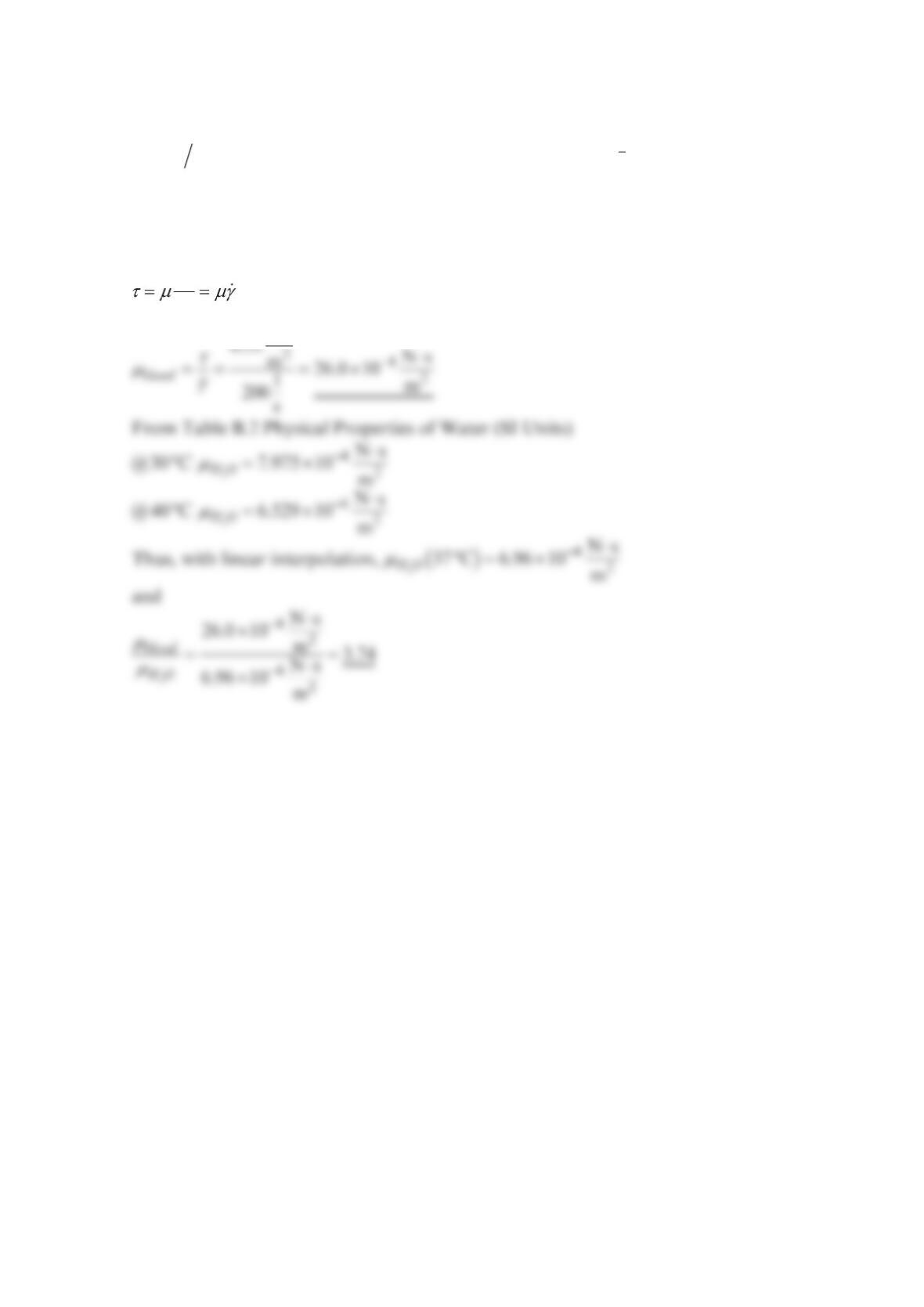
Problem 1.91
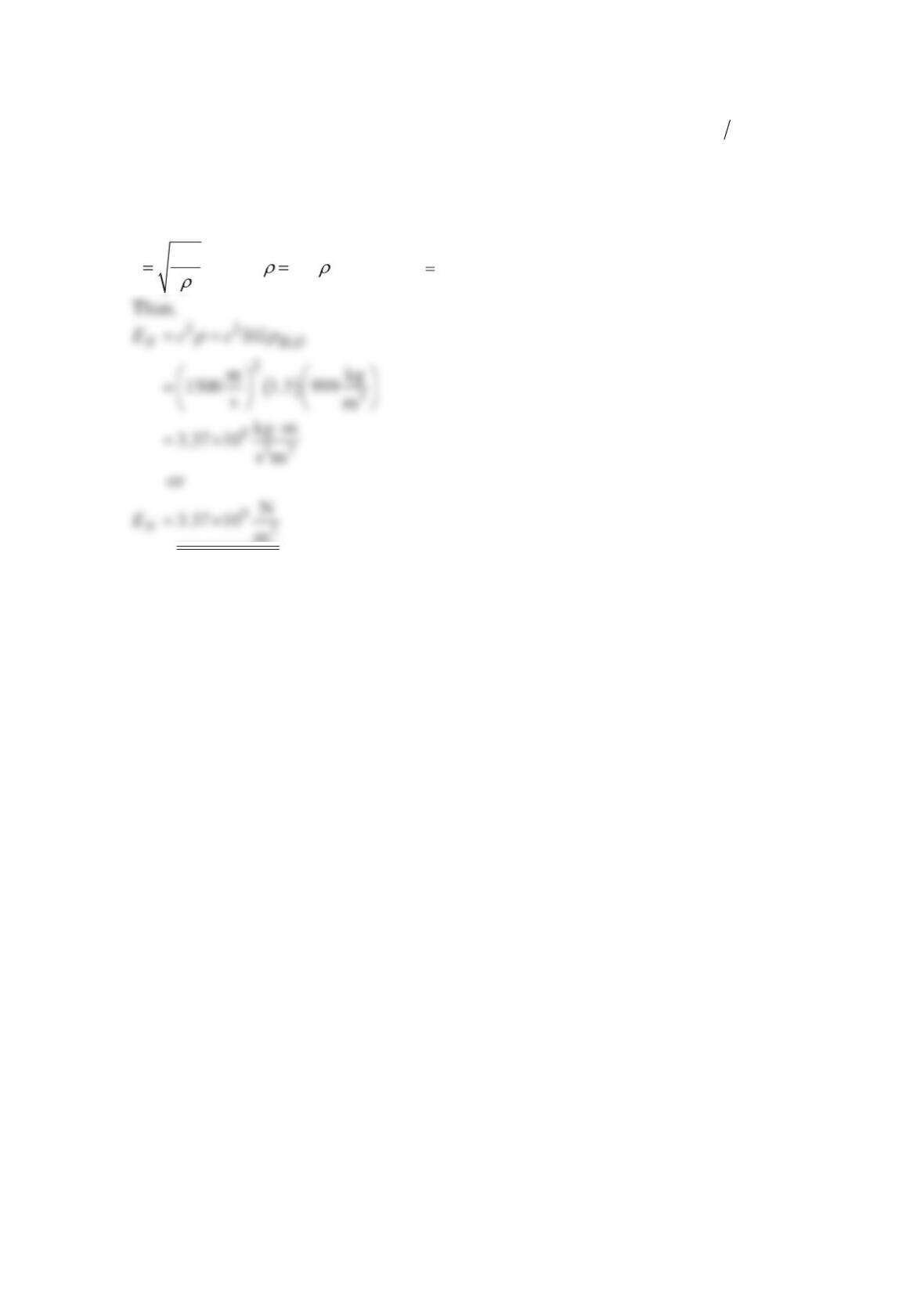
Some measurements on a blood sample at 37
°
C (98.6
°
F) indicate a shearing stress of
0.52 2
N
mfor a corresponding rate of shearing strain of 200 1
s
. Determine the apparent
viscosity of the blood and compare it with the viscosity of water at the same temperature.
Solution 1.91
N
du
dy
Problem 1.93
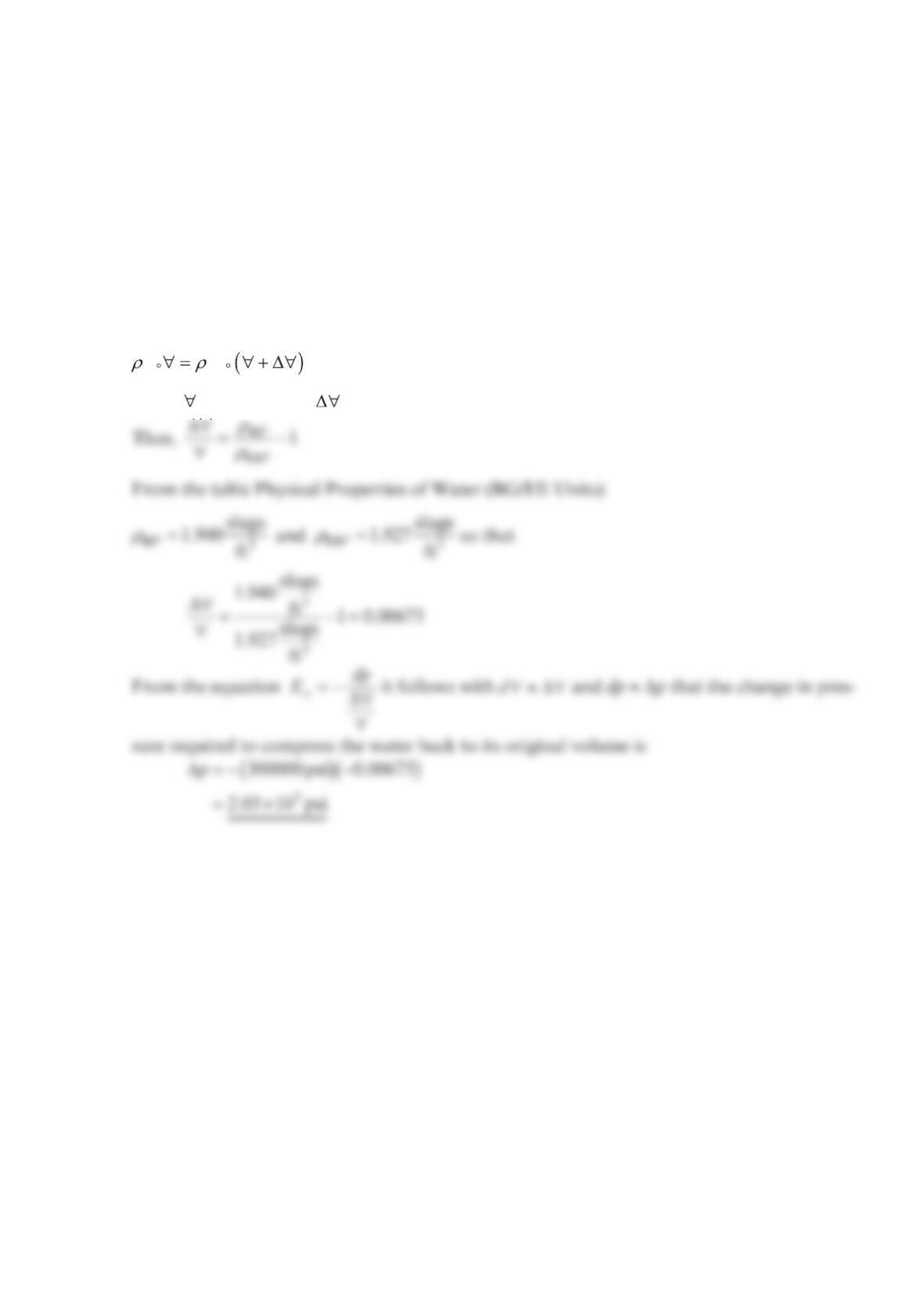
A sound wave is observed to travel through a liquid with a speed of 1500
m
s. The specific
gravity of the liquid is 1.5. Determine the bulk modulus for this fluid.
Solution 1.93
N
E
c, where 2
HO
SG and 1.5
S
G
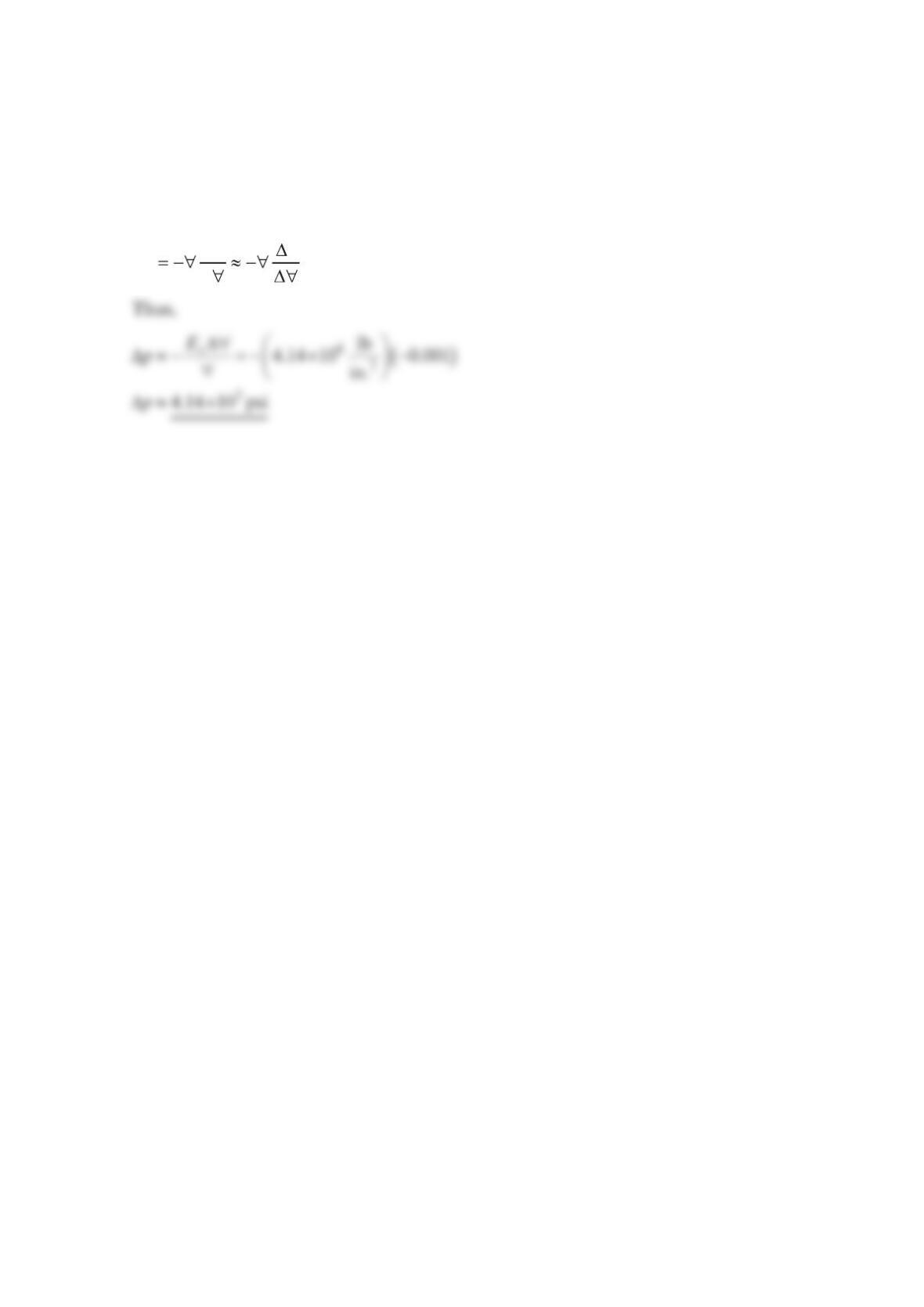
Problem 1.94
A rigid-walled cubical container is completely filled with water at 40
°
F and sealed. The wa-
ter is then heated to 100
°
F. Determine the pressure that develops in the container when the
water reaches this higher temperature. Assume that the volume of the container remains
constant and the value of the bulk modulus of the water remains constant and equal to
300,000
p
s
i
.
Solution 1.94
Since the water mass remains constant,
40 100
where is volume and is change in volume if water were unconstrained during heating.
Problem 1.95
Estimate the increase in pressure (in
p
s
i
) required to decrease a unit volume of mercury
by 0.1 %.
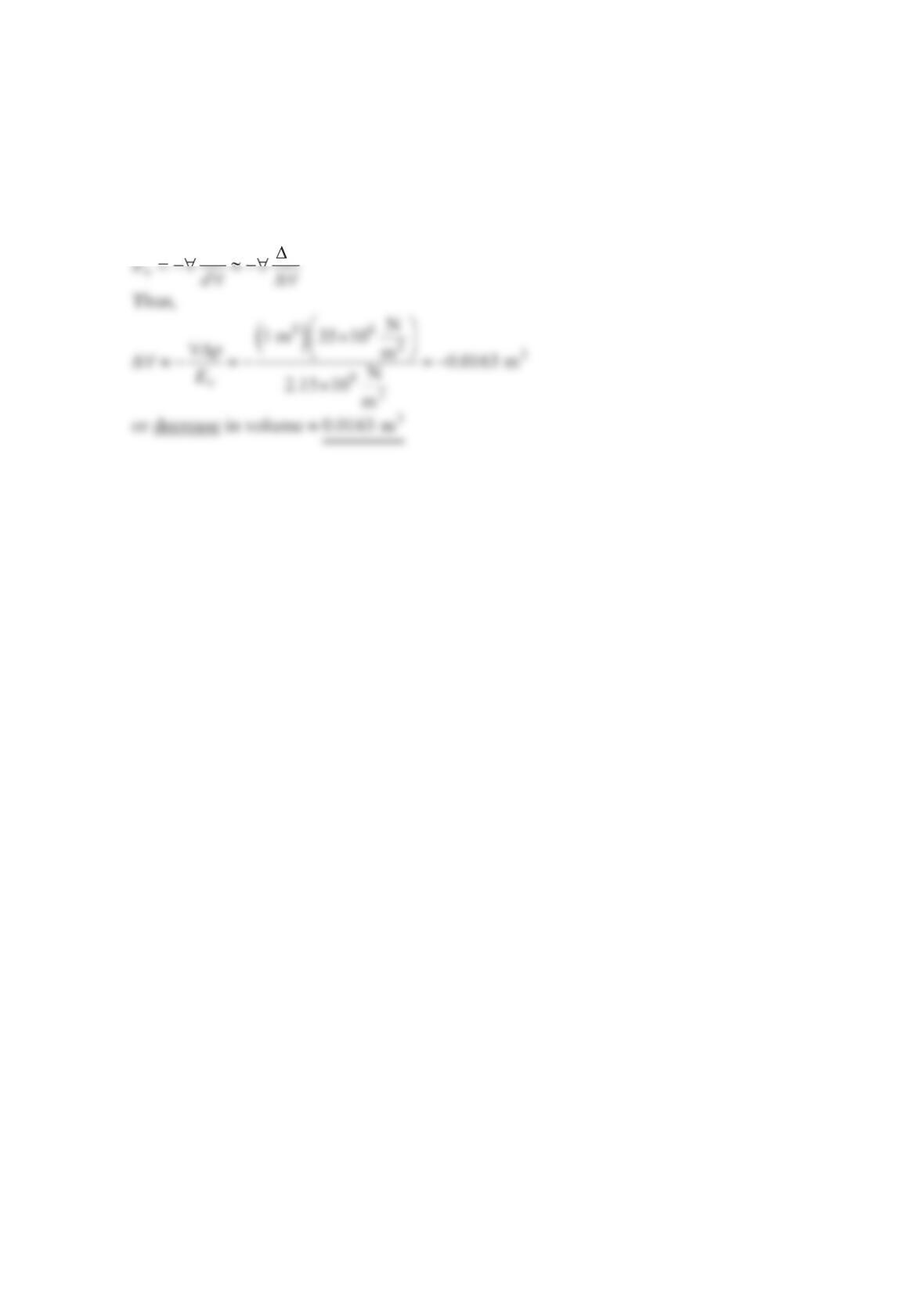
Solution 1.95
v
dp p
E
d
Problem 1.96
A 1
3
m
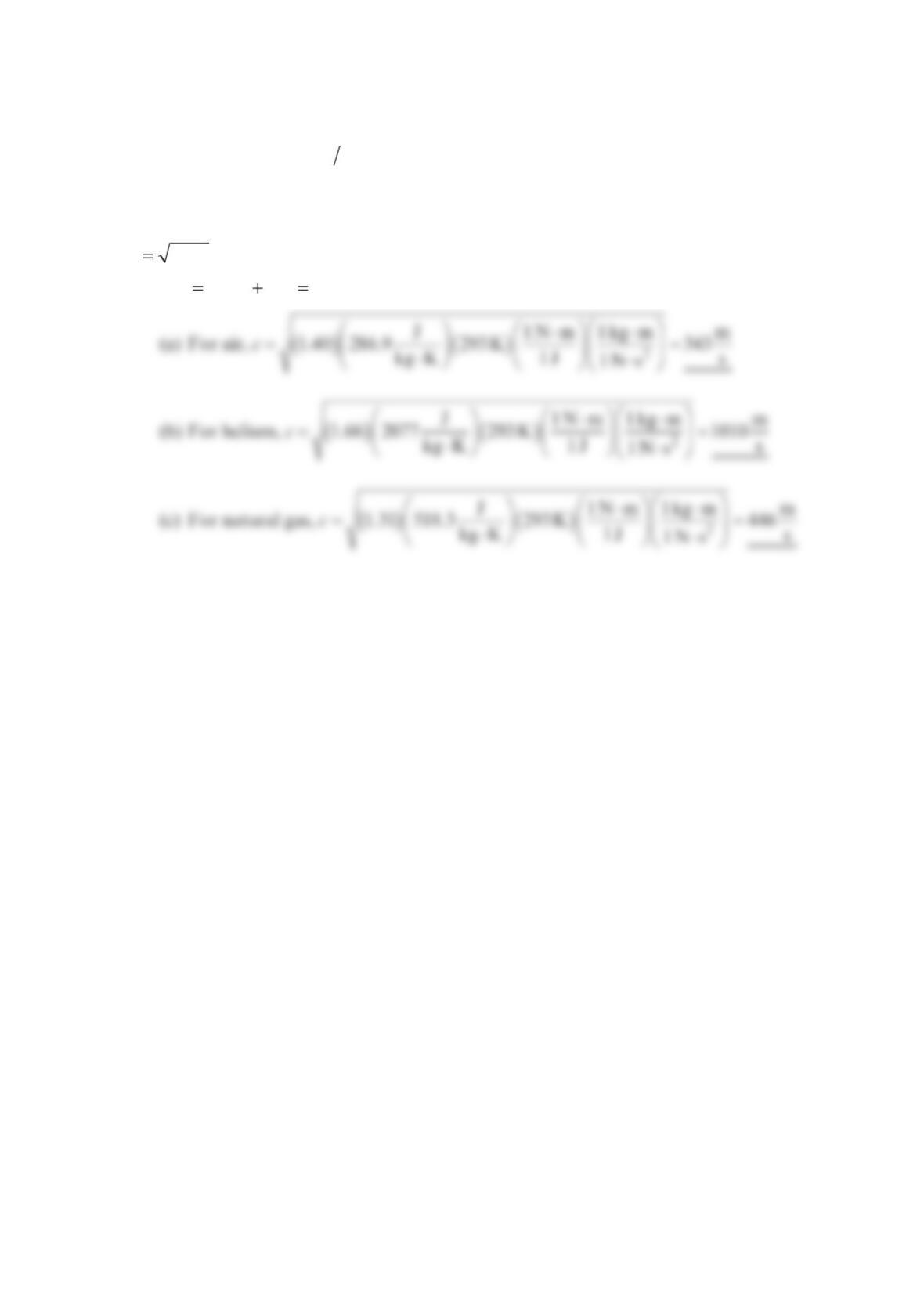
volume of water is contained in a rigid container. Estimate the change in the volume
of the water when a piston applies a pressure of 35
M
Pa.
Solution 1.96
dp p
Problem 1.97
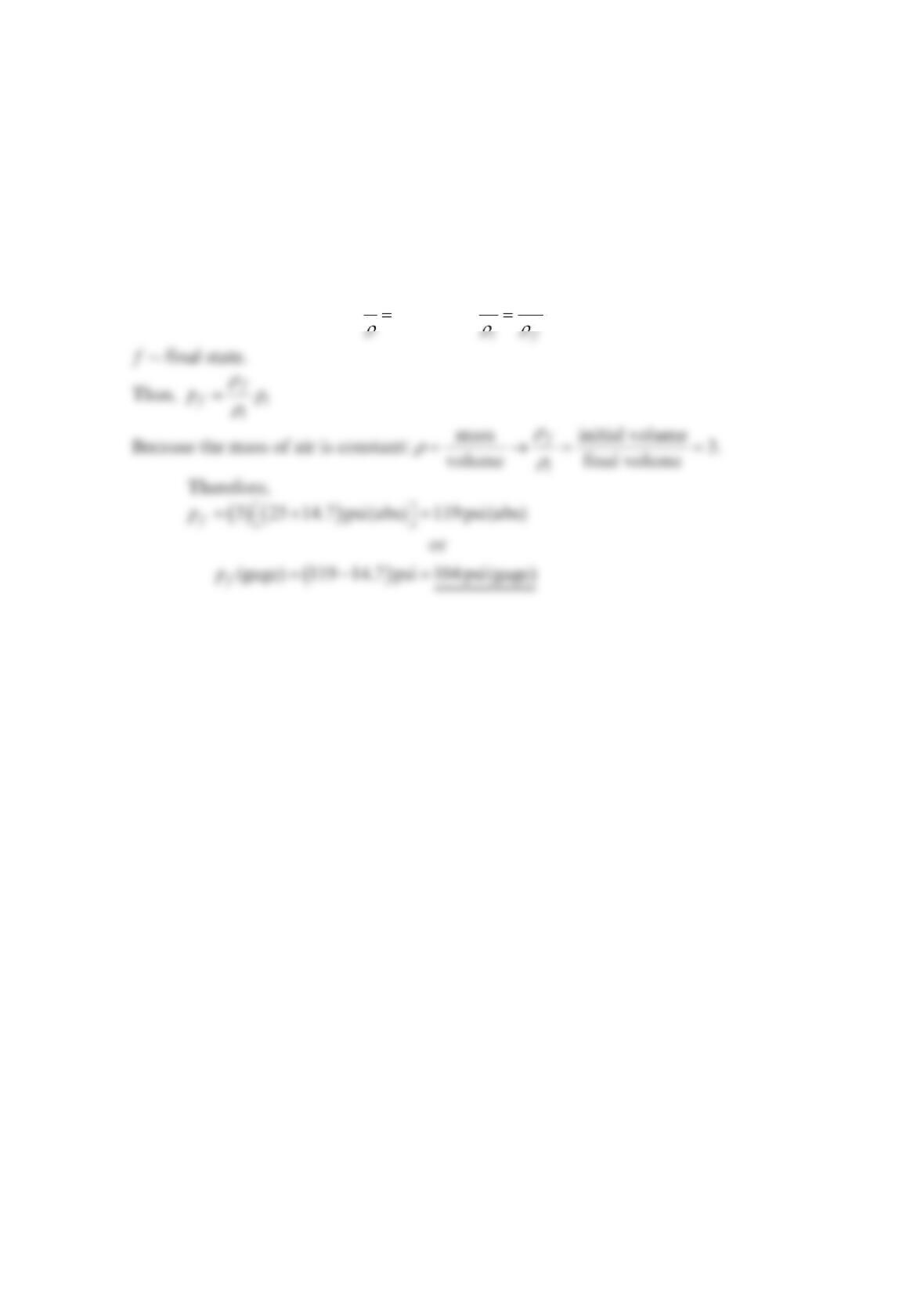
Determine the speed of sound at 20
°
C in (a) air, (b) helium, and (c) natural gas (methane).
Express your answer in
m
s.
Solution 1.97
ckRT
With 20°C 273 293K
T:
Problem 1.98
Air is enclosed by a rigid cylinder containing a piston. A pressure gage attached to the cyl-
inder indicates an initial reading of 25
p
s
i
. Determine the reading on the gage when the pis-
ton has compressed the air to one-third its original volume. Assume the compression pro-
cess to be isothermal and the local atmospheric pressure to be 14.7
p
s
i
.
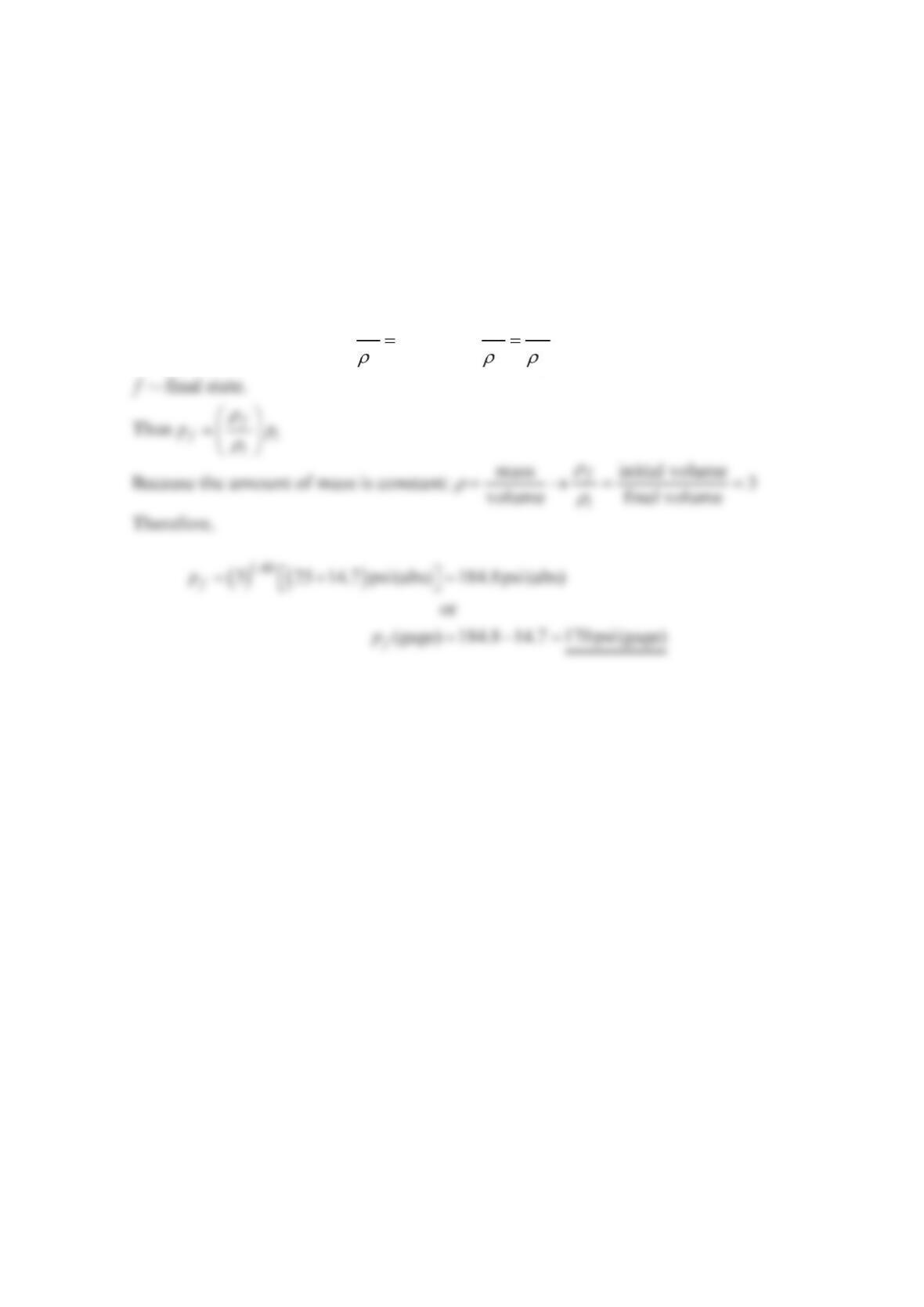
Solution 1.98
For isothermal compression, constant=
f
i
p
p
p where initial state
i
and
Problem 1.99
Air is enclosed by a rigid cylinder containing a piston. A pressure gage attached to the cyl-
inder indicates an initial reading of 25
p
s
i
. Determine the reading on the gage when the pis-
ton has compressed the air to one-third its original volume. Assume the compression pro-
cess takes place without friction and without heat transfer (isentropic process) and the local
atmospheric pressure to be 14.7
p
s
i
.
Solution 1.99
For isentropic compression, constant= f
i
kkk
if
p
p
p where initial state
i
and
Problem 1.100
Carbon dioxide at 30
°
C and 300
k
Pa absolute pressure expands isothermally to an abso-
lute pressure of 165
k
Pa. Determine the final density of the gas.
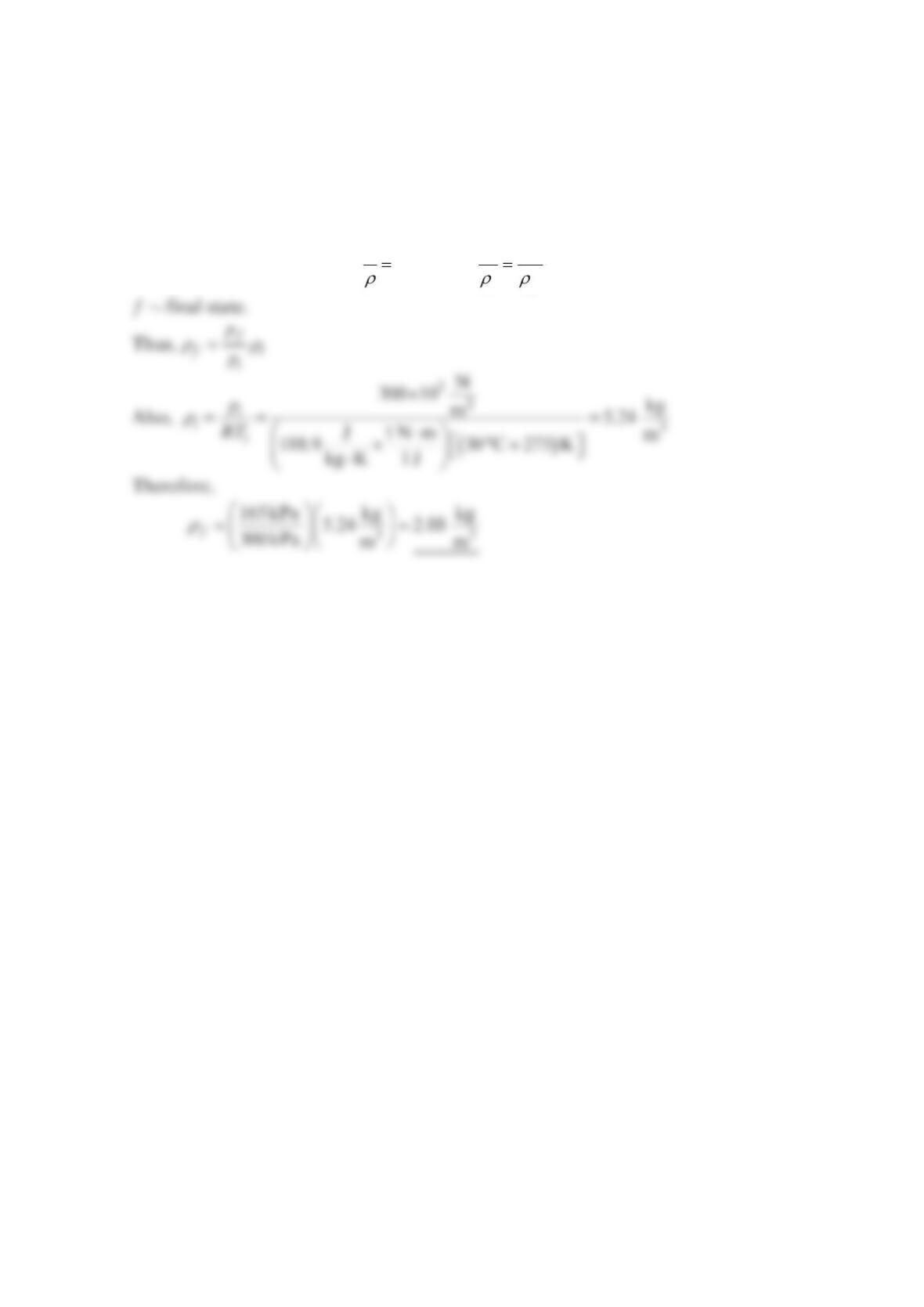
Solution 1.100
For isothermal compression, constant=
f
i
if
p
p
p where initial state
i
and
Problem 1.101
Natural gas at 70
°
F and standard atmospheric pressure of 14.7
p
s
i
(abs) is compressed
isentropically to a new absolute pressure of 70
p
s
i
. Determine the final density and
temperature of the gas.
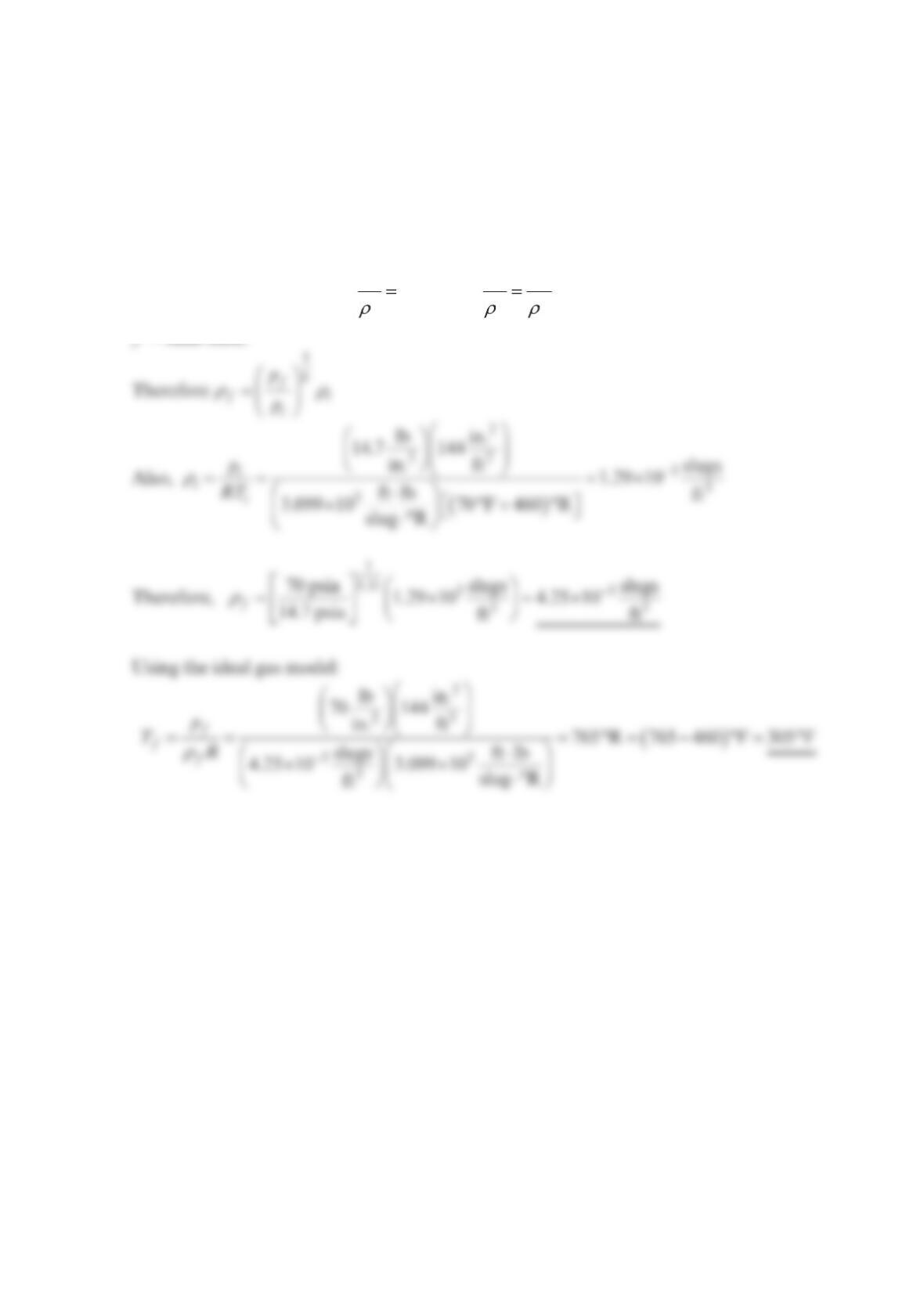
Solution 1.101
For isentropic compression, constant= f
i
kkk
if
p
p
p where initial state
i
and
final state
f
.
Problem 1.102
A compressed air tank in a service station has a volume of 3
1
0 ft . It contains air at
7
0°
F
and
1
50psia. How many tubeless tires can it fill to 44.7 psi
a
at
7
0 °F if each tire has a volume of
3
1
.5 ft and the compressed air tank is not refilled? The tank air temperature remains
constant at
7
0 °F because of heat transfer through the tank’s large surface area.
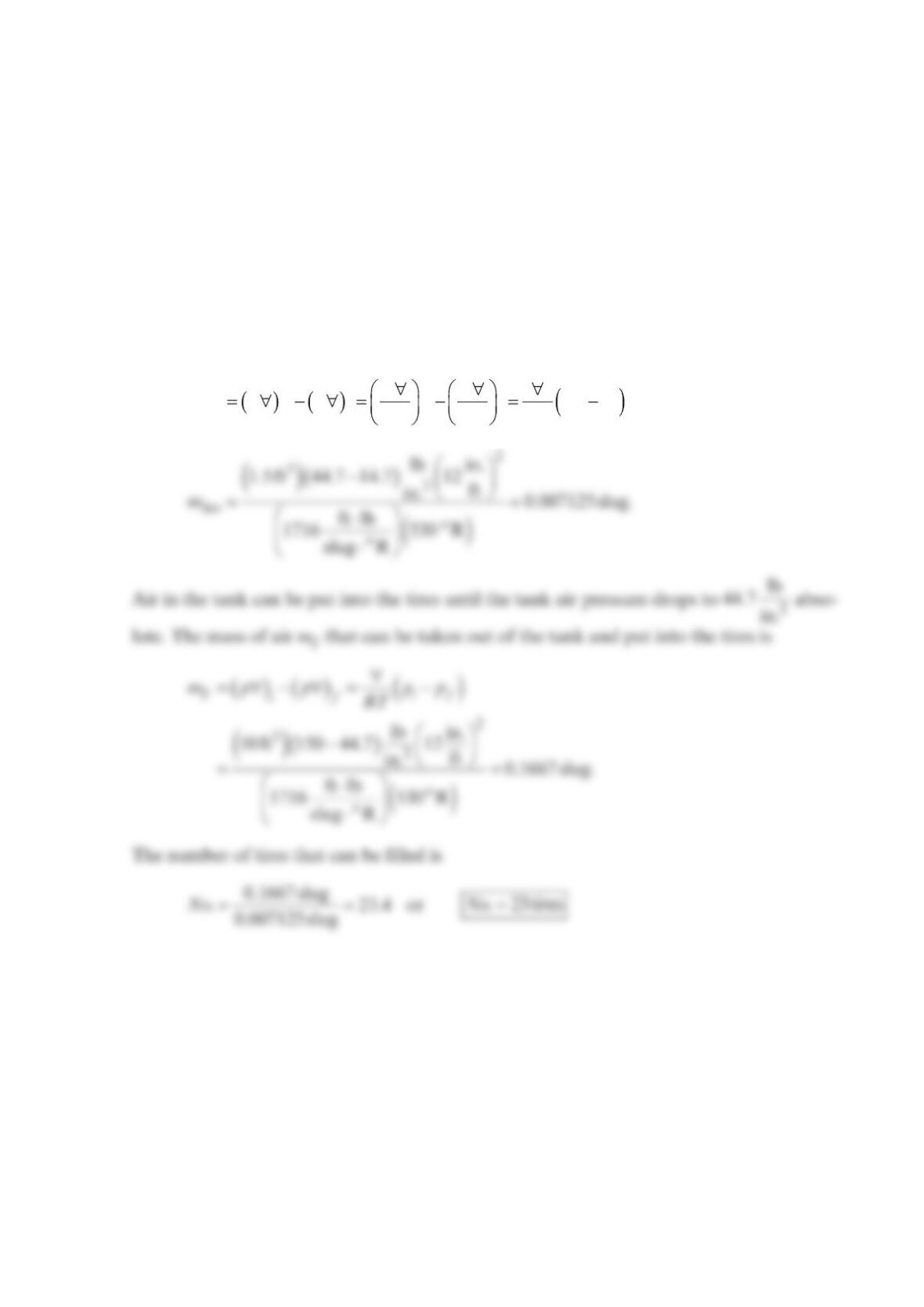
Solution 1.102
Modelling the air as an ideal gas, the mass of air t
m that can be put into each tire is found
from:
tire fi
fi fi
p
p
mp p pp
RT RT RT
Problem 1.103
A regulation basketball is initially flat and is then inflated to a pressure of approximately
2
2
4 lb/in absolute. Consider the air temperature to be constant at
7
0 °F. Find the mass of
air required to inflate the basketball. The basketball’s inside radius is
4
.67 in.
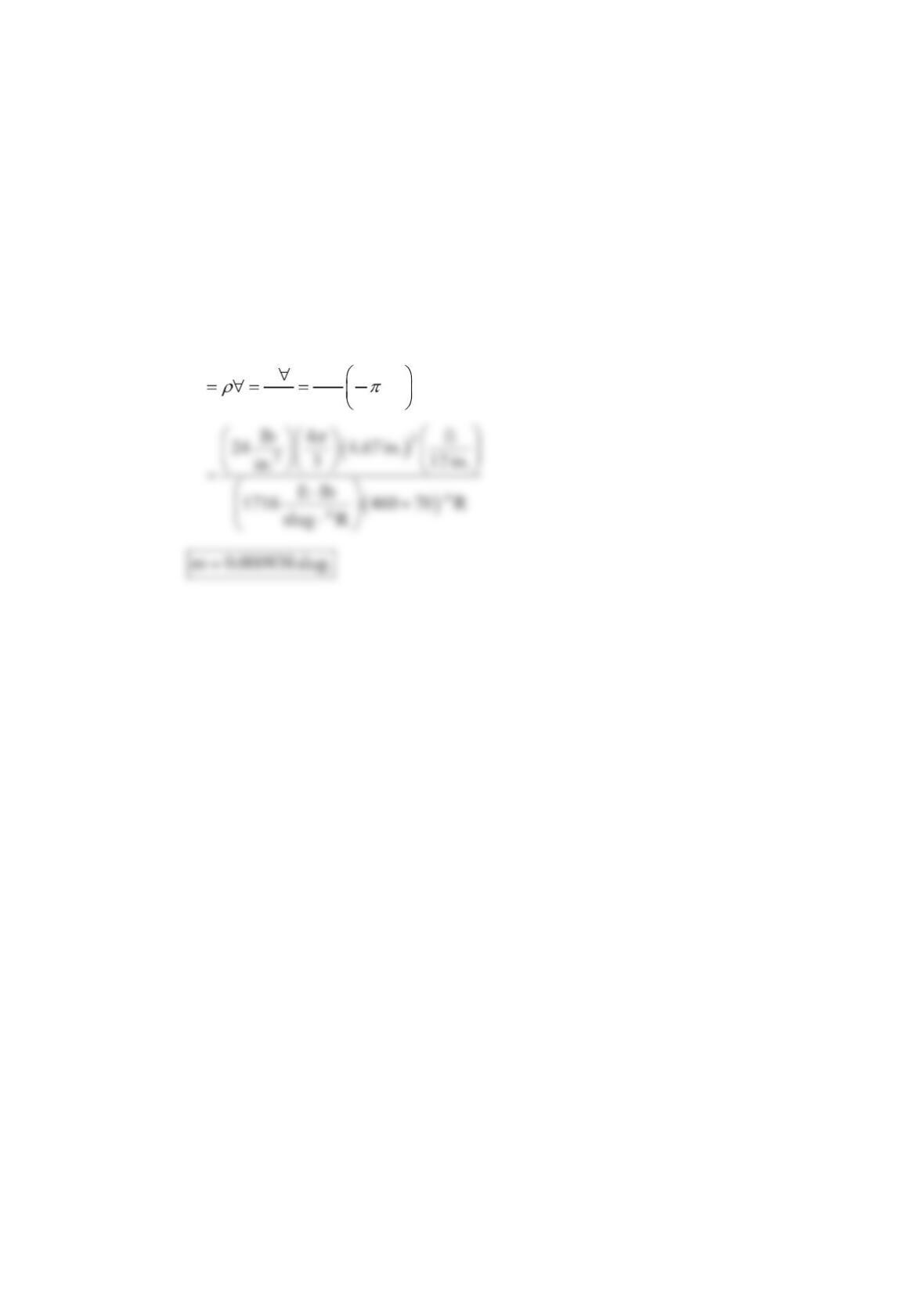
Solution 1.103
Modelling air as an ideal gas and looking up the gas constant for air:
3
4
3
i
p
p
mR
RT RT