1-18 Intermediate Accounting, 8/e
QUALITATIVE CHARACTERISTICS OF ACCOUNTING
INFORMATION
PRIMARY QUALITATIVE CHARACTERISTICS
➢ Relevance
Predictive value
➢ Faithful representation
Completeness — All information that is necessary for faithful
representation.
ENHANCING QUALITATIVE CHARACTERISTICS
➢ Comparability
Ability to help users see similarities and differences among events
and conditions (also includes consistency).
CONSTRAINT: COST EFFECTIVENESS
ELEMENTS OF FINANCIAL STATEMENTS
Assets
Probable future economic benefits obtained or controlled by a particular entity
as a result of past transactions or events.
Liabilities
Investments
Increases in equity of a particular business enterprise resulting from transfers to
it from other entities of something of value to obtain or increase ownership
interests in it.
Distributions
Decreases in equity of a particular enterprise resulting from transfers to owners.
Probable future sacrifices of economic benefits arising from present obligations
of a particular entity to transfer assets or provide services to other entities in the
future as a result of past transactions or events.
Comprehensive
income
The change in equity of a business enterprise during a period from transactions
and other events and circumstances from nonowner sources. It includes all
changes in equity during a period except those resulting from investments by
owners and distributions to owners.
Inflows or other enhancements of assets of an entity or settlements of its
liabilities during a period from delivering or producing goods, rendering
services, or other activities that constitute the entity’s ongoing major or central
operations.
Outflows or other using up of assets or incurrences of liabilities during a period
from delivering or producing goods, rendering services, or other activities that
Gains
Increases in equity from peripheral or incidental transactions of an entity.
Losses
Represent decreases in equity arising from peripheral or incidental transactions
of an entity.
Illustration 1-11
T1–12
1-20 Intermediate Accounting, 8/e
UNDERLYING ASSUMPTIONS
► Economic Entity Assumption
All economic events can be identified with a particular
► Going Concern Assumption
In the absence of information to the contrary, it is
► Periodicity Assumption
The life of a company can be divided into artificial time
► Monetary Unit Assumption
Financial statement elements should be measured in
T1–13
RECOGNITION
Recognition — An item should be recognized in the basic
financial statements when it meets the following criteria:
➢ Definition — the item meets the definition of an element of
financial statements.
➢ Revenue Recognition
Revenue should be recognized when goods and services
➢ Expense Recognition
Expenses are recognized when incurred, which is typically
in the same period as the related revenues.
T1–14
1-22 Intermediate Accounting, 8/e
MEASUREMENT
Measurement — Associating numerical amounts to the
elements.
➢ GAAP uses a “mixed attribute” model
➢ Measurement attributes presently used to measure different
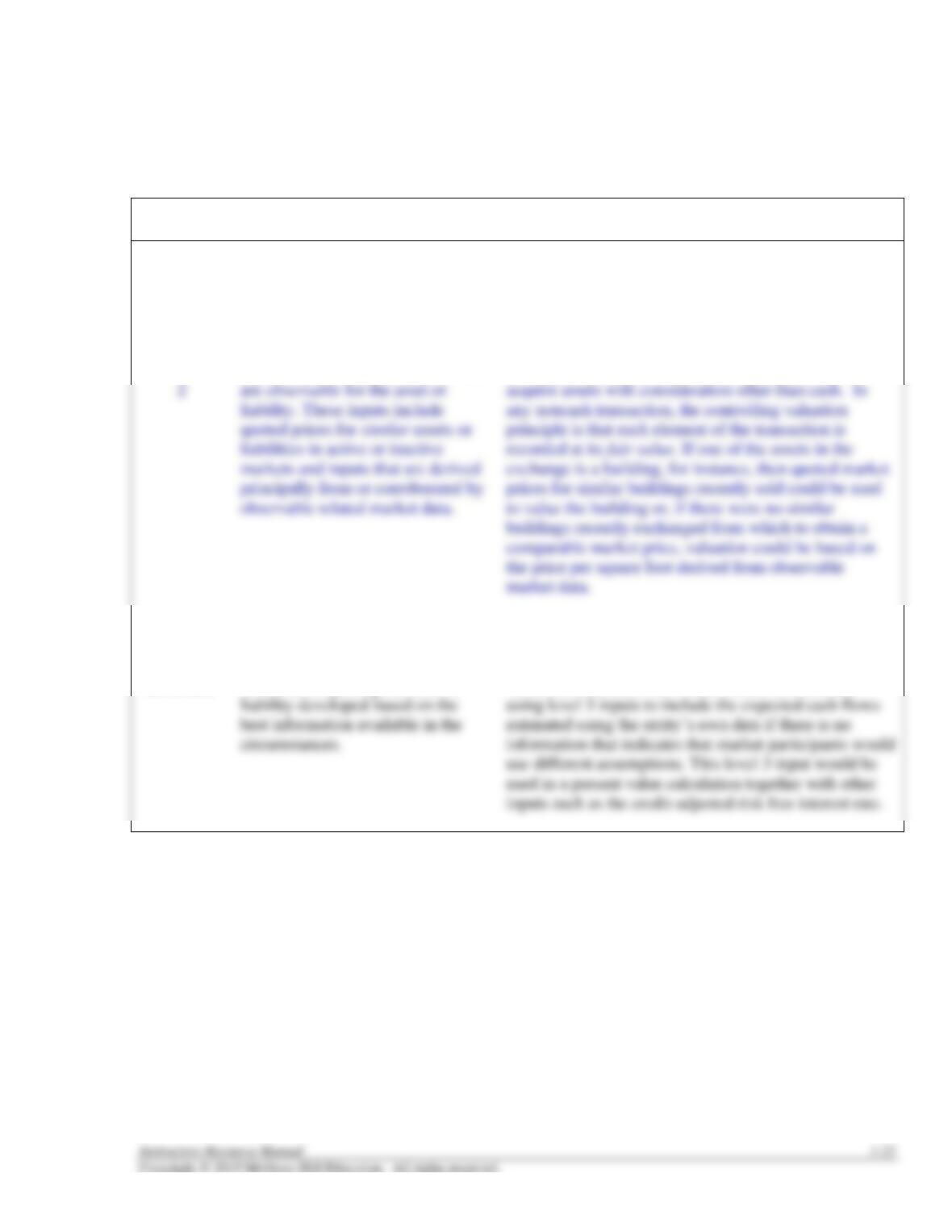
FAIR VALUE HIERARCHY
Level
Inputs
Example
1
Most
Desirable
Quoted market prices in active
markets for identical assets or
liabilities.
In Chapter 12 you will learn that certain investments in
marketable securities are reported at their fair values.
Fair value in this case would be measured using the
quoted market price from the NYSE, NASDAQ, or
other exchange on which the security is traded.
Inputs other than quoted prices that
In Chapter 10 we discuss how companies sometimes
3
Least
Desirable
Unobservable inputs that reflect the
entity’s own assumptions about the
assumptions market participants
would use in pricing the asset or
Asset retirement obligations (AROs), discussed in
Chapter 10, are measured at fair value. Neither level 1
nor level 2 inputs would be possible in most ARO
valuation situations. Fair value would be estimated
Illustration 1-13
T1-16
FULL-DISCLOSURE PRINCIPLE
► The full-disclosure principle means that the financial reports
should include any information that could affect the decisions
made by external users, subject to the cost effectiveness
constraint.
➢ Supplemental information is disclosed in a variety of
T1–17
Suggestions for Class Activities
1. Real World Scenario
America Online (AOL) is a leader in the Internet access provider industry. In 1996, the company
changed a controversial accounting method involving the treatment of the cost of advertising and
free trials. The following is an excerpt from a May 15, 2000, CNET News.com article:
America Online will pay a civil penalty of $3.5 million as part of a settlement
with the Securities and Exchange Commission over the accounting of
Suggestions:
Have the class consider the general treatment of advertising and promotion costs. Why are these
costs normally expensed in the period incurred even though they are incurred with the intention of
Points to note:
Perhaps an important factor prompting the switch was the increased competition in the industry

1-26 Intermediate Accounting, 8/e
2. PetSmart Analysis
Have students, individually or in groups, go to the most recent PetSmart. annual report using
EDGAR which can be located at: ww.sec.gov. Ask them to:
1. Compare revenues, total costs and expenses, net income, total assets and total shareholders’
equity with those in the 2013 report in Appendix B of the text. Are there any discernible

3. Group/Research Activity
The debate over principles-based versus rules-based accounting standards provides an excellent
opportunity for class discussion, in-class debate, or for a writing assignment. One suggestion is to
4. International Accounting Activity
What are the advantages and disadvantages to accounting convergence? Two recent articles in
Accounting Horizons provide an excellent overview of the research evidence:
• Luzi Hail, Christian Leuz, and Peter Wysocki (2010) Global Accounting Convergence and the
Suggestions:
have a debate in which different groups of students take pro- vs. con-convergence positions.
5. Professional Skills Development Activities
The following are suggested assignments from the end-of-chapter material that will help your
students develop their communication, research, analysis and judgment skills.
Communication Skills. In addition to Communication Case 1-7, Judgment Case 1-12 can be
Research Skills. In their careers, our graduates will be required to locate and extract relevant

1-28 Intermediate Accounting, 8/e
Analysis Skills. The “Broaden Your Perspective” section includes Analysis Cases that direct
students to gather, assemble, organize, process, or interpret data to provide options for making
Judgment Skills. The “Broaden Your Perspective” section includes Judgment Cases that require
students to critically analyze issues to apply concepts learned to business situations in order to
6. Ethical Dilemma
The chapter contains the following ethical dilemma:
ETHICAL DILEMMA
You have recently been employed by a large retail chain that sells sporting goods. One of your
tasks is to help prepare periodic financial statements for external distribution. The chain’s largest
creditor, National Savings & Loan, requires quarterly financial statements, and you are currently
working on the statements for the three-month period ending June 30, 2016.
During the months of May and June, the company spent $1,200,000 on a large radio and TV
advertising campaign. The $1,200,000 included the costs of producing the commercials as well as
You may wish to discuss this in class. If so, discussion should include these elements.
Step 1—The Facts:
One of your tasks as an employee of a large sporting goods chain is to prepare financial
statements for external use. You are currently preparing quarterly statements for the quarter ending
June 30, 2016, that will be given to the chain’s largest creditor, National Savings & Loan. The CFO
Step 2—The Ethical Issue and the Stakeholders:
The ethical issue or dilemma is whether your obligation to challenge the CFO’s request for
capitalization of the advertising expense is stronger than your obligation to your employer’s financial
1-30 Intermediate Accounting, 8/e
Step 3—Values:
Values include competence, honesty, integrity, objectivity, loyalty to your employer, and
responsibility to users of financial statements.
Step 4—Alternatives:
1. Follow the suggestion of the CFO to record the advertising costs as a prepaid asset.
Step 5—Evaluation of Alternatives in Terms of Values:
1. Alternative 1 illustrates loyalty to the employer.
Step 6—Consequences:
Alternative 1
Positive consequences: You would keep your job and please the CFO. The company would
Alternative 2
Positive consequences: Users of financial statements would receive more conservative
Alternative 3
Positive consequences: You would maintain your integrity. Users may receive more

Alternative 4
Positive consequences: You maintain your integrity and avoid conflict with management and
Step 7—Decision:
Student(s) must decide their course of action.

1-32 Intermediate Accounting, 8/e
Assignment Chart
Access to the FASB codification is required for any exercises like 1-3 and 1-4. FASB controls
access to the codification, but they have an academic program that departments can sign up
for. If your school has paid for a site license of the Academic Accounting Access Program,
faculty and students will have free access to the FASB Codifi cation. Check with your
accounting department to determine if your school has registered for this program. All of the
features available with the Professional View version ( http://asc.fasb.org ) are included with
the Academic Accounting Access Program.
Learning Est. time
Questions Objective(s) Topic (min.)
1-1
1-1
Function and primary focus of financial
accounting
5
1-2
1-1
Efficient allocation of resources
5
1-3
1-1
Investment-credit decision
5
1-4
1-1
Investment-credit decision
5
1-5
1-1
Objective of financial accounting
5
1-6
1-2
Cash versus accrual accounting
5
1-7
1-3
Generally accepted accounting principles
5
1-8
1-3
Roles of the SEC and FASB
5
1-9
1-5
Role of the auditor
5
1-10
1-5
Sarbanes-Oxley Act
5
1-11
1-4
Economic consequences of accounting standards
5
1-13
1-6
Purpose of the conceptual framework
5
1-14
1-7
Relevance and faithful representation
5
1-7
Components of relevance and faithful
representation
5
1-16
1-7
Cost effectiveness
5
1-17
1-7
Materiality
5
1-18
1-7
Financial accounting elements
5
1-19
1-8
Assumptions underlying GAAP
5
1-20
1-8
Going concern assumption
5
1-21
1-8
Periodicity assumption
5
1-22
1-9
Broad accounting principles
5
1-23
1-9
Historical cost; justification
5
1-24
1-9
Revenue recognition criteria
5
1-25
1-9
Expense recognition criteria
5
1-26
1-9
Full-disclosure principle
5
1-27
1-9
Fair value hierarchy
5
1-28
1-9
Measurement attributes
5
1-29
Revenue/expense and asset/liability approaches
5
1-30
Conceptual framework under IFRS
5
1-31
International standard setting
5
Brief Learning Est. time
Exercises Objective(s) Topic (min.)
1-1
1-2
Accrual accounting
15
1-2
1-7
Financial statement elements
5
1-3
Basic assumptions and principles
10
1-4
Basic assumptions and principles
10
1-5
Basic assumptions and principles
10
1-6
IFRS organizations
10
Learning Est. time
Exercises Objective(s) Topic (min.)
1-1
1-2
Accrual accounting
20
1-2
1-2
Accrual accounting
15
1-3
1-3
FASB codification research
15
1-4
1-3
FASB codification research
20
1-5
1-3
Participants in establishing GAAP
10
1-6
1-7
Financial statement elements
10
1-7
1-7
Concepts; terminology; conceptual framework
10
1-8
1-7
Qualitative characteristics
15
1-9
1-7
Basic assumptions, principles, and constraints
10
Basic assumptions and principles
10
Basic assumptions and principles
15
Basic assumptions and principles
15
Basic assumptions, principles, and constraints
15
assumptions, principles
15
CPA/CMA Learning Est. time
Exam Questions Objective(s) Topic (min.)
CPA-1
1-7
Qualitative characteristics
3
CPA-2
1-7
Qualitative characteristics
3
CPA-3
1-3
Standard-setting
3
CPA-4
1-7
Qualitative characteristics
3
CPA-5
1-7
Qualitative characteristics
3
CPA-7
1-1
Objective of financial reporting
3
CPA-8
1-7
Financial statement elements
3
CPA-9
IFRS standard setting structure
3
IFRS conceptual framework
3
1-3
Standard-setting
3
1-7
Qualitative characteristics
3
1-7
Recognition concepts
3
Learning Est. time
Cases Objective(s) Topic (min.)

Judgment Case 1-1
1-3
The development of accounting standards
30
Research Case 1-2
1-3
Accessing SEC information through the Internet
35
Research Case 1-3
1-4
Accessing FASB information through the
Internet
40
Research Case 1-4
1-3, 1-11
Accessing IASB information through the Internet
40
Research Case 1-5
1-3, 1-4
Accounting standards in China
60
Communication Case 1-6
1-7
Relevance and reliability
30
Communication Case 1-7
1-4
Accounting standard setting
60
Ethics Case 1-8
1-5
The auditors’ responsibility
30
Judgment Case 1-9
1-7
Qualitative characteristics
20
Judgment Case 1-10
1-5, 1-7
GAAP; comparability and the role of the auditor
20
Judgment Case 1-11
1-7
Cost effectiveness
30
Judgment Case 1-12
1-9
The realization principle
20
Analysis Case 1-13
1-9
The matching principle
25
Judgment Case 1-14
1-9
Capitalize or expense?
20
Real World Case 1-15
1-7, 1-9
Elements; disclosures; The GAP
20
Judgment Case 1-16
Convergence
20
Air France-KLM Case
1-11
Air France-KLM, Financial statements,
accounting principles
30