A
AP
PP
PE
EN
ND
DI
IX
X
A
A
D
De
er
ri
iv
va
at
ti
iv
ve
es
s
L
Le
ec
ct
tu
ur
re
e
O
Ou
ut
tl
li
in
ne
e
Derivatives
A. Derivatives are financial instruments that “derive” their values from some other security or
index. (TA-1)
B. They are extensively used to hedge against various risks, particularly interest rate risk.
C. Hedging means taking a risk position that is opposite to an actual position that is exposed
to risk. (TA-2)
1. Interest rate futures are derivative contracts often bought and sold to hedge against
risk. They allow a firm to sell (or buy) a financial instrument at a designated future
D. All derivatives, no exceptions, are carried on the balance sheet as either assets or liabilities
at fair value. When the fair value changes, a gain or loss occurs. (TA-4)
1. If the derivative is not designated as a hedging instrument, or doesn’t qualify as one,
E. When a derivative designated as a fair value hedge is adjusted to reflect changes in fair
value, the resulting gain or loss is included currently in earnings. At the same time,
though, the loss or gain from changes in the fair value, due to the risk being hedged, of the
item being hedged also is included currently in earnings. (TA-5) (TA-8)
F. When a derivative designated as a cash flow hedge is adjusted to reflect changes in fair
A-2 Intermediate Accounting, 8/e
G. A foreign currency hedge can be a hedge of foreign currency exposure of: (TA-7)
1. a firm commitment – treated as a fair value hedge.
H. To qualify as a hedge, the hedging relationship must be “highly effective” in achieving
offsetting changes in fair values or cash flows. Hedge accounting must be terminated for
hedging relationships that no longer are highly effective. (TA-9)
P
Po
ow
we
er
rP
Po
oi
in
nt
t
S
Sl
li
id
de
es
s
A PowerPoint presentation of the Appendix is available at the textbook website.
T
Te
ea
ac
ch
hi
in
ng
g
T
Tr
ra
an
ns
sp
pa
ar
re
en
nc
cy
y
M
Ma
as
st
te
er
rs
s
The following can be reproduced on transparency film as they appear here, or
DERIVATIVES
Derivatives are financial instruments that “derive” their
The most frequently used derivatives are:
o Financial futures
Derivatives can manage or hedge companies’ exposures to
risk, including interest rate risk, price risk, and foreign
exchange risk.
TA-1
A-4 Intermediate Accounting, 8/e
DERIVATIVES USED TO HEDGE RISK
Hedging means taking a risk position that is opposite to an
actual position that is exposed to risk.
A forward contract is similar to a futures contract but does
not call for a daily cash settlement for price changes in the
underlying contract. Gains and losses on forward contracts are
paid only when they are closed out.
An option gives its holder the right either to buy or to sell an
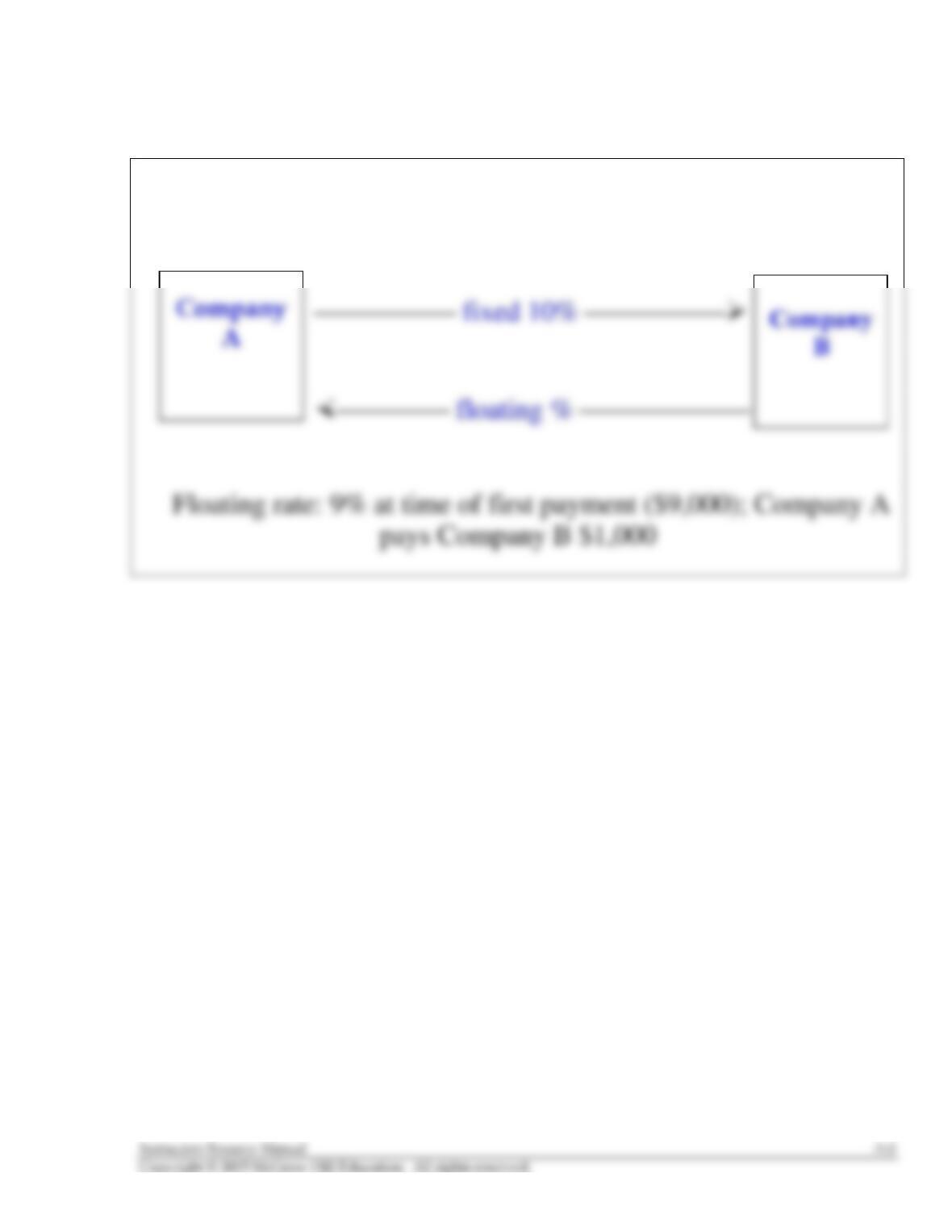
INTEREST RATE SWAP
Swap of annual payments on $100,000 notional amount; fixed
interest rate: 10% ($10,000)
TA-3
A-6 Intermediate Accounting, 8/e
ACCOUNTING FOR DERIVATIVES
All derivatives, no exceptions, are carried on the balance sheet
How we account for the gain or loss depends on how the
derivative is used.
1. If the derivative is not designated as a hedging
2. If the derivative is used to hedge against exposure to
risk, the gain or loss is either
TA-4
FAIR VALUE HEDGES
A change in either prices or interest rates can cause a change
in the fair value of an asset, a liability, or a commitment to buy
A gain or loss from a fair value hedge is recognized
immediately in earnings along with the loss or gain from the
item being hedged.
o When the derivative is adjusted to reflect changes in fair
TA-5
A-8 Intermediate Accounting, 8/e
CASH FLOW HEDGES
If a derivative is used to hedge against exposure to changes in
cash inflows or outflows of an asset or liability or a forecasted
transaction, it can be designated as a cash flow hedge.
When the derivative is adjusted to reflect changes in fair
Comprehensive income includes net income itself and
changes in elements of the balance sheet that the FASB feels
don’t (yet) belong in net income:
o foreign currency translation adjustments
FOREIGN CURRENCY HEDGES
The possibility that foreign currency exchange rates might
change exposes many companies to foreign currency risk.
• a forecasted transaction – treated as a cash flow hedge.
• a company’s net investment in a foreign operation – the
TA-7
A-10 Intermediate Accounting, 8/e
ILLUSTRATION
INTEREST RATE SWAPS
Wintel Semiconductors issued $1 million of 18-month, 10% notes
payable to First Bank on January 1, 2016. Wintel is exposed to the risk that
general interest rates will decline, causing the fair value of its debt to rise.
To hedge against this fair value risk, the firm entered into an 18-month
Illustration A-1
TA-8
Floating settlement rates were 9% at June 30, 2016, 8% at December 31,
2016, and 9% at June 30, 2017, and December 31, 2017. Net interest
receipts can be calculated as shown below. Fair values of both the
derivative and the note resulting from those market rate changes are
assumed to be quotes obtained from securities dealers.
1/1/2016 6/30/2016 12/31/2016 6/30/2017
Fixed rate 10% 10% 10% 10%
Illustration A-1
TA-8 (continued)
When the floating rate declined from 10% to 9%, the fair values of both the
derivative (swap) and the note increased. This created an offsetting gain on the
derivative and loss on the note. Both are recognized in earnings the same period
(June 30, 2016).
January 1, 2016
Cash …………………………………………………………… 1,000,000
Notes payable ………………………………………………… 1,000,000
To record the issuance of the notes.
June 30, 2016
Interest expense (10% x ½ x $1 million) ………………. 50,000
Cash …………………………………………………………… 50,000
The net interest settlement on June 30, 2016, is $5,000 because the fixed rate is
Illustration A-1
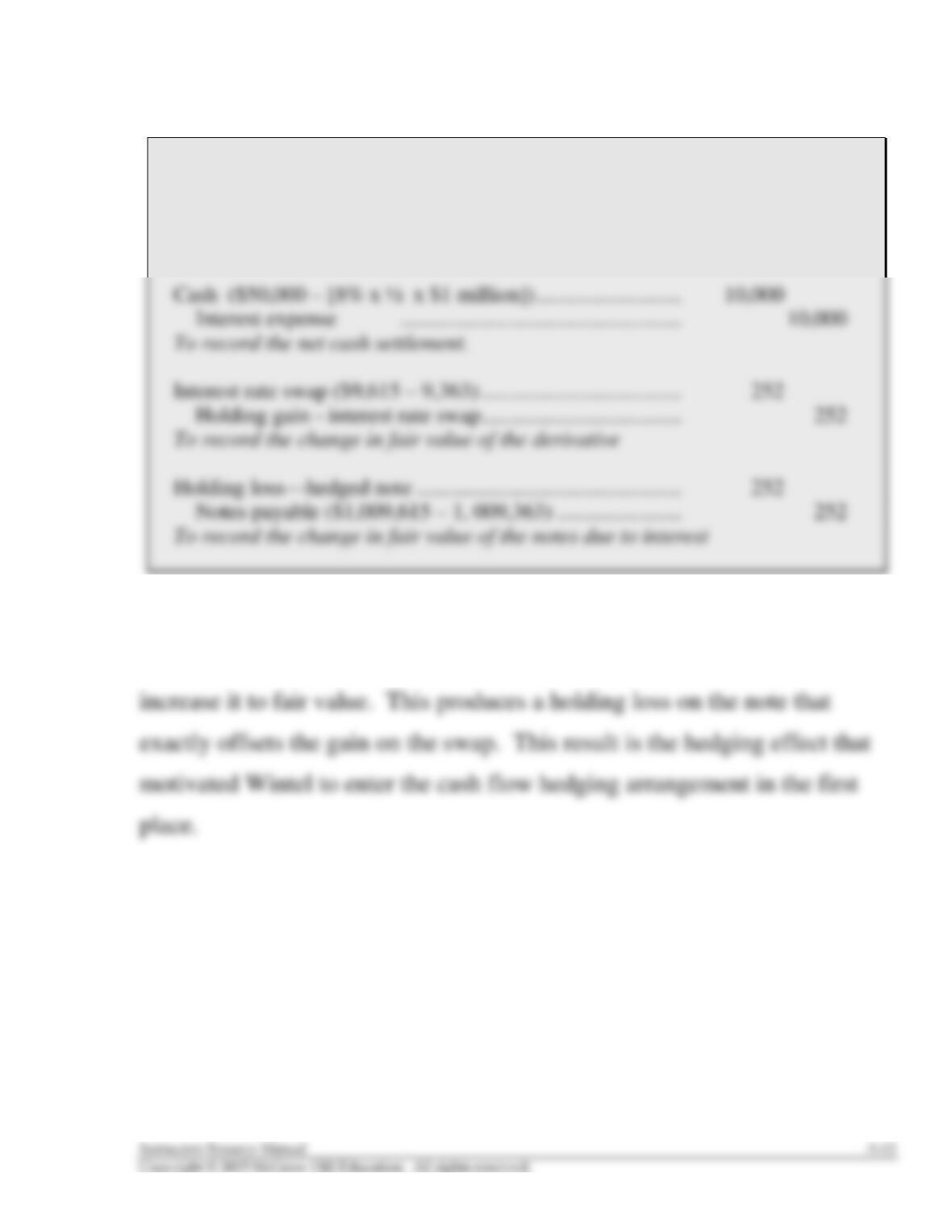
TA-8 (continued)
December 31, 2016
Interest expense ……………………………………………. 50,000
Cash (10% x ½ x $1,000,000) …………………………………. 50,000
To record interest.
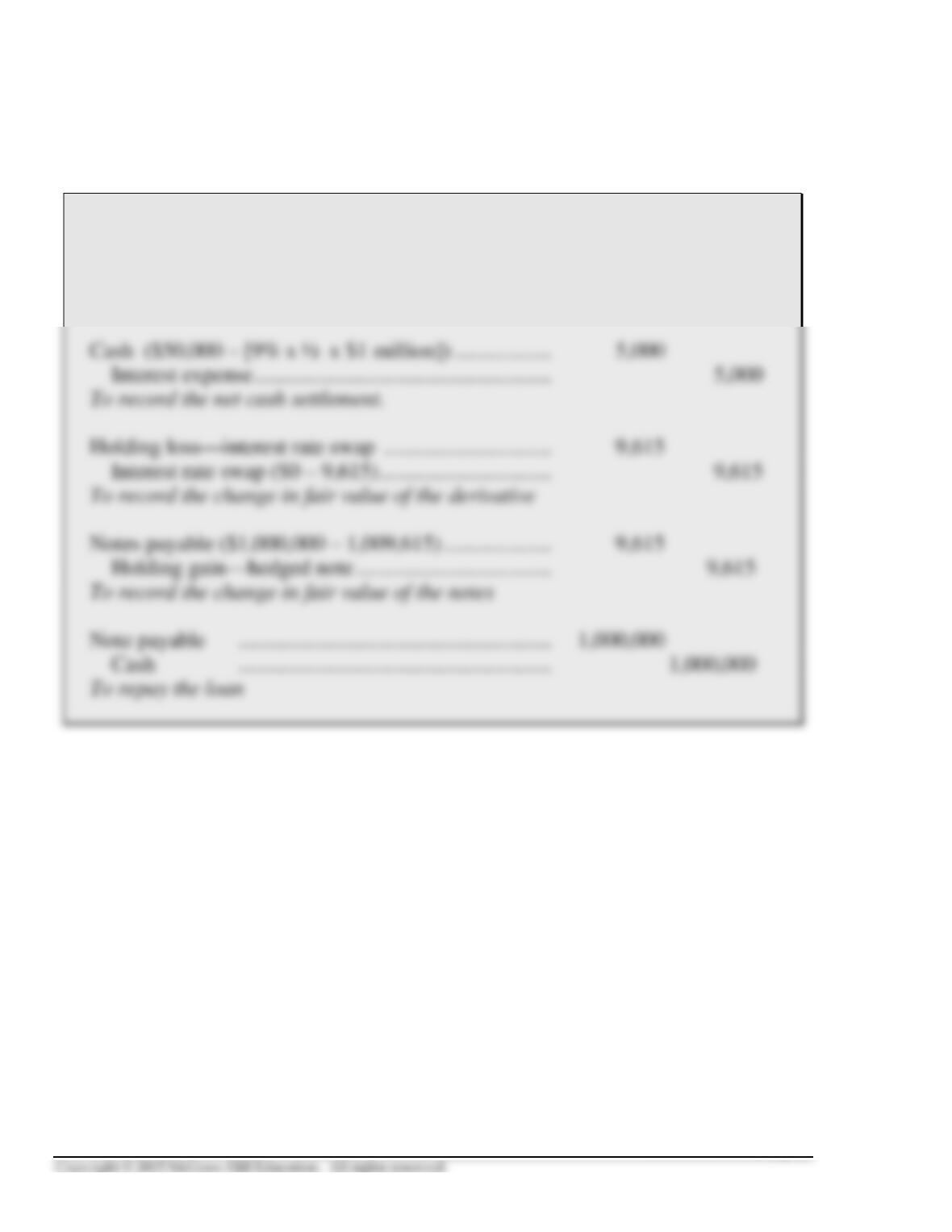
The fair value of the swap increased by $252 (from $9,363 to $9,615).
Similarly, we adjust the note’s book value by the amount necessary to
Illustration A-1
TA-8 (continued)
A-14 Intermediate Accounting, 8/e
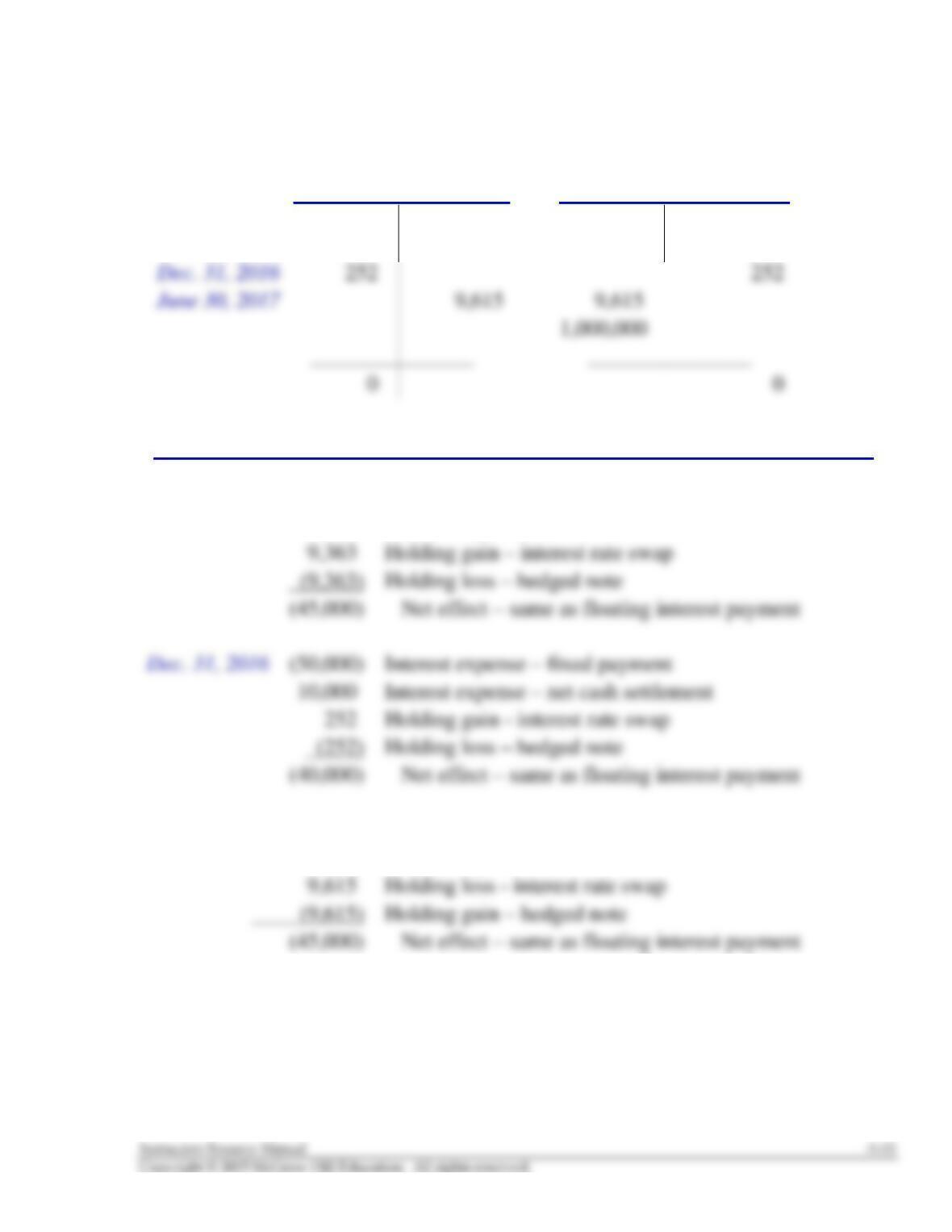
At June 30, 2017, Wintel repeats the process of adjusting to fair value both the
derivative investment and the notes being hedged.
June 30, 2017
Interest expense …………………………………………………. 50,000
Cash (10% x ½ x $1,000,000) ………………………….. 50,000
To record interest.
Illustration A-1
TA-8 (continued)
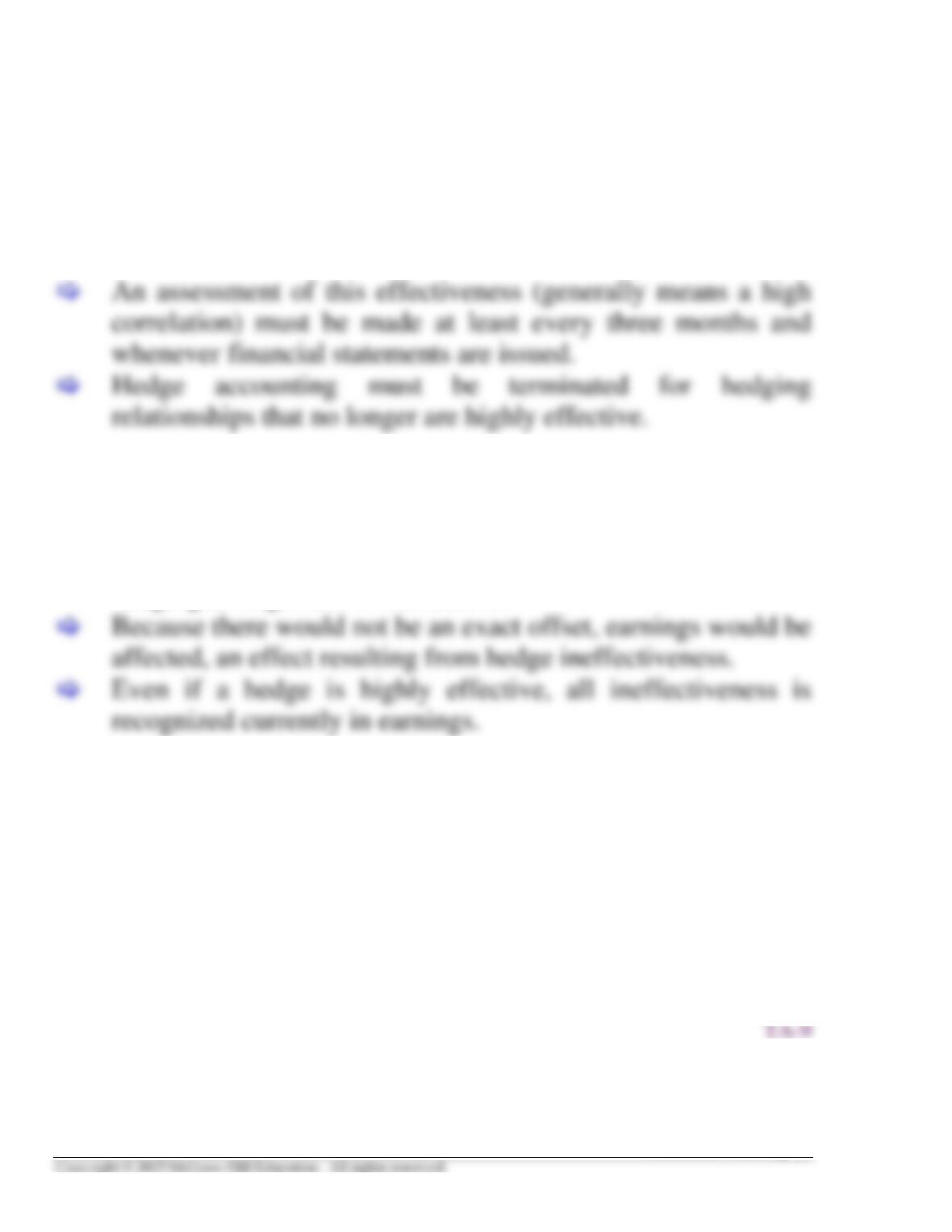
EFFECTS ON BALANCES
Swap Notes
Jan. 1, 2016 1,000,000
June 30, 2016 9,363 9,363
Income Statement + (−)
June 30, 2016 (50,000) Interest expense – fixed payment
5,000 Interest expense – net cash settlement
June 30, 2017 (50,000) Interest expense – fixed payment
5,000 Interest expense – net cash settlement
Illustration A-1
TA-8 (continued)
A-16 Intermediate Accounting, 8/e
HEDGE EFFECTIVENESS
To qualify as a hedge, the hedging relationship must be highly
effective in achieving offsetting changes in fair values or cash
flows.
HEDGE INEFFECTIVENESS
The loss and gain will not exactly offset each other if the
hedging arrangement is ineffective.
FAIR VALUE CHANGES UNRELATED TO RISK BEING HEDGED
Fair value changes unrelated to the risk being hedged are
ignored.
S
Su
ug
gg
ge
es
st
ti
io
on
ns
s
f
fo
or
r
C
Cl
la
as
ss
s
A
Ac
ct
ti
iv
vi
it
ti
ie
es
s
Professional Skills Development Activities
The following are suggested assignments from the end-of-chapter material that will help your
Communication Skills. Communication Cases A-2 requires group interaction. Real World
Cases A-1 and A-3 are suitable for student presentation(s). Questions A-6 and A-7 create good
Research Skills. In their professional lives, our graduates will be required to locate and extract
Analysis Skills. Communication Case A-2 and Real World Case A-3 provide opportunities to
develop analysis skills.
A
As
ss
si
ig
gn
nm
me
en
nt
t
C
Ch
ha
ar
rt
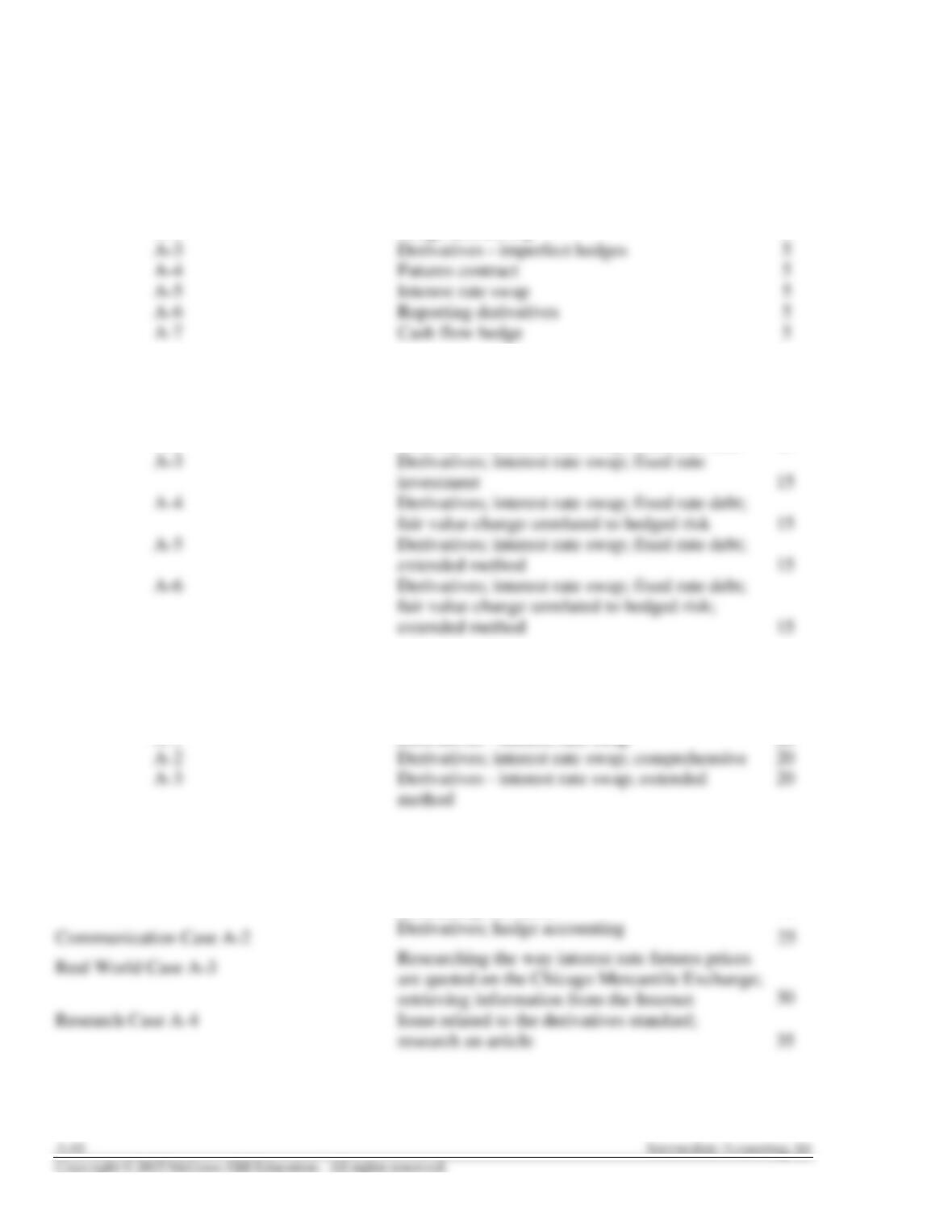
t
Est. time
Questions Topic (min.)
A-1
Derivatives
5
A-2
Hedge accounting
5
A-3
Derivatives – imperfect hedges
5
A-4
Futures contract
5
A-5
Interest rate swap
5
A-6
Reporting derivatives
5
A-7
Cash flow hedge
5
Est. time
Exercises Topic (min.)
A-1
Derivatives – hedge classification
15
A-2
Derivatives; interest rate swap; fixed rate debt
15
investment
15
fair value change unrelated to hedged risk
15
extended method
15
extended method
15
Est. time
Problems Topic (min.)
A-1
Derivatives – interest rate swap
20
A-2
Derivatives; interest rate swap; comprehensive
20
method
Est. time
Cases Topic (min.)
Research Case A-1
Disclosure of derivative risk; research article in
Accounting Horizons
45
Communication Case A-2
retrieving information from the Internet
30
research an article
35