73
CHAPTER
6
The Evolution of
Management and
Organization Theory
I. LEARNING OBJECTIVES
After reading Chapter 6 in the textbook, the student should be able to:
1. Explain the origins of public management by tracing the
development of management practices into principles and
describe the tenets of orthodox ideology and bureaucracy.
pp. 235–241;
252–255
II. SUGGESTED LECTURE
A. Early Influences upon Public Administration
The Roman military had the earliest and most pervasive impact on public adminis-
tration. Today, the lexicon of public administration employs many words, phrases,
B. The Significance of Administrative Doctrine
Management principles evolved from the military and relied upon authoritarian
structures. They required a governance system that focused on order, precision,
reliability, and obedience. A core set of principles promoted goal achievement,
74 The Evolution of Management and Organization Theory
CHAPTER 6
C. The Evolutionary Nature of Organization Theory
We have seen many theories of how organizations live and die, as well as how they
are changed and modified. The major groupings are:
1. Classical Organization Theory: Organization theory began with the authori-
tarian model offered by the military. It came into its own during the industrial
revolution. At this time workers had few firights,” which explains why its tenets
seem harsh. Adam Smith—the father of the discipline of economics—was the
first to set forth guiding principles for division and specialization of labor.
a. Scientific Management: As the organization function became more
a charismatic leader, and a value-free approach to social research.
2. Neoclassical Organization Theory was a later variation of the classical
rational-structural form. Its exponents sought to modify the mechanistic,
over simplistic views of the classical school. Herbert A. Simon was the first
75
III. Assessments
3. fiModern” Structural Organization Theory: Thomas Burns and G. M. Stalker
4. Systems Theory: Systems thinking is important to organizational theory
because the whole world is made up of interrelated organic and dynamic
systems. James Gleick made his famous observation of this in fiThe Butter–
fly Effect,” i.e., the fluttering of a butterfly’s wings in Tokyo may influence
5. New thinking about organizations now emphasizes networks and how orga-
nizations manage on the boundary. Some scholars such as Robert Agranoff
III. ASSESSMENTS
Multiple-Choice Questions
1. Which of the following is not a basic tenet of classical organization theory?
a. Organizations exist to accomplish production-related and economic
goals.
b. Production is maximized through specialization and division of labor.
c. People in organizations act in accordance with Nicolo Machiavelli’s
principles.
d. People in organizations act in accordance with rational economic
principles.
p. 244, c
2. The acknowledged father of scientific management and the author of
The Principles of Scientific Management was
76 The Evolution of Management and Organization Theory
CHAPTER 6
3. Administrative Theory began with:
a. authoritarian systems of management.
b. democratic systems of management.
c. laissez faire systems of management.
d. none of the above.
p. 239, a
4. Which of the following is Burns and Stalker’s contribution to organization
theory?
5. argued that organizations strive to maintain a state of dynamic
equilibrium through a process of adaptation. This person explained that
organizations self-regulate and adapt to survive.
a. Max Weber.
b. Norbert Weiner.
c. Catheryn Seckler-Hudson.
d. James Gleick.
p. 260–261, b
6. Which of the following is NOT included in Max Weber’s theory of the ideal
type bureaucracy?
7. The PODSCORB principles were closest to which of the following theorists?
a. Herbert Simon
b. Amitai Etzioni
c. Luther Gulick
d. Charles Lindblom
pp. 251, c
8. Adam Smith’s work on laissez faire capitalism posited all of the following,
except:
77
III. Assessments
9. The scholar who shattered the apparent politics-administration dichotomy
and held that politics is an integral part of administration was:
10. All of the following describe sociologist Philip Selznick, except:
a. He was a sociologist that argued organizations are not isolated from
11. Paul Appleby argued that:
a. apolitical governmental processes were antithetical to the American
experience.
b. politics and administration ought to remain separate.
c. administration is a skill only available to a few.
d. upper level management could be studied scientifically.
p. 251, a
12 Which of the following is true of fithe bureaucracy”?
a. It is the totality of the government.
b. It often refers to a general invective that refers to inefficient organizations
encumbered by red tape.
c. It often refers to all public officials of a government.
d. All of the above are true.
pp. 253–254, d
Chapter 6 Student Self Assessment Questions
Q1 Why is it that the profession of public management began and developed as
the profession of arms?
Q2 What is organization theory?
Q3 Robert Agranoff argues in his new work, Collaborating to Manage (2012)
that public bureaucracies must do what to begin true collaboration?
Q4 What is the distinction between organization theory and classical
78 The Evolution of Management and Organization Theory
CHAPTER 6
Q7 Which of the following is not one of the fundamental tenets of
organization theory?
Q8 The politics-administration dichotomy of the progressive era lost its
viability because of what?
Q9 What is the name of an organization theory that assumes human beings
satisfice because they do not have the intellectual capacity to
Q14 Which of the following is one of the major themes of the neoclassical
organization theorists?
Q15 What is the basic concept behind cybernetics in the systems theory?
Q16 Max Weber’s seminal work on Bureaucracy is not an fiadovocacy” work—
it simply analyzes why bureaucracy is the most likely form of organization
to survive over time. Which of the following is not a characteristic of his
ideal type of bureaucracy?
Q17 Which of the following is not one of the various meanings of
bureaucracy?
Q18 Which of the following is not among the basic assumptions of the
fimodern” structural school?
Q19 Catheryn Seckler Hudson’s early work on management, like other works
of the early modern period, provided a list of principles, but her work also
noted what warning?
Q20 Why is it that the principles approach to management, whether of the
civilian or military variety, was a pivotal development in the advancement
79
IV. Activities
IV. ACTIVITIES
Small Group Discussion Exercise: Management,
Intergovernmental Relations and Homeland Security
The Department of Homeland Security (DHS) faces exceptional challenges in over–
coming intergovernmental fragmentation, confusion, and potential ineffectiveness.
Discuss the challenges that the DHS faces in dealing with homeland security and
interagency coordination while not violating civil rights or taking power away
from state and local governments. How does the DHS affect intergovernmental
DHS through the lens of:
1. classical organization theory,
2. scientific management,
Which theory (or combination of theories) seems best suited to understanding the
work of Homeland Security?
Class or Small Group Exercise: The Large Consequence
of Small Courses
Read the following well-known poem by Benjamin Franklin from Poor Richard’s
Almanac (1758) (also on pp. 243–244):
For the want of a nail the shoe was lost,
Review fiThe Butterfly Effect” (p. 262 in textbook) fia butterfly stirring the air
today in Peking can transform storm systems next month in New York.”
Then, in small groups or on your own, construct answers to the following
prompts about systems theory and the consequence of organizational change:
1. The basic tenets of systems organization theory.
80 The Evolution of Management and Organization Theory
CHAPTER 6
4. How does a more educated workforce have a systems impact on the modern
organization?
5. How can leadership affect fidynamic equilibrium” in the organizational
system?
Discussion Issues with Instructor’s Notes
1. Enumerate the basic thinking of classical organization theory.
2. How does Adam Smith’s conception of division and separation of labor relate
to the classical model of organization theory?
3. Explain how Frederick Taylor’s fiscientific management” fits into this model.
Instructor’s Note: Instructors should refer to the explanation of classical
organization theory in the textbook. Adam Smith’s argument stated that to
4. Explain the two most significant contributions that Herbert Simon made to
organization theory.
a. Explain how the condition fisatisficing” comes about in public
policymaking.
b. Explain fisatisficing” in the context of your own work experience.
Instructor’s Note: Herbert Simon’s article on proverbs of administra-
tion challenged the idea of the leading scholars of his day that a principles
5. What did the term fibureaucracy” originally mean? What does the word
fibureaucracy” generally signify to the public today? Give an example of a
public agency that was highly bureaucratic in nature but is in the process
of visible change to a more competitive, innovative, and adaptable
model.
81
IV. Activities
Instructor’s Note: The term fibureaucracy” is used for the totality of
federal, state, and local government that continues irrespective of changes in
Individual Exercises
Critical Thinking: fiHow Do Public Sector Organizations Learn?”
Peter Senge’s theory about the learning organization was discussed in this chapter.
Senge’s argument is that in the modern climate of rapid change, only those orga-
Writing Exercises
Using one of the following key words or phrases of your choice, write a short
analysis linking the word or phrase from the scholarly text to an incident in your
workplace, your daily life, or a media report that you have heard.
bounded rationality bureaucracy
82 The Evolution of Management and Organization Theory
CHAPTER 6
Individual Assignment
You don’t often see a government org chart on the front page of a major newspaper,
but The LA Times is an example. see the following:
L.A. COUNTY SUPERVISORS MOVE
TO CONSOLIDATE POWER BY
WEAKENING CEO’S JOB
Abby Sewell, Contact Reporter
They are called the fifive little kings.”
Each represents a constituency of about 2 million people. Together, they
oversee America’s largest local government agency, with a $27-billion budget and
100,000 employees.
On Tuesday, the Los Angeles County Board of Supervisors decided to grant
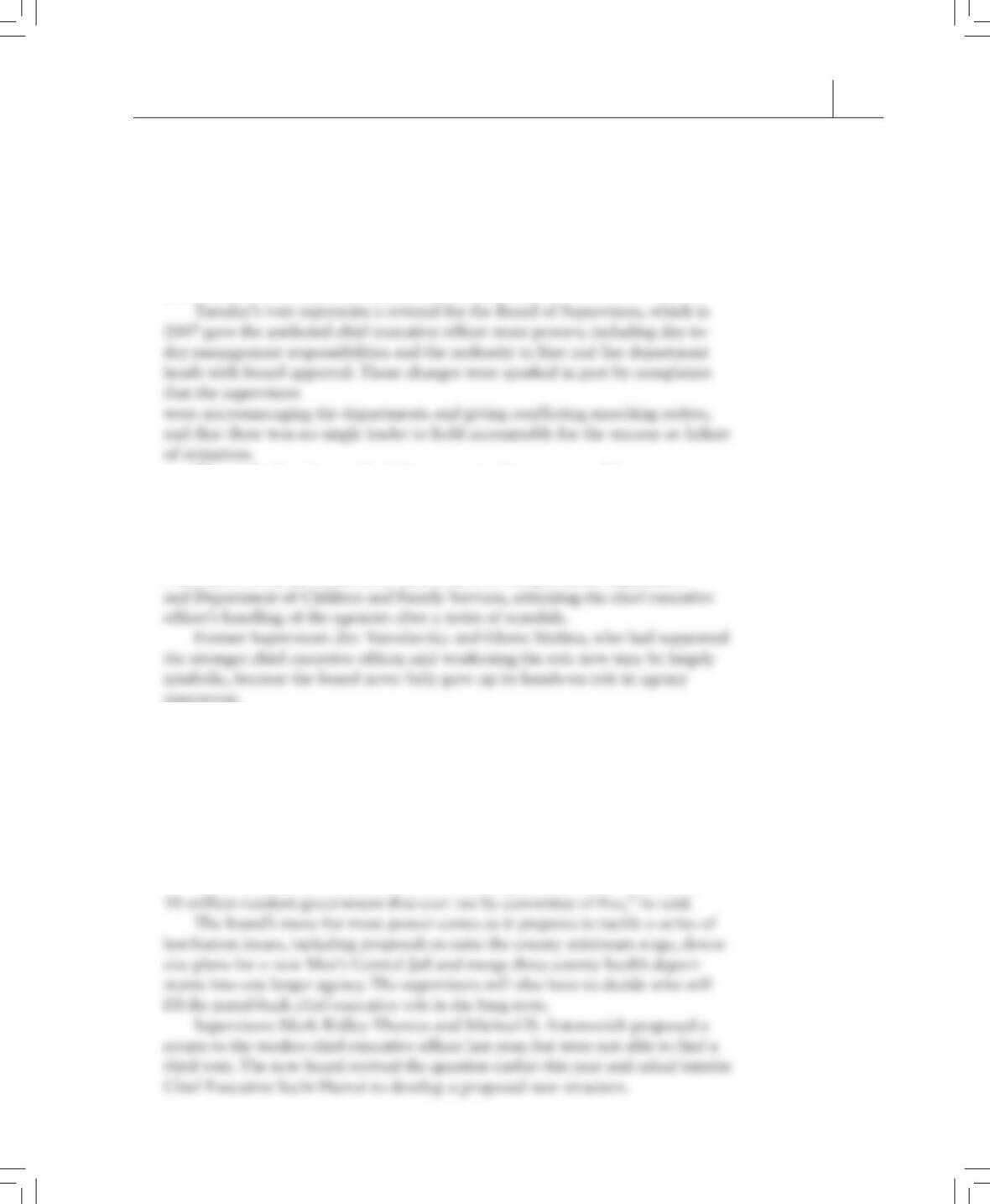
New chain of command
On Tuesday, the Los Angeles County Board of Supervisors voted to remove control of
departments from the county’s CEO and return it to the board.
Reports to board Reports to board
Before After
Board of Supervisors Board of Supervisors
83
IV. Activities
simply create more meddling by the elected officials and politicize the workings
of government.
fiIn the short term, there will be a lot less conflict between the supervisors
and the CEO’s office,” said Raphael Sonenshein, executive director of the Pat
Brown Institute for Public Affairs at Cal State L.A. fiThe question is what’s
it going to do for the daily operations. . . They won’t know when they’re too
involved. They’ll think their involvement is just right. The other shoe to drop is
how will it affect everybody else’s ability to do their job?”
The results have been mixed. An assessment by a county advisory com-
mission in 2008 found that the stronger chief executive officer structure had
increased collaboration between departments, but had also slowed down work in
some cases by adding another layer of bureaucracy. The commission found that
it also had increased tensions between the supervisors and the top administrator.
Three years later, the board took back control of the probation department
operations.
fiEverybody meddled. We all meddled, one way or the other,” Molina said.
Yaroslavsky agreed that board members had continued to micromanage—
even going as far as having their aides ghostwrite recommendations that were
supposed to be coming from department heads. He added that some initiatives
were stalled because of power struggles between supervisors and the chief
executive.
Yaroslavsky is now advocating for an elected county executive, a proposal
that has not found support among the current board members.
fiOutside of the former Soviet Union, Los Angeles County is the only . . .
84 The Evolution of Management and Organization Theory
CHAPTER 6
Along with returning direct authority over most departments to the board,
the new system will formalize other changes that have already been made under
the new board, such as eliminating five deputy chief executive officer positions.
In part, the drive to return to a weaker chief executive officer model stemmed
from a bitter feud between Ridley-Thomas and former Chief Executive Officer
William T Fujioka.
Fujioka declined to comment on the restructuring. Ridley-Thomas said the
new system will allow the county to fimaximize the efficiencies and the account-
ability for the delivering of services” to county residents.
Discussion Questions
Can you sort out the political issues from the managerial issues?
If you were an organizational consultant, how would you advise the county
V. ADDITIONAL WEB RESOURCES
Herbert A. Simon
www.psy.cmu.edu/psy/faculty/hsimon/hsimon.html
Simon earned an international reputation as one of the founders of artificial intelligence.
International Society for Performance Improvement (ISPI)
www.ispi.org
The ISPI works to improve productivity in the workplace. The site is dedicated to raising
85
V. Additional Web Resources
Max Weber’s home page
www.faculty.rsu.edu/~felwell/Theorists/Weber/Whome.htm
Weber’s many accomplishments, including theories, writings, and research, are neatly orga-
Fredrick Taylor Archive
www.stevens.edu/library/collections/fwtaylor.html
Taylor, often known as the founder of scientific management, had a great influence on devel-
Mckinsey
www.mckinsey.com/business-functions/organization
One of the leading business consultancies, they have a variety of studies and research reports