CHAPTER
4
Intergovernmental
Relations
I. LEARNING OBJECTIVES
After reading Chapter 4 in the textbook, the student should be able to:
1. Define intergovernmental relations and explain why they
pp. 145–149
2. Describe the constitutional features of US federalism, and
pp. 149–154
3. Analyze the formal structure of powers, roles, and relation-
pp. 154–162
4. State the meaning of fiscal federalism, explain the various
forms of grants and payments from one level of government
to another, and assess the impact of devolution on a federal
system.
pp. 164–176
II. SUGGESTED LECTURE
A. The Evolution of the US Federal System
The United States was originally a loose confederation of independent states that
delegated powers on selected issues to the central government. This kind of central
42 Intergovernmental Relations
CHAPTER 4
B. The Dynamic Structure of Intergovernmental Relations
Intergovernmental relations are like a marble cake, with the levels of govern-
ment intermingled within each other with blurred boundaries. The relationships
have evolved over the years via various understandings by the parties of the term
“federalism.”
1. Dual Federalism: This configuration no longer exists; however, in the last
century, branches of government could, and did, pretend that they were
functionally separate and working independently, but not against each other.
2. Cooperative Federalism: As its name suggests, this is a more collaborative
strong national government.
5. New New Federalism: An attempt at revenue sharing—to arrest the rising
fiscal burdens of many state and local governments, to help offset the fiscal
imbalances between states, and to use the accumulated budget surpluses.
When budgets became tighter and deficits increased, the policy—and
C. Intergovernmental Management
There are various concepts that illustrate intergovernmental management.
1. Picket Fence Federalism: Bureaucratic specialists represent the horizontal
pickets in the picket fence metaphor. They operate all along the federal, state,
43
II. Suggested Lecture
2. Councils of Government (COGs): Any multijurisdictional arrangements
across governments to provide for transportation, water, etc., that affect a
3. Cost of Compliance: Complying with the mandates of higher levels of
governments and other micromanagers can be costly to states and espe-
cially to the local governments. To address this issue, Congress passed the
Unfunded Mandate Reform Act of 1995, which declares that any future bill
D. Fiscal Federalism
Following the money: In the beginning of our federal system, states tended to have
more autonomy due to geographic distances between them and the center. The pic-
ture changed with advancements in technology and industry that overcame such
difficulties. The scene changed again due to program increases during the New
Deal and with social laws of the 1960s, such as the Civil Rights Act of 1964.
These laws and programs had mandates that had to be uniformly applied across
the nation (busing, welfare, etc.). One way to make the new programs palatable to
E. The Devolution Revolution
In 1994, Republican governors held a convention at Williamsburg, Virginia, to call
for the return of power from the federal government to the states in a document
44 Intergovernmental Relations
CHAPTER 4
known as the “Williamsburg Resolve.” It passed by an overwhelming majority.
Across the nation, however, many saw the “resolve” as somewhat hypocritical. It
appeared that the Republican governors were saying that they wanted free gifts
1. The Public Choice Solution: Public choice theory rejects the welfare eco-
nomics that arose out of the New Deal. It questions whether such federal
intervention really is the intent of the citizens. Its exponents feel that
2. Race to the Bottom: The ultimate devolution objective is to privatize goods
and services. However, who is to make up the gap that inevitably exists
when private enterprise cannot or will not provide goods and services to
certain segments of our society? What will this mean to our nation in terms
III. ASSESSMENTS
Multiple-Choice Questions
1. Which of the following is not a feature of a true federal system such as exists
in the United States?
a. A written constitution that divides governmental powers between a central
government and constituent governments, giving power to each.
b. Levels of government, through their own instrumentalities, exercising
power directly over citizens.
c. Subnational units acting directly on citizens while the central government
acts only upon the subnational units.
d. A constitutional distribution of powers that cannot be changed unilaterally
by any level of government or by the ordinary process of legislation.
pp. 145, c
2. The term “devolution” means:
a. a democratic revolution.
b. uploading power from the states to the federal government.
45
III. Assessments
c. returning power to subnational governments.
d. a. and b.
pp. 175–176, c.
3. Which of the following statements is not true?
4. Which of the following is not an advantage of a federal system of
government?
a. Greater scope for diversity and experimentation in policy.
b. A tendency toward policy incrementalism that is seen as integral to
democracy.
c. An ability to provide sufficient allowance for the needs of minorities.
d. A clear national direction without negotiation or conflict with subnational
states.
p. 151, d
5. Morton Grodzins’s famous example of a rural sanitarian who worked for
local governments while being paid by state governments based on standards
6. The form of government enjoyed by the citizens of the United States is
known as:
a. unitary government.
b. commonwealth of sovereign states.
c. federal system.
d. and c.
p. 149, c
7. Cooperative federalism
a. emerged during the New Deal.
b. is the notion that national, state, and local governments are cooperating.
c. both a. and b.
d. none of the above.
p. 155, c
46 Intergovernmental Relations
CHAPTER 4
8. The theory that government needs to spend money (“pump priming”)
during periods of economic decline was developed by:
a. Ronald Wilson Reagan.
b. John Maynard Keynes.
c. Harry Truman.
d. Theodore Roosevelt.
p. 156, b
9. Historically, the most common grant programs have been grants.
Since the Nixon administration, however, there has been an increase in the
use of grants, which give states more control of the use of federal
10. Which of the following is an example of creative federalism?
11. Which of the following questions concerning fiscal federalism is frequently
raised during elections?
a. Why shouldn’t local government pay for local services with its own tax
dollars?
b. Why can’t there be more block grants rather than categorical grants from
the federal government?
c. Why can’t the citizens of the states just keep their money rather than
paying it to the federal government so they can return it in grants and
services?
d. Why can’t the federal government simply take over the costs of areas
such as public transportation, road maintenance, and other functions
that severely drain the resources of the local governments?
p. 165, c
12. The theory that government action and resulting expenditures are best
placed at the local level of government is known as
47
III. Assessments
Chapter 4 Student Self Assessment Questions
Q1 Which of the following statements is not one of the features of a true
federal system?
Q2 What are the basic constitutional features of US federalism?
Q3 Where is the best place to find out which level of government will have
overall responsibility for what functions?
Q4 In looking over the list of top 30 nations, the majority of the world’s
population is governed by what type of government
Q5 What is fiscal federalism?
Q10 What was the impact of the comprehensive welfare reform bill passed by
the Congress in 1996?
Q11 Which statement best defines intergovernmental relations?
Q12 The phase of intergovernmental relations that sought to foster the
development of a singular Great Society by integrating the poor into
mainstream America is called what?
Q13 A mandate that states that a school lunch program must meet specified
national standards for nutrition is known as what?
Q14 While government remains the only player in society that has formal
authority to act in the name of “the people,” it has seen its responsibility
distributed to which other actors?
Q15 Since 2000, Which function comprises the largest source of outlays from
the federal government to state and local governments
Q16 In the McCulloch v. Maryland case of 1819, the Supreme Court upheld
the implied powers granted to Congress by the necessary and proper
48 Intergovernmental Relations
CHAPTER 4
Q21 Federalism, like most institutional forms of government, is a solution to,
or an attempt to solve, what type of problem?
Q22 What is the intergovernmental relations metaphor that holds that the
cooperative relations among the varying levels of government result in an
IV. ACTIVITIES
Individual Exercise: Critical Thinking—“Pedro Salazar
and the Thorny Issue of Illegal Immigration”
Immigration is an issue that closely involves intergovernmental relations between
the federal, state, and local governments. Consider the case of Pedro Salazar, an
unlawful immigrant who has managed to scale a high fence that separates Mexi-
cali in Baja California, Mexico, from Calexico in California, USA. If he falls and
Source: Professor Breena E. Coates, Department of Management, California State
University San Bernardino.
Instructor’s Note: Ask Students whether they see Morton Grodzins’ marble cake
metaphor at work here. Then have students divide into three groups and debate
49
IV. Activities
Group Exercise: The “Publius” Debate on Devolution
Group 1: The Thesis
Q “Less is More!”
Q “Washington must do less! States should do more!”
A group of lieutenant governors of midwestern and western states have come
together at the Sheraton Hotel in Scottsdale, Arizona, to formulate the “Publius
providing grant monies.
Group 2: The Antithesis
Q “The United States is a Republic”
A number of states and special interest groups disagree with this position and have
asked for a debate to precede the actual meetings. This was approved by the “Pub-
lius” group. Thus, another group of lieutenant governors from opposing states and
leaders of public interest groups have arrived to present the opposing view. They
elites in the system will gobble up even more of the benefits. Who, they ask, will
protect the rights of the poor and disadvantaged if the federal government is taken
out of the picture?
Debate Guidelines
Q Divide into two teams, assigning the thesis and antithesis positions.
Additional Discussion Issues and Instructor’s Notes
1. The Personal Responsibility and Work Opportunity Act of 1996, which
ended welfare as we knew it, is an example of devolution in action. Explain
the factors that lead to this major overhaul of welfare policy. Discuss
whether welfare reform has been successful. What are the advantages and
50 Intergovernmental Relations
CHAPTER 4
disadvantages resulting from the federal government’s disengagement from
this important issue?
Instructor’s Note: Welfare became such an intractable problem at the
federal level by the 1990s that Congress gave up on it and dumped the
2. Explain public-choice theory. What government service, in your opinion, is
best handled at the local level? Why?
Instructor’s Note: Public-choice theory really came about during the
presidency of Ronald Reagan and continued into the 1990s with a Repub-
Writing Exercises
Using one of the following key words or phrases of your choice, write a short anal-
ysis linking the word(s) or phrase from the scholarly text to an incident in your
workplace, your daily life, or a media report that you have heard.
accountability mandate
Bill of Rights block grant
51
IV. Activities
Thought Piece: “The Marble–Cake Metaphor”
Using Morton Grodzins’s expression of the marble-cake metaphor, explain how
cooperative arrangements between levels of government in the United States
complicate the management of policies and programs. Choose one public policy
or program of interest (e.g., law enforcement, education, criminal justice, etc.) to
explain the implications of the marble cake mingling of interests.
Instructor’s Note:
Case studies are often difficult to grade—here is a rubric we have used for the
Katrina Case study—which can help point the student towards a successful
analysis.
Introduction
This assignment is intended to acquaint you with the case study method
of teaching; something you will encounter in many of the courses you
take as part of this program. In a case study you are given information
about an actual situation. You must then identify the significant facts and
issues, consider the people involved and what their interests are, reflect
CASE STUDY
Hurricane Katrina—Lessons in
Contemporary Intergovernmental
Relations
52 Intergovernmental Relations
CHAPTER 4
Web–Based Discussion and Writing Assignment
Q Creating a new Vision for IGR for a mega mega city.
Q Read the linked article to the NYT about China.
Q Do you agree with the closing assessment ? Why or why not?
Wang Jun, a historian of Beijing’s development, said creating the new supercity
CHINA MOLDS A SUPERCITY AROUND BEIJING
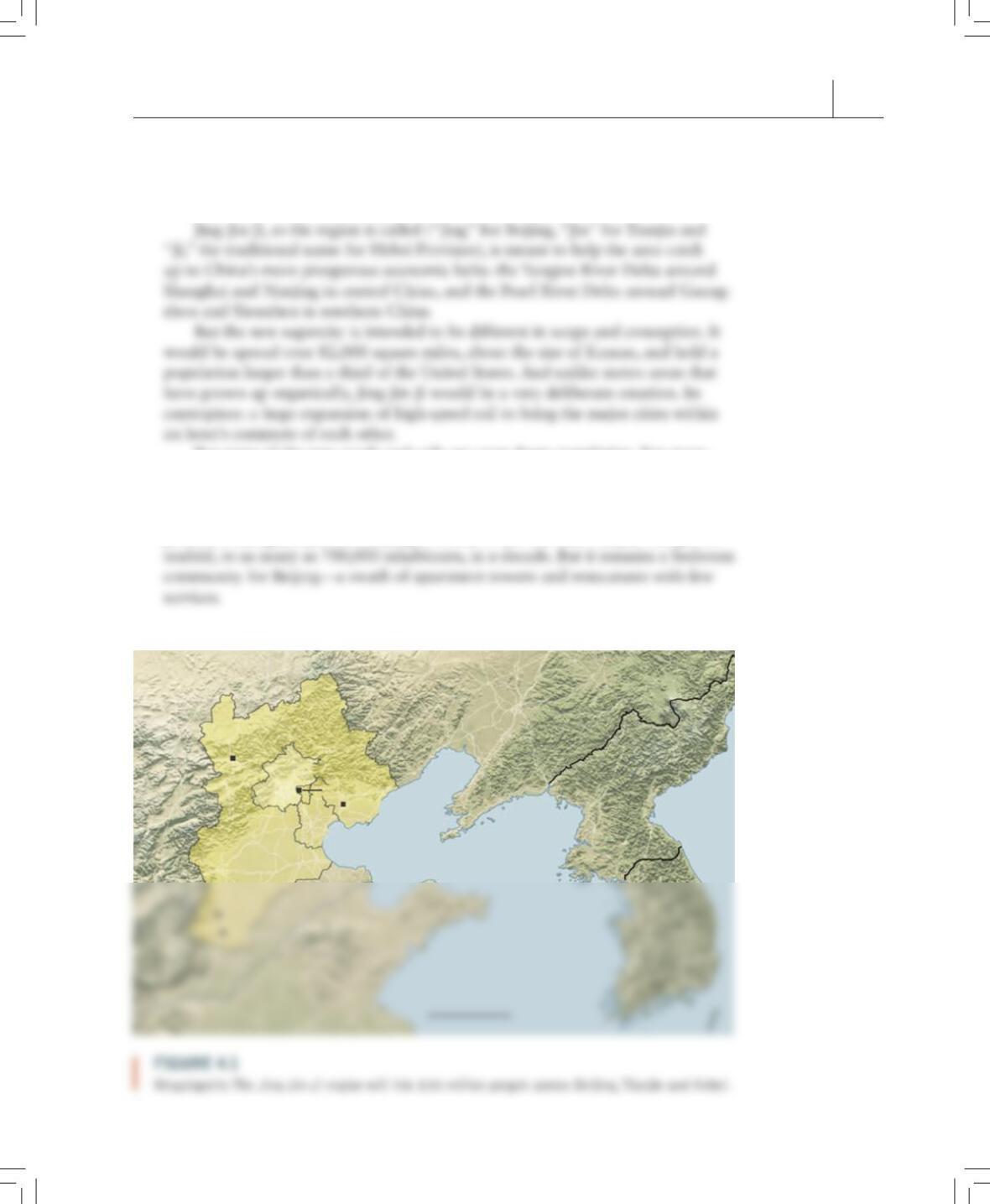
As Chinese officials are developing a megalopolis that will contain more than
130 million people, some suburban residents cope with difficult commutes and
shortages of public services.
By Jonah M. Kessel, New York Times , published July 19, 2015.
“There’s not much I can contribute to the family anymore,” Mr. Liu, 62, said
as his son waved goodbye from a bus window. “He is exhausted every day, so if I
can help him get a bit more rest, I’ll do it.”
The Liu family’s commuting habit is a small but telling part of a megacity in
the making.
For decades, China’s government has tried to limit the size of Beijing, the
capital, through draconian residency permits. Now, the government has embarked
on an ambitious plan to make Beijing the center of a new supercity of 130 million
people.
53
IV. Activities
This month, the Beijing city government announced its part of the plan,
vowing to move much of its bureaucracy, as well as factories and hospitals, to the
hinterlands in an effort to offset the city’s strict residency limits, easing conges-
tion, and to spread good-paying jobs into less-developed areas.
But some of the new roads and rails are years from completion. For many
people, the creation of the supercity so far has meant ever-longer commutes on
gridlocked highways to the capital.
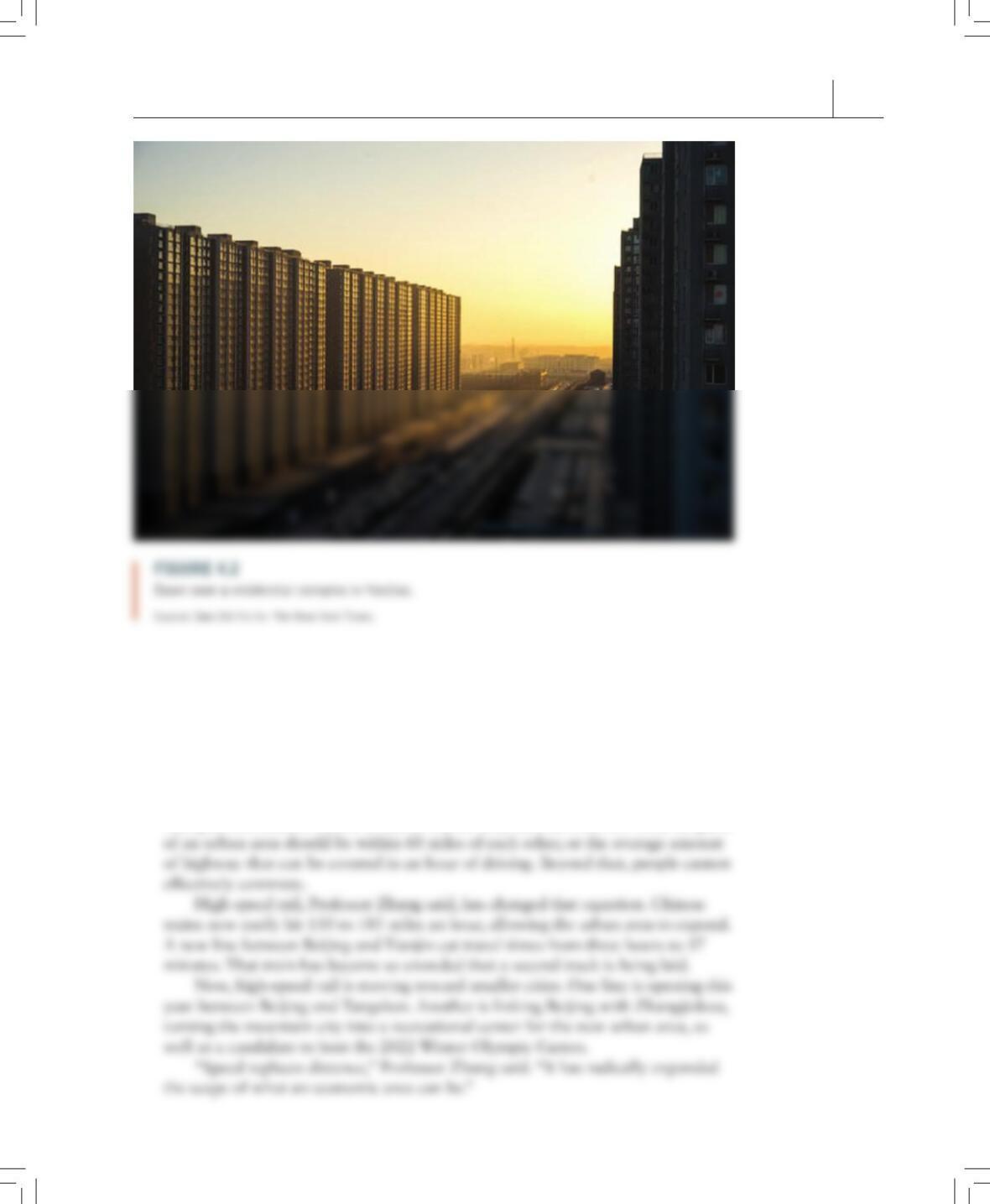
Encouraged by Hebei Province’s relatively open residency policies and inex-
pensive housing, people are flocking to suburbs like this one. Yanjiao has grown
54 Intergovernmental Relations
CHAPTER 4
Many believe that the transportation woes will sort themselves out, given
enough time and money. A subway and better light rail are planned to open in
three to five years, and a new bridge over the Chaobai River to Beijing is under
construction.
More worrying for many Yanjiao residents is the dearth of hospitals and
schools.
But the city has no bus terminals, no cinemas and only two very small parks.
“The streets flood in the rain because there is no good drainage,” said Xia Zhi-
yan, a 42-year-old employee of a printing company. “They just built more and
more apartments without the most basic facilities.”
Even by the cheek-by-jowl standards of Chinese public spaces, Yanjiao’s
main park is hopelessly crowded. On a recent Sunday afternoon, in-line skaters
bumped into each other at a strolling speed, kite lines crossed in the air and older
men politely jostled each other as they practiced calligraphy with water brushes
on the sidewalk.
Infrastructure has also lagged. Until recently, high-speed rail failed to connect
many vital cities around Beijing, while many roads did not link up. Planning reports
say the area has 18 “beheaded” highways—major arteries built in one of the three
districts but not linked to others. One highway ends at a bridge over the mostly
dried-out river dividing Yanjiao from Beijing, and has remained unfinished for years.
But several factors are making Jing-Jin-Ji a reality. The most immediate is
President Xi Jinping, who laid out an ambitious plan for economic reform in
2013 and has endorsed the region’s integration.
55
IV. Activities
Beijing is shifting much of its city administration to the Tongzhou suburb,
ending the longstanding practice of putting government offices in the old imperial
district.
The plan has started to drive up property prices in the suburbs, according to
local news reports.
Improving the infrastructure, especially high-speed rail, will be critical.
According to Zhang Gui, a professor at the Hebei University of Technology, Chi-
nese planners used to follow a rule of thumb they learned from the West: all parts
56 Intergovernmental Relations
CHAPTER 4
Wang Jun, a historian of Beijing’s development, said creating the new super–
city would require a complete overhaul of how governments operated, including
instituting property taxes and allowing local governments to keep them. Only
V. ADDITIONAL WEB RESOURCES
National Association of Counties
www.naco.org
This site presents information from the only national organization that represents county
National Association of Regional Councils (NARC)
www.narc.org
The NARC promotes regionalism as the most effective way to provide services and address
National Conference of State Legislatures (NCSL)
www.ncsl.org
The most comprehensive collection of information regarding state laws and policies, the
NCSL site provides comparative data on state policies in a number of areas, including bud-
National Governors Association (NGA)
www.nga.org
The organization is a public policy group that represents the nation’s governors. The site
gives information about the governors as well as current news that deals with their offices.
Publius: The Journal of Federalism
www.oxfordjournals.org/our_journals/pubjof/index.html
The site allows online access for Publius, considered to be the foremost journal on federal-
57
V. Additional Web Resources
Council of State Governments
www.csg.org
Founded in 1933, The Council of State Governments is our nation’s only organization serv-
Governance
www.governancejournal.net
One of the top rated journals with a strong global perspective— Governance is published