CHAPTER
1
Defining Public
Administration
I. LEARNING OBJECTIVES
After reading Chapter 1 in the textbook, the student should be able to:
1. Examine how Public Administration is defined as a field of
pp. 6–23
2. Trace the history of the evolution of the public service in the
United States and compare how different concepts of admin-
istration and civil service have set the stage for modern public
administration at the federal, state, and local government levels.
pp. 24–30
3. Explain how public administration has developed as a
pp. 20–23;
II. SUGGESTED LECTURE
A. Defining Public Administration
A single ineluctable definition of the term fipublic administration” will not suffice,
because the field encompasses a complex set of interrelated concepts. It also draws
B. Analyzing the Definitions of Public Administration
1. Political—Public administration is what government does, within its polit-
ical environment. It is this political context that makes it fipublic.” Public
2Defining Public Administration
CHAPTER 1
administration is about implementation of the public interest. It is also about
doing collectively what cannot be done as well individually.
2. Legal—The foundations of public administration in the United States are
based on law, and are bound by legal decrees. Public administration is law
C. Public Administration is an Academic Field
Public administration within an academic interdisciplinary context draws primar–
ily from political science, law, and management. It also incorporates other fields in
the social, behavioral, and natural sciences, including economics, sociology, anthro-
D. Public Administration is Both an Old and a Young Discipline
The earliest civilizations—Egyptians, Babylonians, Chinese, Greeks, Romans, and
others provided guidance on the art and science of management. Our focus in
this textbook, however, is on the occupational specialty and academic discipline
of American public administration in recent times. As a scholarly discipline, public
E. Public Administration and the Cycles of Reform
Public administration is continuously reforming itself, depending on the prevailing
political climate and theories within the academic disciplines that bear upon it.
3
III. Assessment
Some presidents have criticized government itself as the problem in society and not
as the solution to public problems. In the 1990s, and specifically under the Clinton
III. ASSESSMENT
Multiple-Choice Questions
1. The authors define public administration in:
a. one single definition.
2. In 1955, Dwight Waldo was the first to insist that analysts fisee administra-
tion in terms of its environment,” meaning essentially that:
a. similar administrative acts may be performed differently in different
3. This individual argued that there was a need for a science of administration:
a. Leonard White
4. When public administration is said to be the fiking’s largesse,” this is an
example of:
a. the divine right of kings.
b. a big-city political machine that dispenses benefits, favors, aid, and
assistance.
c. the regulatory role of public administration.
d. the duties of the public administrator.
p. 13, b
5. Government regulation means that government creates:
a. policies to control the social and economic activities of the citizenry.
4Defining Public Administration
CHAPTER 1
6. Which of the following is NOT among key assumptions for the study of
public administration, according to Leonard White?
a. Administration is a unitary process that can be studied uniformly at mul-
tiple levels of government.
7. You have learned that public administration is a profession. Professions
are characterized by specific criteria. To be defined as a profession, public
administration must meet three criteria. Which of the following statements
does NOT represent one of these criteria?
a. A body of academic and practical knowledge that is applied to the ser–
vice of society.
8. When some public administrators have described public administration as
being fiMickey Mouse,” we are referring to:
a. the merit system.
b. the fired tape” that can exist in public administration.
9. The author of the first introductory textbook in public administration, in
1926, was:
a. David Lillienthal.
10. The mystical ficity upon a hill” reference that originated with John Winthrop
in the 1630s and has been repeated in varied forms by Presidents Kennedy,
Reagan, and Obama is an example of:
11. The founding father of public administration who wrote the essay fiThe
Study of Administration,” which laid the foundation for the science of pub-
lic administration was:
a. Thomas Jefferson.
12. Administrative law is focused on:
a. correctness of procedures that agencies use in exercising their authority.
b. the totality of executive directives, and constitutional, statutory, and
Chapter 1 Student Self Assessment Questions
Q1 What is an example of direct public administration?
Q2 What is an example of indirect public administration?
Q3 Privatization of government services became popular during which
presidential administration?
Q7 Which of the following is an example of administrative law?
Q8 What is an example of the Supreme Court decision in the case Kelo v.
New London ?
Q9 Which of the following is an example of redistributive policy?
Q10 How are the ancient Code of Hammurabi and today’s government
6Defining Public Administration
CHAPTER 1
Q15 Who was one of the authors of the Federalist Papers ?
Q16 How are President Barack Obama and President John F. Kennedy
similar?
identity crisis?
Q20 Why does the textbook claim that Public Administration is now more
interdisciplinary as a field of study and a discipline?
Q21 The size of the public workforce has changed in the last 25 years—
which best describes the historical trend for federal, state, and local
governments?
Q22 In 2014 most of the employees in the United States public sector
(federal, state, and local) were employed in what occupation
function?
IV. ACTIVITIES
Class Exercise: Privatization—For and Against
Team A: Bureaucrats and Citizens (Against Privatization). Team B: Bureaucrats and
Big Business (For Privatization). Moderators: two, one from each Team.
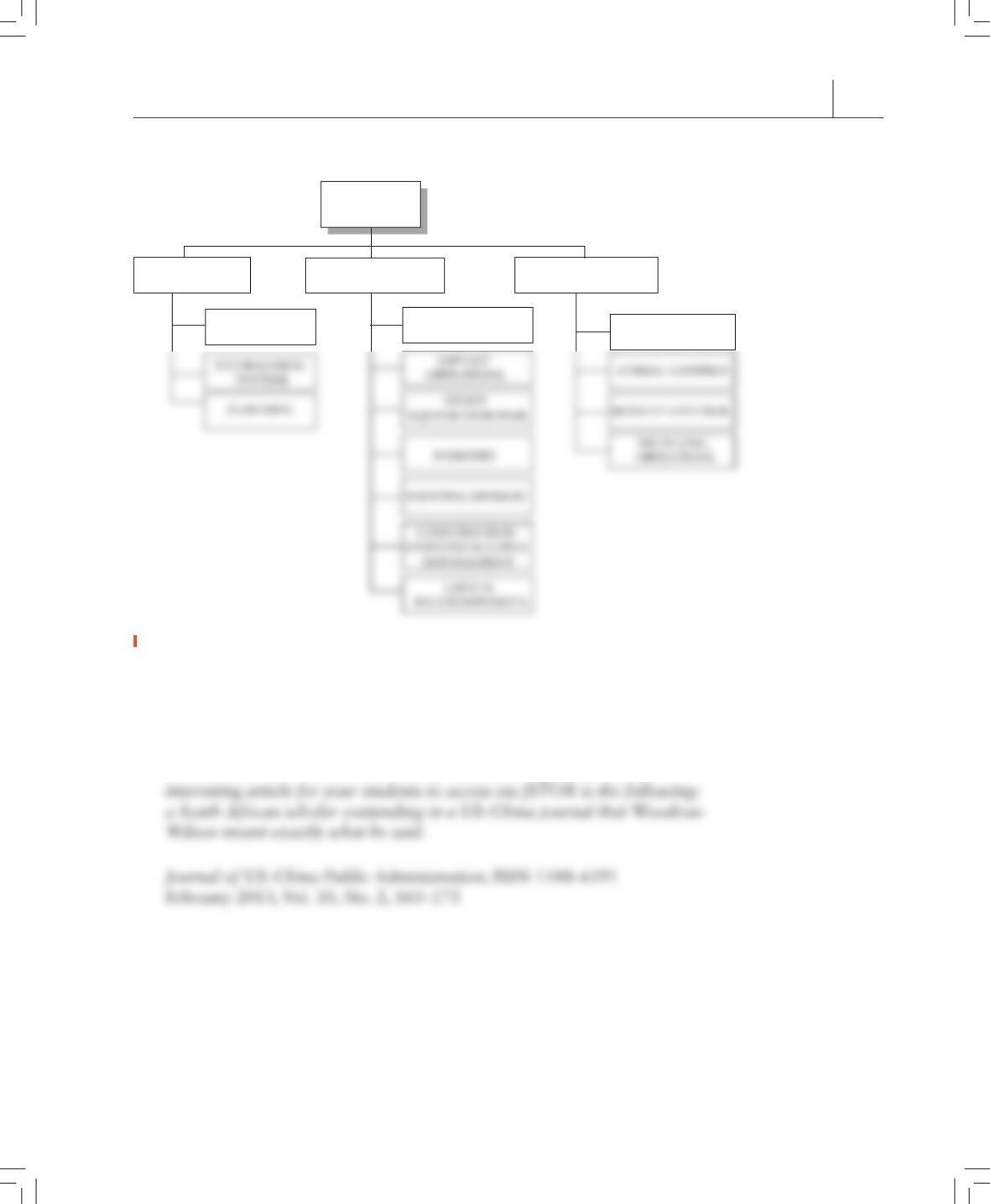
Issue: Privatization of the Department of Public Services of the city of White
Bluff, Oregon. Organizational chart for areas of service attached.
7
IV. Activities
Discussion Questions
1. Politics–Administration Dichotomy. Can partisan politics and administration
really remain separate in public bureaucracies?
Instructor’s Note: The PA Dichotomy continues to generate debate—an
THE POLITICS–ADMINISTRATION DICHOTOMY:
WAS WOODROW WILSON MISUNDERSTOOD
OR MISQUOTED?
Dominique E. Uwizeyimana
University of Limpopo, Limpopo Province, South Africa
DEPARTMENT OF PUBLIC SERVICES
(White Bluff, Oregon)
DIRECTOR
ADMINISTRATION BUREAU OF PUBLIC
WORKS OPERATIONS
ENVIRONMENTAL
SERVICES OPERATIONS
ACCOUNTING
MAINTENANCE
OPERATIONS
COLLECTION
DIVISION
FIGURE 1.1
8Defining Public Administration
CHAPTER 1
Abstract
Literature which explored the theories of fipolitics-administration dichotomy”
remains divided as to whether Woodrow Wilson was the author of the politics-
2. Power Issues in the Bureaucracy. What is the difference between special
interest power and public interest power? What is the relative power between
special interests and public interests in the political arena? (These questions
are more fully discussed in Chapter 2.)
3. Ethics Issues. Is it ever acceptable for public administrators to fidirty their
hands” for the public good? (Ethical issues are more fully discussed in
Chapter 5.)
Instructor’s Note: Questions 1 through 3 pull together a number of
4. List and explain four ways in which public administration has affected your
life on the local, state, and federal level in the last year.
Instructor’s Note: Instructors should let students talk. The four
5. Explain how rules expand our understanding and compliance with the law.
The authors note that public legislation and its administration is continu-
ously undergoing cycles of reform. What, in your opinion, is most in need of
reform in government in present times?
9
IV. Activities
6. fiPolitical language . . . is designed to make lies sound truthful and murder
respectable, and to give an appearance of solidity to pure wind.” Explain
the above quote from George Orwell, using examples you may have seen in
recent times. Can lies for the public good ever be justified, in your
opinion?
Instructor’s Note: The instructor can explain that political language is
geared to justify positions, not necessarily to communicate the truth. Euphe-
7. Investigate the Department of Homeland Security of the United States
and its equivalent in your home state. How are these offices organized
to manage national security in the United States? How do the multiple
approaches to understanding public administration map onto the manage-
ment of security concerns across multiple levels of government and
multiple agencies?
Instructor’s Note: Homeland security is a useful example to demonstrate
Writing Exercises
Using one of the following key words or phrases of your choice, write a short
analysis linking the word(s) or phrase from the textbook to an incident in your
workplace, your daily life, or from a media report that you have heard.
The New Deal Lobby
10 Defining Public Administration
CHAPTER 1
Group Exercise
Critical Thinking: fiIs Government Regulation Necessary?”
There are many laws and agencies that regulate how businesses operate. For exam-
ple, the Environmental Protection Agency (EPA) regulates air emissions, water
and land pollution. The Food and Drug Administration (FDA) regulates food and
pharmaceutical quality and safety, the Sarbanes Oxley Act regulates accounting
practices in organizations, etc. It seems to many people that each year the list of
regulations and regulatory agencies gets larger. Some people, Libertarians in partic-
ular, call for less government regulation and many businesses also argue in similar
fashion. Others say that without government regulation, people and businesses
would promote their own self-interest and cite the Tragedy of the Commons.
Instructor’s Note: Divide the class into two groups. Group 1: Argue for the proposi-
tion that without government regulation people—especially those with lesser voices
Source: Professor Breena E. Coates, Department of Management, California State
University, San Bernardino.
Facing pressure to crack down on crime amid a record budget deficit, Oakland
is joining other US cities that are turning over more law-enforcement duties
to private armed guards. In 2009, the Oakland City Council voted to hire
International Services Inc., a private security agency, to patrol crime-plagued
CASE STUDY Privatizing Police Forces
11
IV. Activities
Discussion and Writing Assignment
Government Power and Authority: The Issue of Eminent Domain
Using Blackboard, Moodle, or another online venue, use the following case for dis-
cussion on government power and authority. As a group or as a discussion between
two individuals, take the following positions:
A. The citizens who held out against the city to keep their homes
Summarize your arguments into a written paper of two to three pages.
On June 23, 2005, the Supreme Court ruled in Kelo v. New London that the
fipublic use” provision of the fiTakings Clause” of the Fifth Amendment of the US
Constitution permits use of eminent domain for economic development purposes
THEY CAN TAKE IT IF THEY WANT IT
by Edward Glaeser
Most states passed laws to restrict eminent-domain takings after Kelo. They won’t
do us any good.
What limits should be placed on the public power to take private property?
Questions
1. Do you think that privatization of public services is a good thing? Why
or why not?
12 Defining Public Administration
CHAPTER 1
arena of ideas. When the Supreme Court ruled in favor of New London’s land
grab, the public was furious. Over the next two years, according to a report by
the anti-eminent domain Castle Coalition, 44 state legislatures fipassed new laws
aimed at curbing the abuse of eminent domain for private use.”
Yet in reality, the public power to take private property for almost any pur–
THE GRASPING HAND
By Ilya Somin
Chicago, 356 pages, $30
The Kelo case arose because the state of Connecticut and the nonprofit New
London Development Corp. (or NLDC) wanted to attract pharmaceutical
giantPfizerto New London to provide an economic jolt to that post-industrial
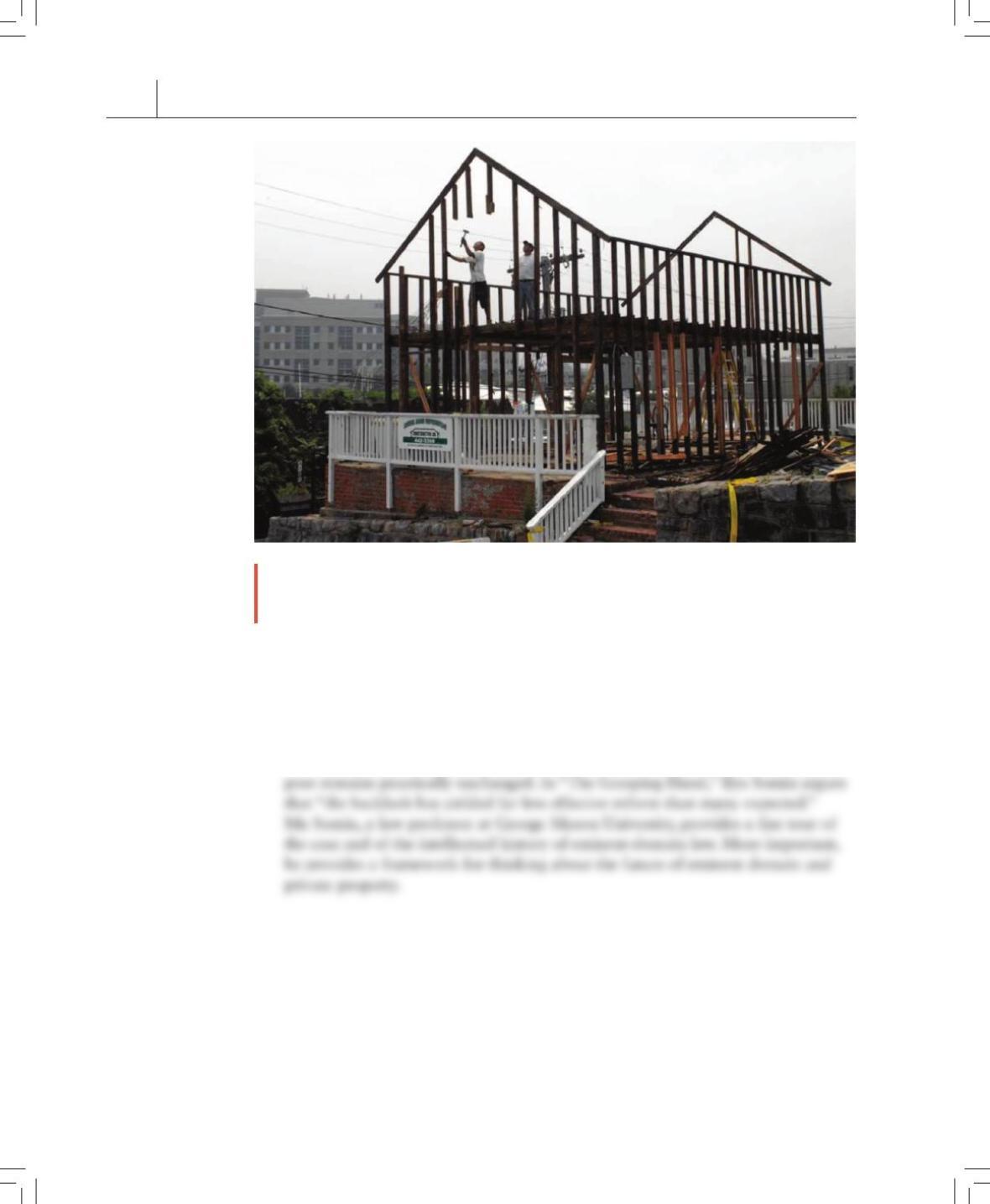
FIGURE 1.2
Susette Kelo’s house in New London, Conn., being dismantled.
Photo: Associated Press
13
IV. Activities
Susette Kelo owned a little pink house on the Fort Trumbull peninsula. When
the NLDC tried to take her (and her neighbors’) land using eminent domain, the
case went all the way up to the Supreme Court.
It was an ideal poster child for the argument in favor of limiting eminent
domain. One study found more than 10,000 examples of fiactual or threatened
condemnation for private parties between 1998 through 2002.” Out of all these,
build a new headquarters in New London.”
The land grab looked even worse because the leader of the NLDC, the non-
profit that took the land, was married to a Pfizer executive, who told the Hartford
Courant in 2001 that fiPfizer wants a nice place to operate.” I share Mr. Somin’s
belief that the corporation chief figenuinely believed that she was acting for the
public good and was not simply trying to advance the private interests of Pfizer.”
Still, it didn’t look great.
Moreover, as public policy, the plan looked bad. The use of tax breaks and
Other such eminent-domain-abetted economic development projects, such
as Detroit’s 1981 seizure of the Poletown neighborhood for a General Motors
factory, look equally unwise.
Yet the US Supreme Court supported the New London taking by a 5–4
margin. And to the more than 80 percent of Americans who disagreed—including
both Rush Limbaugh and Ralph Nader—the court appeared to be radically rede-
fining property rights. According to Mr. Somin, this view is wrongheaded.
14 Defining Public Administration
CHAPTER 1
Eminent domain cases all look back to the Fifth Amendment, which states:
finor shall private property be taken for public use, without just compensation.”
The Due Process clause of the 14th Amendment extended this right to takings
by state governments. Mr. Somin provides new evidence supporting the view
that 19th-century courts often held a narrow definition of fipublic use” that
would have excluded economic development. Hence an originalist approach
in Kelo could have led the Supreme Court to reject the New London taking. Yet
a sudden judicial shift restricting eminent domain would have also been a radical
break with recent precedent—and a power grab, moving authority from local
governments to federal courts.
If property owners like Susette Kelo are to be protected, we need both
judicial and legislative action. The simplest reform—a blanket ban on eminent
domain—is off the table: No US government will ever abjure the power to take
land, which is clearly accepted in the Bill of Rights. But there are many more
modest limitations that could be instituted.
This last option is hard, because the government can so easily manufac-
ture alternative justifications. If we ban the economic-development rationale
used in Kelo , grasping governments will just try to define the desired property
15
V. Additional Web Resources
I am even less enthusiastic about proposals to ban takings that transfer land
to private entities. There is no reason to restrict the private provision of public
services. A taking that expands an underperforming public school is surely worse
than an identical one that expands a far better charter school. We should not shut
down the option of using eminent domain to build privately operated highways
or sewage systems.
V. ADDITIONAL WEB RESOURCES
American Society for Public Administration
www.aspanet.org
The American Society for Public Administration, which has been representing the public ser–
those interested in working in the public service field.
Association for Public Policy Analysis and Management
www.appam.org
This organization offers a multidisciplinary annual conference that attracts the highest-
American Political Science Association (APSA)
www.apsanet.org
This is a reference site for scholarly information about the field of political science. Members
of the organization have access to scholarly journals and articles through the site. It also con-
tains information about conferences and gatherings organized by APSA to promote political
science and research in the field.
16 Defining Public Administration
CHAPTER 1
National Association of Schools of Public Affairs and
Administration (NASPAA)
www.naspaa.org
The NASPAA serves as a national and international resource for the promotion of excellence
in education and training for public service. Its institutional membership includes more than
International City Management Association (ICMA)
http://icma.org/en/icma/home
For students with an interest in local government, ICMA is the premier organization for
city managers and city government career professionals. ICMA also has extensive materials
and informational assets on leadership and professional ethics. You can register to receive
regular updates via ICMA SmartBrief: icma@smartbrief.com
Association for Research on Nonprofit Organizations
and Voluntary Action (ARNOVA)
GovManagement Daily
www.govmanagement.com
Associated with ASPA, GovManagement Daily is a free e-mail newsletter—basically a clip-