Case Study III-5
213
Teaching Note on Case Study III-5
Objectives
The main objectif of this case is to illustrate how a mid-sized manufacturing company effectively
implemented a full suite of ERP modules with the help of a third-party consultant and excellent
change management practices. Specific learning points could include:
Key project milestones and the project roles that need to be played
Overview
NIBCO is a privately-held manufacturing company with annual revenues close to $420 million
and more than 3000 employees. In 1995, it had 10 plants and 17 distribution centers in the U.S.
stovepipe information systems would not support the type of cross-functional operations that the
company wanted. A consulting firm helped the company develop a strategic information systems
should replace its legacy systems with common, integrated systems over a 3- to 5-year timeframe.
Case Study III-5
214
planning, sales and distribution). The human resources module was also purchased at this time,
but would be implemented later.
The case describes the legacy IT environment, the ERP purchase and implementation partner
choices, the selection and composition of what came to be called the TIGER team, the workspace
design for the project team (TIGER den), the key issues addressed by each project sub-team, the
incentive scheme, and the complexity added by a distribution center consolidation initiative that
runs behind schedule.
Epilogue
As the project leads had warned, NIBCO did experience a major dip in productivity in the first
months after Go Live. As Beutler was quoted by Craig Stedman as saying in a ComputerWorld
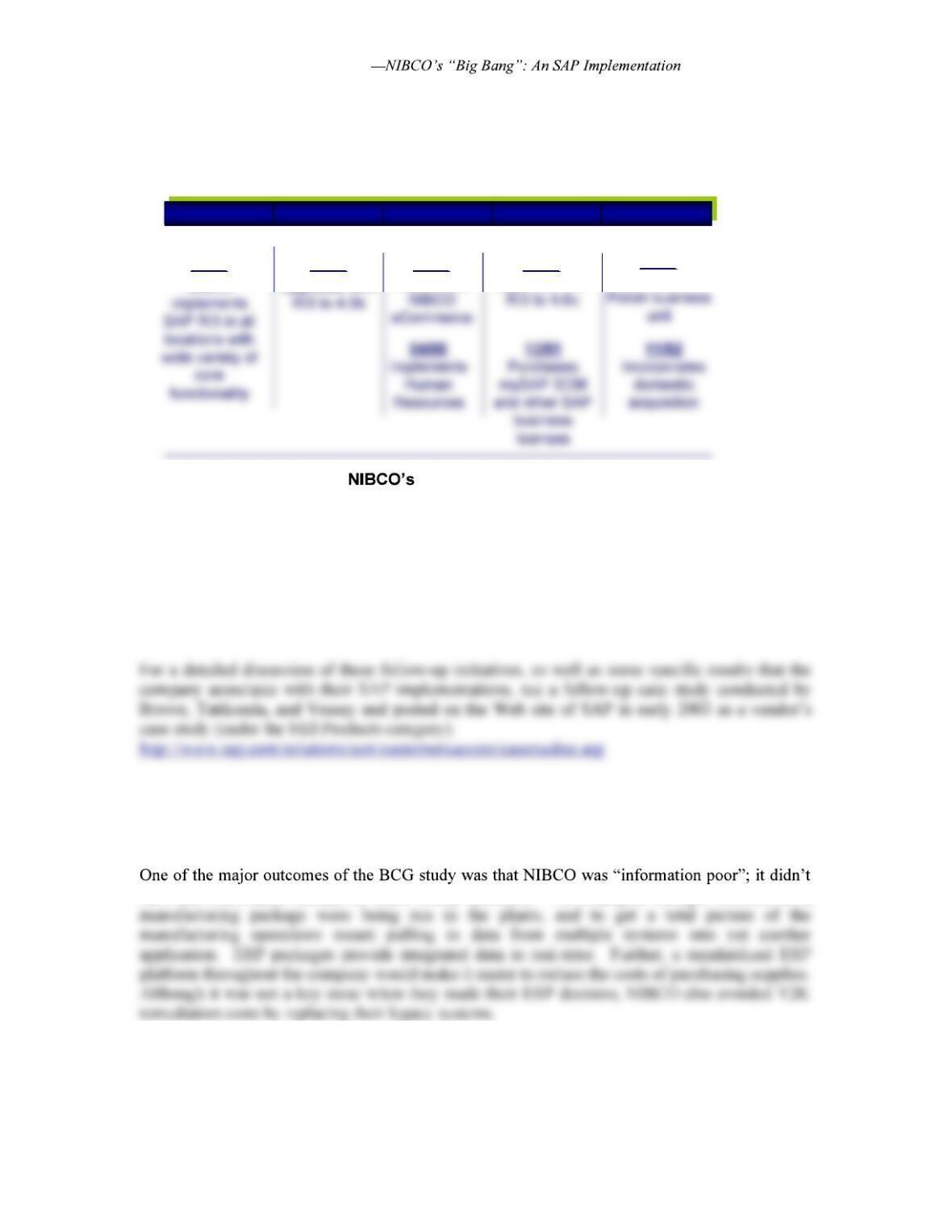
Since its Big Bang implementation, the company has continued to be proactive in its ERP
initiatives and has conducted six major projects. Two of these projects were to implement new
Case Study III-5
215
1998
1998
01/98
NIBCO
03/99
Upgrades SAP
01/00
Implements
03/01
Upgrades SAP
1999
1999 2000
2000 2001
2001 2002
2002
05/02
Incorporates
Exhibit 1: Timeline of Major Projects Following SAP R/3
Implementation
In addition, the knowledge transfer that was so important during the project itself has resulted in a
strong core of expertise within the IS organization that continues to pay dividends. An April
2000 business intelligence report for NIBCO management benchmarked the firm as an IT leader
within its industry.
Questions for Discussion
1. Why did NIBCO decide to purchase an ERP system?
have the information needed to make timely decisions. For example, multiple versions of a
216
2. Why did it choose a Big Bang approach, rather than the 3-to-5 year plan suggested by the
consulting firm?
The conversion strategy options for NIBCO included: 1) Big Bang (in which all but the HR
module would be implemented throughout the company at one time); 2) phased (in which certain
modules usually support modules such as finance and accounting, or human resources modules,
3. Describe the pros and cons of a Big Bang approach, versus a less risky rollout strategy. If
you had been the IS head at NIBCO, what approach would you have recommended and
why?
A Big Bang (or cutover) approach is especially risky for ERP projects with a full suite of
4. A triad of managers led the NIBCO approach. What do you see as the pros and cons of
this approach?
5. Describe the project team roles and the characteristics of the team members sought to fill
these roles.
Three sub-teams were set up with responsibility for the major modules: 1) sales and distribution,
217
6. Comment on the number of key managers that were selected to serve on the project team,
and whether this was a success factor or not.
7. Critique the change management initiatives associated with this project.
Attention to managing the organizational changes related to the project is particularly important
in a Big Bang implementation because the whole company has to be ready to change at the same
8. Critique the distribution center consolidation plan in terms of increasing or lessening the
risks of the ERP project implementation.
9. Using the five success factors described in Chapt
was conducted.