Case Study I-5 Data Governance at InsuraCorp
Teaching Note on Case Study I-5
Data Governance at InsuraCorp
Objectives
management issues for which business managers, IS managers, or both are responsible. In particular, the
Overview
InsuraCorp is a financial services company with three major lines of business that have grown through
acquisitions. Under a new CEO, there has been a new focus on achieving cross-business unit synergies,
including the cross-selling of products. To support a single point of contact for customer sales, IT
standards initiatives have become major priorities for the business.
In previous years, each of three business units had its own IT unit and an IT Vice President that reported
directly to its business executives. In early 2006 essentially all IT resources were centralized under a new
CIO. The former IT VPs for the business units were still the key contacts for the business leaders of the
three divisions, but after centralization these IT VPs now had a solid-line report to the CIO and a dotted-
line report to the business division.
The new CIO also established a set of IT principles that defined the new IT role in the organization and
provided guidelines for decisions about IT resources. For example, purchased systems would now be
The remainder of the case describes some of the challenges faced as part of the EDR project. For
example, data inconsistencies across different source files raised not only data standardization issues, but
also data quality concerns.
At the end of the case, several questions are raised about where in the organization (business managers, IS
managers, or both) the responsibility should lie for:
2. Employee access to specific data sets.
4. Data security.
Case Study I-5 Data governance at InsuraCorp
68
Questions for Discussion
1. What business strategy change led to the decision to centralize the IS organization personnel and
other IT assets?
To sell a product sold by one business unit to the same customer of a different product sold by a different
2. How will Principles #11 and #14 (in Exhibit 2) enable the new business strategy?
– Principle #11: We will favor integrated solution sets over separate stand-alone solutions.
This principle signals a major change in the criteria to be used for developing or purchasing new
–
owner.
This principle specifically points to the EDR initiative that was implemented in 2006. The objective of
3. Give an example of a data quality problem that was identified. Why was this problem not
identified earlier?
Data quality problems from a specific source file, as well as across source files, are referred to. For
4. At the end of the case, several data governance questions are raised. Choose any two of these and
provide a rationale for whether IS managers, business managers, or both should be responsible for
this type of data governance.
[Note: The questions at the end of this case study are designed to promote a class discussion of several
Case Study I-5 Data governance at InsuraCorp
69
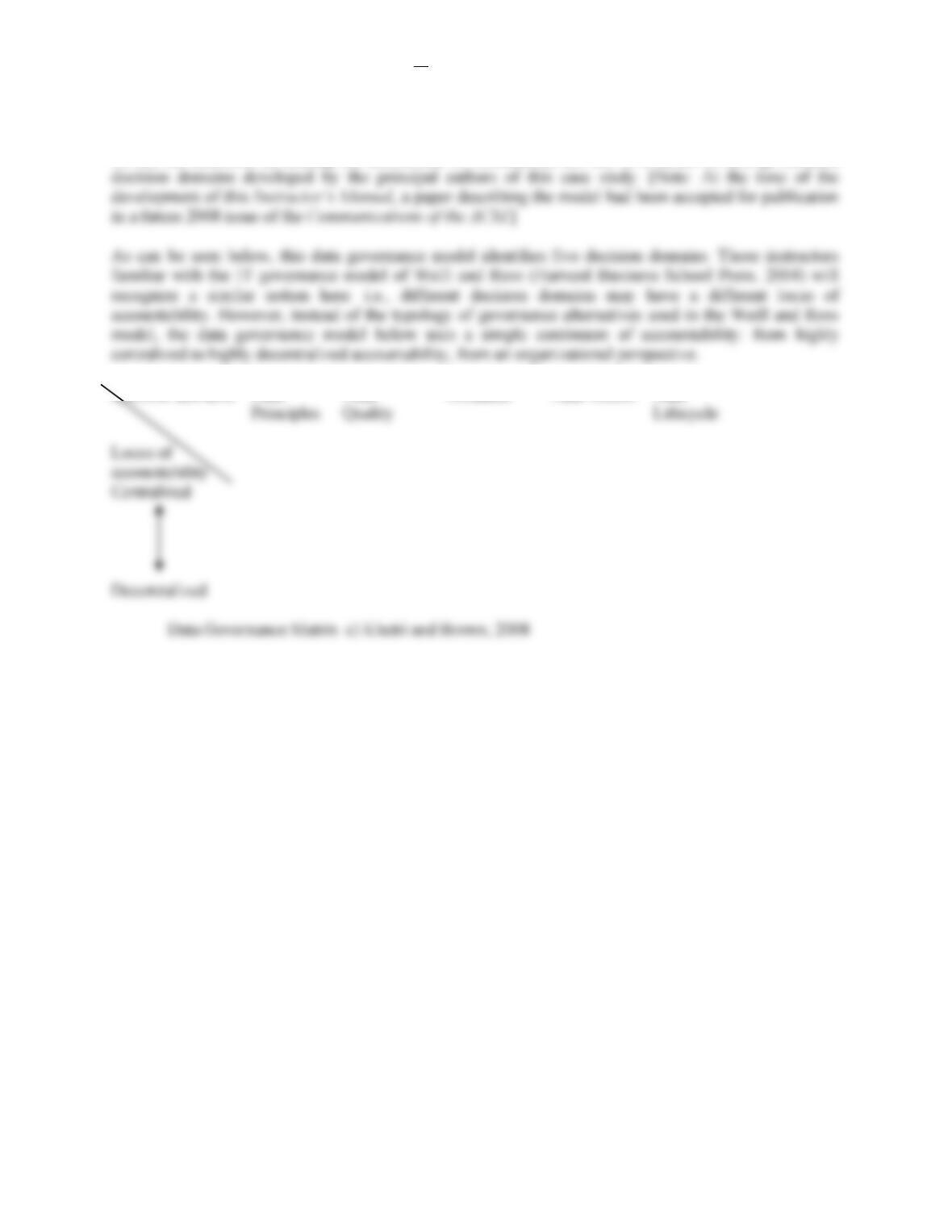
To aid the instructor in leading the discussion, we recommend the use of a model of data governance
Decision domains
Data
Data
Metadata Data Access Data