Case Study I-4 Supporting Mobile Health Clinics
63
Teaching Note on Case Study I-4
Supporting Mobile Health Clinics:
Objectives
This case study illustrates the challenges faced by providing real-time IT support and data integration
across mobile workers. Specifically, the case highlights the computer and communications support needs
for dispersed healthcare providers working from mobile clinics to provide primary care to pediatric
Overview
The overall mission and history of the CHF is first presented so that students can understand this specific
healthcare context. The primary mission of the CHF in NYC today
health care, including health education, preventative care (including vaccinations), diagnosis and
management of acute and chronic diseases, as well as facilitating patient referrals to other clinicians or
hospitals as needed. (Note that the definition of pediatric care in this case is from birth to age 24.)
The CHF clinics are housed in 36- to 44-foot long vans referred to as the Mobile Medical Clinics
(MMCs). Two CHF principles underlying the delivery of care, and therefore the designs of the vans, are:
Exhibit 2 shows the general MMC model, which includes a separate registration area and waiting room, a
some unique challenges, as described in the case:
Designing a clinician environment that meets medical standards and complies with professional
Software packages provide two major types of functionality for this type of clinic:
Practice Management systems that support administrative tasks
Case Study I-4 Supporting Mobile Health Care Clinics
64
The case primarily focuses on the challenges related to supporting the communication needs of clinicians
working in the MMCs, which are summarized into five technology characteristics:
Network availability and reliability
Although the majority of data patient transmissions between the MMC and labs or other healthcare
providers is text-based, access to high-density images (digital x-rays) is also needed at the time of a given
Several networking solutions that have been tried out, including two different wireless solutions, are
Teaching Suggestions
This case can be used in several different ways, depending on the specific nature of the course, the
background of the stud
that distinctions be made for providing IT support for routine primary care versus crisis situations. In
addition to the Telecommunications and Networking discussions in Chapter 3, the textbook also discusses
the concept of business continuity planning and HIPAA in the Information Security chapter (Chapter 14).
Depending on the instructor and student interests, the Internet could be used to learn more about:
a. HIPAA security rules
Case Study I-4 Supporting Mobile Health Care Clinics
65
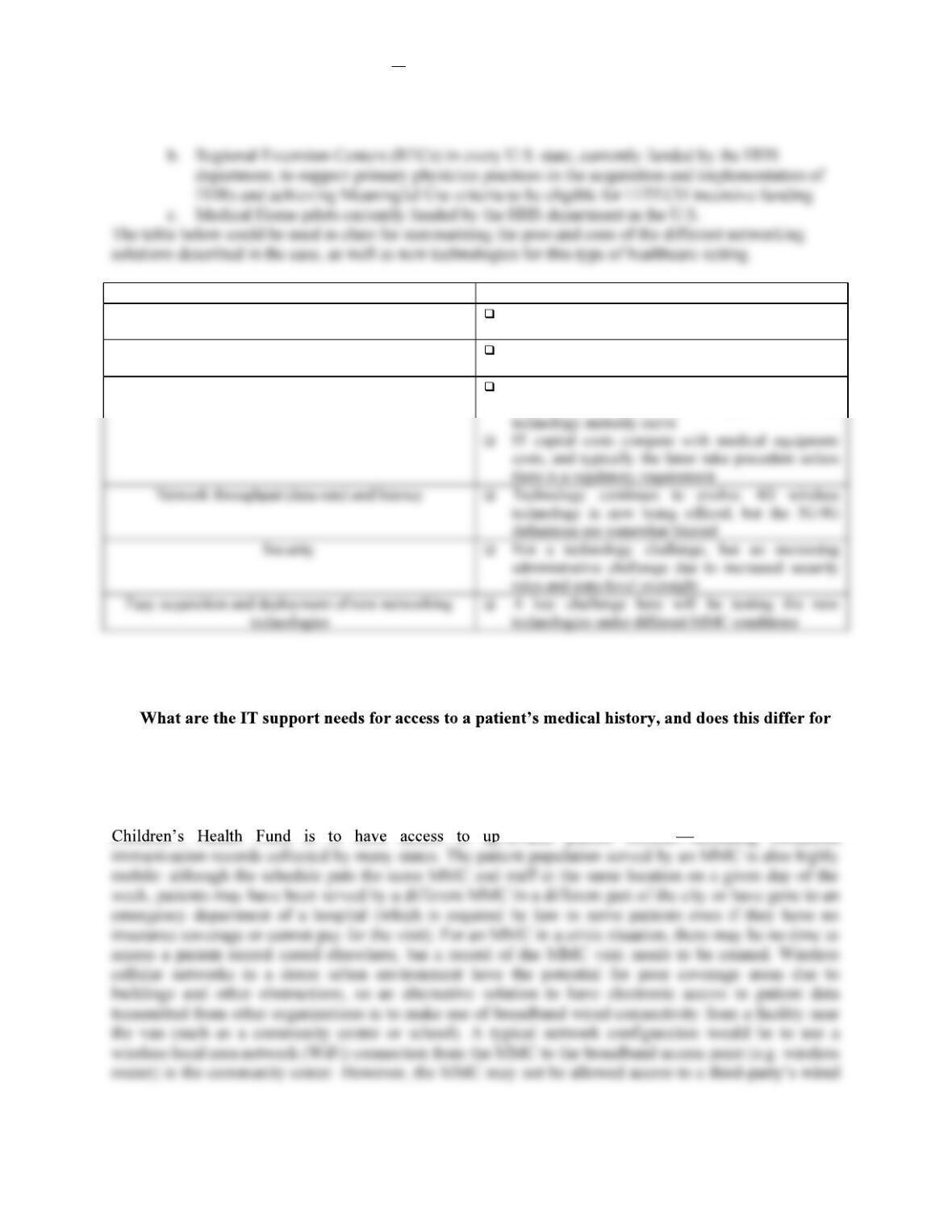
Networking Requirement Status and Challenges
Network Availability and Reliability
Major challenge: dependable and reliable wireless
coverage
Easy to use and zero-support networking equipment Depends upon the
technology and the
knowledge/experience of the user
Inexpensive
Dependent on the networking equipment and
technology available and its position on the
IT capital costs compete with medical equipment
latter take precedent unless
Technology continues to evolve: 4G wireless
technology is now being offered, but the 3G/4G
y challenge, but an increasing
administrative challenge due to increased security
A key challenge here will be testing the new
Questions for Discussion
1.
routine versus provided by an MMC versus emergency care (such as post-9/11)?
Software packages readily available for small primary care clinics provide both administrative and
clinical applications (PMS and EHR) and a local area network and laptop computers by clinicians will
support the access to this data within the examination room. However, a major challenge for the
-to-date patient records including childhood
2. What are the IT support needs for patient referrals to a specialist or another medical facility,
and does this differ for routine versus provided by an MMC versus emergency care?
An important design goal for the CHF is to be affiliated with a local medical center or institution. To
3.
4. What is the possible role of satellite communications? Emerging 4G wireless cellular networks?
5.
6. The typical patient in a developing country such as India is the custodian of his/her patient
record. When visiting a specialty clinic, doctors records before they
diagnose and treat a patient. What are the advantages and disadvantages of this approach?