
Case #21
“General Electric Medical Systems, 2002″
Harvard Business School Case #9-702-428 (Rev. February 26. 2003)
Academic instructors who are registered with the publisher’s
website (http://www.hbsp.harvard.edu) may download the Teaching
Note #5-703-413 (Rev. June 7, 2003) for this case free of charge.
ABSTRACT
This case focuses on the formulation of a business strategy
related to the global expansion of General Electric Medical
Systems. The business, marketing and manufacturing issues
TEACHING OBJECTIVES
The specific teaching objective of this case is to practice
decision-making when selecting a global business expansion
strategy for General Electric Medical Systems. The choice is to
be made among competing options that each having advantages and
SUGGESTED QUESTIONS FOR CLASSROOM DISCUSSION
1. What is the underlying logic of the idea for Global Product
Company (GPC)?
2. What are the pros and cons of the Chinese recommendations to
change GPC?
2
3. What are the pros and cons of slashing product prices in
China?
ANALYSIS
1. What is the underlying logic of the idea for Global Product
Company (GPC)?
The logic behind the Global Product Company (GPC) is
straight-forward. R&D competencies are to be centralized in order
to supply innovative technologies which can then be supplemented
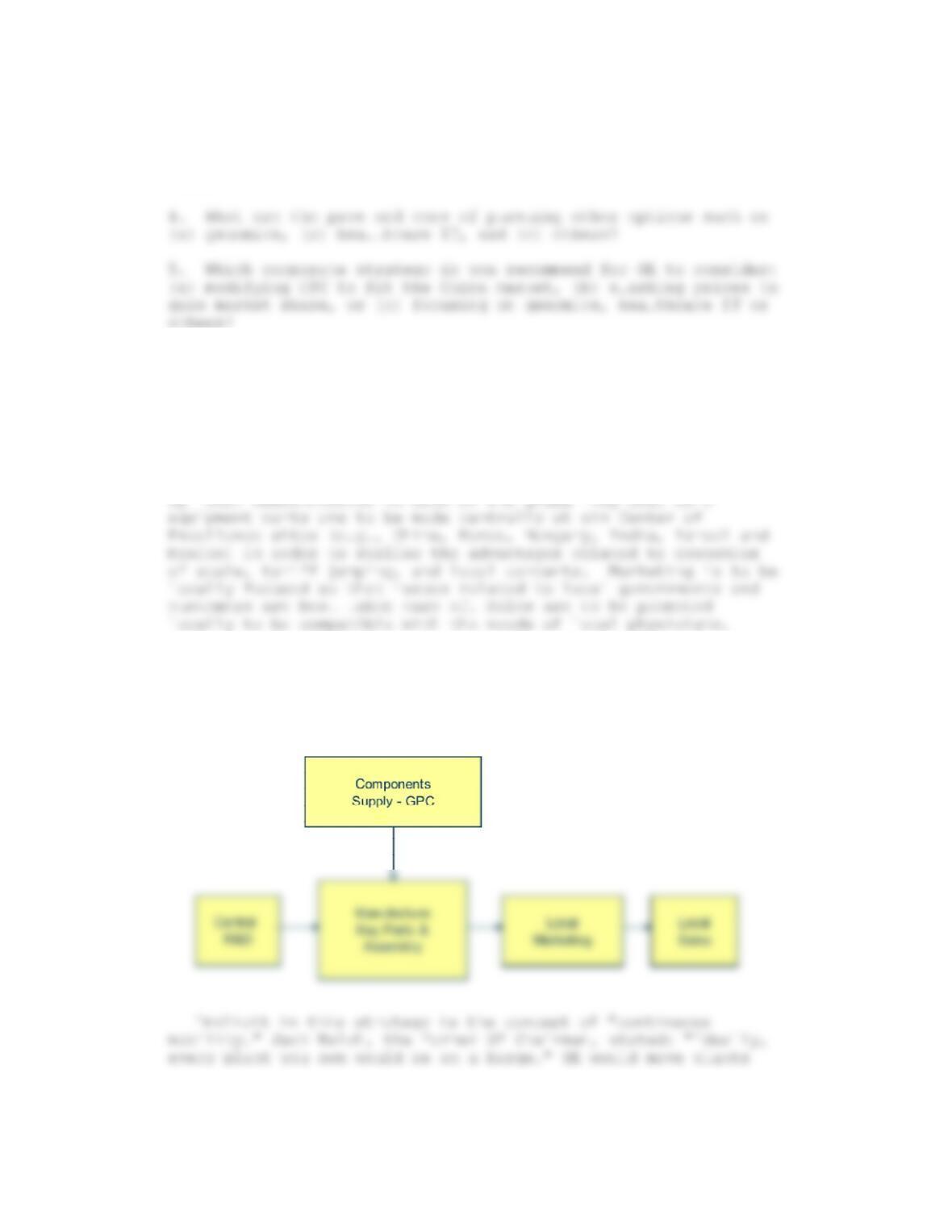
This strategy splits the value chain, as illustrated in
Figure C21-1.
FIGURE C21-1. SPLITTING THE VALUE CHAIN

3
2. What are the pros and cons of the Chinese recommendations to
change GPC?
The GEMS country manager for China recommends the “in China
for China” strategy. According to this strategy, low-end products
are to be manufactured in China, low-end products are to be sold
in China and exported to other developing countries, and other
low-end products (e.g., those made in Mexico) are to be imported
to China.
In opposition to the “in China for China” strategy are the
following two reasons:
A. Moving production from Mexico to China will raise the
breakeven volume. Let us assume that the product is priced at
$3,300 per unit, that the incremental fixed cost to shift

4
B. The cost structure is composed of 80 percent materials and 20
percent labor. A shift of production to low-cost regions will
typically yield a cost savings of 20 percent of materials and 50
percent of labor. Thus, a total reduction of product cost is
about 26 percent. Since the GPC strategy is already 60% complete,
3. What are the pros and cons of slashing product prices in
China?
One recommendation is to mark down product price in China as
a way to spur sales. The advantages of price reduction are that
it can be implemented easily and instantly. Using the Patient
Monitoring Device as example, a device which is made in Mexico
for China, a reduction of price from $3,300 to $3,000 would
increase sales from 800 to 1200 units.
4. What are the pros and cons of pursuing other options such as
(a) Genomics, (b) Healthcare IT, and (c) others?
Pursuing these other options means that GEMS should forget
about China for now and focus instead on other products and
regions.

5
The major reason for such a strategy is that the China market
is too small at this time (e.g., $584,000) and hence does not
justify a lot of managerial efforts.
5. Which corporate strategy do you recommend that GE consider:
(a) modifying GPC to fit China market, (b) slashing the price to
gain market share, or (c) focusing on genomics, healthcare IT or
others?
It is advisable to take an initial vote at this point to
record the preferences of students. This initial record can then
be compared with that of a final vote after this question has
been reviewed.

6
TABLE C21-1. COMPLEXITY OF OPTIONS
R&D Manufacturing Regulation Marketing Sales
Healthcare IT Make data Ethical issues Working with (Same as
available to regarding data hospitals and marketing)
doctors for usage. Privacy clinics to re-do
profession.
Genomics Move from Optimizing Longer- Possible entirely Compensating
engineering to manufacturing pharma-like different marketing sales force
GPC Changes All in managing
supply chains.
After this set of evaluation criteria is defined, the three
options under discussion are then rank-ordered with respect to
each of these criteria. For example, the option of “Modifying
GPC” is ranked as the best, the option “Reduce Price” the second
of global business.

7
TABLE C21-2. Rational Decision Analysis
Weight Modify GPC Reduce Price Pursue Others
Short-term Benefits 10 10 6 5
Long-term Benefits 10 8 5 10