Case #16
“Gateway: Moving Beyond the Box,”
Harvard Business School Case #9-601-038 (Rev. May 9, 2002)
Academic instructors who are registered with the publisher’s
website (http://www.hbsp.harvard.edu) may download the Teaching
Note #5-602-130 (May 9, 2002) for this case free of charge.
ABSTRACT
Gateway manufactures computers to customer specifications and
sells directly to end-users. In response to changing market
conditions, Gateway initiates a set of new strategies with
innovative features: (1) they have broadened the offering to
include PCs, peripheral support (service warranty), Internet
access, software, financing and computer training to realize
additional revenue from its existing customers; (2) they have
TEACHING OBJECTIVES
The teaching objective of this case is to expose students to
the complex issues related to marketing technology products in a
highly competitive market, considering the bundles of benefits
offered to end-users, distribution strategy, customer
SUGGESTED QUESTIONS FOR CLASSROOM DISCUSSION
1. Explain the risks associated with the Country Stores and
Your:)Ware program.
2. What were the core competencies of the “old” Gateway?
2
3. What are the core competencies needed for the “new” Gateway
to succeed?
ANALYSIS
1. Explain the risks associated with the Country Stores and
Your :) Ware program.
There are several risks associated with the program. They
are:
A. It is uncertain how many customers will use the Country
2. What were the core competencies of the “old” Gateway?
The “old” Gateway was good at selling computers via phone
3. What are the core competencies needed for the “new” Gateway
to succeed?
The “new” Gateway needs to be good at implementing several
new strategies concurrently.
3
B. “Beyond the Box” strategy – The need to broaden the offerings
to include peripherals, Internet access, financing, software, and
warranty services, all of which have higher gross margins than
4. What makes Gateway think it will succeed in being a “service”
provider where its competitors have failed?
Expanding from products to services is a well-known strategy
followed by numerous other competitors of Gateway such as IBM and
5. Do you agree with Gateway’s strategy? Why or why not?
The hexagon strategy is based on the concepts that it is less
costly to retain customers than to acquire new ones, and that
computer customers spend about $20000 for PCs but another $4000
4
6. How profitable do PC sales have to be in order for the
“Beyond the Box” strategy to be successful?
The “Beyond the Box” strategy is closely linked to the PC
sales, without which few customers would want to buy the
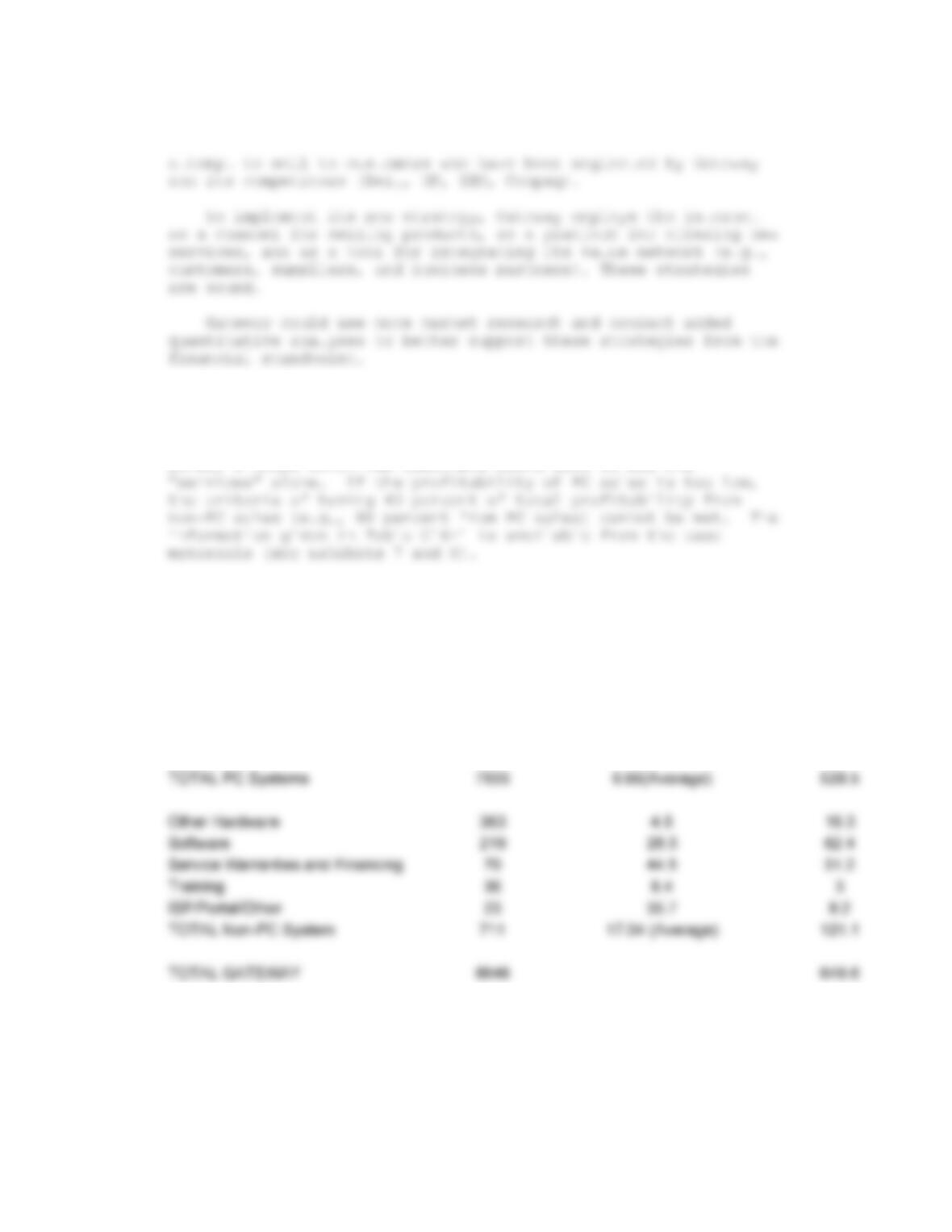
TABLE C16-1. 1999 COMPANY PERFORMANCE
REVENUE ($M) OPERATING MARGIN (%) PROFIT ($M)
Desktop 6507 6.5 423
Portable 1148 6.8 78.1
Servers 280 9.8 27.4
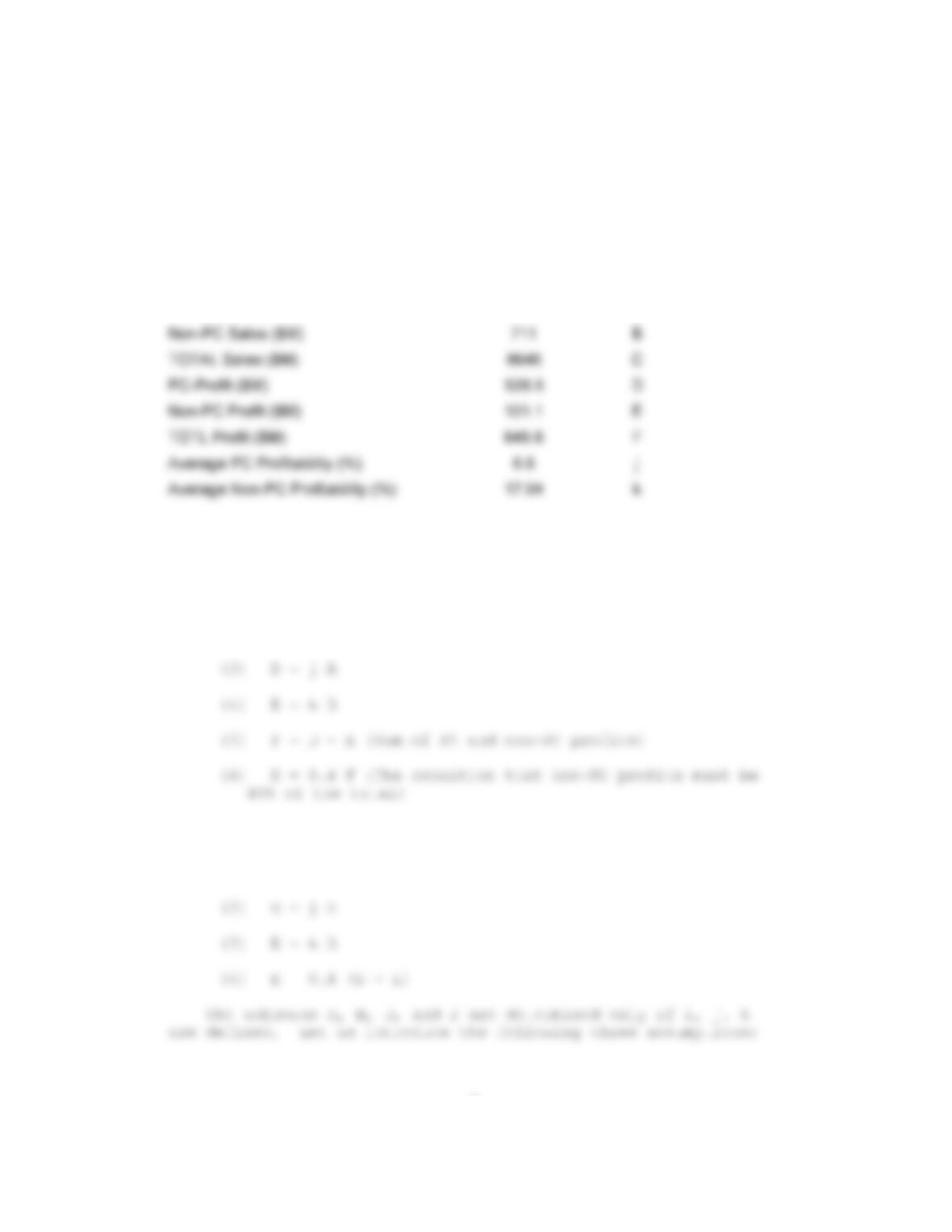
A. One way of figuring out the required PC system profitability
is to use the information in Table C16-2.
5
TABLE C16-2. PROJECTION OF COMPANY PERFORMANCE IN 2001
1999 2001
Annual Sales Growth Rate (%) 16 i
PC Sales ($M) 7935 A
For the items in Table C18-2, the following relationships
exist:
(1) C = 8646 (1+i)^2 – (Total sales in year 2001)
(2) C = A + B (Sum of PC and non-PC sales)
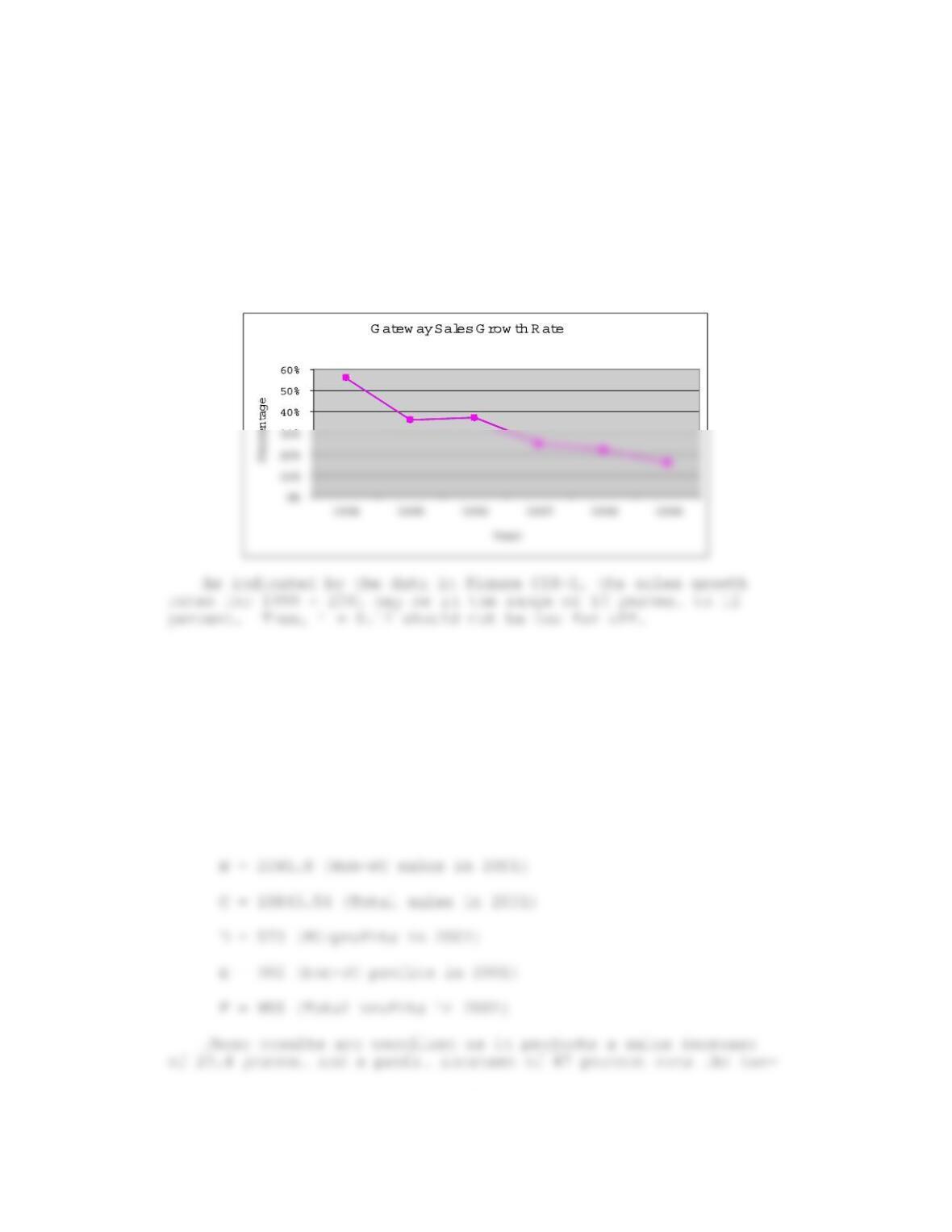
By substitution, these equations reduce to the following set
of four:
(1) A + B = 8646 (1+i)^2
6
(a) i = 0.12. We assume that Gateway will achieve an annual
sales growth of 12 percent per year for the period of 1999 to
2001. Other numbers may also be introduced such as 0.1 or 0.16.
Guidance may be obtained by studying the past sales growth rates
of Gateway (see Figure C18-1).
FIGURE C16-1. GATEWAY SALES GROWTH RATE
(b) j = 0.0666. We assume for now that the profitability of PC
systems could remain at 6.6 percent in 2001. This assumption
could be modified later.
(c) k = 0.1704. We assume that the profitability of non-PC
systems could remain at 17.03 percent in year 2001.
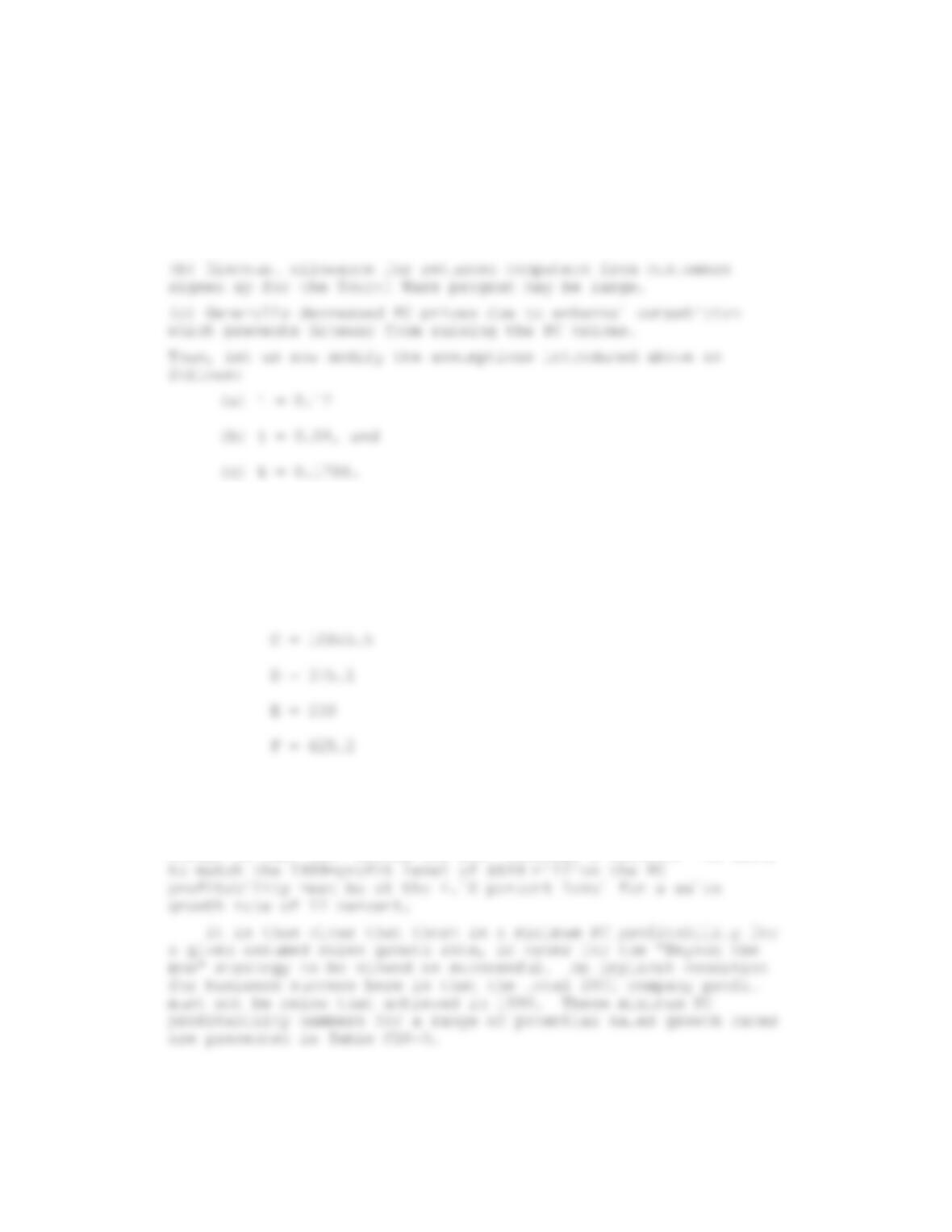
With these three assumptions, the above equations yield the
following results:
A = 8603.7 (PC sales in 2001)
7
year period. However, the realistically achievable PC
profitability could be much lower due to a combination of the
following three factors:
(a) Country Stores are costly to operate. These operational
expenses will diminish the profitability of PC sales.
With these assumptions, the new results for A, B, D and E are as
follows:
A = 9378
B = 1467.8
Note that while the total sales are at the high level of
$10,845 million, the profit in 2001 has been diminished to $625
million, below the level of $649 million achieved in 1999.
Having a total profit below the 1999 level is of course not good
enough to call the “Beyond the Box” strategy a success. In fact,
8
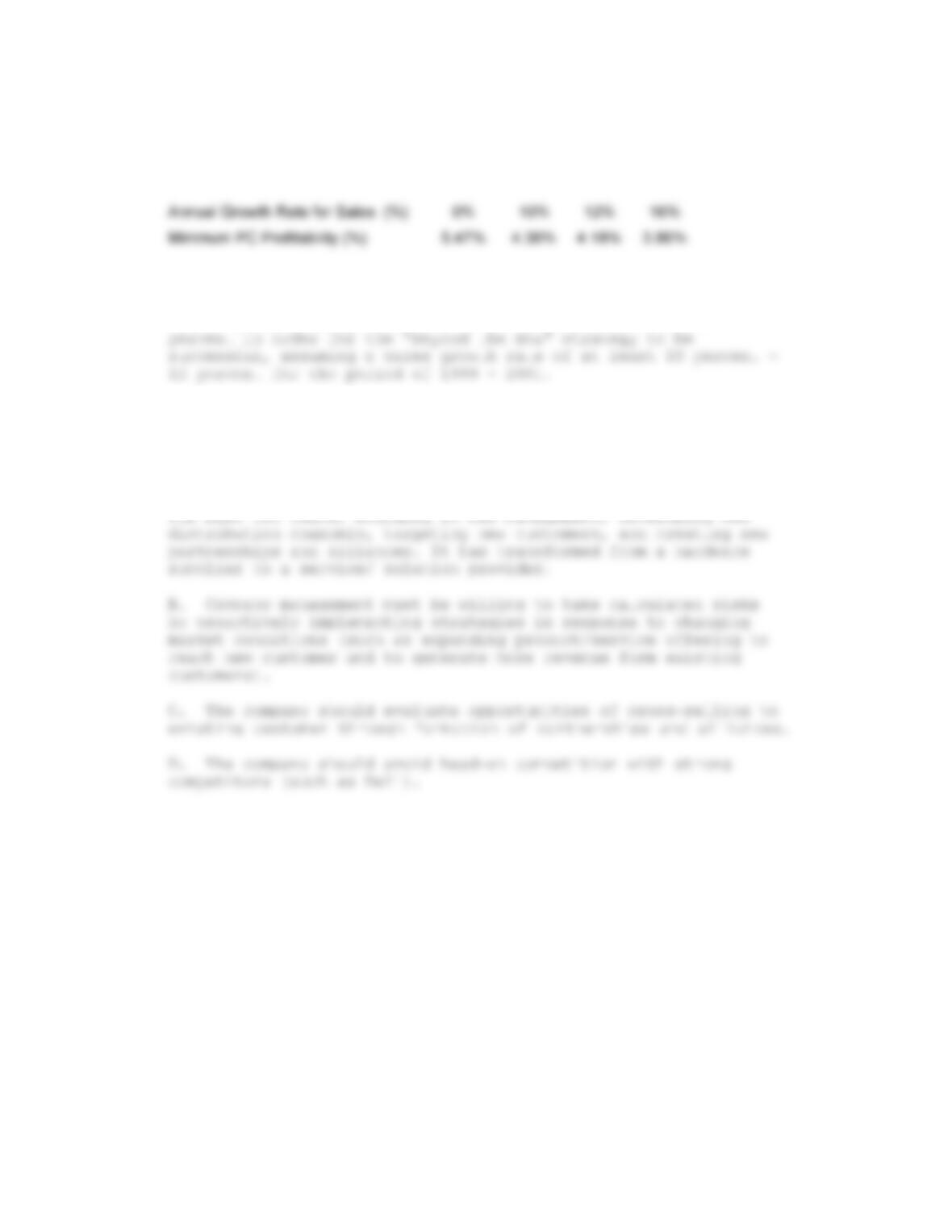
TABLE C16-3. MINIMUM PC-PROFITABILITY
Therefore, the answer to this question (Question #6) is that
the PC profitability must be at least 4.18 percent to 4.36
7. What are lessons you learned in this case?
The following lessons are apparent from this case:
A. Companies must be willing to change if needed. Gateway has
undergone a major transformation of strategy and organization in