
1
Case #15
“Black & Decker Corporation (A): Power Tools Division,”
Harvard Business School Case #9-595-057 (Rev: March 30, 2001).
Academic instructors who are registered with the publisher’s
website (http://www.hbsp.harvard.edu) may download the Teaching
Note #5-598-106 (Feb. 12, 1998) for this case free of charge.
ABSTRACT
In spite of being very strong in two other related market
segments for professional-industrial and consumer segments, this
TEACHING OBJECTIVES
The objective of this case is to illustrate the importance of
brand image of technologically superior products in order to
SUGGESTED QUESTIONS FOR CLASSROOM DISCUSSION
1. What is this case about?
2. Why cannot Black & Decker (B&D) make any money with tradesmen?
Why is B&D in this mess, in spite of having a powerful brand name
and offering high quality product?

2
share in three years from the current base of 9 percent. Which
option should the company pursue? Why?
ANALYSIS
1. What is this case about?
This case is about the management of a product/brand in
consideration of the behavior of the target segment. Brands are
2. Why cannot Black & Decker (B&D) make any money with tradesmen?
Why is B&D in this mess, in spite of having a powerful brand name
and offering high quality product?
B&D power tools are not appealing to tradesmen because of
several reasons:
A. Success of the B&D brand with products (e.g., power tools,
Dustbusters, and waffle irons) for un-sophisticated consumers who
3. Why is B&D’s performance in the professional-tradesmen segment
so much poorer compared to that in the professional-industrial
segment?
For the professional-industrial segment, which is comprised
of companies (commercial contractors, auto assembly plants)

3
4. Why is Makita outselling B&D 8 to 1 in an account which gives
them equal shelf space (see the lead sentence of the case)?
Makita priced its power tool products at 15 percent higher
as compared to B&D. It has its distinct color of red. Its brand
TABLE C15-1. CUSTOMER FEEDBACK
Brand Market
Share
Brand Strength Price One of the
Best
Proud to
Own
(Perceived by
Tradesman)
Black &
9% Average 100 44% ~40%
5. What are the key factors affecting the buying behavior of
tradesmen?
There are economic and non-economic factors affecting the
buying decision of tradesmen. The economic factors include: no
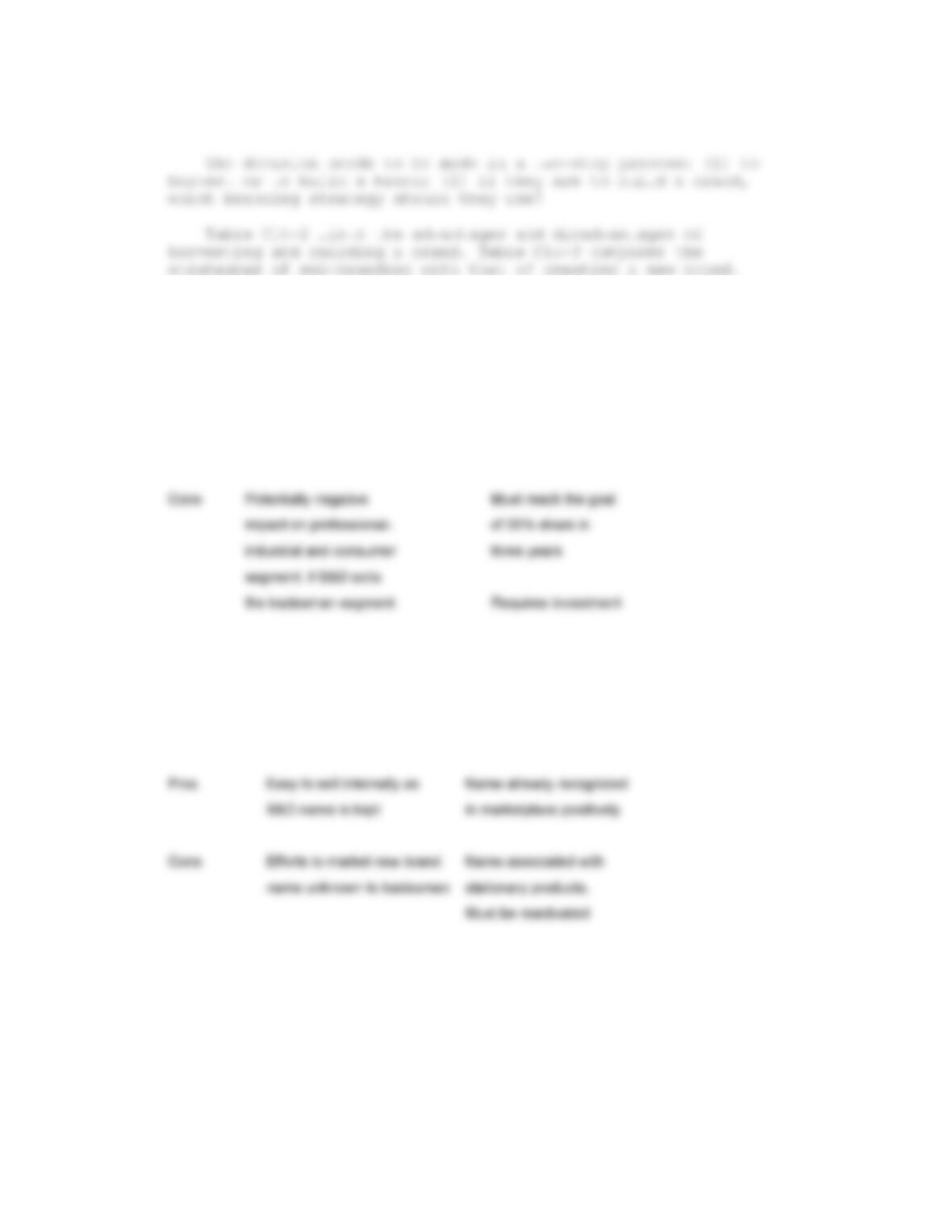
6. B&D management is considering the following options: (a)
harvest the product line; (b) build a brand using a sub-branding
strategy; and (c) build a brand using a new brand name. To pursue
options (b) or (c), the company must achieve 20 percent market
share in three years from the current base of 9 percent. Which
option should the company pursue? Why?
4
TABLE C15-2. HARVEST VERSUS BUILD BRAND
Harvest Build Brand
Pros Easy to implement Strengthen B&D overall
Cash generated can be used position in power tools
elsewhere business
TABLE C15-3. SUB-BRANDING VERSUS NEW BRAND
Sub-Branding New Brand
Definition xxx by Black & Decker Dewalt
In order for the tradesmen segment to achieve 20 percent
market share within three years, efforts to revise B&D marketing
program should address each of the four elements in the marketing
mix:

5
A. Product – Pick a new brand name (Dewaldt) to differ from that
used for consumer products. Use a color (e.g., brown or yellow)
that is different from Charcoal Gray. Table C15-4 shows the brand
color schemes of the competition.
TABLE C15-4. BRAND COLOR
Brand Tool Color
Makita Teal Blue
Add premium product features (e.g., lower noise, vibration,
energy utilization, torque, safety features) that, if possible,
require technology innovation. Expand service (taking advantages
of B&D’s 117 service centers in US versus only 47 centers for
Makita), offering “free loaner tools” and 48-hour repair
guarantee.
B. Price – Raise the price to be at par with Matika to remove
the perception of inferior quality and to improve profitability.
C. Distribution – Use current distribution channels (Home Depot
and Ace Hardware) and offer reimbursement for advertisements.
D. Promotion – Use a well-trained sales force who dresses in
work clothes and visits user sites.Activate web-based product
catalog, users group, FAQs, a “What’s new” column, new user
referral program, news letters, safety training, and others. Use
a product concept testing program to solicit tradesmen feedback

6
subsequent implementation (e.g., worker dedication, program
management and control) of requisite action plans. This is a case