219
C A S E T E A C H I N G N O T E S
H&M in fast fashion: continued success?
Patrick Regnér and H. Emre Yildiz
1. Introduction
This case describes H&Ms strategic capabilities and enables students to evaluate to what extent
the company has competitive advantages in these and if they can be sustained. It raises key
issues to consider when evaluating competitive advantage and the sustainability of
2. Position of the case
This case outlines H&Ms strategic capabilities and is designed to introduce the evaluation of
competitive advantage and its sustainability (Chapter 3 in Exploring Strategy). It allows for a
careful evaluation of resources and competencies in different functions of H&M and an analysis
of possible competitive advantages in these capabilities.
3. Learning objectives
The case is designed to help students to:
understand what strategic capabilities are and the fundamentals of competitive advantage;
4. Teaching scheme
This case can be used as a basis for classroom discussion in a plenary session or as a basis for
group work. The approach naturally depends on the context and time available. It can be used as
an early introduction to strategic capabilities and competitive advantage, but the case is also
sufficiently detailed to be used as the basis for more advanced work and assignments. As
221
5. Questions for discussion
1. In which areas does H&M have strategic capabilities and what are they? What are H&Ms
threshold and distinctive resources and competences?
6. Case analysis
1. Synopsis of H&Ms strategy and competitive position
An initial step in the class discussion is to get the students to realise the real threats H&M is
exposed to. The company has been tremendously successful in fast fashion and has a range of
strategic capabilities. However, H&M now also faces some challenges that need to be evaluated.
An important point here is to make clear that strategic capabilities and their competitive
advantage are evaluated relative to competitors (see Figures 12 in the case). The key points of
H&Ms success and the companys challenges are outlined below:
The flat and simple organisational structure has also been more challenging to preserve due
to H&Ms tremendous growth.
222
2. Assessment of H&Ms strategic capabilities (Question 1)
Based on the distinction between resources and competencies (Table 3.1), students can
distinguish H&Ms resources and competencies. The overview below includes some of the
resources and competences that may come up in a discussion. The following can be considered
resources possessed by H&M:
Physical facilities These include, e.g. production offices (which are primarily responsible
for coordinating with commissioned and approved suppliers and factories across the globe),
distribution centres and warehouses. As noted in the case, H&M does not own any of its
shareholder returns (see Tables 1 and 2).
H&M also has the following competences:
Culture The business model of H&M is aimed to deliver latest fashion at best price, in a
simple way and through a committed workforce. To deliver this, H&M relies on its strong
culture where values and norms like employee involvement, experimentation, pace,
informality, initiative taking and decentralisation are highly encouraged and praised.
223
Marketing and CSR H&M uses conventional marketing channels to create high brand
awareness as well as social media to follow and collect customer feedback and suggestions.
Corporate social responsibility is a key competence for H&M, given that the textile/apparel
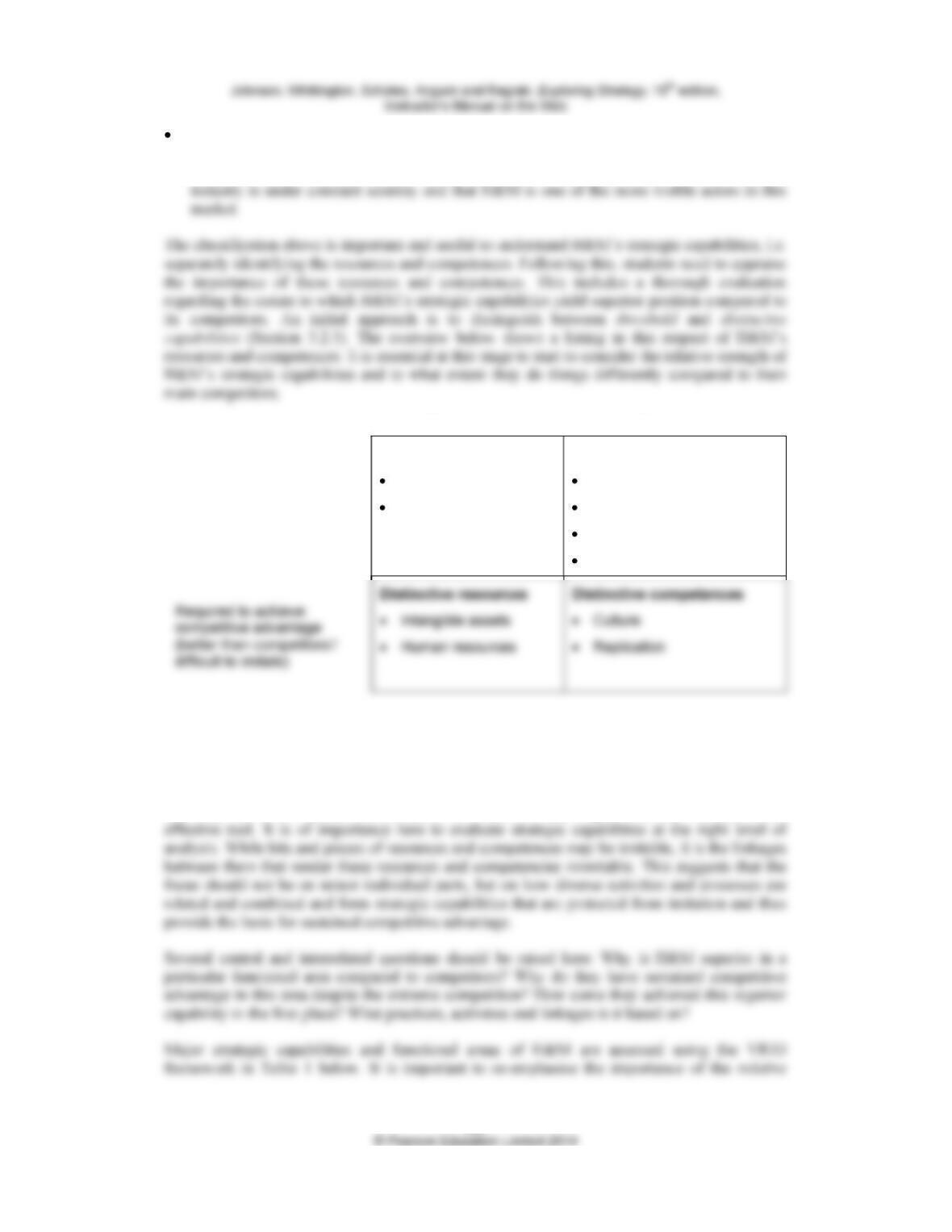
Resources Competences
Required to be able to
compete in a market (same
as competitors/easy to
imitate)
Threshold resources
Physical facilities
Financial
Threshold competences
Design
Store concept
Marketing and CSR
Supply chain management
3. H&Ms sustainable competitive advantages (Question 2)
Even though strategic capabilities have been listed in terms of resources and competences and
have been evaluated through the lens of their threshold and distinctive character, there are more
specific ways to analyse competitive advantages and to what extent they can be sustained. To
that end, the VRIO framework (Section 3.3; Table 3.2 and Figure 3.2) can be used as an
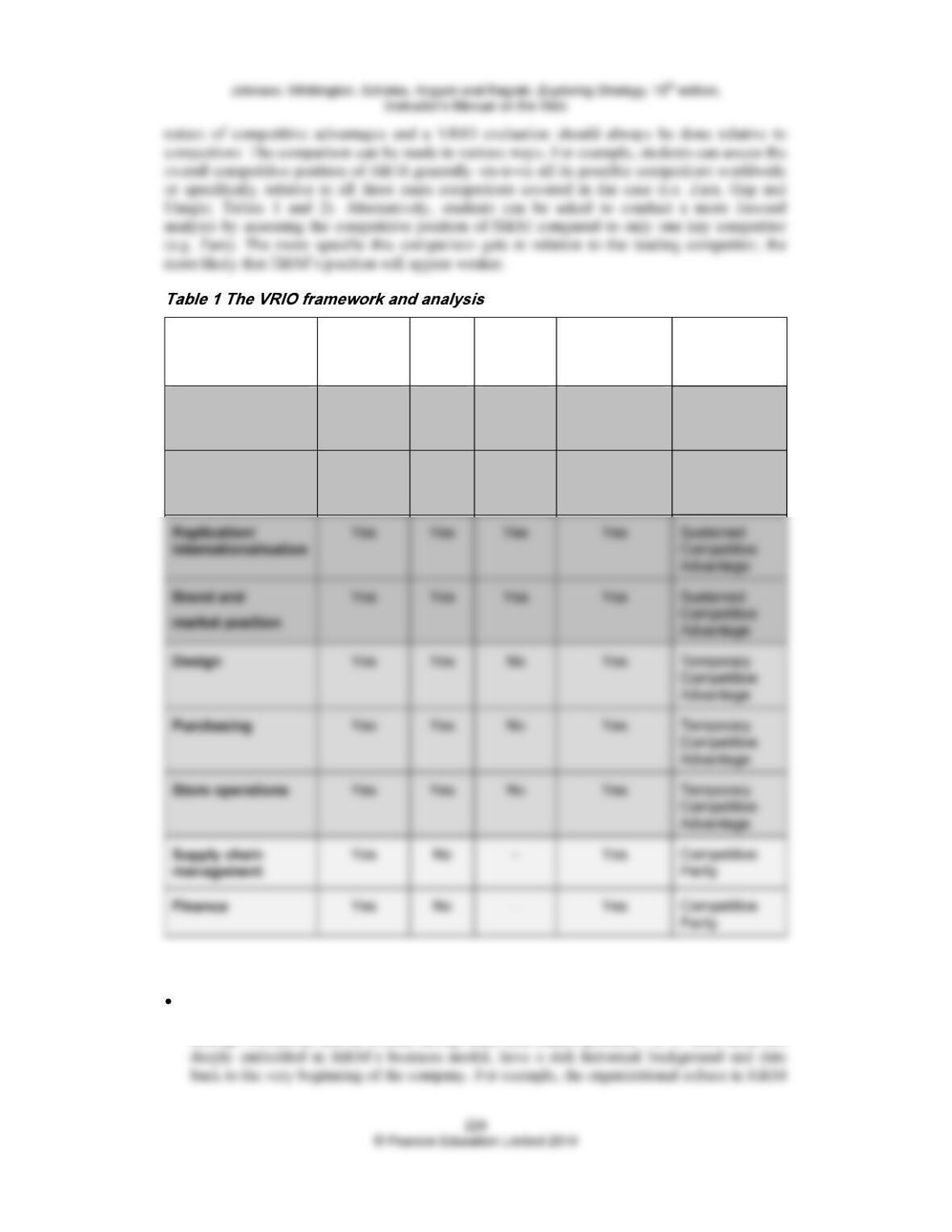
Strategic
capability/function Valuable? Rare? Costly to
imitate?
Supported by
the
organisation?
Competitive
implications
Culture and
leadership
Yes Yes Yes Yes Sustained
Competitive
Advantage
HRM Yes Yes Yes Yes Sustained
Competitive
Advantage
The key points in this VRIO assessment can be summarised as follows:
H&M derives much of its sustained competitive advantage from its unique organisational
culture and related human resource management, its ability to replicate the same store
concept worldwide and its overall strong brand and market position. All of these areas are
There are also some other areas in which H&M enjoys competitive advantage over its
rivals, but where long-term sustainability of their position is only temporary. For example,
both their particular and flexible store layout and their unique design collections are
valuable and rare strategic capabilities. However, H&Ms competitors (e.g. especially Zara)
have similar competences for catching/shaping fashion trends as well as opening up stores
In certain support functions, H&M is at competitive parity with its competitors. These
include supply chain management (SCM) and finance. For instance, H&M has a
sophisticated SCM system, which makes it a valuable resource. However, the resources that
SCM is built upon (i.e. IT systems, warehousing facilities and logistics systems) are readily
available for anyone to acquire. The competences required to effectively run the SCM
226
4. The future of H&Ms competitiveness (Question 3)
Following the assessment of H&Ms competitive advantages, students need to consider how
H&M and its CEO, Karl-Johan Persson can sustain and further strengthen the strategic
capabilities where the company has competitive advantages. The main question, however, is
5. The value chain and value system
Depending on the availability of time, students could also be asked to draw a value chain for
H&M and identify its primary and support activities (Section 3.4.2, Figure 3.4). Students should
know that this exercise needs to cover all primary activities (i.e. inbound logistics, operations,
outbound logistics, marketing and sales and service) and an assessment of the relative
6. H&Ms international strategy
The primary focus of this case is to analyse resources and competences and their potential
competitive advantage. However, internationalisation into foreign markets and replication play a
central role in H&Ms overall strategy. This suggests that this case can also be used in
evaluating and discussing international strategy (Chapter 8; Section 8.4). For example, the four
Thus, it is clear that H&M defines its strategy based on high pressure for cost minimisation and
low pressure for local responsiveness. Students can be asked to question the viability of this and
the extent to which global strategy can successfully be pursued in the long term. Several
themes/questions can be brought up in order to stimulate in-class discussion:
H&M is yet to establish full presence in Asian markets, where additional adjustments and
adaptations to domestic demand preferences in terms of design collections might be
required. Thus, H&M might start to feel stronger pressures for local adaptation and this may
render global strategy a less viable option in the future. If that becomes the case, how