
C A S E T E A C H I N G N O T E S
Academies and Free Schools
Kevan Scholes
1. Introduction
In the early 2010s, the UK was progressively reducing the direct control that local government
2. Position of the case
The main links to Exploring Strategy are to Section 13.3 in Chapter 13specifically, Goold and
3. Learning objectives
The case is primarily designed to help students understand the key issues which influence the
4. Teaching scheme
As a short case, Academies and Free Schools is most likely to be used as a basis for plenary
5. Questions for discussion
Referring to Section 13.3.1 and Figure 13.6:
1. Explain how the UK government is changing the strategic style for controlling schools.
417
6. Case analysis
Strategy styles
Although, real life situations rarely fit precisely into theoretical norms, Goold and Campbells
typology of strategic styles (Section 13.3.1 and Figure 13.6) can be used as the framework to
understand why changes to the control of schools were being made in the early 2010s as
follows:
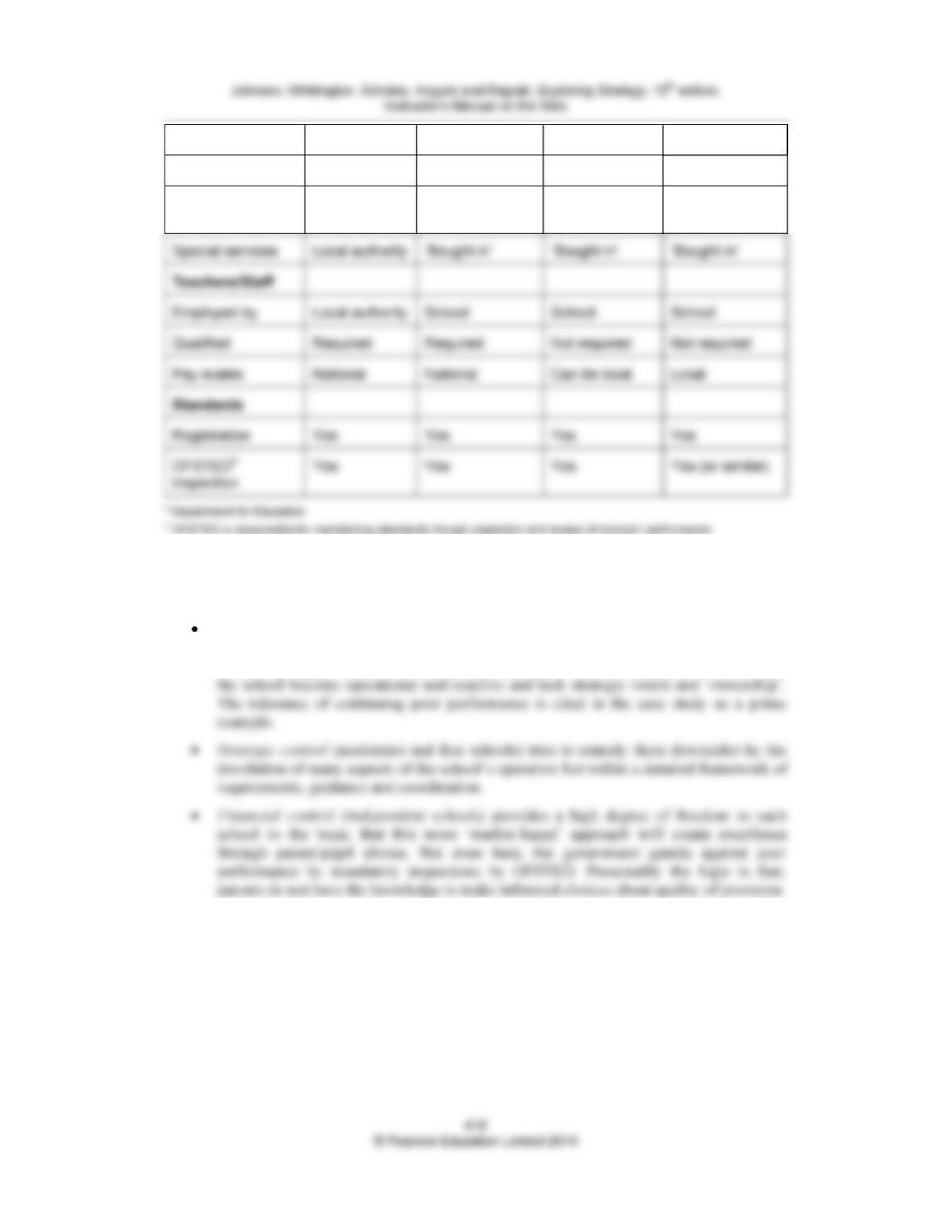
a) First, the table below can be used to compare the spectrum of different types of school
against an agenda of items concerned with the control of schools. It should be noted that the
Aspect of control
Type of school
Traditional
state
State academy State
Free School
Independent
(private)
Governance
Owner Local authority Sponsor and
DfEa
Sponsor and
DfE
Private
(e.g. trust)
Collaboration Local authority Required Required Encouraged
Admissions
Rules Open to all Open to all Open to all Selective
Delivery
School times Centralised Coordinated Coordinated Separate
Curriculum National Some
specialisation
Some
specialisation
Separate
c) Finally, it is useful to reflect on what is said in Section 13.3.1 about the advantages and
disadvantages of these different strategic styles. Students should be asked, how these
general points relate to the specific situation of schools. For example:
Strategic planning (traditional schools) gives central and local government full control
of the political agenda around education, and the powers to manage schools and their
resourcing in great detail. However, a major downside is that managers at the level of