377
C A S E T E A C H I N G N O T E S
Gazprom and NIS: the oil and gas industry in
Serbia
Vladan Hadzic
1. Introduction
This case analyses the acquisition of Serbias major oil company (NIS) by the Russian energy
2. Position of the case
This case relates closely to issues discussed in Chapter 10 of Exploring Strategy on mergers and
3. Learning objectives
The case will help students understand:
the motives behind mergers, acquisitions and alliances;
4. Teaching scheme
This is a medium-size case that students should read before a class, in order to take part in
plenary discussion. There are many interesting issues related to the decision of the Serbian
378
5. Questions for discussion
1. Evaluate the rationale and motivation behind Gazproms acquisition of NIS. Discuss
possible motives (for both companies) for the deal (making sure that the most important
actors/stakeholders and their interests are discussed).
2. What ownership issues emerged in the case? Answer this question by drawing a political
6. Case analysis
1. Evaluate the rationale and motivation behind Gazproms acquisition of NIS. Discuss
possible motives for the deal (making sure that the most important actors/stakeholders and
their interests are discussed).
Motives will be discussed using the environment, capability and expectations framework:
Environment Capabilities Expectations
Speed in fast-moving
product/market
Exploit core competences
in new arena
Institutional shareholders want
continuing growth
Johnson, Whittington, Scholes, Angwin and Regnér, Exploring Strategy, 10th edition,
Instructors Manual on the Web
Motive Gazprom
Business environment
Speed of entry This was the quickest way to enter another market.
Gazprom managed to get the major player in Serbia and
with it almost all petrol stations in the country.
The NIS brand is popular and easily recognisable in
Serbia.
Strategic capability
Gain new capabilities (good fit) Gazprom wanted to gain access to a new market.
South Stream was another motive as Russia was
interested in securing the gas pipeline, and Serbia was
well positioned geographically when it comes to pipelines
for gas export to Central and Eastern Europe (e.g.
Croatia, Bosnia, Hungary, Slovenia and Austria).
380
Motive NIS (including Serbian government and shareholders)
Business environment
Speed of entry Gazprom brand is known worldwide.
Strategic capability
Gain new capabilities (good fit) Gazprom will bring some of their capabilities (e.g.
increased efficiency as well as investment in NIS and also
in Serbian infrastructure).
Stakeholder expectations
Serbian government The Serbian government wanted to sell at least part of the
company (originally they planned to sell 25% for
$300m/155m Euros). Gazprom promised to invest 550m
2. What ownership issues emerged in the case? Answer this question by drawing a political
positioning matrix.
Gazproms asset stripping was discussed in the appendix to the case. After the fall of
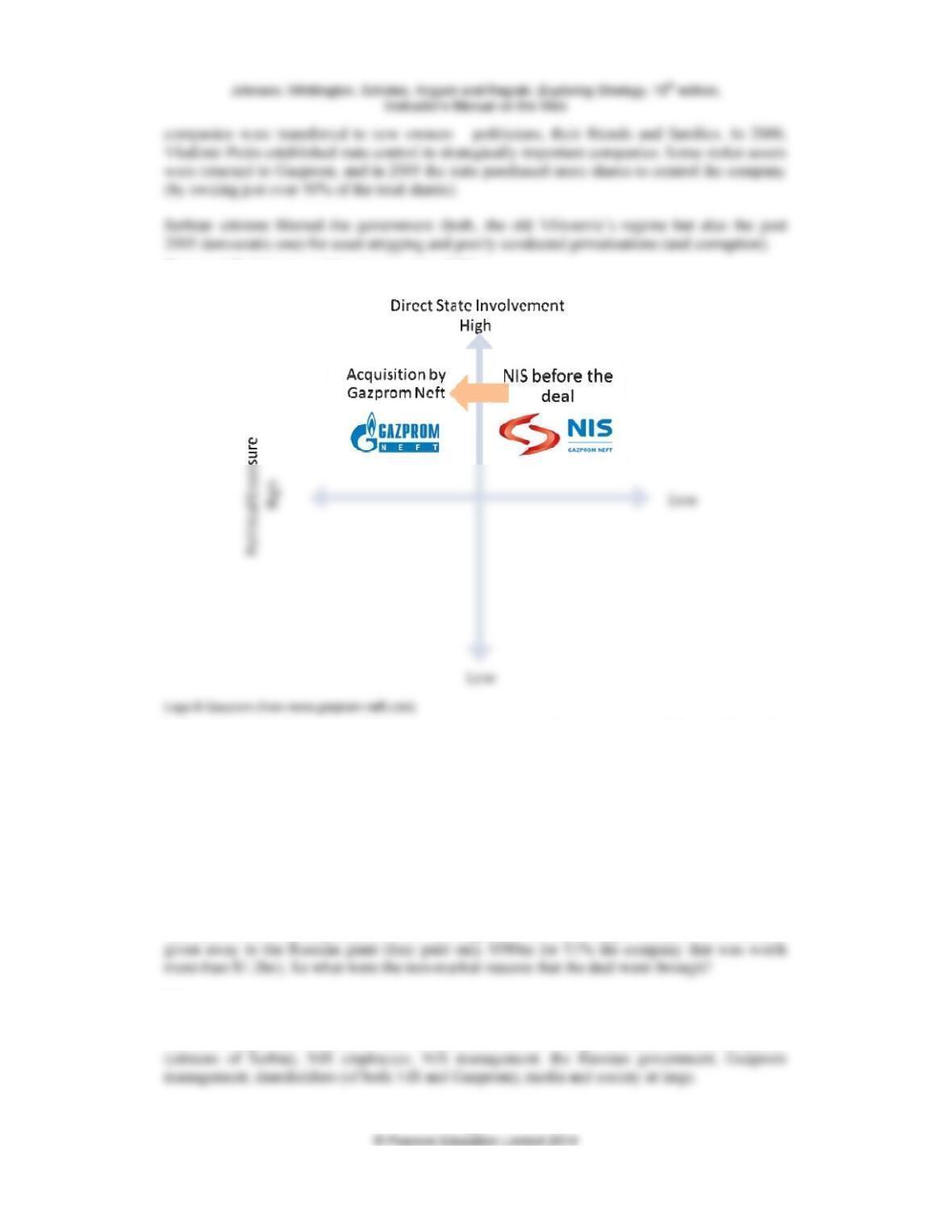
381
Figure 1 Political positioning matrix (NIS)
Before the deal, NIS was a public company but because of privatisation and their stake in the
company the state was interested and hence involved. Political exposure at the time was low,
although once the intention to sell the company was made, public political exposure rose.
3. Analyse the non-market environment. Identify the issue, the stakeholders involved and their
interests.
This deal could be discussed as a non-market strategy.
What is the issue?
The main issue is the acquisition of NIS by Gazprom Neft. According to many, NIS was almost
Who are the actors?
The following main stakeholders can be identified: the Serbian government, the Serbian public
382
What are the actors interests?
Stakeholder Interests
Serbian
government
Under pressure from the public, the Serbian government was looking to
secure a supply of gas at an affordable price. Also, Gazprom promised to
invest in Serbian infrastructure and to employ a significant number of
Serbian public Fed up with numerous scandals and high level of corruption Serbian
citizens were asking for a better deal. They believed that there were other
(better) suitors than Gazprom Neft who were prepared to pay more (such
as OMV from Austria and other firms from the EU). NIS management and
the Serbian government didnt deal very well with the public and media.
Competitors There is very little competition in Serbia (only smaller companies like OMV
and Lukoil). NIS was pretty much a monopoly before the deal (NIS owns
the largest network of filling stations in Serbia).
NIS employees The company was in a difficult situation and many jobs were at risk. The
majority of NIS employees were happy as they believed that jobs will be
saved. However, it turned out that Gazprom made a number of
redundancies since they took over.
Instructors Manual on the Web
383
4. Carry out a political analysis of the deal.
Political issues are relevant in this case, as the deal was essentially a deal between the two
governments (Russian and Serbian). The state is always an important actor in the oil and gas
sector. From the appendix, it can be seen that the Russian government (headed by Vladimir
Putin) established state control in 2000 for strategically important companies (including
Gazprom).
Recent (and current) political issues (e.g. wars in 1990s in former Yugoslavia and a crisis
related to Kosovo) are partially responsible for the closer relationship between the two
governments. The Serbian government was looking for help as much of the world appeared to
be against them on the issue of Kosovo. According to the Serbian government, Kosovo is an
integral part of Serbia and it cannot be written off so easily. But in order to resist external
The importance of this analysis for the deal is that Serbia had many good reasons based on
history and political links for working closely with the Russian state and Russian companies.
Selling NIS to Gazprom (even at a discounted rate) might have seemed a good move to the
Serbian government. By aligning itself with a powerful ally and benefitting from Russias
importance on the world stage may have seemed sensible. How this might affect Serbias
ambitions of joining the EU remains to be seen.
5. Discuss success of the deal so far, discussing specific issues for all parties involved.
Despite criticism, the Serbian government achieved a return similar to the one they initially
51% stake sold for $580m valuing the company at around $1.1bn which is much less than
Deloitte & Touches valuation of around $3.2bn.
The deal certainly brought some benefits to Serbia. For example, as far as tax is concerned, NIS
CEO Kirill Kravchenko said, when interviewed for the Serbia-Times on 19 April 2013, that
12% of the total state tax income comes from NIS.
2012 was the most successful year in the history of NIS so far. It is evident from the share price
(Figure 2 in the case study) that NIS shares performed well after the deal, which means that the
deal was well received in financial markets. Normally, this would indicate that the deal is
expected to add to profitability.