425
C A S E T E A C H I N G N O T E S
LEAX: managing growth in a volatile world
Anders Melander
1. Introduction
This case covers strategic developments and the management of change in the LEAX Group
(LEAX). The main focus is on the second half of 2008 until the end of 2012 a period when
most companies including LEAX had to deal with an economic recession.
The case invites students to analyse current developments in manufacturing industries through
Part 1 The present
This section sets the scene by introducing the present situation of LEAX a financially healthy
company that strives to expand in an increasing volatile environment.
Part 2 LEAX
This section provides an understanding of LEAXs history. The crisis that the family-owned
Part 3 Facing the immediate crisis and the time afterwards
The different phases of the crisis are described. The somewhat paralysing phase in November
2008, was soon followed by a phase of vigorous action. As the demand stabilised in the spring
426
2. Background to the case
As this is a brief case, we want to expand on the information provided.
LEAX grew mainly organically until year 2000. In the new millennium, the growth has mainly
been achieved through acquisitions of production sites from major customers such as ABB
(two) and Scania (one) and greenfield investments in Latvia (two production sites) as well
brown-field site (acquiring a building) in Brazil. Approximately, 70 per cent of the expansion
In 2008, LEAX was both a decentralised and centralised company! The group consists of five
subsidiaries which operate six factories in a decentralised way. However, the CEO (Roger
Berggren) is of crucial importance to the company. He is personally involved in all major
negotiations with customers and is the one sensing most of the environmental changes. The
companys headquarters (organised as one limited company) can be described as slim.
3. Position of the case
The main purpose of the case is to facilitate understanding of managing change and strategic
4. Learning objectives
If the case is used on the basic level, the comprehension may end with an understanding of the
427
5. Teaching scheme
Until 2008, LEAXs growth has been exceptionally strong (on average 34% annually for more
than ten years). In this period, there had been both upturns and downturns, but the market
development has been stable and predictable. Suddenly, however, in the autumn of 2008, the
company had to deal with a severe demand crisis. The CEO, Roger Berggren, was now facing a
completely new situation. What did Roger do?
In this way, students are directed towards thinking through the time dimension and the effect of
changes in environmental conditions. The conclusion being that a stable and predictable
environment is likely to foster strategic capabilities that do not necessarily enhance survival
under more volatile and difficult conditions.
6. Questions for discussion
1. Why has LEAX been so successful in the past?
2. Could the company have been better prepared when the demand crisis hit the heavy vehicle
industry?
428
7. Case analysis
1. Why has LEAX been so successful in the past?
LEAXs history could be divided into three phases. In the first phase (19821992), the company
grew from 0 to 17 employees. The company was entirely dependent upon short-term contracting
and the nearby Volvo factory accounted for 80 per cent of turnover. Following the crisis in
In the second phase (19982008), the rapid growth was to a large extent built on the foundations
laid out in the 1990s. The focus on more advanced production drove LEAX to compete for
larger outsourcing contracts and when opportunities emerged, Roger was bold enough to
acquire entire factories. Another crucial step was the new greenfield investments in Latvia.
2. Could the company have been better prepared when the demand crisis hit the industry?
The obvious answer to this question is yes. LEAX was hit by the crisis just as every other player
in the mechanical sector was. Applying the sensing, seizing and reconfiguration framework and
comparing LEAX with some of their close competitors the company stands out as being faster
Instructors Manual on the Web
429
3. Evaluate the actions taken in 2008 and 2009. Are they appropriate?
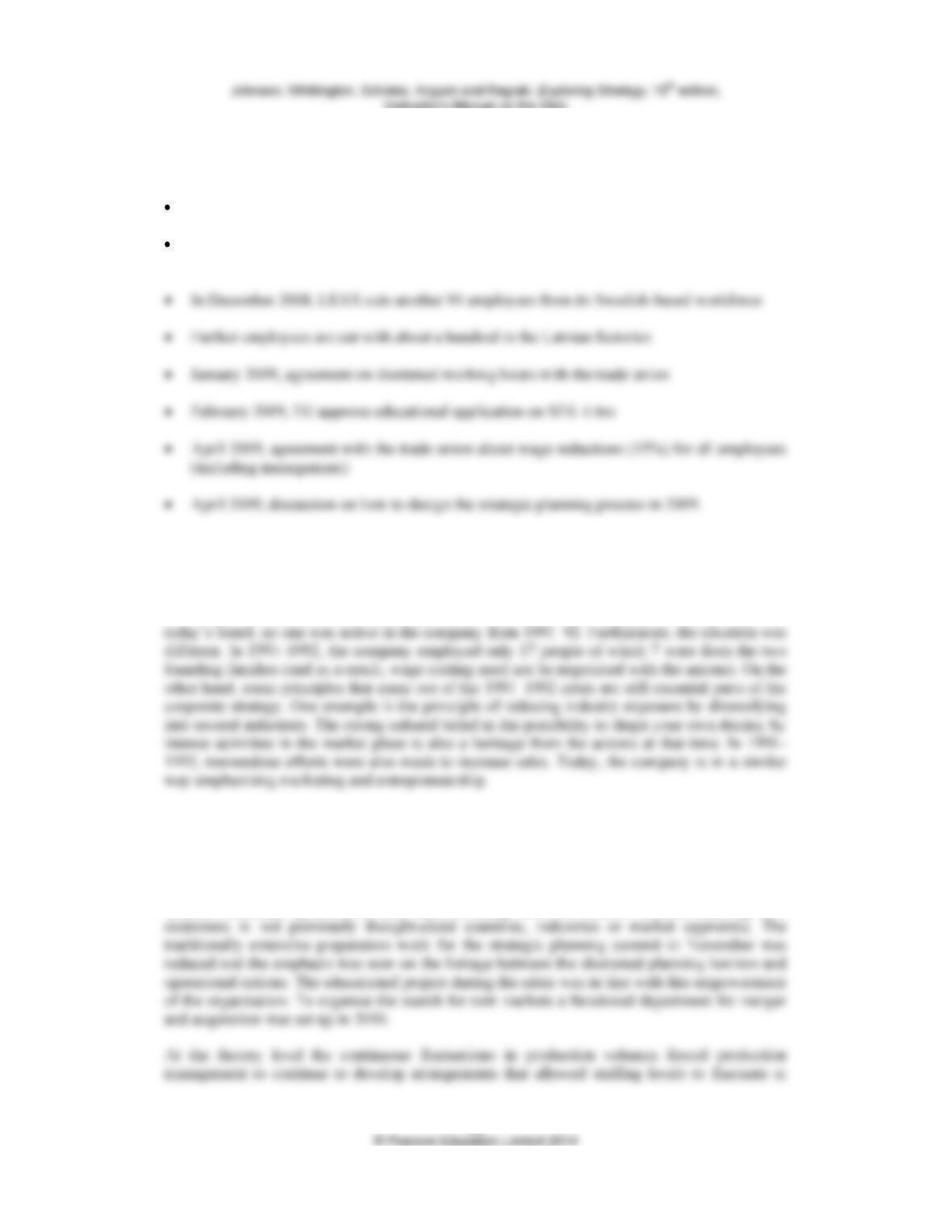
Here follows some of the key factors and actions that are mentioned in the case:
23 October 2008, Volvo Trucks and Scania announce their poor Q3 results.
Early November 2008, LEAX decide to cut 50 employees from its Swedish-based
workforce
4. In 19911992, LEAX went through a similar crisis. Are the lessons learned at that time of
any value in dealing with the 20082009 crisis?
The only member of the current management team who was active in the crisis of 19911992
was Roger (he had then been employed for two years and was responsible for quality). On
5. Thinking past the crisis, which actions were decisive for the LEAX Groups improved
performance from 2010 onwards?
It is suggested in the case that a new strategic planning cycle was introduced in 2009. In reality
this planning cycle differed a lot from the earlier ones. The focus was now changed from
internal efficiency (production, lean manufacturing, etc.) to business creation (finding new
430
6. How can the latest development with the German expansion be explained?
An important explanation to the expansion in Germany is that the long battle over Scania came
to an end in 2012. When the Volkswagen Group took control of the German truck manufacturer
MAN in Munich and the Swedish Scania Group commentators predicted a fast merger between