385
C A S E T E A C H I N G N O T E S
International HIV/AIDS Alliance (B): a strategy
for 2020
Gerry Johnson
1. Introduction
This case study provides students with the opportunity to consider the extent to which changes
of strategy are required for the international HIV/AIDS Alliance. The A case is available on the
2. Position of the case
The case raises issues from Chapter 2 on the business environment, Chapter 3 on strategic
capabilities and Chapter 4 on the importance of different stakeholders. Much of what is written
3. Learning objectives
Study of the case involves students in:
Assessing the impact of key changes in the environment on the strategy being followed by
4. Teaching scheme
Much of the strategic analysis relating to the key issues facing AIDS Alliance is dealt with in
the case study itself. So, these may be used, in the main, to illustrate the importance for a
386
5. Questions for discussion
1. What are the strategic options available to AIDS Alliance for its strategy to 2020?
6. Case analysis
1. and 2.
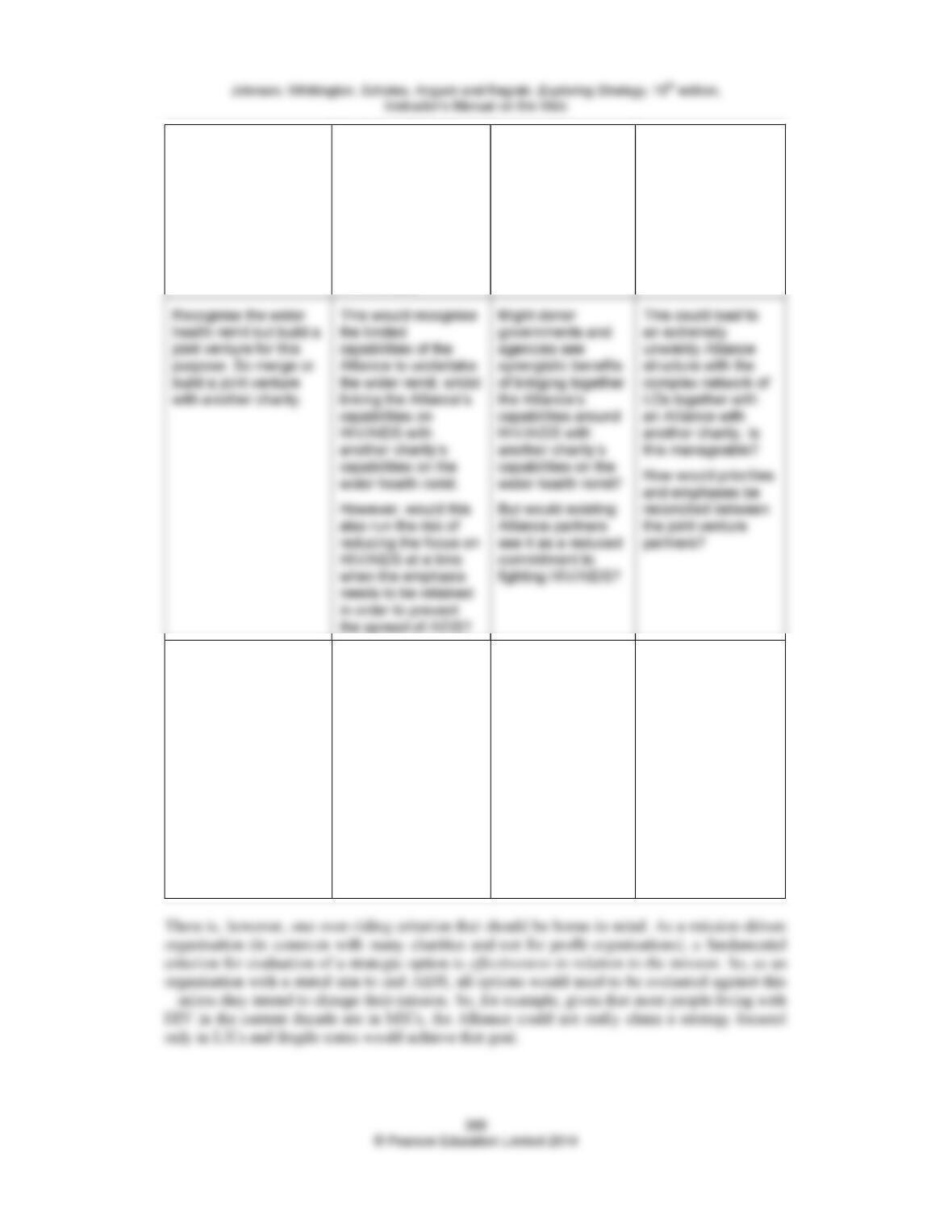
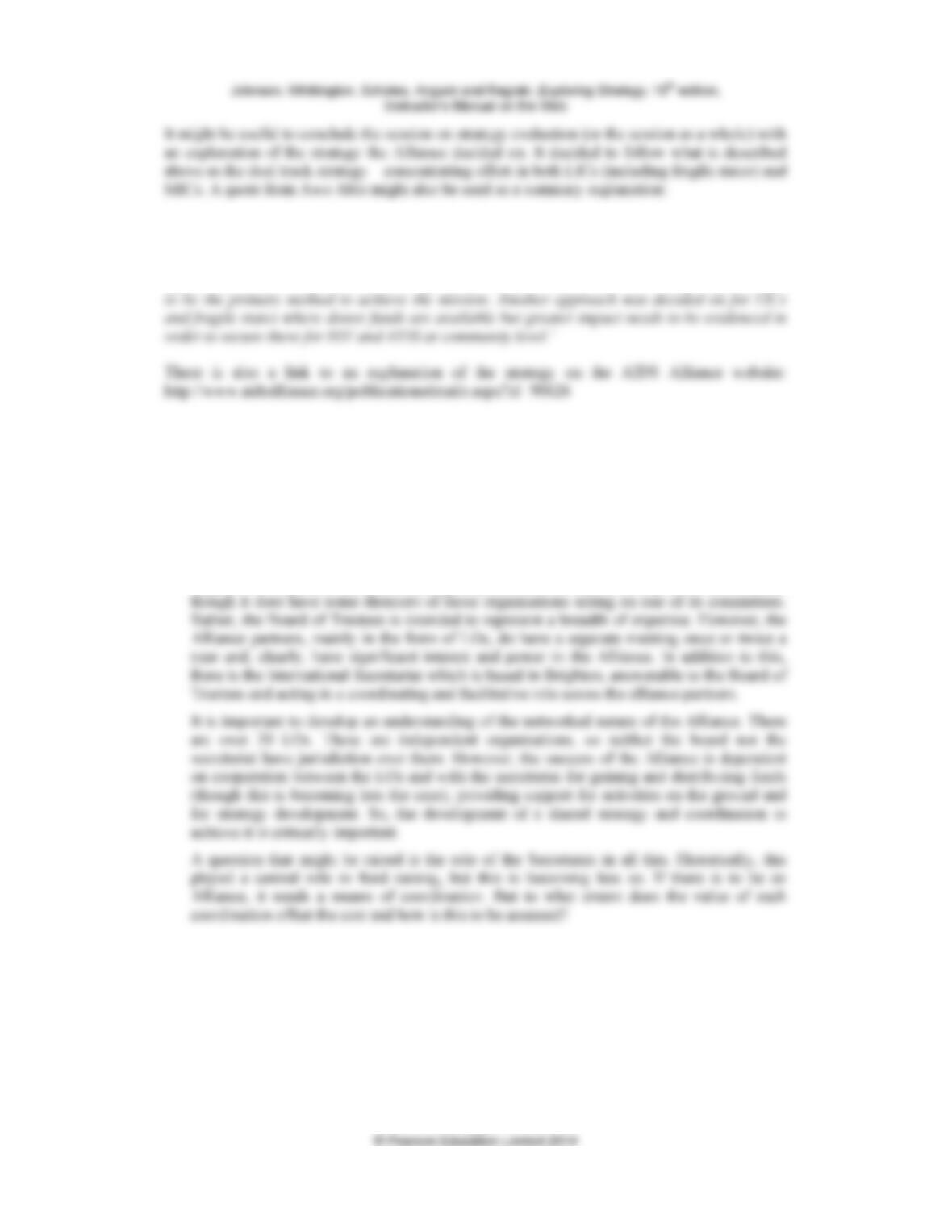
In the table below some of the options identified by the Alliance are included together with
other options that students might generate.
Strategic options Suitability Acceptability Feasibility
Focus on HIV/AIDS in
marginalised states
(i.e. where donor
agencies will focus but
where there is least
Arguably the alliance
becomes the donor
agencies
organisation of choice
for LICs.
May require
backing off on
Alliances human
rights agenda in
such states.
The Alliance has
less experience in
working in fragile
states which are
projected to be the
Do not expand in LICs.
Develop LOs ability to
act as government
contract service
providers and develop
their advocacy role
such that they become
Therefore, need to
develop advocacy in
LOs: is this the
Alliances traditional
core capability?
Loss of support for
LICs.
Does the Alliance
wish to be
associated with the
strategy that
requires a different
business model?
support?
May require getting
involved in wider
health provision of
which, there is less
experience.
Does the Alliance
A balance between
LICs and MICs but
work differently in
them; e.g.
In MICs emphasis
on advocacy,
Work in LICs would
build on current
capabilities (e.g.
channelling donor
funding and LO
development) but the
Work with MICs
would require
allying (maybe
merging?) with
other agencies.
Could the Alliance
Overall, a bigger
Alliance.
Requires the
segmentation of
LOs and significant
investment:
Move to a wider health
remit; diversify away
from the focus on
HIV/AIDS.
In line with how donor
governments and
agencies are seeking
to behave.
Would government
and donor agencies
recognise the
capabilities of the
Does not build on
traditional
capabilities, so
would require the
And arguably it takes
the eye off the ball of
HIV/AIDS at the very
time when research
shows the need to
focus on ensuring
that treatment takes
place as a means of
preventing the spread
of HIV/AIDS
Focus on fundraising,
i.e. if funds for
HIV/AIDS are
dropping, switch the
emphasis of the
Alliance to fundraising
through lobbying,
developing commercial
contracts, etc.
Reduce the emphasis
on support for
LOs/recognise that
many of these may be
self-sustaining.
In the past, the
Alliance had more to
do with coordinating
donor agency funds
rather than fund
raising per se. Does
the Alliance have the
capabilities to do
this?
Government and
donor agencies are
increasingly moving
funding direct to
LOs. Would they
see a central role in
funding as
legitimate or
desirable?
How would LOs
respond to this,
when many need
ongoing support?
389
The twin goals of the Alliance in this new strategy are to ensure that governments and civil
society sustain the HIV response and have an impact on the HIV epidemic. The Alliance
acknowledges that to do so, it would need to differentiate its approach. It decided on one
approach for MICs where financial and political sustainability of the civil society response was
3. Considering Question 3, students would need to take account of at least two important
characteristics of the Alliance.
i) Governance and alliance structures
It is important for students to understand the form of this alliance. It consists of a network of
organisations throughout the world corresponding to what, in Section 10.4.2 of Chapter 10,
is described as a complementary alliance. The governing body of the Alliance is the Board
of Trustees, made up of independent people concerned with HIV/AIDS. This body was not
supposed to represent the local Linking Organisations (LOs) that are part of the network,
ii) Strategy development
One of the key responsibilities of the secretariat is to develop a strategic plan for the
Alliance. This poses a challenge given (a) the secretariat does not have authority over the
LOs and (b) the multiple stakeholders who have an influence on the plan. This coordinating
role is common for strategic planners but, for example, in most commercial organisations
they work more in a directive coordinating role on behalf of a board of directors. Here, the