
400
C A S E T E A C H I N G N O T E S
Dancing with the mouse: a strategic
metamorphosis at Ocean Park, Hong Kong
Daphne Po May Wong
1. Introduction
This case traces the historical development of Ocean Park (OP), a maritime theme park located
in Hong Kong. Its thirty-five years of history show a pattern of strategic metamorphosis. The
2. Position of the case
Since the main issue in the case is strategy development and this subject is typically taught at a
later stage in most strategy programmes, the case is probably best used towards the end of the
3. Learning objectives
The case should help students to understand and analyse the following strategy concepts:
Strategic drift and how this might lead to both strategic flux and eventual transformation (or
4. Teaching scheme
5. Questions for discussion
1. Using the strategic drift framework (Figure 5.8) construct a chart which maps out the
strategic development stages of Ocean Park from 19772013 into distinct phases. Explain
6. Case analysis
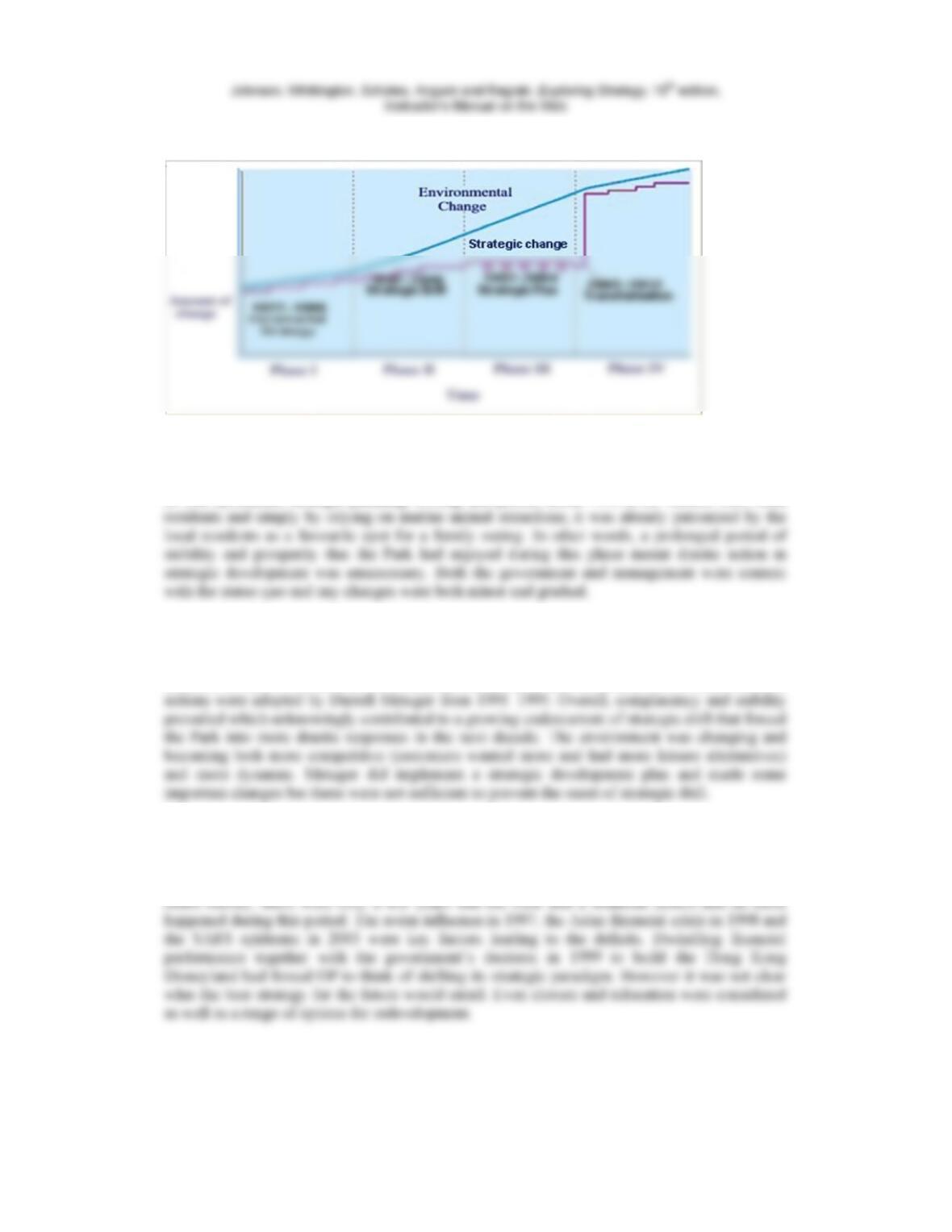
1. Using the strategic drift framework (Figure 5.8) construct a diagram which maps out the
strategic development stages of Ocean Park from 19772013 into distinct phases. Explain
402
© Pearson Education Limited 2014
Figure 1 Strategic drift of the Ocean Park, Hong Kong
Phase I 19771986 Stability and conformity
In 1977, when Ocean Park was the only theme park in Hong Kong, competition was absent and
so was systematic strategic planning. During this period, about 70% of its visitors were local
Phase II 19871996 Drifting apart
In this period, Ocean Park largely continued to follow the same path. Some deliberate actions to
translate its three core missions of education, conservation and entertainment into more concrete
Phase III 19972004 Period of flux
19972004 was a watershed period in Ocean Parks history. A series of adverse external factors
resulted in alarming deficits and forced OP to resort to a more conscious effort to change. In its
403
Phase IV 20052012 Transformation
The MRP clearly indicated OPs strategic development route had entered the phase of
transformation. The objective of turning a modest community park into a world class marine
2. Explain with examples, how Ocean Park has seen elements of a) deliberate strategy
processes, b) emergent strategy approaches and c) imposed strategy in the course of its
development.
Phase I 19771986 Emergent strategies
The strategic process of OP was predominantly emergent in this phase. Strategic change was
incremental in a process of fermentation, progressing slowly within a rather stable business
Phase II 19871996 Predominantly emergent mixed with some signs of deliberate strategies
The strategic development approach in this period was still predominantly emergent, but with
the first more deliberate attempt to introduce some planning e.g. Metzgers development plan
Phase III 19972004 Predominantly emergent, followed by imposed strategy
A lot of organisations can get by simply through fine-tuning existing strategies rather than
creating new ones continuously, nevertheless the emergent approach has a potential danger in
breeding complacency and inertia which can lead to strategic drift. Ocean Park is a prime
example of how conformity and complacency had diminished its ability to catch up with the
404
Phase IV 20052012 Predominantly deliberate and imposed strategy
The MRP clearly illustrates a sharp turn from emergent to deliberate strategy. In addition, there
3. To what extent are Ocean Parks strategic decisions historically conditioned?
Ocean Parks history is a major factor that is woven throughout its strategic fabric and still
exerts far-reaching impact on how its leaders direct the whole developmental process. Its tri-
next moves. All this supports the view that organisational decisions are historically conditioned.
4. Based on the case and other reference materials (e.g. annual reports and website of the
a. How Zeman repositioned OP
Zeman first reinstated the uniqueness of OPs oceanarium background and concluded that:
conservation, education and entertainment remains as the core attributes but this time
b. Application of relevant theories
A number of strategic management frameworks can help explain the stance taken by Zeman.
This question gives room for students to broaden their knowledge of strategic management
405
i) Competitive strategy
Porter (1986, 1996), in his classics on competitive strategy, advocated being different whether
in a broad or focused market. He proposed that competitive strategy can be summarised in the
generic strategies (see Figure 6.2 of Exploring Strategy).
ii) Resource-based view (as discussed in Section 3.1 in Exploring Strategy)
Competitive advantage of a firm can be derived and sustained from the deployment of its
distinctive capabilities refer to the VRIO criteria in Chapter 3. Obviously, OP possesses its
own unique resources and competences and by continuing to develop its marine, animal and
iii) The Blue Ocean strategy
The Blue Ocean strategy (Kim and Mauborgne, 2004) is about creating new market spaces
where there is no competitor. By applying both differentiation and low cost strategies, and
following this up by actions to create total offers to customers that match the critical success
5. Evaluate the contribution of leadership in turning around the strategies and performance of
Ocean Park.
The early leadership of Ocean Park did not have a major impact on the development of strategy,
however, the vision and the mission set by Sir Kenneth Ping-Fan Fung from the outset have
been instrumental in the evolution of the park.

Amid all the problems the Park faced starting from the late 1990s, new leaders were brought in
to turnaround its fortunes. Appointing an unconventional entrepreneur like Zeman to manage a
governmental park first appeared controversial, but soon turned out to be the right choice. A
theme park layman but also a savvy entrepreneur, he forwarded an aggressive strategic direction
to save the Park. He had the bold vision of changing the market position of OP to a world class
standard and appointed a very capable executive to implement that vision. It was the
combination of Zeman and Mehrmann that paved the way for an aggressive MRP that
transformed the park.