
431
C A S E T E A C H I N G N O T E S
Changing tracks at Babcock Rail
Gerry Johnson
1. Introduction
This case study provides students with the opportunity to consider a strategic change
programme at the engineering services firm Babcock Rail. In particular, the case invites
2. Position of the case
The case study is focused on issues of strategic change so it is most relevant to Chapter 14 of
3. Learning objectives
Study of the case requires students understanding of:
The context of strategic change in designing a change programme or evaluating its success
4. Teaching scheme
This case study may be employed in a relatively conventional case study session by providing it
to the students beforehand with the questions below and asking students to employ the concepts

432
5. Questions for discussion
1. Identify the key aspects of the context of change that John Howie faced at Babcock Rail.
6. Case analysis
The analysis of the above questions can draw on some of the main concepts and frameworks
In terms of the specific questions, the case analysis might include the following.
1. The context of change
In relation to the change kaleidoscope the main points are as follows:
Time
Babcock Rail was loss making and this situation was exacerbated by the loss of the high output
Scope
In one respect, the changes required seemed to be fairly limited in relation to delivering against

Johnson, Whittington, Scholes, Angwin and Regnér, Exploring Strategy, 10th edition,
Instructors Manual on the Web
Preservation
John Howie identified the need to preserve what he saw to be the strengths of competent rail
Diversity
There was a lack of diversity of business experience. Most of those working for the company,
Capability
The managers at Babcock Rail had experience of change programmes there had been a
number of change programmes over the preceding years. However, these were top down change
Capacity
Despite their experience of change, it could not be taken for granted that there was a capacity
Readiness
The indication is that, everyone accepted there was a problem at Babcock Rail and, therefore,
Power
Certainly, John Howie seemed to have the power to make the changes necessary within the
business but, in the end, the effectiveness of the change programme would also depend on
convincing Network Rail of the effectiveness of any changes.

Johnson, Whittington, Scholes, Angwin and Regnér, Exploring Strategy, 10th edition,
Instructors Manual on the Web
434
Such assumptions seem to be supported by stories about the difficulties in dealing with
Network Rail.
2. Levers for change
Students should be able to trace through a whole series of levers for change, discussed both in
Chapters 13 and 14. These include the following.
Improvement in information systems were underway (led by Kenny Douglas).
Structural change was introduced across the business, bringing together previously separate
suboptimal business units into two divisions focused on the customer rather than the
technical base of the business.
Changing processes and routines: these included:
a. Tackling the defensive routines that had developed in relation to Network Rail
In terms of symbolic changes: John Howies introduction to the firm was accompanied by
stories about how he had done it before effectively at Faslane. The behaviour of John
Howie, himself, seemed to be markedly different from previous chief executives with his
435
Power: The most obvious move in terms of power within Babcock Rail was the
management restructuring, which removed blockages to change and put in place managers
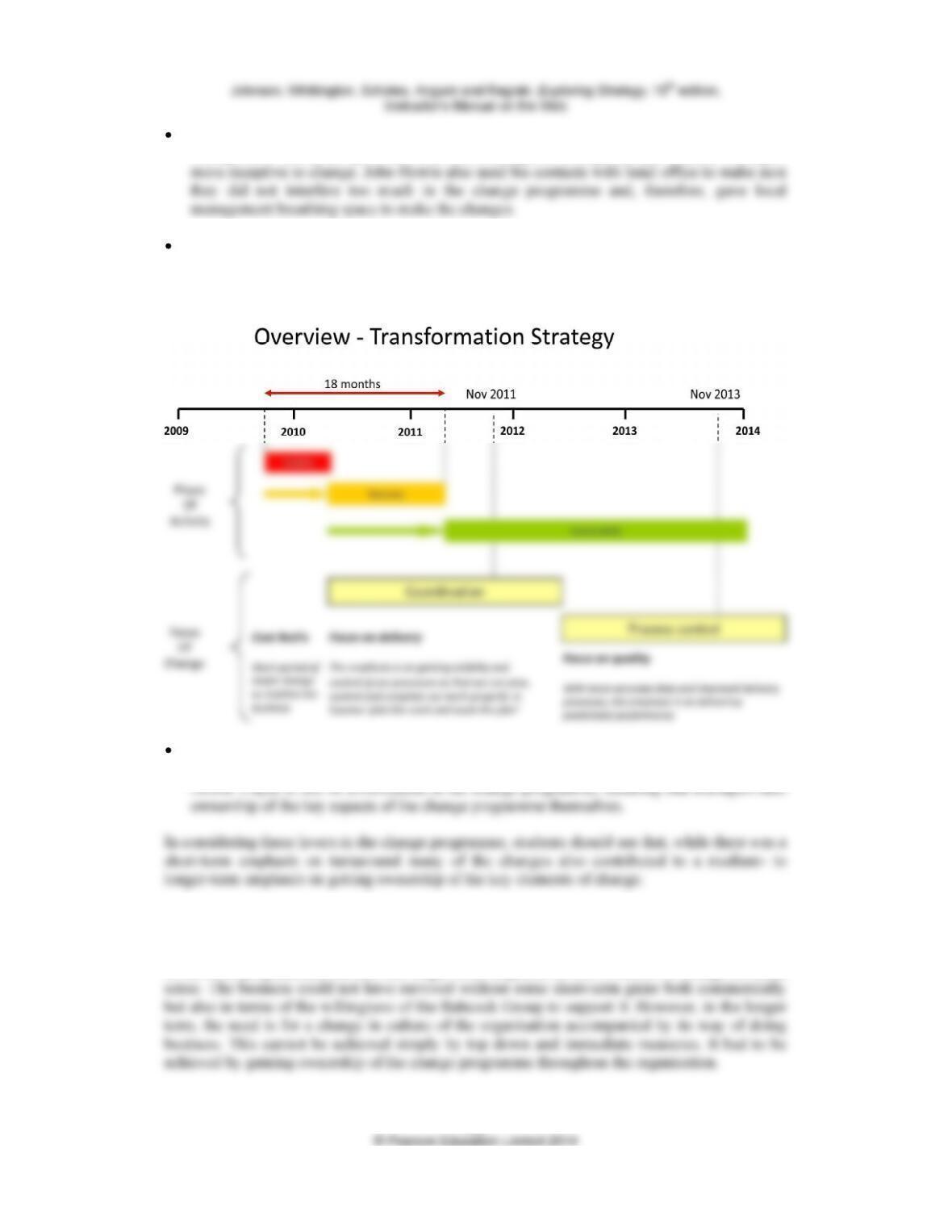
Timing: John Howie emphasised the staged nature of the change programme the importance
of bite sized chunks of change. This was encapsulated in a stage model, that he used in
presentations to staff and laid out the expectations of the change programme by such stages;
see Figure 1 below.
There was a need to show some short-term wins and this was facilitated by Howies personal
contacts with senior management at Network Rail. However, in the medium to longer term
3. Do these levers for change make sense in the change context?
Students should see that the emphasis on both the need for short-term wins (effectively a
turnaround programme), but also the longer-term emphasis on the evolution of change do make

436
4. Change programmes in different contexts. Students should be referred to the end of chapter 14
case study Sergio Marchionne: leading change in Fiat and Chrysler.
It may be worth comparing the change levers in the Babcock Rail context with the change levers
employed in other contexts. For example, as suggested in Question 3 above:
The situation at both Fiat and Chrysler were turnaround situations too but in these situations
there was also a need to change peoples attitudes and assumptions. So, this was initial