362
C A S E T E A C H I N G N O T E S
Strategic leadership and innovation at
Apple, Inc.2
Loizos Heracleous and Angeliki Papachroni
1. Introduction
The case begins by noting Apples current, leading market position, its near bankruptcy during
the 1990s, and its remarkable turnaround under Steve Jobs since 1997. It ends with the question
2. Position of the case
The case is likely to be taught in the middle or latter part of the course, dealing essentially with
3. Learning objectives
The learning objectives for this case are the following:
To explore the nature of strategic leadership using Steve Jobs leadership at Apple Inc. as an
example
proprietary system).
4. Teaching scheme
The Apple, Inc. case typically leads to spirited discussion, given that a significant percentage of
the students will own an Apple product and be fans of the company, and virtually all students
will have heard of Apple and be familiar with at least one of its product offerings. Given the
iconic status of the company, students analysis may not always be dispassionate.
This case can be discussed effectively in around 90 minutes. It fits well as either the first, or the
In terms of use of time, depending on the time available (for example, if there are 120180
minutes available to discuss the case), these last three issues could be suitable for in-class group
work.
On the first discussion question, the class can be divided into two groups, and each group asked
to provide good reasons for either sustaining or opening up Apples system. This issue leads to
interesting discussions, since there are good reasons for both decisions, and a decision on this
issue is a key strategic choice that Apple has to make (see analysis of this issue toward the end
of this teaching note).
5. Questions for discussion
Some preparatory questions that can be given to students in advance are:
1. How innovative is Apple? Is it a strategic innovator?
Two further questions that can be brought up during the discussion, and that can stretch
students thinking, are:
1. Should Apple rethink its closed system, proprietary ecosystem approach?
364
6. Case analysis
1. Is Apple a strategic innovator?
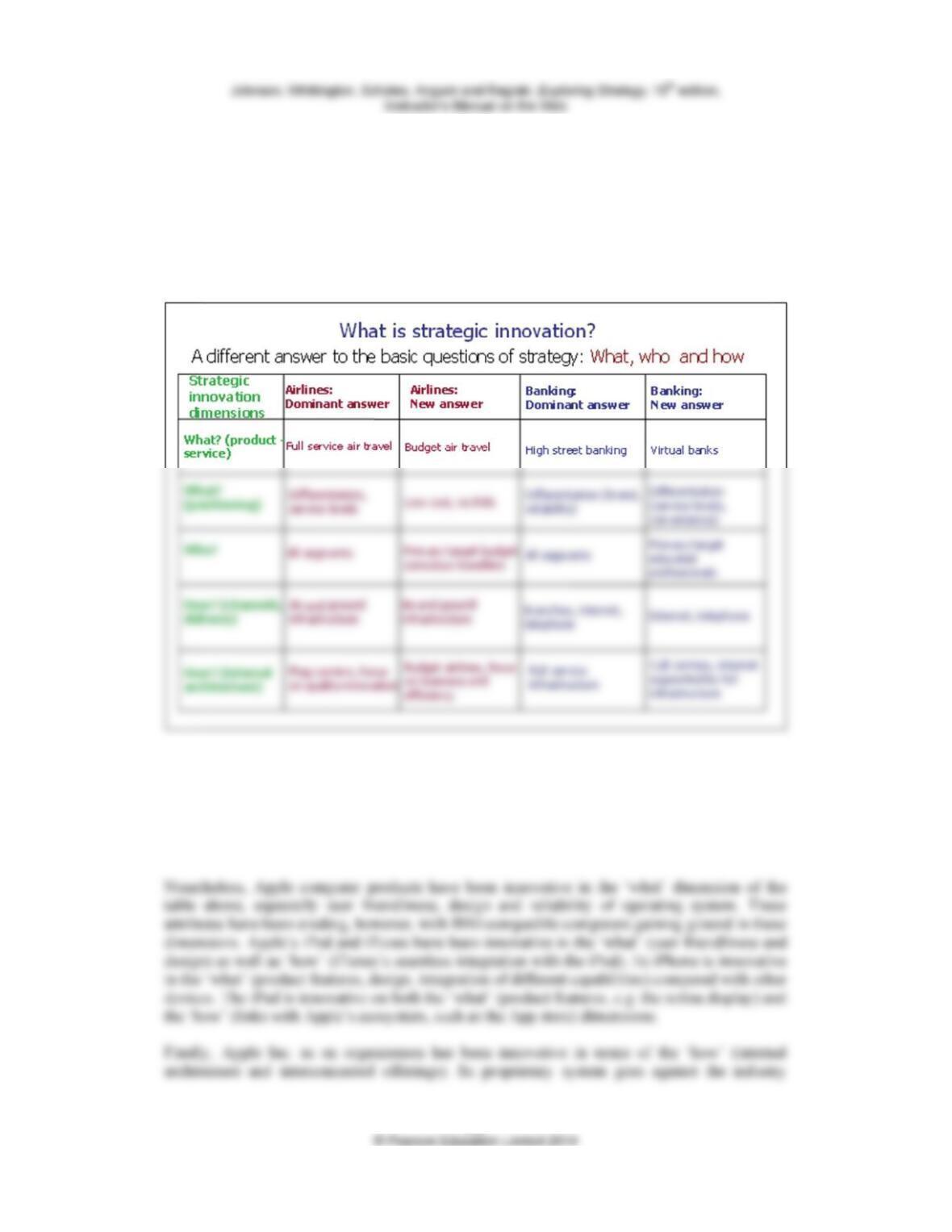
Strategic innovation is defined as offering different answers than the established ones, to the key
questions of strategy; who, what and how (Markides, 1998). Historical examples include
internet banking vs. high street banking, and budget airline carriers vs. flag carriers. These two
examples can be analysed as follows:
So has Apple engaged in strategic innovation?
It is important to note at the start that Apple is not a typical first-mover (Section 9.4.1) indeed,
its strategy is more to follow, but to do so highly effectively. In this sense, as in the case of
iTunes, for example, a lot of its innovation is business model innovation rather than simple
technological innovation (Section 9.2.4).
365
recipe of specialisation, and leads to both dangers and opportunities (as discussed in additional
Question 1). This analysis shows that Apple can be seen as a strategic innovator, particularly in
the dimension of what (products) as well as how (internal architecture and interconnected
offerings).
An interesting question to pursue further here would be what factors aid Apples innovative
capacity (Apples core competency: see also Chapter 3). These include:
proprietary ecosystem enabling the seamless integration of hardware and software;
2. What is your evaluation of Steve Jobs as a strategic leader at Apple?
Materials from Sections 14.2.1 and 14.2.2 will be particularly useful here: highlighted especially
are the roles of top managers as leaders (envisioning, aligning and embodying) and leadership
styles (transformational or transactional).
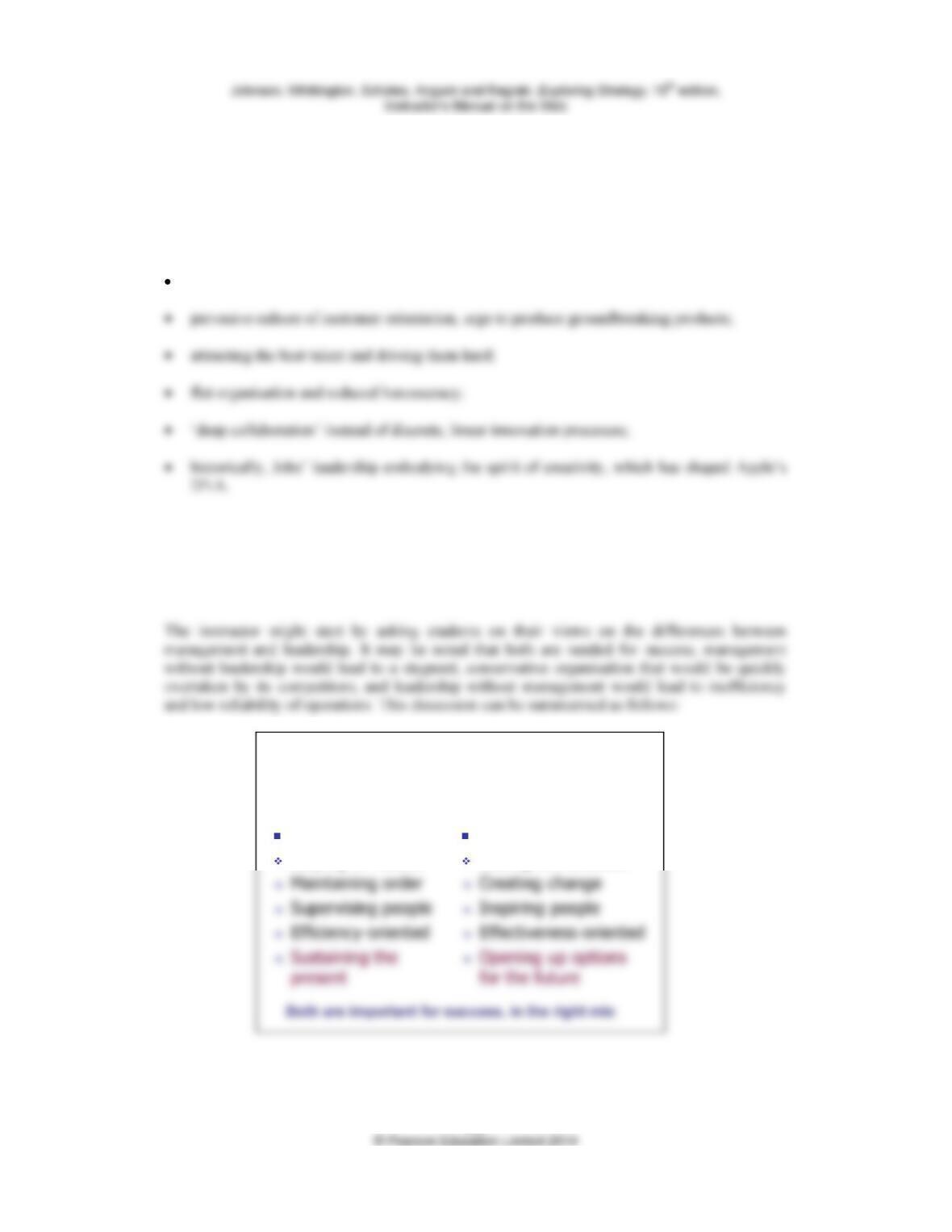
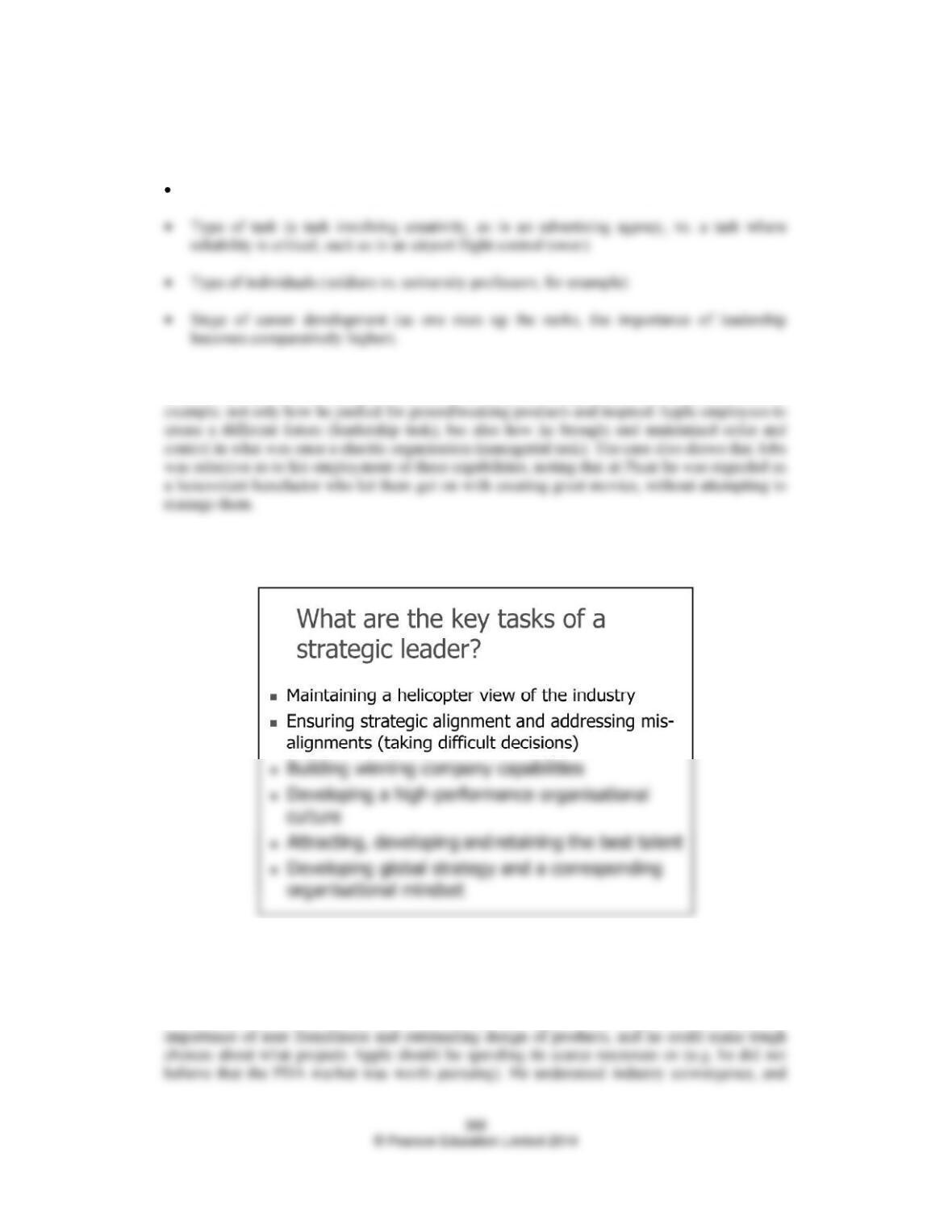
Is there a difference between
management and leadership?
Management
Staying on course
Leadership
Setting the direction
Johnson, Whittington, Scholes, Angwin and Regnér, Exploring Strategy, 10th edition,
Instructors Manual on the Web
The instructor might ask, what determines the right mix of management and leadership? This is
a matter of weighing up relevant factors, which include:
Type of organisation (having mechanistic vs. organic organisation designs for example)
Was Jobs more of a leader or a manager? This is an interesting question. It is clear that Jobs was
more of a leader than a manager, but also that he had both capabilities. The case outlines, for
The instructor might then ask, what is it that makes a leader strategic? What is it, in other words,
that can connect leadership with strategy? Some potential answers to this question are below:
Again the discussion can turn to the extent to which Jobs was a strategic leader. Considering
the above issues:
Jobs clearly had a helicopter view of the industry and could draw strategic implications from it,
which translated into resource allocation decisions for Apple. For example, he understood the
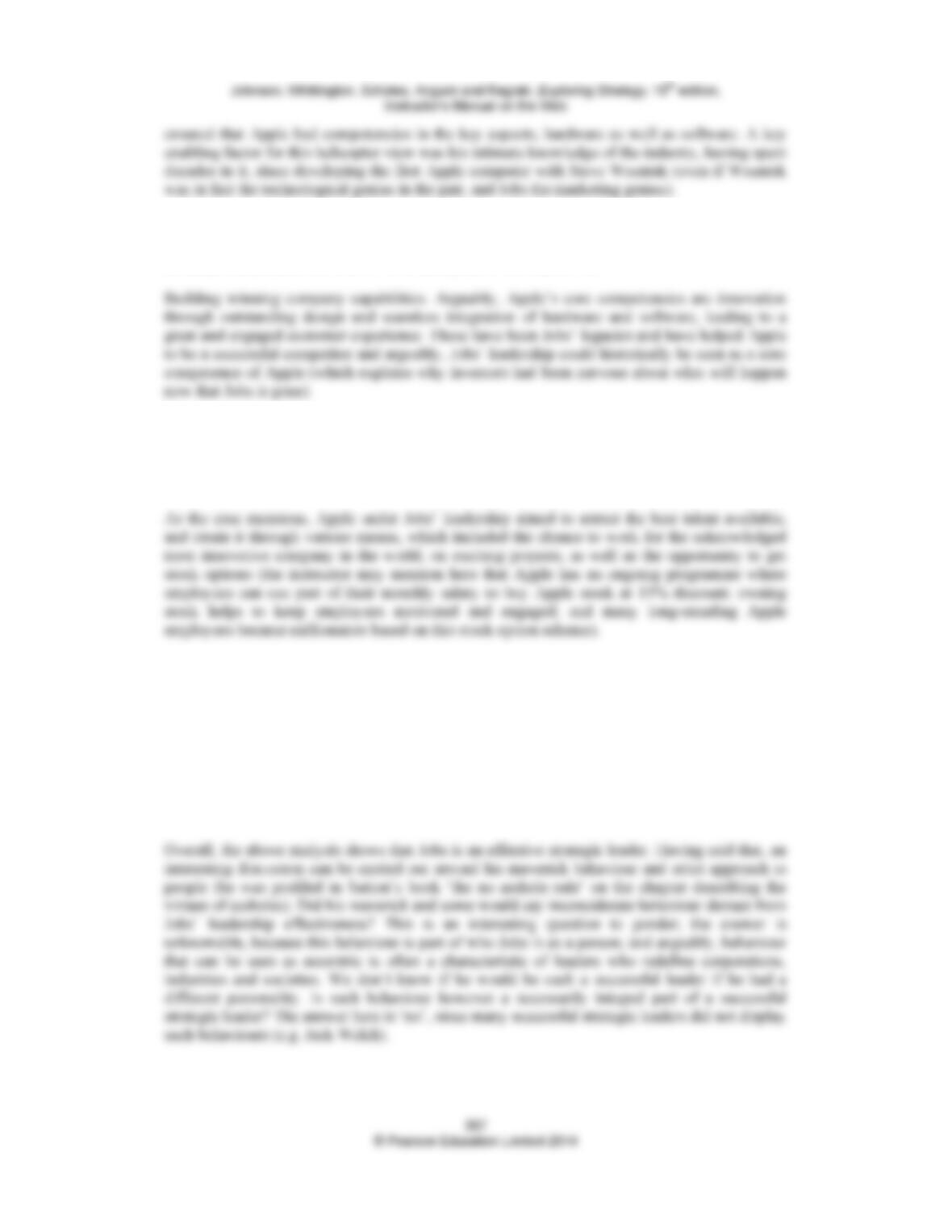
Apple was strategically aligned after Jobs tenure, and Jobs eliminated some misalignments
such as a chaotic culture with little cost control, and too much resource spent on new product
development projects that did not have enough promise or potential.
As the case describes, the culture at Apple was high-pressure, where excellent people were
pushed hard to deliver groundbreaking products; and characterised by a strong sense of
community and belonging to one of the worlds best organisations. Jobs leadership was a key
driver of this atmosphere.
Developing global strategy and a corresponding organisational mindset: As the financial
information in the case shows, almost a third of revenues come from the US and the rest from
around the world. Having said that, Apple still remains a quintessentially American corporation,
in terms for example of image, culture, location where innovations are developed, and seat of
control. A case could be made that Apple needs to focus more on global emerging markets,
where growth is fastest. Its premium strategy however, may not be the most suitable for
emerging markets such as China and India, where people are more price-sensitive. This poses an
interesting strategic challenge, of how Apple should approach large emerging economies such
as these.
368
3. What are your recommendations to Apple in the Cook era?
Materials from Section 14.4.1 on the forcefield analysis of change and from Section 14.5 on the
types of change (from adaptation to revolution) may be helpful here.
Of course, it is difficult to make recommendations to a leading company. However, Additional
Questions 1 and 2 discussed below, as well as the previous analyses, point to some
recommendations:
Consider how to compete in leading emerging economies. Apples premium strategy seems
at odds with the conditions in emerging markets. On the other hand, should Apple follow a
Sustain control of its technological ecosystem (see Additional Question 1).
Expand its own retail distribution chains. This is a use of Apples cash that makes a lot of
sense; Apple stores strengthen the brand, bring Apple closer to its customers, enable it to
control the whole customer experience, and help it win new converts.
Additional discussion question
1. Should Apple rethink its closed ecosystem, proprietary approach?
There are likely to be split opinions on this issue. There are good arguments for either decision,
as follows:
Apple should sustain its proprietary ecosystem because:
369
it enables systemic (vs. stand-alone) innovations that would have been difficult otherwise.
On the other hand, Apple should open up its proprietary ecosystem because:
Whatever formal analysis suggests however, Apple is likely to keep its proprietary ecosystem,
given the belief that it aids groundbreaking innovation and user friendliness, and supported by
Apples exceptional performance over the last several years.
If there is sufficient time, the instructor can bring up here the following issue: An interesting
aspect of Apples proprietary system is the effective achievement of synergies. Synergies are
notoriously hard to achieve. How has Apple succeeded in achieving synergies (e.g. hardware-
software interoperability, deep collaboration) where most other companies fail to do so? Some
relevant factors here would be:
Tight control historically exercised by Steve Jobs, and since late 2011 by Tim Cook
2. Is Apple off the rollercoaster that has characterised its history?
Since this is a question about the future, it is impossible to have a definitive answer. However,
the following issues are relevant:
Apples ability to focus its efforts and resources is beneficial. As the case notes, Jobs often
said Im as proud of what we dont do as of what we do. Jobs removed 70% of product
development projects when he took charge at Apple in 1997. This focus is consistent with
Having said the above, the risks of operating through a proprietary system, in world of open
standards, are significant. It is by no means clear that Apples competitive advantages will
continue to effectively outweigh these risks.