215
C A S E T E A C H I N G N O T E S
A source of cheap energy or a source of
problems the potential benefits and costs of
shale gas
Steve Pyle and Bob Dover
1. Introduction
This case study provides students with the opportunity to consider (a) the development of the
2. Position of the case
This case provides the opportunity for a debate on the benefits and costs of developing shale oil
and gas in particular within the European environment. It is worth emphasising that the
3. Learning objectives
Study of the case involves students in understanding:
How aspects of the macro-environment influence the development of an industry the use
of the PESTEL framework (2.2.1 of Chapter 2 of Exploring Strategy)
Instructors Manual on the Web
216
4. Teaching scheme
This case study can be taught as a class discussion orchestrated by the instructor around an
analysis of the industry using the PESTEL framework. However, two key drivers of change
should soon emerge the economic priority to find new sources of energy and the widespread
5. Questions for discussion
1. Using the PESTEL framework, identify the key drivers of change in the shale gas/oil
industry. Identify the main opportunities and threats that arise from this analysis.
6. Case analysis
1. Using the PESTEL framework identify the key drivers of change in the shale gas/oil
industry. Identify the main opportunities and threats that arise from this analysis.
If students have done previous cases using PESTEL, it may be advisable to cover this question
relatively quickly in order to get onto the scenarios. However, there are a wide variety of macro-
217
Economic viability of shale gas seams; cost of energy; economies of scale; availability of
infrastructure; cost of developing drilling operations; long run energy costs; economic growth
2. Using the two most appropriate drivers of change build a two-by-two matrix showing four
alternative scenarios for the shale gas/oil industry (use a 1015 year time horizon).
Students can be encouraged to identify the key drivers of change and asked to prioritise the
PESTEL factors. A number of different scenarios can be developed by using different
combinations of factors. It is likely that a consensus might settle on some combination of these
key factors:
Government support (or lack of it)
There is no one right answer to building scenarios and students should be encouraged to think
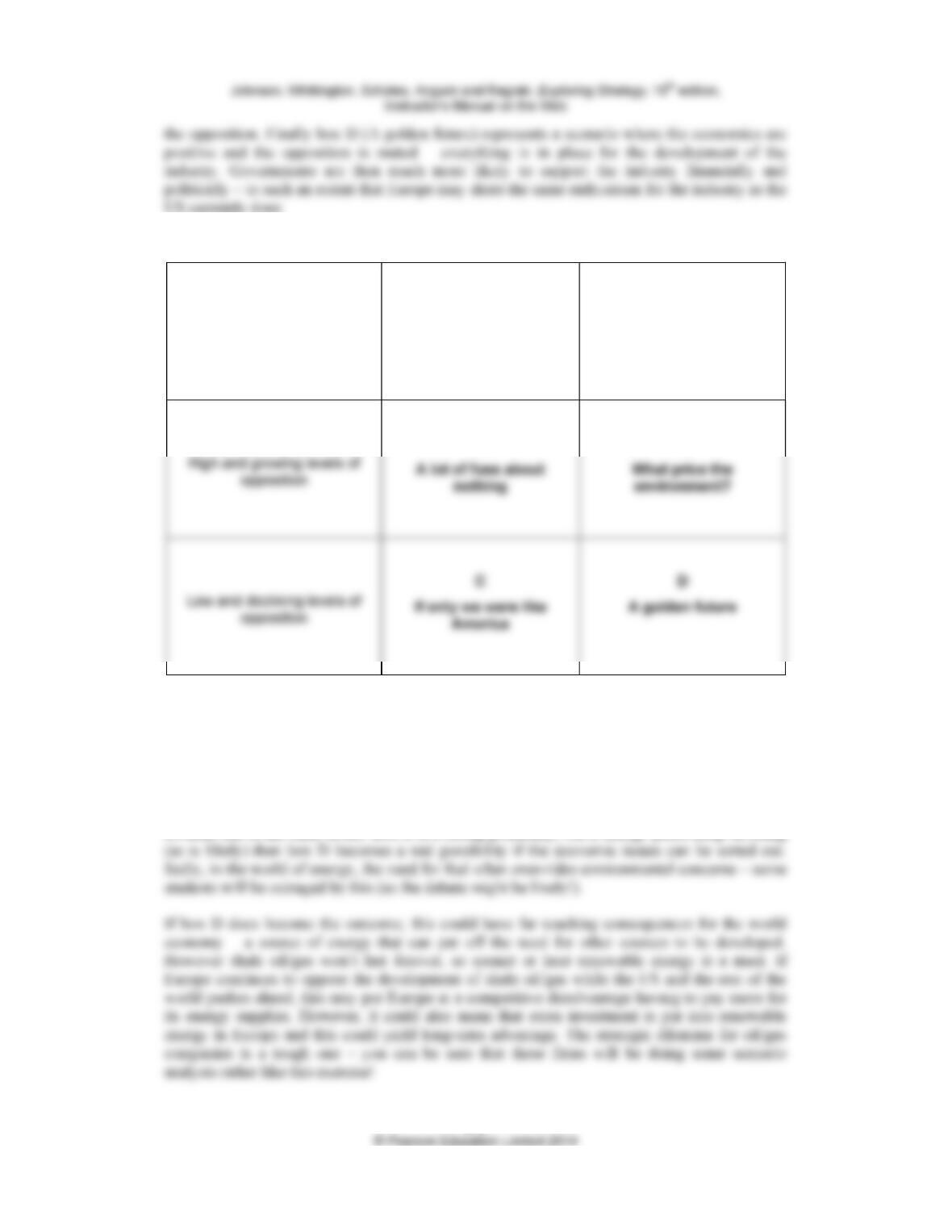
widely and creatively. However, one such matrix is illustrated below in Figure 1 reflecting the
uncertainty about economic viability in Europe and the trends in opposition on environmental
grounds. There is nothing special about the names given to the quadrants (AD), students can
have some fun coming up with their own names for different scenarios. Box A (a lot of fuss
about nothing) might occur if the shale gas seams are too thin; government does not provide any
investment support and firms decide it is not a viable opportunity. In this scenario, the
218
US currently does.
Figure 1
ENVIRONMENTAL
OPPOSITION
ECONOMIC
Too expensive to develop
economically
VIABILITY
Cost reductions lead to
increasing viability
A
B
3. Argue the case for one of these scenarios explaining the logic behind the scenario and the
consequences of this scenario for strategies in the energy industry.
Whether these (or alternative) scenarios are used, it is a good idea to get students to think
through the consequences of the scenario. It is possible to make a convincing case for any of the
scenarios illustrated above and the current situation is likely to evolve over time. As of 2013, it
could be argued that the European industry is in box A, but over time it is likely to move
towards one of the other boxes. Box B is a strong possibility, but if energy prices keep on rising