InstructorManualtoMikePeng&KlausMeyer(2011):InternationalBusiness,CengageLearning.
Instructor Manual
Chapter 6: Investing Abroad Direct
to accompany Mike Peng & Klaus Meyer: International Business, Cengage Learning
Prepared by Klaus Meyer
version February 2011
Introduction to the Topic
Learning Objectives
1. understand the vocabulary associated with foreign direct investment (FDI)
4. appreciate the benefits and costs of FDI to host and home countries
5. participate in two leading debates on FDI
General Teaching Suggestions
Next to trade and financial investment, direct investment is a cornerstone of international
business. This is the second chapter on basic transactions laying theoretical foundations. We
use John Dunning’s OLI framework to explain why when and where companies engage in
direct investment, and round up the chapter with a brief discussion of the impacts and the role
of institutional influences on FDI.
Opening Case Discussion Guide
The opening case outlines how Spanish firms have successfully expanded beyond their own
country since the late 1990s. It introduces some of the biggest names of Spanish business
Chapter Outline, Section by Section
InstructorManualtoMikePeng&KlausMeyer(2011):InternationalBusiness,CengageLearning.
Section 1: The FDI Vocabulary
Key Ideas
This section introduces, brief and concisely, key terms on FDI and MNEs, and introduces
some key data on FDI stock and flow on a national level.
Key Concepts
foreign portfolio investment (FPI)
Investment in a portfolio of foreign securities such as stocks and bonds.
joint-venture
An operation with shared ownership by several domestic or foreign companies
upstream vertical FDI
A type of vertical FDI in which a firm engages in an upstream stage of the value.
downstream vertical FDI
InstructorManualtoMikePeng&KlausMeyer(2011):InternationalBusiness,CengageLearning.
The amount of FDI moving in a given period (usually a year) in a certain direction.
FDI stock
The total accumulation of inbound FDI in a country or outbound FDI from a country across a given
period of time (usually several years).
Section 2: Why do Firms become MNE by Engaging in FDI
Key Ideas
The OLI paradigm is the most used framework to explain international production (or foreign
Key Concepts
OLI paradigm
A theoretical framework positing that ownership (O), locational (L) and internationalization (I)
advantages combine to induce firms to engage in FDI
internalization advantages
Advantages of organizing activities within a multinational firm rather than using a market transaction
Internalization
The replacement of cross-border markets (such as exporting and importing) with one firm (the MNE)
InstructorManualtoMikePeng&KlausMeyer(2011):InternationalBusiness,CengageLearning.
The location advantages that arise from the clustering of economic activities in certain locations.
asset specificity
An investment that is specific to a business relationship
Intra-firm trade
International trade between two subsidiaries in two countries controlled by the same MNE.
Section 3: National institutions and FDI
Key Ideas
Applying the institution-based view, we look at some of the institutions in home and host
economies that influence FDI decisions. This theme will be further deepened in Chapter 12
on foreign entry strategies.
Key Concepts
Local content requirements
InstructorManualtoMikePeng&KlausMeyer(2011):InternationalBusiness,CengageLearning.
Section 4: Benefits and costs of FDI
Key Ideas
This section provides a very brief introduction to the FDI spillovers literature by introducing
the main (possible) effects that FDI has on others in the home economy. Table 6.2 provides a
very condensed summary of a sprawling literature.
Section 5: Debates and Extensions
Key Ideas
The first debate concerns the bargaining that takes place between MNEs and host
governments, introducing the ideas of bargaining power and obsolescing bargain.
Key Concepts
bargaining power
The ability to extract a favourable outcome from negotiations due to one party’s strengths.
obsolescing bargain
Refers to the deal struck by MNEs and host governments, which change their requirements after the
initial FDI entry.
InstructorManualtoMikePeng&KlausMeyer(2011):InternationalBusiness,CengageLearning.
A state-owned investment fund composed of financial assets such as stocks, bonds, real estate, or other
financial instruments
Section 6: Implications for Practice
Key Ideas
Review Questions
Review questions are provided to students on the website accompanying the book. They
directly ask to summarize the material provided in the text. Instructors may also use the
questions to structure their lectures or review sessions.
Review Questions
(as provided to students on the website)
Material in the Book
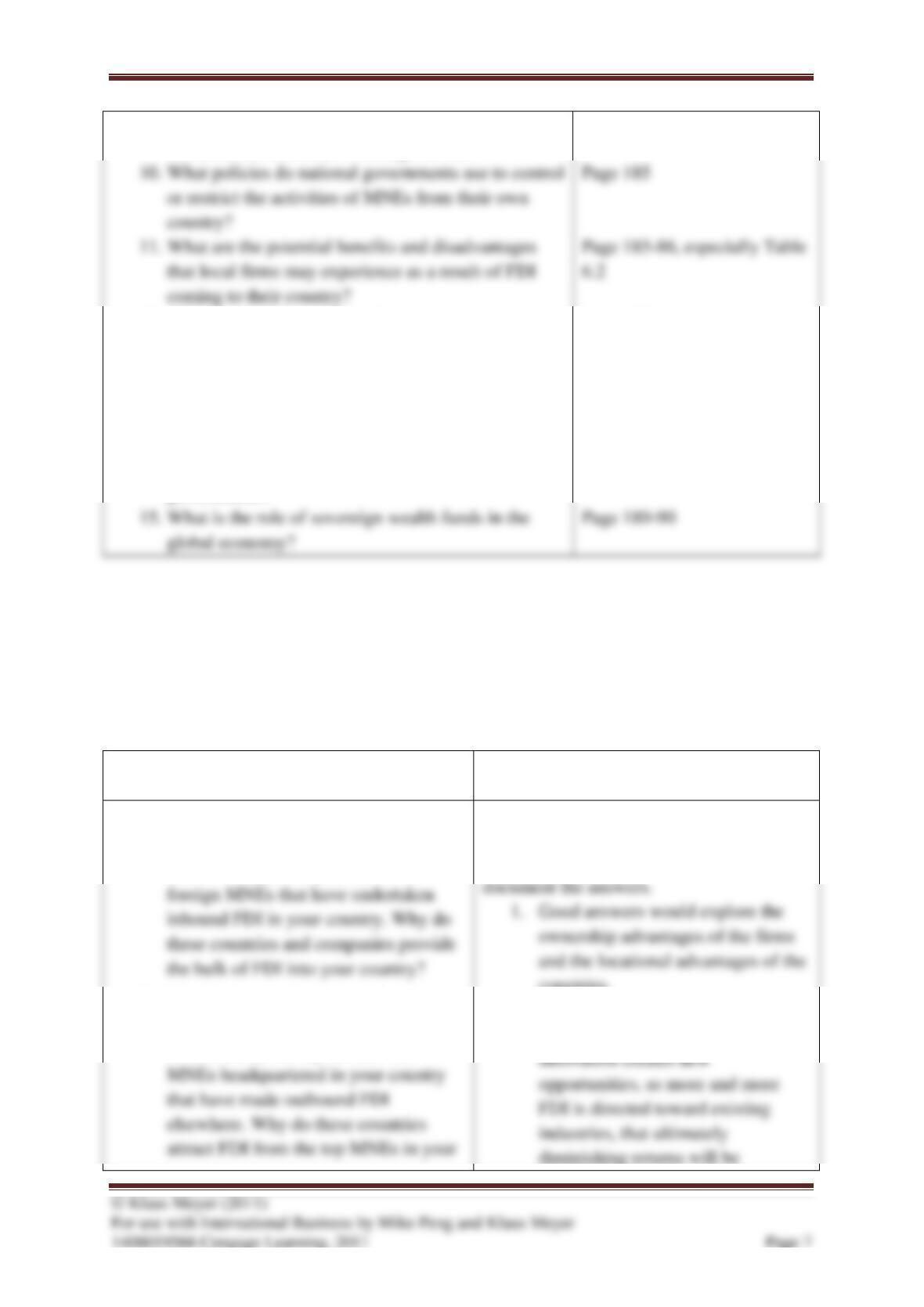
1. Distinguish key terminology with respect to FDI:
direct versus portfolio investment, horizontal versus
vertical FDI, upstream versus downstream FDI, FDI
stock versus FDI flows!
5. Why would firms want to ‘internalize’ cross-border
transactions within their organization?
6. Why would firms set up a FDI sales operation, rather
than export from the home country?
Pages 166-67
Page 179 and Table 6.1
Page 179
InstructorManualtoMikePeng&KlausMeyer(2011):InternationalBusiness,CengageLearning.
9. What policies do national governments use to control
or restrict the activities of foreign MNEs?
12. What are the potential benefits and disadvantages
that ordinary people – as consumer or workers – may
experience as a result of FDI coming to their
country?
13. Is FDI good or bad for the natural environment?
14. Explain the phenomenon of ‘obsolescing bargain’ in
the relationship between MNEs and host
governments!
Page 183-84
Page 187
Page 187
Page 188
Critical Discussion Questions
At the end the chapter, we provide discussion questions that aim to stimulate students
thinking beyond memorizing the material learned in the chapter. They are designed to be
used at a basis for in-class discussions, group work, or individual assignments. Below,
provide some indicative answers of issues that may be raised in response to these questions.
Discussion Questions
(as provided in the book)
Indicative Responses
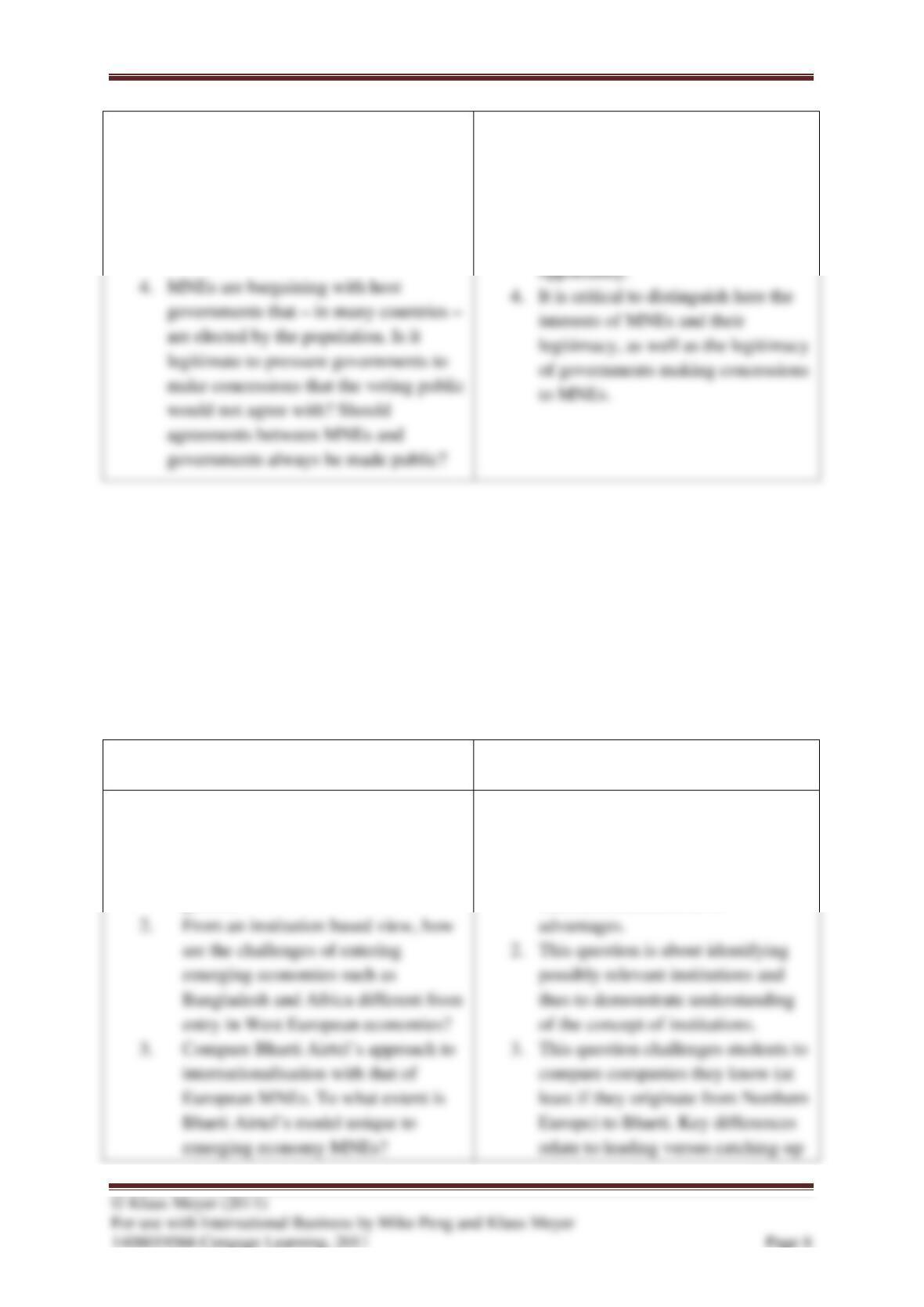
1. Identify the top-five (or -ten) source
countries of FDI into your country.
Then identify the top-ten (or -20)
2. Identify the top-five (or -ten) recipient
countries of FDI from your country.
Then identify the top-ten (or -20)
These are all questions in which the answer
is not as important as the thought process
and the ability to clearly articulate and
countries.
2. As above.
3. It should be noted that unless
InstructorManualtoMikePeng&KlausMeyer(2011):InternationalBusiness,CengageLearning.
country?
3. Worldwide, which countries were the
largest recipient and source countries of
FDI last year? Why? Will this situation
change in five years? Ten years? How
about 20 years down the road? Why?
encountered and countries now
receiving significant amounts of
FDI will receive less and less as
global corporations redirect FDI
into other counties with greater
innovative and entrepreneurial
Closing Case
The closing case provides further opportunities to apply ideas and concepts learned in this
chapter in a real world setting. The Closing Case for this Chapter is “Bharti Airtel” and
focuses on the strategy of an MNE from an emerging economy, India, engaging aggressively
in FDI in South Asia and Africa. Below are some indicative responses to the case discussion
questions.
Case Discussion Questions
(as provided in the book)
Indicative Responses
1. From a resource based view, what are
Bharti Airtel’s main resources? How
were these resources build, and how
do they shape its ongoing path of
growth?
1. The key to this question is for
students to correctly identify
resources (also see Chapter 4), and
how they contribute to the firm’s
internationalization as O-
InstructorManualtoMikePeng&KlausMeyer(2011):InternationalBusiness,CengageLearning.
Further Learning Activities
In addition to the cases and discussion questions provided in the book, instructors may want
to use any of the following activities to further engage students with the material.
1. Your MNE is looking to evaluate the industrial capability of various locations
worldwide. Based on readily available data concerning the potential and performance
of different countries, the information you provide will drive future investment by
your company. Choose a country each from Asia, Europe, North America, and South
America and summarize your findings about each. Of the four countries from four
continents, how would you rank them? Why?
2. The main premise for development at your company in the coming years is to shift its
offshore services to Africa. As such, you have been asked to develop a report that
evaluates which African countries have increased the possibility of creating a long-
term advantage for your company. Also, be sure to include the African countries that
have decreased their capacity to create a long-term advantage. Can you please
generate a top five list and a bottom five list from Africa for this purpose?

InstructorManualtoMikePeng&KlausMeyer(2011):InternationalBusiness,CengageLearning.
Further Readings
At the end the chapter, suggested further readings are provided. The primary aim is to
provide students a starting point for further work, for example when preparing a class
assignment or dissertation. These references also are recommended for instructors not
familiar with the topic and wishing to ‘get ahead of the students’ before lecturing on a topic.
J.H. Dunning, 2000, The eclectic paradigm as an envelope for economic and business theories of
MNE activities, IBR, 12, 141-171 – a summary of the OLI paradigm.
J.H. Dunning & S. Lundan, 2008, Multinational Enterprises and the Global Economy, 2nd ed.,
Cheltenham: Elgar – the most comprehensive book on the multinational enterprise, including
theoretical foundations, empirical evidence, and policy issues.

InstructorManualtoMikePeng&KlausMeyer(2011):InternationalBusiness,CengageLearning.