
1219
Chapter 50
Real Property and
Landlord-Tenant Relationships
See Separate Lecture Outline System
INTRODUCTION
This chapter examines the ways in which ownership rights in property can be held; the nature of ownership rights in
real property; the legal requirements for the transfer of real property, including the types of rights that are transferred by
various deeds; and adverse possession. Other topics include eminent domain and the government’s responsibility to pay com-
pensation when condemning private land for public use.
ADDITIONAL RESOURCES—

1220 INSTRUCTOR’S MANUAL TO ACCOMPANY BUSINESS LAW, TWELFTH EDITION
VIDEO SUPPLEMENTS
The following video supplements relate to topics discussed in this chapter—
PowerPoint Slides
To highlight some of this chapter’s key points, you might use the Lecture Review PowerPoint slides compiled for
Chapter 50.
CHAPTER OUTLINE
I. The Nature of Real Property
Real property usually refers to land, but it also includes subsurface rights, air rights, and fixtures.
A. LAND AND STRUCTURES
Land includes the soil on the surface of the earth, the natural products or artificial structures attached to it, water
on or under its surface, and the air space above it.
B. AIRSPACE AND SUBSURFACE RIGHTS
Significant limitations on air or subsurface rights normally have to be indicated on the deed.
1. Airspace Rights
2. Subsurface Rights
Ownership of land’s surface and subsurface can be separate. Rights to the subsurface can be valuable when
minerals, oil, or natural gas is there. Conflicts may arise between surface and subsurface owners when
attempts are made to excavate. Generally, the owners of subsurface rights are absolutely liable if their
excavation causes the surface to subside.
C. PLANT LIFE AND VEGETATION
When land with growing crops is sold, the sale includes the crops, unless otherwise specified. Crops sold by
themselves are goods (and the sale is covered by the UCC [UCC 2–107(2)])..
II. Ownership and Other Interests in Real Property
A. OWNERSHIP IN FEE SIMPLE

CHAPTER 50: REAL PROPERTY AND LANDLORD-TENANT RELATIONSHIPS 1221
CASE SYNOPSIS—
Case 50.1: Biglane v. Under the Hill Corp.
Nancy and James Biglane owned a building in Natchez, Mississippi, in which they operated a gift shop and in which
they lived. Andre Farish and Paul O’Malley owned the building next door, in which they operated the Natchez Under
the Hill Saloon. Despite precautions on the Biglanes’ part and accommodations on the Saloon’s part, the noise kept the
Biglanes awake at night. They filed a suit in a Mississippi state court against the Saloon. The court enjoined the
defendant from opening doors or windows when music was playing and ordered it to prevent its patrons from loitering
in the street. Both parties appealed.
…………………………………………………………..……………………………………………………………………
Notes and Questions
Should the history of a location have any bearing on a determination of the owners’ rights with respect to the use
of their property? In this case, the state supreme court sketched the history of the section of Natchez that was closest
to the Mississippi River, which is where the disputants were located. From its earliest settlement, the area had been
described as “a gambler’s paradise, a sink–hole of iniquity and a resort of the damned,” populated with “gambling dens,
saloons, houses of ill repute, . . . pirates and slave-traders.” The use of Natchez as a port “gave way to steam-powered
locomotives, which in turn gave way under the advent of automobiles and airplanes,” but the area’s “infamous past
. . . saved it and secured its future. . . . Tourists began to flock to Silver Street—the only remaining portion of
[Natchez] Under-the-Hill,” as it was called. In whose favor might this history have weighed in this case?
What factors might complicate a case that involves similar facts but arises between neighbors across international
within their borders based on such a concept. Some jurisdictions may have different standards with respect to what
ANSWER TO “THE ETHICAL DIMENSION” QUESTION IN CASE 50.1
At one point, the Biglanes blocked off two parking lots that served the Saloon. Was this an unreasonable
interference with the Saloon’s rights? Explain. The Saloon claimed that the Biglanes’ act was “a tortious interference
with a business relationship.” This requires an act that is intended to, and does, damage a business, “without right or
justifiable cause” (i.e., with malice). The trial court ruled in favor of the Saloon on this claim, despite finding no actual
damage (in fact, the Saloon’s business had increased), and awarded nominal damages because of the intentional

1222 INSTRUCTOR’S MANUAL TO ACCOMPANY BUSINESS LAW, TWELFTH EDITION
nature of the act. The state supreme court reversed the award. Although the ownership of one of the lots was in
dispute (the Biglanes owned the other one), actual damage was an important element of this claim, and in this case
none was shown.
ANSWER TO “THE LEGAL ENVIRONMENT DIMENSION”
QUESTION IN CASE 50.1
Could repulsive odors emanating from a neighbor’s property constitute unreasonable interference with a property
owner’s rights? Discuss. Yes (for example, a property owner might be overwhelmed by the repulsive odors of a
rendering plant). The general rule is the same—“a business, although in itself lawful, which impregnates the
atmosphere with disagreeable and offensive odors and stenches, may [unlawfully interfere with the right of] those
occupying property in the vicinity, where such obnoxious smells result in a material injury to such owners”—according
to the court in the Biglane case. An injunction would likely be the proper remedy.
ADDITIONAL BACKGROUND—
Real Property Terminology
The distinction between real property and personal property is usually fairly easy to make. Real property consists
of land and any vegetation and artificial structures such as houses and barns on the land. Personal property, by
contrast, is property other than land which may be moved by the holder such as jewelry or stocks or clothes or
automobiles.
B. LIFE ESTATES
A life estate lasts for the life of some specified individual. The tenant of a life estate has certain rights with
limits—use without waste, extraction of resources by existing facilities only, mortgage for periods shorter than
the life term. A life tenant’s duties include maintaining the value of the property.
C. CONCURRENT OWNERSHIP
Concurrent owners include tenants in common, joint tenants, tenants by the entirety, and community property
owners.

1. Tenancy in Common
2. Joint Tenancy
Joint tenants each own an undivided interest in the whole, and a deceased joint tenant’s interest passes to
3. Tenancy by the Entirety
4. Community Property
Only some states allow property to be owned as community property. If property is held as community
property, each spouse technically owns an undivided one-half interest in it.
ADDITIONAL BACKGROUND—
The Four Unities—Time, Title, Interest, and Possession
Both the joint tenancy and tenancy by the entirety require that certain preconditions exist before a valid tenancy
can be said to exist. First, the owners of the estate must have both received their interests at the same time (unity of
time). Second, the owners of the estate must both draw their title from the same deed or document (unity of title).
D. LEASEHOLD ESTATES
1. Fixed-Term Tenancy or Tenancy for Years
2. Periodic Tenancy
3. Tenancy at Will
4. Tenancy at Sufferance
A tenancy at sufferance is the possession of land without right, created when another tenancy ends and the
tenant remains in possession without the owner’s consent.
E. NONPOSSESSORY INTERESTS
An easement allows a person to use land without taking anything from it. A profit allows a person to take
something from the land.
2. Easement or Profit in Gross
3. Creation of an Easement or Profit
Profits and easements are created by deed, will, implication, necessity, or prescription. Creation by deed or
4. Termination of an Easement or Profit
There are three methods of termination: (1) deed an easement or profit to the owner of the land burdened
5. License
A license is the revocable right of a person to come onto another person’s land. The text provides the
example of a ticket to a movie.
III. Transfer of Ownership
The text outlines the details of a real estate transaction and explains transfers of real property by deed, will, adverse
possession, and eminent domain.
B. REAL ESTATE SALES CONTRACTS
The steps in a sale of real estate include the formation of a contract, a title search, financing (which may include a
mortgage), a property inspection, and a closing.
1. Contingencies
CHAPTER 50: REAL PROPERTY AND LANDLORD-TENANT RELATIONSHIPS 1225
2. Closing Date and Escrow
3. Implied Warranties in the Sales of New Homes
In a few states, a seller makes no warranties (unless the deed or contract specifies otherwise)—a buyer
4. Seller’s Duty to Disclose Hidden Defects
In most states, sellers must disclose any known defect that materially affects the value of the property and
that the buyer could not reasonably discover.
ENHANCING YOUR LECTURE—
POTENTIAL PROBLEMS
WHEN REAL ESTATE IS ADVERTISED ONLINE
The Internet has transformed the real estate business, just as it has transformed other industries. Today’s real
estate professionals market properties—and themselves—online. Given that the Internet knows no physical borders,
what happens when an online advertisement reaches people outside the state in which the real estate professional is
licensed? Is this illegal? Can the agent be sued for fraud if the ad contains misrepresentations? Such questions are
likely to arise in the future as more and more people use the Internet to search for properties.
STATE LICENSING STATUTES AND ADVERTISING
Although some states have rules regarding the advertising of real property, these regulations usually do not
specifically address Internet advertising, which necessarily reaches consumers beyond the state’s borders. At least one
state, California, flatly prohibits Internet advertising of real estate by individuals not licensed in the state.b But how can
a state enforce such a law or check credentials of the Web advertisers? California’s Department of Real Estate suggests
1226 INSTRUCTOR’S MANUAL TO ACCOMPANY BUSINESS LAW, TWELFTH EDITION
that anyone who advertises real property online and is not licensed in California should include a disclaimer on the
ad—but this is not required.
ACTIONS FOR MISREPRESENTATIONS (FRAUD)
Suppose that a real estate agent, either inadvertently or intentionally, makes a misstatement online about some
important aspect of real property that is for sale. Someone, relying on the statements, responds to the ad and
eventually contracts to buy the property, only to discover later that the ad misrepresented it. What remedies does the
buyer have? In this situation, the buyer can complain to the state authority that granted the agent’s license, and the
state may even revoke the license for such conduct. If the buyer wants to obtain damages or cancel the contract,
however, he or she will have to sue the agent for fraud. At this point, jurisdiction problems may arise.
FOR CRITICAL ANALYSIS
Do your students think that the federal government should regulate the advertising of real property on the
Internet to protect consumers from potential fraud? If so, what kind of regulations would be appropriate, and how
might they be enforced?
1996).
d. State by Humphrey v. Granite Gate Resorts, Inc., 1996 WL 767431 (Minn.Dist. 1996), aff’d, 568 N.W.2d 715 (Minn.App. 1997), aff’d again, 576
N.W.2d 747 (Minn. 1998); Hasbro, Inc. v. Clue Computing, Inc., 994 F.Supp. 34 (D.Mass. 1997).
C. DEEDS
Possession and title to land can be passed by deed without consideration. A deed requires—
• The names of the grantor and grantee.
• Words evidencing an intent to convey.
ADDITIONAL BACKGROUND—
CHAPTER 50: REAL PROPERTY AND LANDLORD-TENANT RELATIONSHIPS 1227
Legal Descriptions
A deed must contain a legal description of the property being conveyed in order to transfer title to the buyer. A
metes and bounds legal description involves the use of compass directions and distances from a specific point of
beginning around the boundaries of the property. In earlier times, metes and bounds descriptions often used
references to natural and artificial monuments such as boulders, the side of a road, etc., to describe the boundaries of
a parcel of property. The disadvantage of describing a property line by reference to a stream, for example, became
obvious when the stream dried up and the boundary line could no longer be ascertained.
1. Warranty Deeds
2. Special Warranty Deed
This warrants only that the grantor held good title during his or her ownership of the property, not that
there were no title defects when others owned it. If all liens and encumbrances are disclosed, the seller is
not liable if a third person interferes with the buyer’s ownership.
ENHANCING YOUR LECTURE—
A SHED IS ONE THING, A GARAGE QUITE ANOTHER
Shortly after Richard and Laura Dufrane purchased a home with an attached garage in a subdivision in Greenfield,
Wisconsin, they began constructing a detached garage on the edge of their property. Their neighbor, Mary Pietrowski,
told the Dufranes “multiple times” that the garage violated a restrictive covenant that prevented property owners in
the subdivision from erecting any buildings other than one house and one garage on their land. After the garage had
been built, Pietrowski asked a court to issue an order that the garage be razed (destroyed).

1228 INSTRUCTOR’S MANUAL TO ACCOMPANY BUSINESS LAW, TWELFTH EDITION
THE BOTTOM LINE
Those who purchase real estate should check carefully to determine what restrictive covenants, if any, apply to the
property.
a. Pietrowski v. Dufrane, 634 N.W.2d 109 (Wis.App. 2001).
3. Quitclaim Deed
This warrants less than other deeds, conveying only whatever interest the grantor has.
4. Grant Deed
5. Sheriff’s Deed
This gives ownership rights to a buyer at a sheriff’s sale.
D. RECORDING STATUTES
These statutes require transfers to be recorded in public records (generally in the county in which the property is
located) to prevent fraud. Many states require the grantor’s and two witnesses’ signatures.
ADDITIONAL BACKGROUND—
Basic Types of Recording Statutes
Recording statutes are in force in every jurisdiction. Their purpose is to provide prospective buyers with a way to
check whether there has been an earlier transaction. Hence, recording a deed gives constructive notice to the world
that a certain person is now the owner of a particular parcel of real estate.
who records his or her deed first can claim priority. Irrespective of the particular type of recording statute adopted by
1. Marketable Title

2. Title Search
3. Methods of Ensuring Good Title
The text discusses hiring an attorney to provide an opinion based on a reading of an abstract of title; holding
a court hearing in those states that use the Torrens system of title registration; and (most commonly)
obtaining title insurance, which insures the grantee against losses due to title defects.
E. ADVERSE POSSESSION
Adverse possession is a means of obtaining title to land without delivery of a deed. Adverse possession statutes
aid in the resolution of boundary disputes and in quieting title when it is in dispute, adverse possession statutes
encourage the use of property by assuring that it remains in the stream of commerce, by depriving owners who
sit on their rights too long of their property, and by rewarding possessors who put land to productive use. The
elements are—
CASE SYNOPSIS—
Case 50.2: Scarborough v. Rollins
Charles Scarborough and Mildred Rollins were adjoining landowners in Starkville, Mississippi. Rollins believed that
their common boundary ran along the northern edge of a gravel road. Scarborough believed that the road, as well as “a
grassy area” across its northern edge, was entirely his property. Scarborough filed a complaint in a Mississippi state
court against Rollins to confirm title according to his interpretation. Rollins filed a counterclaim to confirm title based
on her belief. The court entered a judgment for Rollins. Scarborough appealed.
…………………………………………………………..…………………………………………….……………………..
Notes and Questions
If Rollins had done nothing on the disputed land except to claim title, and Scarborough had made use of the road,
would the result have been different? Probably. Without an exercise of use over the property, Rollins would have had
difficulty successfully asserting possession. The use must be actual, open, visible, continuous, hostile, and exclusive to
the interests of others to constitute possession sufficient to acquire title by adverse possession. Scarborough’s use
might have met these criteria. A claim of ownership based on Rollins’s deed might not have been enough in the face of

1230 INSTRUCTOR’S MANUAL TO ACCOMPANY BUSINESS LAW, TWELFTH EDITION
such use.
ANSWER TO “WHAT IF THE FACTS WERE DIFFERENT?” IN CASE 50.2
Suppose that Rollins had not paid any taxes on the disputed land and that Scarborough had done so. Would the
result have been different? Explain. Probably not. The payment of taxes would have lent support to Scarborough’s
claim, but it would not have sufficiently undercut Rollins’s proof of her claim to succeed. Without an exercise of use
ANSWER TO “THE E-COMMERCE DIMENSION”
QUESTION IN CASE 50.2
How might the Internet have facilitated either party’s claim to the disputed property? Depending on the public
records available online, the parties might have found it easier to check documents—old maps, deeds and documents
of transfer, etc.—online than it may have been possible to do in person in local paper files. Also, either party might
have set up a camera that could be viewed online to alert themselves to, and to record, activity on the disputed
property.
ADDITIONAL CASES ADDRESSING THIS ISSUE —
Recent cases applying the principles of adverse possession include the following.
• Dickson v. Young, 79 Ark.App. 241, 85 S.W.3d 924 (2002) (landowners’ maintaining four garden areas on a
disputed parcel, as well as mowing the grass and building a shed on the property, established the owner’s intent to
adversely possess the parcel, even though the owner said that he did not intend to possess the land of another).
IV. Limitations on the Rights of Property Owners
Limitations not discussed below include tax and environmental laws.
CHAPTER 50: REAL PROPERTY AND LANDLORD-TENANT RELATIONSHIPS 1231
CASE SYNOPSIS—
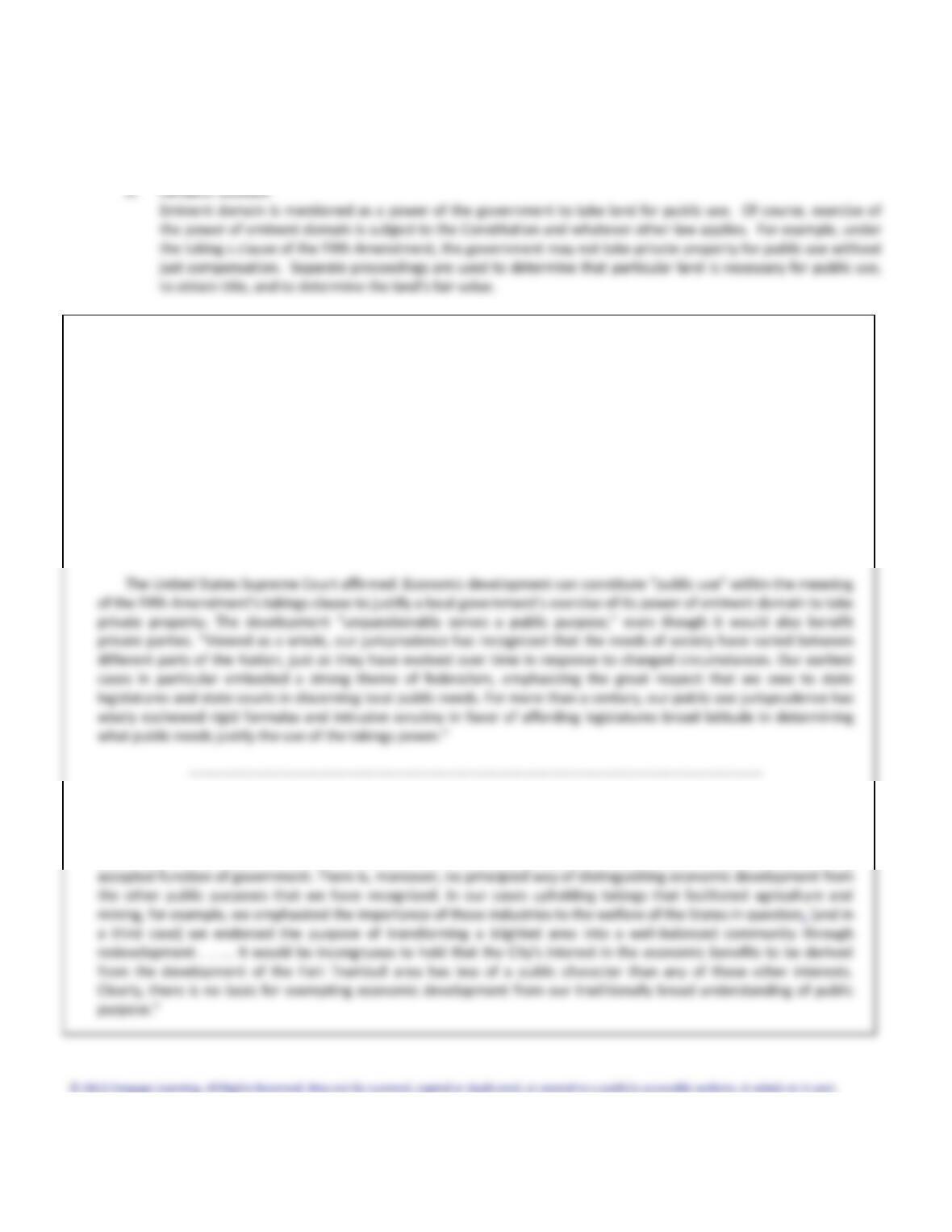
Case 50.3: Kelo v. City of New London, Connecticut
A Connecticut state agency designated the city of New London a “distressed municipality,” and in 1996, the federal
government closed a naval facility in the Fort Trumbull area of the city. In 1998, Pfizer Inc. announced that it would
build a $300 million facility on a site next to Fort Trumbull. Hoping to attract businesses, the city council approved a
plan to redevelop the area that once housed the federal facility. When negotiations with some of the owners fell
through, the city began condemnation proceedings. Susette Kelo and others filed a suit in a Connecticut state court
against the city and others. The plaintiffs claimed, among other things, that taking their property would violate the
“public use” restriction in the U.S. Constitution’s Fifth Amendment. The court ruled in favor of both sides. On appeal,
the Connecticut Supreme Court held that the proposed takings were valid. The owners appealed.
Notes and Questions
The plaintiffs urged the courts to “adopt a new bright-line rule that economic development does not qualify as a
public use,” but the Court chose not to do this. Why? “Promoting economic development is a traditional and long

1232 INSTRUCTOR’S MANUAL TO ACCOMPANY BUSINESS LAW, TWELFTH EDITION
ANSWERS TO QUESTIONS AT THE END OF CASE 50.3
1. Why did the United States Supreme Court grant certiorari in this case, and what did the Court hold with respect to
the principal issue? The Court “granted certiorari to determine whether a city’s decision to take property for the pur-
2. Considering the impact of the ruling in this case, what are some arguments against the decision? There was a
dissent in this case, and in the dissent’s view, under the majority’s holding, “[n]othing is to prevent the State from
replacing any Motel 6 with a Ritz-Carlton, any home with a shopping mall, or any farm with a factory.” The
“beneficiaries” of these circumstances “are likely to be those citizens with disproportionate influence and power in the
political process, including large corporations and development firms. As for the victims, the government now has
license to [take] property from those with fewer resources.”
B. LEGISLATION PROHIBITING TAKINGS FOR ECONOMIC DEVELOPMENT
Most states prohibit takings for economic development, limiting local governments’ ability to take private
property and give it to private developers.
C. RESTRICTIVE COVENANTS
A restrictive covenant is a private restriction on the use of land. It runs with the land if the original parties and
their successors are entitled to its benefit or burdened with its obligation. It must be in writing and subsequent
owners of the property must know of it.
ADDITIONAL BACKGROUND—
The Fair Housing Act
The Fair Housing Act of 1968 (42 U.S.C. Sections 3601–3631) is part of the Civil Rights Act of 1968, one of the three
comprehensive civil rights laws that were enacted by Congress in the 1960s. The Civil Rights Act of 1968 was signed by
President Lyndon Johnson seven days after the death of the Reverend Martin Luther King, Jr., who was assassinated on
April 4, 1968.
The act condemns discrimination on the basis of race, color, religion, national origin, or gender in the sale and
The act covers all housing built with federal financial assistance, multiple dwellings having more than four units,
single-family homes sold in real estate developments that are not owned by private parties, and any private housing
CHAPTER 50: REAL PROPERTY AND LANDLORD-TENANT RELATIONSHIPS 1233
sold or rented by a real estate agent. The proscription extends to institutions providing financing and to brokers, as
well as agents and property owners.
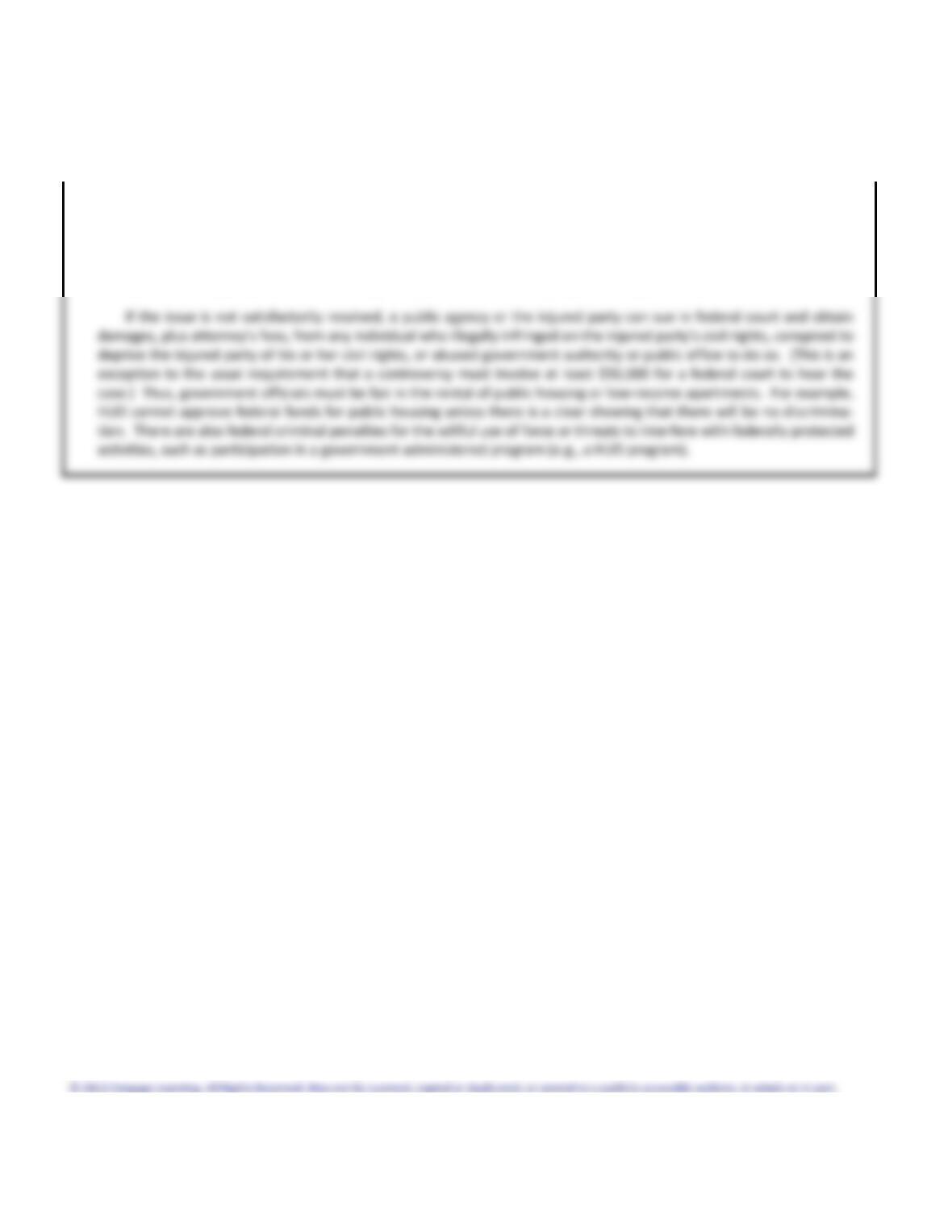
Federal fair housing laws are administered by the Department of Housing and Urban Development (HUD). To
obtain relief under the Fair Housing Act, first a complaint must be filed with the secretary of HUD for conciliation or
referral to a state agency when local housing laws provide “substantially equivalent rights and remedies.”