Chapter 46
Environmental Law
Case 46.1
C.A.D.C.,2008.
New Jersey v. E.P.A.
517 F.3d 574, 65 ERC 1993, 380 U.S.App.D.C. 134
United States Court of Appeals,
District of Columbia Circuit.
State of NEW JERSEY, et al., Petitioners
Argued Dec. 6, 2007.
Decided Feb. 8, 2008.
Rehearing En Banc Denied May 20, 2008.
ROGERS, Circuit Judge:
Before the court are petitions for review of two final rules promulgated by the Environmental Protection Agency regarding the emission of
hazardous air pollutants (“HAPs”) from electric utility steam generating units (“EGUs”). The first rule removes coal– and oil-fired EGUs from the
list of sources whose emissions are regulated under section 112 of the Clean Air Act (“CAA”), 42 U.S.C. § 7412. Revision of December 2000
Regulatory Finding (“Delisting Rule”), 70 Fed.Reg. 15,994 (Mar. 29, 2005). The second rule sets performance standards pursuant to section
111, 42 U.S.C. § 7411, for new coal-fired EGUs and establishes total mercury emissions limits for States and certain tribal areas, along with a
112 list. Thereafter it promulgated CAMR under section 111. EPA’s removal of these EGUs from the section 112 list violates the CAA because
section 112(c)(9) requires EPA to make specific findings before removing a source listed under section 112; EPA concedes it never made such
findings. Because coal-fired EGUs are listed sources under section 112, regulation of existing coal-fired EGUs’ mercury emissions under section
111 is prohibited, effectively invalidating CAMR’s regulatory approach. Accordingly, the court grants the petitions and vacates both rules.
I.
In 1970, Congress added section 112 to the CAA. Pub.L. No. 91-604, § 4(a), 84 Stat. 1676, 1685 (1970). In its original form, section 112 required
reduction in emissions which can be achieved by application of [the] best available control technology,” S.REP. NO. 101-228, at 133, reprinted
in 1990 U.S.C.C.A.N. at 3518; see, e.g., CAA § 112(g)(2)(A), Congress imposed specific, strict pollution control requirements on both new and
existing sources of HAPs. Congress specified that new sources must adopt at minimum “the emission control that is achieved in practice by
the best controlled similar source, as determined by the Administrator.” Id. § 112(d)(3). Existing sources (with certain exceptions) must adopt
emission controls equal to the “average emission limitation achieved by the best performing 12 percent of the existing sources.” Id. §
[t]he Administrator shall perform a study of the hazards to public health reasonably anticipated to occur as a result of emissions by [EGUs]
of pollutants listed under subsection (b) of this section after imposition of the requirements of this chapter. The Administrator shall report
the results of this study to the Congress within 3 years after November 15, 1990. The Administrator shall develop and describe in the
Administrator’s report to Congress alternative control strategies for emissions which may warrant regulation under this section. The
Administrator shall regulate [EGUs] under this section, if the Administrator finds such regulation is appropriate and necessary after
Steam Generating Units, 65 Fed.Reg. 79,825, 79,827 (Dec. 20, 2000) (“2000 Determination”). “As a result the source category for Coal– and Oil-
Fired [EGUs] was added to the list of source categories under section 112(c)” on December 20, 2000. National Emission Standards for
Hazardous Air Pollutants: Revision of Source Category List Under Section 112 of the Clean Air Act (“2002 Notice of Listing”), 67 Fed.Reg. 6521,
6522, 6524 (Feb. 12, 2002).
In early 2004, EPA proposed two regulatory alternatives to control emissions from coal- and oil-fired EGUs. The first was similar to EPA’s
FN1. Section 111 requires the Administrator to “establish [ ] … standards of performance,” CAA § 111(b)(1)(B), for pollutants from
new sources that in the Administrator’s judgment “cause[ ], or contribute [ ] significantly to, air pollution which may reasonably be
anticipated to endanger public health or welfare.” Id. § 111(b)(1)(A). “Standards of performance” are designed to limit emissions to
reflect “the degree of emission limitation achievable through the application of the best system of emission reduction which (taking
into account the cost of achieving such reduction and any nonair quality health and environmental impact and energy requirements)
FN2. Upon reconsideration, EPA made no substantive change to the Delisting Rule but revised CAMR’s State mercury allocations and
the statistical analysis used for new source performance standards; EPA declined to stay CAMR. Revision of December 2000 Clean Air
Act Section 112(n) Finding Regarding Electric Utility Steam Generating Units; and Standards of Performance for New and Existing
Electric Utility Steam Generating Units: Reconsideration, 71 Fed.Reg. 33,388, 33,388-89, 33,395-96 (June 9, 2006).
II.
New Jersey and fourteen additional States, the Michigan Department of Environmental Quality, the Pennsylvania Department of
FN3. Certain intervenors also contend, citing Thomas v. New York, 802 F.2d 1443, 1446-47 (D.C.Cir.1986), that the Administrator’s
determination in December 2000 to list EGUs as a source under section 112(c)(1) was not binding for lack of notice and comment
and, consequently, that EPA was never required to comply with section 112(c)(9)’s delisting process for EGUs. We need not consider
this contention, however, because EPA has steadfastly refused to join it. See New York v. Reilly, 969 F.2d 1147, 1154 n. 11
(D.C.Cir.1992); see also Util. Air Regulatory Group v. EPA, No. 01-1074, 2001 WL 936363, at *1 (D.C.Cir. July 26, 2001).
[2] EPA offers several arguments in an attempt to evade section 112(c)(9)’s plain text, but they are not persuasive. First, EPA seeks to reach
step two of Chevron and obtain judicial deference to its interpretation by maintaining that section 112(n)(1) makes section 112(c)(9)
ambiguous because “[l]ogically, if EPA makes a determination under section 112(n)(1)(A) that power plants should not be regulated at all
under section 112 … [then] this determination ipso facto must result in removal of power plants from the section 112(c) list.” Resp’t Br. at 26.
But this simply does not follow. Section 112(n)(1) governs how the Administrator decides whether to list EGUs; it says nothing about delisting
EPA to avoid a literal interpretation at Chevron step one, it must show either that, as a matter of historical fact, Congress did not mean what it
appears to have said, or that, as a matter of logic and statutory structure, it almost surely could not have meant it,” Engine Mfrs. Ass’n v. EPA,
88 F.3d 1075, 1089 (D.C.Cir.1996), showings EPA has failed to make.
[3][4] Second, EPA maintains that it possesses authority to remove EGUs from the section 112 list under the “fundamental principle of
administrative law that an agency has inherent authority to reverse an earlier administrative determination or ruling where an agency has a
from the section 112 list without regard to section 112(c)(9), it would not also have the authority to remove any other source by ignoring the
statutory delisting process.
[5] Finally, EPA states in its brief that it has previously removed sources listed under section 112(c) without satisfying the requirements of
section 112(c)(9). But previous statutory violations cannot excuse the one now before the court. “[W]e do not see how merely applying an
unreasonable statutory interpretation for several years can transform it into a reasonable interpretation.” F.J. Vollmer Co. v. Magaw, 102 F.3d
section, it cannot be used to regulate sources listed under section 112; EPA thus concedes that if EGUs remain listed under section 112, as we
hold, then the CAMR regulations for existing sources must fall. Resp’t Br. at 99, 101-02; see also Delisting Rule, 70 Fed.Reg. at 16,031. EPA
promulgated the CAMR regulations for new sources under section 111(b) on the basis that there would be no section 112 regulation of EGU
CHAPTER 46: ENVIRONMENTAL LAW 753
emissions and that the new source performance standards would be accompanied by a national emissions cap and a voluntary cap–and-trade
Case 46.2
U.S.,2009.
Entergy Corp. v. Riverkeeper, Inc.
129 S.Ct. 1498, 68 ERC 1001, 173 L.Ed.2d 369, 77 USLW 4248, 09 Cal. Daily Op. Serv. 4095, 2009 Daily
Journal D.A.R. 4885, 21 Fla. L. Weekly Fed. S 747
FN1. The EPA and its Administrator appeared as respondents in support of petitioners. See Brief for Federal Parties as
Respondents Supporting Petitioners. References to “respondents” throughout the opinion refer only to those parties
challenging the EPA rules at issue in these cases.
I
Petitioners operate-or represent those who operate-large powerplants. In the course of generating power, those plants also
generate large amounts of heat. To cool their facilities, petitioners employ “cooling water intake structures” that extract water
92-500, (May 1, 1977), at http:// www. epa. gov/ waterscience/ 316 b/ files/ 1977 AEIguid. pdf, (all Internet materials as visited
Mar. 30, 2009, and available in Clerk of Court’s case file); 69 Fed.Reg. 41584 (describing system of case-by-case permits under
the draft guidance).
In 1995, the EPA entered into a consent decree which, as subsequently amended, set a multiphase timetable for the EPA to
FN2. Closed-cycle cooling systems recirculate the water used to cool the facility, and consequently extract less water
from the adjacent waterway, proportionately reducing impingement and entrainment. Riverkeeper, Inc. v. EPA, 358
A3-13, Table A3-4 (Feb.2004), online at http:// www. epa.gov/waterscience/316b/phase2/econbenefits/final/a3.pdf. Those
facilities remove on average more than 214 billion gallons of water per day, causing impingement and entrainment of over 3.4
billion aquatic organisms per year. 69 Fed.Reg. 41586.
FN3. The EPA has also adopted Phase III rules for facilities not subject to the Phase I and Phase II regulations. 71
Fed.Reg. 35006 (2006). A challenge to those regulations is currently before the Fifth Circuit, where proceedings have
been stayed pending disposition of these cases. See ConocoPhillips Co. v. EPA, No. 06-60662.
To address those environmental impacts, the EPA set “national performance standards,” requiring Phase II facilities (with some
exceptions) to reduce “impingement mortality for all life stages of fish and shellfish by 80 to 95 percent from the calculation
41606.
The regulations permit the issuance of site-specific variances from the national performance standards if a facility can
demonstrate either that the costs of compliance are “significantly greater than” the costs considered by the agency in setting
the standards, 40 CFR § 125.94(a)(5)(i), or that the costs of compliance “would be significantly greater than the benefits of
(2007). We then granted certiorari limited to the following question: “Whether [§ 1326(b) ] … authorizes the [EPA] to compare
costs with benefits in determining ‘the best technology available for minimizing adverse environmental impact’ at cooling water
intake structures.” 552 U.S. —-, 128 S.Ct. 1867, 170 L.Ed.2d 743 (2008).
II
FN4. The dissent finds it “puzzling” that we invoke this proposition (that a reasonable agency interpretation prevails) at
the “outset,” omitting the supposedly prior inquiry of “ ‘whether Congress has directly spoken to the precise question
at issue.’ ” Post, at 1519, n. 5 (opinion of STEVENS, J.) (quoting Chevron, 467 U.S., at 842, 104 S.Ct. 2778). But surely if
Congress has directly spoken to an issue then any agency interpretation contradicting what Congress has said would be
unreasonable.
756 CASE PRINTOUTS TO ACCOMPANY BUSINESS LAW
most efficiently produces some good. In common parlance one could certainly use the phrase “best technology” to refer to that
which produces a good at the lowest per-unit cost, even if it produces a lesser quantity of that good than other available
technologies.
Respondents contend that this latter reading is precluded by the statute’s use of the phrase “for minimizing adverse
discharges of all pollutants if the Administrator finds … that such elimination is technologically and economically achievable,” §
1311(b)(2)(A) (emphasis added). See also § 1316(a)(1) (mandating “where practicable, a standard [for new point sources]
permitting no discharge of pollutants” (emphasis added)). Section 1326(b)‘s use of the less ambitious goal of “minimizing
adverse environmental impact” suggests, we think, that the agency retains some discretion to determine the extent of
reduction that is warranted under the circumstances. That determination could plausibly involve a consideration of the benefits
FN5. Respondents concede that the term “available” is ambiguous, as it could mean either technologically feasible or
economically feasible. But any ambiguity in the term “available” is largely irrelevant. Regardless of the criteria that
render a technology “available,” the EPA would still have to determine which available technology is the “best” one.
And as discussed above, that determination may well involve consideration of the technology’s relative costs and
benefits.
FN6. The statute does not contain a hyphen between the words “conventional” and “pollutant.” “Conventional
pollutant” is a statutory term, however, see 33 U.S.C. § 1314(a)(4), and it is clear that in § 1311(b)(2)(E) the adjective
modifies “pollutant” rather than “control technology.” The hyphen makes that clear.
The first four of these tests are elucidated by statutory factor lists that guide their implementation. To take the standards in
(presumed) order of increasing stringency, see Crushed Stone, supra, at 69-70, 101 S.Ct. 295: In applying the BPT test the EPA is
instructed to consider, among other factors, “the total cost of application of technology in relation to the effluent reduction
concerned, the BTA test (the one at issue here) is to be treated the same as those two. See 475 F.3d, at 98. It is not obvious to
us that the first of these propositions is correct, but we need not pursue that point, since we assuredly do not agree with the
second. It is certainly reasonable for the agency to conclude that the BTA test need not be interpreted to permit only what
those other two tests permit. Its text is not identical to theirs. *1508 It has the relatively modest goal of “minimizing adverse
environmental impact” as compared with the BATEA’s goal of “eliminating the discharge of all pollutants.” And it is
potentially relevant factors. If silence here implies prohibition, then the EPA could not consider any factors in implementing §
1326(b)-an obvious logical impossibility. It is eminently reasonable to conclude that § 1326(b)‘s silence is meant to convey
nothing more than a refusal to tie the agency’s hands as to whether cost-benefit analysis should be used, and if so to what
degree.
Contrary to the dissent’s suggestion, see post, at 1517, our decisions in Whitman v. American Trucking Assns., Inc., 531 U.S. 457,
so.
This extended consideration of the text of § 1326(b), and comparison of that with the text and statutory factors applicable to
four parallel provisions of the Clean Water Act, lead us to the conclusion that it was well within the bounds of reasonable
interpretation for the EPA to conclude that cost-benefit analysis is not categorically forbidden. Other arguments may be
available to preclude such a rigorous form of cost-benefit analysis as that which was prescribed under the statute’s former BPT
standard, which required weighing “the total*1509 cost of application of technology” against “the … benefits to be achieved.”
impingement and entrainment of 1.4 billion aquatic organisms, id., at 41661, Exh. XII-6, with annualized use-benefits of $83
million, id., at 41662, and non-use benefits of indeterminate value, id., at 41660-41661-when compared to annual costs of $389
million, demonstrates quite clearly that the agency did not select the Phase II regulatory requirements because their benefits
equaled their costs.
While not conclusive, it surely tends to show that the EPA’s current practice is a reasonable and hence legitimate exercise of its
disproportionate to any environmental benefit’ ”). While the EPA’s prior “wholly disproportionate” standard may be somewhat
different from its current “significantly greater than” standard, there is nothing in the statute that would indicate that the
former is a permissible interpretation while the latter is not.
Indeed, in its review of the EPA’s Phase I regulations, the Second Circuit seemed to recognize that § 1326(b) permits some form
of cost-benefit analysis. In considering a challenge to the EPA’s rejection of dry cooling systems FN7 as the “best technology
FN7. Dry cooling systems use air drafts to remove heat, and accordingly remove little or no water from surrounding
water sources. See 66 Fed.Reg. 65282 (2001).
In the last analysis, even respondents ultimately recognize that some form of cost-benefit analysis is permissible. They
acknowledge that the statute’s language is “plainly not so constricted as to require EPA to require industry petitioners to spend
FN8. Justice BREYER would remand for the additional reason of what he regards as the agency’s inadequate
explanation of the change in its criterion for variances-from a relationship of costs to benefits that is “ ‘wholly
disproportionate’ ” to one that is “ ‘significantly greater.’ ” Post, at 1515 – 1516 (opinion concurring in part and
dissenting in part). That question can have no bearing upon whether the EPA can use cost-benefit analysis, which is the
only question presented here. It seems to us, in any case, that the EPA’s explanation was ample. It explained that the
CHAPTER 46: ENVIRONMENTAL LAW 759
“wholly out of proportion” standard was inappropriate for the existing facilities subject to the Phase II rules because
those facilities lack “the greater flexibility available to new facilities for selecting the location of their intakes and
installing technologies at lower costs relative to the costs associated with retrofitting existing facilities,” and because
“economically impracticable impacts on energy prices, production costs, and energy production … could occur if large
numbers of Phase II existing facilities incurred costs that were more than ‘significantly greater’ than but not ‘wholly out
of proportion’ to the costs in the EPA’s record.” 68 Fed.Reg. 13541 (2003).
It is so ordered.
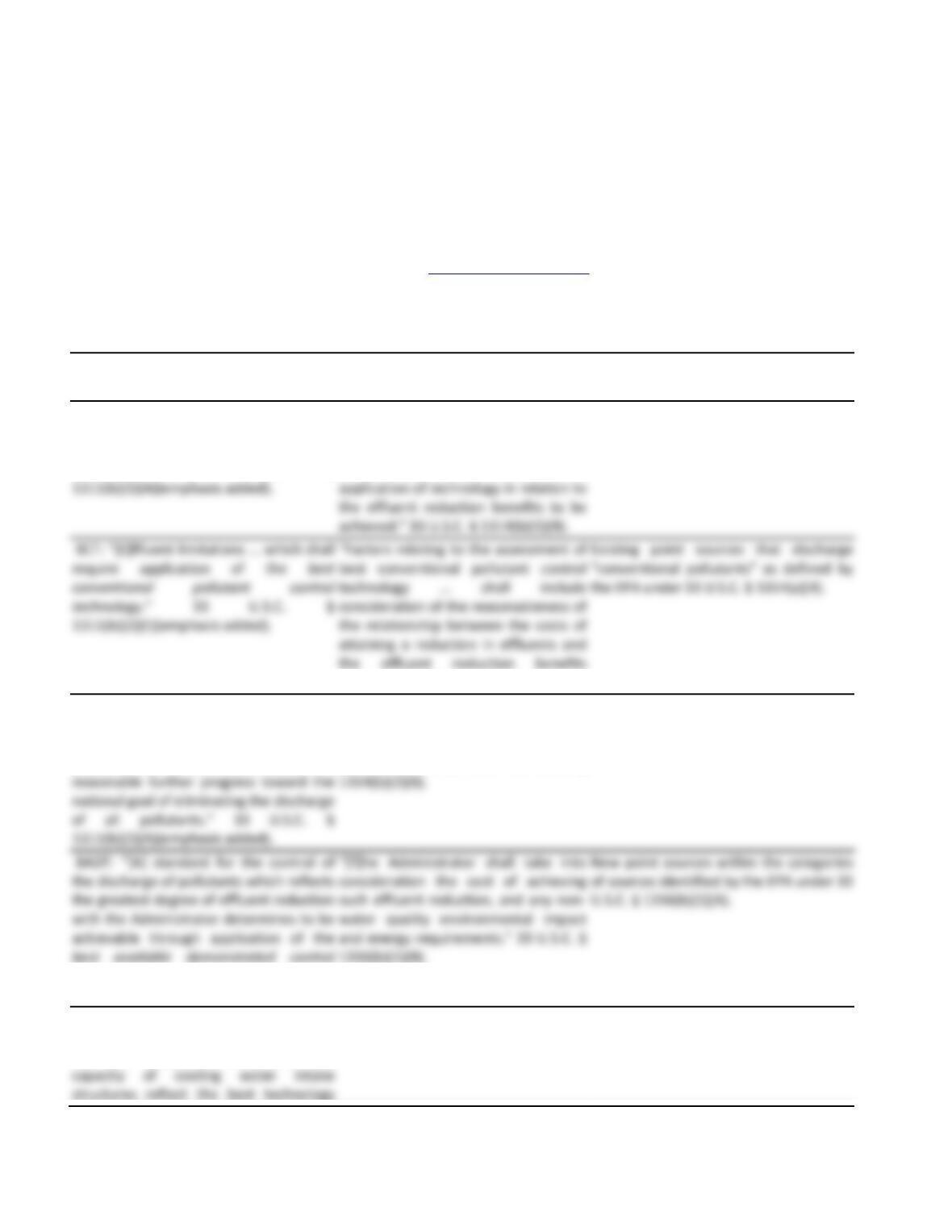
APPENDIX TO OPINION OF THE COURT
Statutory
Statutorily Mandated
Entities Subject
Standard
Factors
to Regulation
BPT: “[E]ffluent limitations … which shall
require the application of the best
practicable control technology currently
available.” 33 U.S.C. §
“Factors relating to the assessment of
best practicable control technology
currently available … shall include
consideration of the total cost of
Existing point sources during the Clean
Water Act’s initial implementation
phase.
derived.” 33 U.S.C. § 1314(b)(4)(B).
BATEA: “[E]ffluent limitations … which …
shall require application of the best
available technology economically
achievable… which will result in
“Factors relating to the assessment of
best available technology shall take
into account … the cost of achieving
such affluent reduction.” 33 U.S.C. §
Existing point sources that discharge
toxic pollutants and non-conventional
pollutants.
technology.” 33 U.S.C. §
1316(a)(1)(emphasis added)
BTA: “Any standard … applicable to a
point source shall require that the
location, design, construction, and
N/A
Point sources that operate cooling water
intake structures.
Case 46.3
516 F.3d 316
U.S. v. Lucas
C.A.5 (Miss.),2008.
FN1. Not every count included all Defendants. See infra note 3.
II
Robert J. Lucas owned Big Hill Acres, Inc. (BHA, Inc.) and Consolidated Investments, Inc. Through these companies, he acquired Big Hill Acres
(BHA), a large parcel of land in Jackson County, Mississippi approximately eight miles from the Gulf of Mexico. He subdivided the property and
sold mobile home lots under long-term installment plans. The property was not connected to a central municipal waste system, and County
FN2. A July 15, 1997, letter from MDH to Thomspon indicated that he must “either fully comply with the statutes when designing
systems, or cease and desist immediately.” A June 3, 1999, cease and desist order from the Army Corps of Engineers told Lucas that
unpermitted placement of dredged or fill material into wetlands violated the CWA and ordered him to cease and desist constructing
homes in a subdivision near Vancleave, Mississippi. An August 4, 1999, administrative order from the EPA notified Lucas that
FN3. Count 1 charged all Defendants with Conspiracy to defraud buyers using the U.S. mails and conspiracy to violate the CWA;
Counts 2-18 charged Lucas, Wrigley, Thompson, and BHA, Inc. with mail fraud; Count 19 charged Lucas, Wrigley, and BHA, Inc. with
mail fraud; Counts 20-22 charged Lucas with violating Section 404 of the CWA; Counts 23-26 charged Lucas, Wrigley, and Thompson
with violating Section 404 of the CWA; Counts 27-29 charged Lucas with violating Section 404 of the CWA; Counts 30-32 charged
Lucas, Wrigley, and Thompson with violating Section 402 of the CWA; Counts 33-39 charged Lucas and Wrigley with violating Section
…. Not all wetlands fall under the protection of the Clean Water Act. However, wetlands that are waters of the United States are protected
by the Clean Water Act. Wetlands are considered waters of the United States if they are adjacent to a navigable body of open water.
Wetlands are adjacent to a navigable body of water if there is a significant*324 nexus between the wetlands in question and a navigable–in–
fact waterway. Some of the factors which you may wish to consider in determining whether there is a significant nexus include, but are not
limited to: … flow rate of surface waters from the wetlands into a navigable body of water … evidence of any past or present contamination
FN4. Defendant Lucas’s Brief at 55.
[2][3] We review alleged error in jury instructions for an abuse of discretion, reversing “only when ‘the charge as a whole leaves us with
FN5.Treadaway v. Societe Anonyme Louis-Dreyfus, 894 F.2d 161, 168 (5th Cir.1990) (quoting McCullough v. Beech Aircraft Corp., 587
F.2d 754, 759 (5th Cir.1979)).
FN6.United States v. Simkanin, 420 F.3d 397, 410 (5th Cir.2005).
The court’s instructions were not in error, nor was the court’s omission of Defendants’ requested instructions. The court’s instructions
FN7. The term “adjacent” is substantially similar to Defendants’ requested term of “truly adjacent.”
[T]he government has shown that there is a significant nexus between the wetlands on Big Hill Acres and navigable-in-fact waters. Showed
that the surface from the Big Hill Acres site drains in three directions. The western portions of the site drain into Bayou Costapia. Bayou
Costapia empties into the Tchoutacabouffa River, which then empties into the Gulf of Mexico. The central *325 portions of the Big Hill
Acres development drained through tributaries into Old Fort Bayou Creek. And Old Fort Bayou Creek connects to Old Fort Bayou, which is a
FN8. Defendants do not challenge the instructions on the grounds that they failed to include the Rapanos v. United States standard
for navigable waters. This is understandable. The Rapanos plurality requires a channel adjacent to a wetland to be adjacent to “a
relatively permanent body of water connected to traditional interstate navigable waters” to constitute “waters of the United
States,” 547 U.S. 715, 126 S.Ct. 2208, 2227, 165 L.Ed.2d 159 (2006), and the Rapanos concurrence requires a “significant nexus”
FN9.United States v. Davis, 226 F.3d 346, 354 (5th Cir.2000).
[5] Under the CWA, the United States has jurisdiction over the “waters of the United States,”FN10 i.e., navigable waters. Wetlands adjacent to
FN10.33 U.S.C. § 1362(7).
FN11.See. e.g., United States v. Riverside Bayview Homes, Inc., 474 U.S. 121, 133, 106 S.Ct. 455, 88 L.Ed.2d 419 (1985) (“We cannot
say that the Corps’ conclusion that adjacent wetlands are inseparably bound up with the ‘waters’ of the United States-based as it is
on the Corps’ and EPA’s technical expertise-is unreasonable.”); Rapanos, 126 S.Ct. at 2217 (recognizing that subsequent cases
limiting federal jurisdiction over certain waters have not overruled Riverside Bayview).
FN12.126 S.Ct. at 2221.
FN13.Id. at 2227.
The plurality did not define “relatively permanent,” finding that “we have no occasion in this litigation to decide exactly when the drying-up of
a stream bed is continuous and frequent enough to disqualify the channel ….”FN14
FN14.Id. at 2221 n. 5.
[6] Its adjacency standard finds its roots in Solid Waste Agency of Northern Cook Cty. v. Army Corps of Engineers (“SWANCC”).FN15SWANCC did
FN15.531 U.S. 159, 121 S.Ct. 675, 148 L.Ed.2d 576 (2001).
FN16.Id. at 162, 121 S.Ct. 675.
FN17.126 S.Ct. at 2220.
FN18. The definition includes wetlands that neighbor tributaries of navigable waters because the plurality definition includes