2. Housing and Urban Development Assistance
An interest-free loan may be obtained from the U.S. Department of Housing and Urban Development (HUD)
3. Short Sales
A short sale is a sale of the property for less than the balance due on a mortgage loan. A borrower—who
4. Sale and Leaseback
5. Home Affordable Modification Program
The U.S. Treasury Department’s Home Affordable Modification Program (HAMP) encourages private lenders
to modify mortgages to lower the monthly payments of borrowers in default (to 31 percent of the debtor’s
gross monthly income). HAMP may share a lender’s costs to modify a loan and provides other incentives.
a. Determination If a Homeowner Qualifies
To qualify for a HAMP modification—
• A loan must have originated on or before January 1, 2009.
• A home must be its owner’s primary residence and must be occupied by its owner.
b. Steps Taken to Alleviate the Mortgage Burden
A loan is restructured by adding delinquencies—unpaid interest, taxes, or insurance premiums—to the
principal and cutting the interest rate so that a borrower’s payments are 31 percent of his or her gross
monthly income. If the rate would be less than 2 percent, a lender can re-amortize the loan, extending
the payments for up to forty years.
6. Voluntary Conveyance
A deed in lieu of foreclosure conveys property to a lender in satisfaction of a mortgage. The lender thereby
7. Friendly Foreclosure
8. Prepackaged Bankruptcy
B. THE FORECLOSURE PROCEDURE
A formal foreclosure extinguishes a borrower’s equitable right of redemption. The two most common types of
foreclosure are judicial foreclosure and power of sale foreclosure. In the former—available in all states—a court
supervises the process. In the latter—available in only a few states—a lender forecloses on and sells the property
without court supervision.
1. Acceleration Clauses
2. Notice of Default (NOD) and of Sale
Filing a notice of default with the appropriate state office initiates a foreclosure. The borrower is put on
notice to take steps to pay the loan and cure the default. If this does not occur, the lender gives a notice of
sale to the borrower, posts it on the property, files it with the county, and announces it in a newspaper. The
property is then sold at auction on the courthouse steps.
CASE SYNOPSIS—
Case 31.2: Mitchell v. Valteau
Mitchell signed a note and mortgage secured by a house. The mortgage provided for the sale of the house on the
borrower’s default. Mitchell defaulted and the lender obtained a court order to seize the property. Mitchell was
notified. The parties negotiated a new agreement that postponed the seizure and sale. Mitchell again defaulted, and
the court issued a new notice of seizure. Despite several attempts, Mitchell was not served with this notice personally.
The house was seized and sold. Mitchell filed a suit in a Louisiana state court against the lender and others for wrongful
seizure. The court issued a judgment in the defendants’ favor. Mitchell appealed.
CHAPTER 31: MORTGAGES AND FORECLOSURES AFTER THE RECESSION 765
When the executory proceeding was resumed, there was no obligation to serve Dr. Mitchell with another notice of
seizure.”
…………………………………………………………..……………………………………………………………………
Notes and Questions
What purpose is served by the seizure and sale of property on its mortgagor’s default? The seizure and sale of
ANSWERS TO QUESTIONS AT THE END OF CASE 31.2
1. What are the purposes of the notice provisions in the Louisiana code? Did this court stay true to those purposes?
2. How might the lender have avoided the dispute in this case? The dispute might have been avoided if the lender
had refused to go through with the sale until the borrower was personally served. Assuming that the borrower might
have then challenged the sale on other grounds, the lender might have avoided the entire process by giving the
borrower every opportunity to make good on their agreement—staying in constant touch to remind her of the need to
make payments, and staying amenable to further renegotiation of the terms, for example. The lender might also have
insisted on a co-signer for the mortgage.
ADDITIONAL CASES ADDRESSING THIS ISSUE —
Recent cases focusing on notice, service, and other requirements in foreclosure proceedings include the
following.
reasonably attempt to have, a face-to-face meeting with the mortgagor before it could commence foreclosure, the
must name a personal representative for a deceased mortgagor in a foreclosure proceeding for the court to acquire
766 INSTRUCTOR’S MANUAL TO ACCOMPANY BUSINESS LAW, TWELFTH EDITION
jurisdiction—there must be personal service because the mortgagor is a necessary party to the action).
• First National Bank of Chicago v. Silver, 73 A.D.3d 162, 899 N.Y.S.2d 256 (2 Dept. 2010) (a summary judgment in a
foreclosure action in the mortgagee’s favor must be reversed and the complaint dismissed when the mortgagee did not
deliver statutory-specific notice to the homeowner, together with the summons and complaint, as required by state
law).
• Rabinowitz v. Deutsche Bank, __ Misc.2d __, __ N.Y.S.2d __, 2010 WL 2106217 (Sup. 2010) (a mortgagee gave
the successful bidder refused to sign a memorandum of sale and decided not to buy the property—the mortgagee
3. Deficiency Judgments
If the sale proceeds do not cover the amount of the loan, the lender can ask a court for a deficiency
judgment. Some states do not permit deficiency judgments for mortgaged residential property.
CHAPTER 31: MORTGAGES AND FORECLOSURES AFTER THE RECESSION 767
C. REDEMPTION RIGHTS
• In all states, a borrower can exercise an equitable right of redemption to buy the property after default by
paying the amount of the debt, plus interest and costs, before the foreclosure sale.
TEACHING SUGGESTIONS
1. Ask students to discuss any firsthand experiences they might have had with mortgages and foreclosure.
2. Obtain copies of a mortgage contract and ask students to discuss whether the apportionment of rights and duties
real estate sales contract.
3. Show students a set of the documents used in a local real estate closing. Discuss what each of the documents is
and what its legal importance and effects are.
4. It could be explained that there are four types of statutory foreclosure—
• Strict foreclosure is allowed in a few states in which, after a period following default, the mortgagee acquires
absolute title to the property.
5. Discuss the topic of mortgage fraud. Among the motivations are a borrower’s desire to buy a property that he or
she cannot afford, and a dishonest lender’s desire for profit. A borrower commits fraud when he or she misrepresents
6. What can a borrower who has lost his or her home to foreclosure do to rebuild credit and possibly become a
homeowner again? Positive steps include—
768 INSTRUCTOR’S MANUAL TO ACCOMPANY BUSINESS LAW, TWELFTH EDITION
• Find an affordable residence. If the lender is agreeable, this might be the home that was foreclosed on. If not,
renting another property can be an initial step in rebuilding credit.
• Create a budget. Setting saving and spending limits are important steps toward reestablishing credit and
accruing funds toward the purchase of a home.
• Consult with a credit counselor. A credit counselor can help a borrower establish financial goals and a plan to
DISCUSSION QUESTIONS
1. What is the usual method of mortgage foreclosure? The usual method of foreclosure is a judicial sale at which the
mortgaged real estate is sold. If the sale proceeds cover the mortgage debt and foreclosure costs, the debtor receives any
surplus. If the proceeds do not cover the debt and costs, the mortgagee can seek to recover the difference through a deficiency
2. How might a notice of default and foreclosure actually benefit a debtor? A debtor benefits most from having a debt
3. Does the Truth-in-Lending Act adequately balance the interests of creditors and debtors? Why or why not? According
to the text, the Truth-in-Lending Act (TILA) of 1968 requires lenders to disclose the terms of a loan in clear, readily
understandable language so that borrowers can make rational choices. With respect to real estate transactions, TILA applies

4. What is Regulation Z, and to what type of transactions does it apply? The Federal Reserve Board of Governors issued
5. Should the federal government regulate the advertising of real property and mortgages on the Internet to protect
consumers from potential fraud? If so, what kind of regulations would be appropriate, and how might they be enforced? Yes,
6. How might a borrower protect against falling victim to a dishonest lender or a mortgage scam? One step a borrower
7. Were the changes to the Bankruptcy Code enacted in 2005 a factor in causing the recent recession? The bankruptcy
reforms of 2005 made it more difficult for homeowners to file for bankruptcy. Those changes also made filing more expensive
and discharged fewer debts. Some observers argue that these circumstances restricted the funds that might have paid
mortgages—if debtors must use their limited resources to pay credit card balances and other debt, those resources are not
available to make mortgage payments. As a result, the argument goes, the number of mortgage defaults were on the rise even
before the recession. The many defaults on high prime and subprime loans that came later only added to what was already a
crisis.
8. How does a short sale work? A short sale occurs when a borrower owes more on a property than it is worth and it is
listed for sale for less than the amount owed. If the borrower can show economic hardship to the lender’s satisfaction, the
lender will agree to accept the proceeds of the sale in satisfaction of the loan and forgive the outstanding debt. Specifically,
9. Can a mortgage be obtained legally at a favorable interest rate without many of the restrictions and much of the
paperwork that attends the formal lending process? For some borrowers, an intra-family mortgage may offer a method to
obtain a home at a more affordable price. For the party that serves as the lender, the loan may offer a way to obtain a higher
rate of interest than banks offer on certificates of deposit (CDs), money-market accounts, and other low-interest investment
ACTIVITY AND RESEARCH ASSIGNMENTS
1. Ask students to call local banks and find out all the costs that are involved in closing a residential real estate transaction
as well as those costs necessary for obtaining a home loan. How much money in excess of the amount of the loan and down
payment is actually required to buy a home?
2. Ask each student to draft a mortgage document providing for a certain type of loan.
3. Have students research local cases concerning the mortgages, foreclosures, and laws discussed in this chapter. In some
communities, there is an abundance of such cases. Local newspapers and local courthouses are potential sources. Specific topics
or specific cases could be assigned to students individually, in small groups, or to the class as a whole. Once they have looked at
some of the cases, ask students under what common fact situations the legal issues tend to arise. What might the parties in
these cases have done to avoid foreclosure or further litigation?
EXPLANATION OF A SELECTED FOOTNOTE IN THE TEXT
Footnote 2: The Mortgage Disclosure Improvement Act of 2008 added to the disclosures that a lender must
make to a borrower on a mortgage subject to 15 U.S.C. Section 1638. The following is the text of parts of 15 U.S.C. Section
1638(a) and (b). Subsections (b)(2)(B) through (F) are part of the amendments.
TITLE 15. COMMERCE AND TRADE
CHAPTER 41. CONSUMER CREDIT PROTECTION
772 INSTRUCTOR’S MANUAL TO ACCOMPANY BUSINESS LAW, TWELFTH EDITION
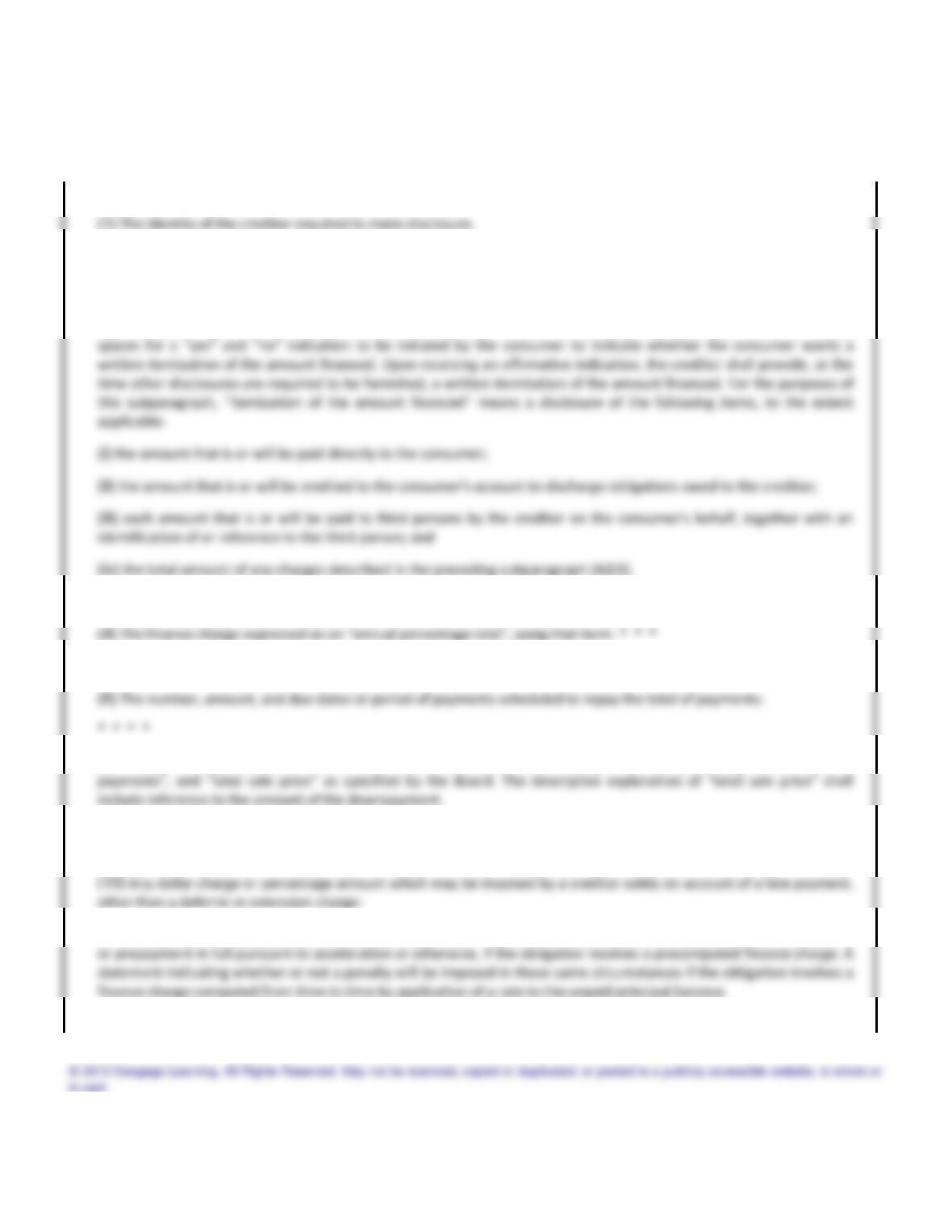
following items, to the extent applicable:
(1) The identity of the creditor required to make disclosure.
(2)(A) The “amount financed”, using that term, which shall be the amount of credit of which the consumer has actual
use. * * *
(B) In conjunction with the disclosure of the amount financed, a creditor shall provide a statement of the consumer’s
right to obtain, upon a written request, a written itemization of the amount financed. The statement shall include
(i) the amount that is or will be paid directly to the consumer;
(ii) the amount that is or will be credited to the consumer’s account to discharge obligations owed to the creditor;
(iii) each amount that is or will be paid to third persons by the creditor on the consumer’s behalf, together with an
(iv) the total amount of any charges described in the preceding subparagraph (A)(iii).
(3) The “finance charge”, not itemized, using that term.
(4) The finance charge expressed as an “annual percentage rate”, using that term. * * *
(5) The sum of the amount financed and the finance charge, which shall be termed the “total of payments”.
(6) The number, amount, and due dates or period of payments scheduled to repay the total of payments:
(8) Descriptive explanations of the terms “amount financed”, “finance charge”, “annual percentage rate”, “total of
(9) Where the credit is secured, a statement that a security interest has been taken in (A) the property which is
purchased as part of the credit transaction * * * .
(10) Any dollar charge or percentage amount which may be imposed by a creditor solely on account of a late payment,
(11) A statement indicating whether or not the consumer is entitled to a rebate of any finance charge upon refinancing
finance charge computed from time to time by application of a rate to the unpaid principal balance.
(12) A statement that the consumer should refer to the appropriate contract document for any information such
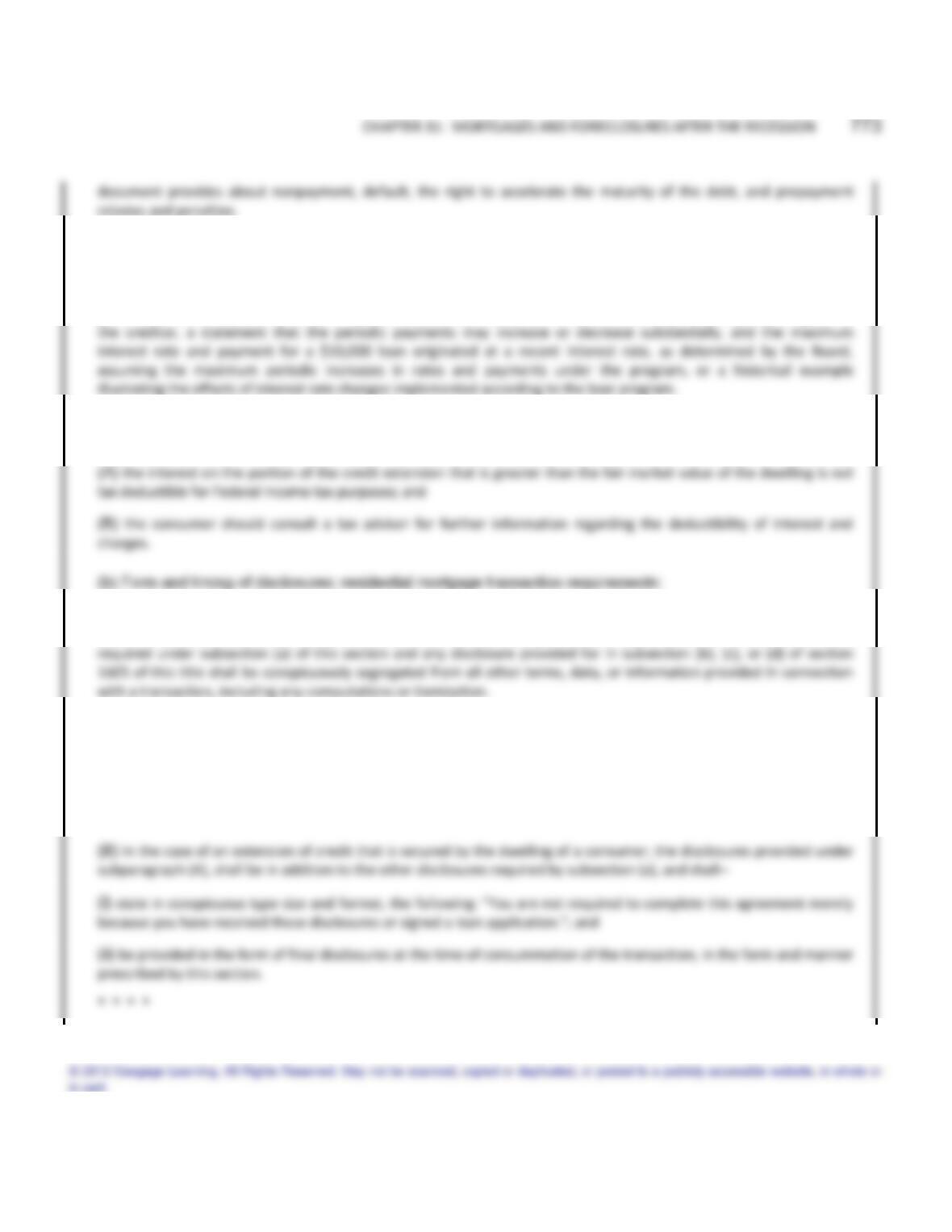
(13) In any residential mortgage transaction, a statement indicating whether a subsequent purchaser or assignee of
the consumer may assume the debt obligation on its original terms and conditions.
(14) In the case of any variable interest rate residential mortgage transaction, in disclosures provided at application as
prescribed by the Board for a variable rate transaction secured by the consumer’s principal dwelling, at the option of
(15) In the case of a consumer credit transaction that is secured by the principal dwelling of the consumer, in which the
extension of credit may exceed the fair market value of the dwelling, a clear and conspicuous statement that—
(A) the interest on the portion of the credit extension that is greater than the fair market value of the dwelling is not
tax deductible for Federal income tax purposes; and
(B) the consumer should consult a tax adviser for further information regarding the deductibility of interest and
charges.
(1) Except as otherwise provided in this part, the disclosures required under subsection (a) of this section shall be made
before the credit is extended. Except for the disclosures required by subsection (a)(1) of this section, all disclosures
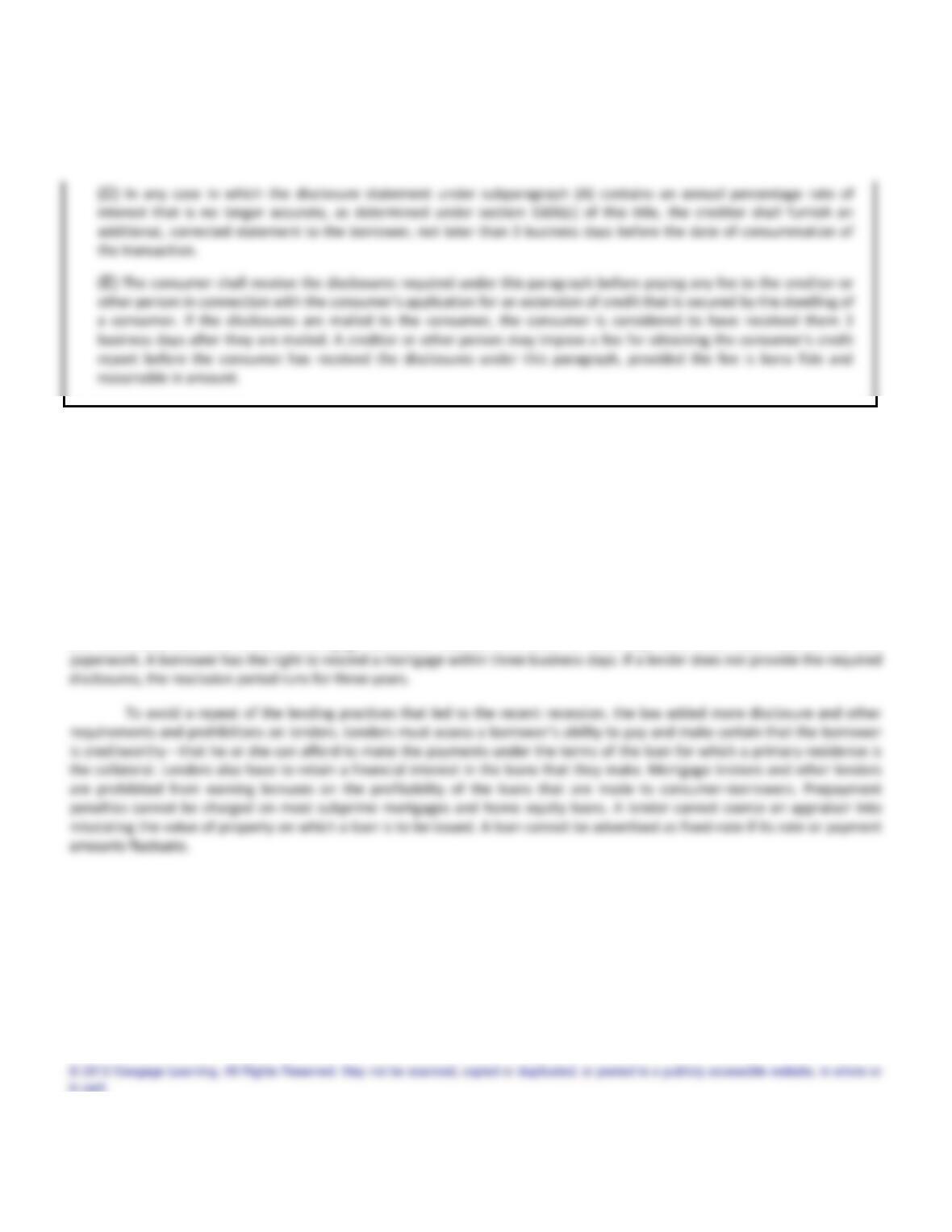
(2)(A) Except as provided in subparagraph (G), in the case of any extension of credit that is secured by the dwelling of a
consumer, which is also subject to the Real Estate Settlement Procedures Act, good faith estimates of the disclosures
required under subsection (a) of this section shall be made in accordance with regulations of the Board under section
1631(c) of this title and shall be delivered or placed in the mail not later than three business days after the creditor
receives the consumer’s written application, which shall be at least 7 business days before consummation of the
transaction.
(B) In the case of an extension of credit that is secured by the dwelling of a consumer, the disclosures provided under
(i) state in conspicuous type size and format, the following: “You are not required to complete this agreement merely
because you have received these disclosures or signed a loan application.”; and
* * * *
774 INSTRUCTOR’S MANUAL TO ACCOMPANY BUSINESS LAW, TWELFTH EDITION
ANSWERS TO ESSAY QUESTIONS IN
STUDY GUIDE TO ACCOMPANY BUSINESS LAW, TWELFTH EDITION
BY HOLLOWELL & MILLER
1. How does the law protect borrowers from the lending practices that led to the recent recession? The Truth-in-Lending
Act (TILA) of 1968 requires lenders to disclose the terms of a loan in clear, readily understandable language so that borrowers
can make rational choices. Disclosure must be made on standardized forms and based on uniform formulas. Terms that must be
disclosed include the loan principal, the interest rate at which the loan is made, the annual percentage rate (APR), and the fees
and costs associated with a loan. A mortgage cannot be finalized until seven or more days after a borrower receives the TILA
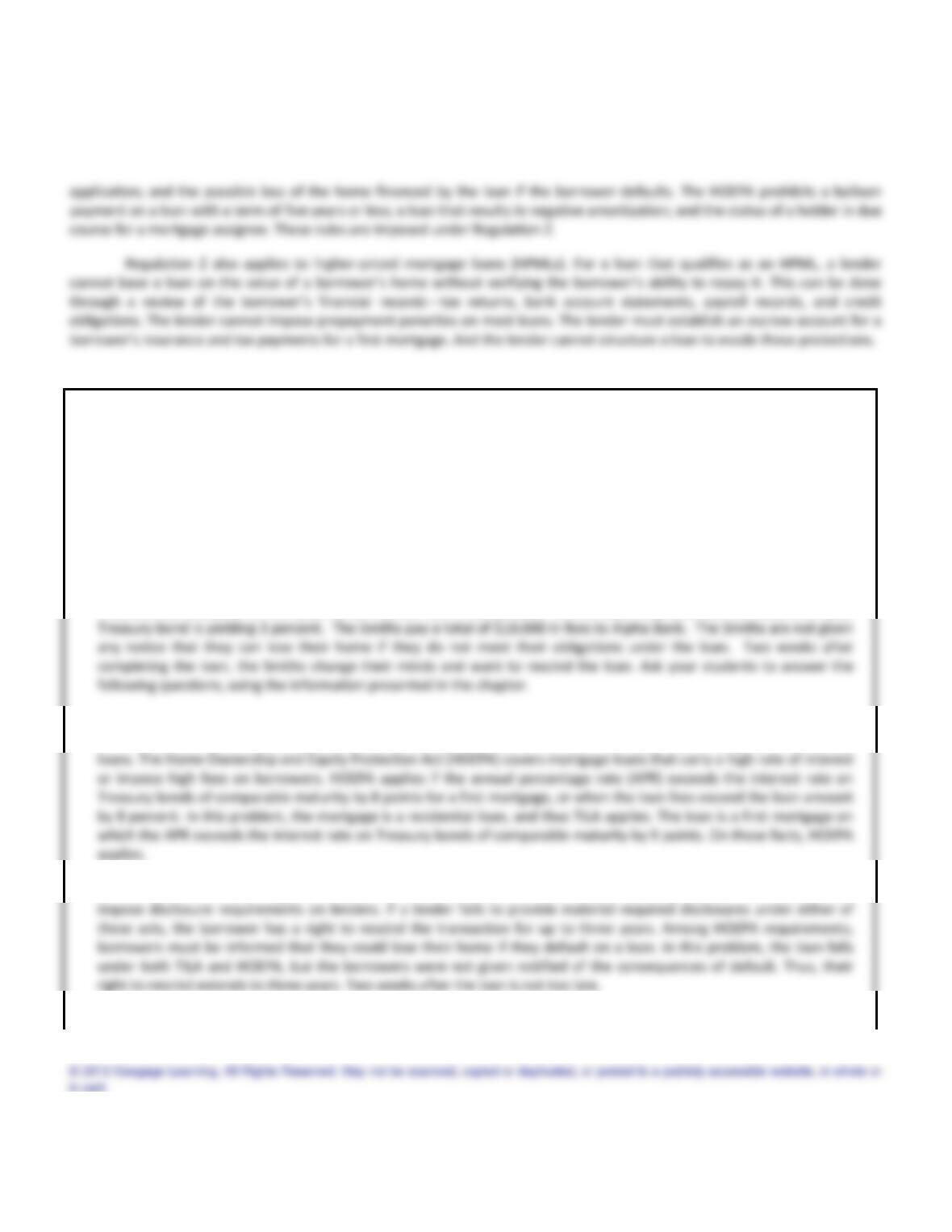
2. What protection exists for borrowers who take out high-cost, high-fee, or higher-priced mortgages from the lending
practices that led to the recession? The requirements and prohibitions that apply to more standard-priced loans under the
Truth-in-Lending Act (TILA) of 1968 also apply to high-cost and high-fee or higher-priced mortgages.
For high-cost and high-fee mortgage products, the Home Ownership and Equity Protection Act (HOEPA) of 1994
amended TILA to require lenders to disclose the APR the regular payment amount, and any balloon payments; for a loan with a
variable interest rate, the possibility that the rate and payment amounts may increase and to what potential maximum the
increase may be; a borrower’s option not to complete the loan simply because of the disclosures or the signing of a loan
CHAPTER 31: MORTGAGES AND FORECLOSURES AFTER THE RECESSION 775
REVIEWING—
MORTGAGES AND FORECLOSURES
AFTER THE RECESSION
Al and Betty Smith’s home is valued at $200,000. They have paid off their mortgage and own the house outright—
that is, they have 100 percent home equity. They lost most of their savings when the stock market declined during the
Great Recession. Now they want to start a new business and need funds, so they decide to obtain a home equity loan.
They borrow $150,000 for ten years at an interest rate of 12 percent. On the date they take out the loan, a ten-year
1. Is the Smiths’ loan covered by the Truth–in-Lending Act as amended by the Home Ownership and Equity Protection
Act? Why or why not? With respect to real estate transactions, the Truth-in-Lending Act (TILA) applies to residential
2. Do the Smiths have a right to rescind the loan two weeks after the fact, or are they too late? TILA and HOEPA
3. Assume now that Alpha Bank gave the Smiths all of the required notices before the loan was completed. If all
776 INSTRUCTOR’S MANUAL TO ACCOMPANY BUSINESS LAW, TWELFTH EDITION
other facts remain the same, do the Smiths have a right to rescind? Discuss your answer. When all required disclosures
4. Suppose now that the Smiths never rescind the loan and that they default four years later while still owing Alpha
Bank $120,000. The bank forecloses and raises only $110,000 when the house is sold at auction. If the state where the
Smiths live follows the majority rule, can Alpha Bank seek the remaining $10,000 from the Smiths? In most states, if the
amount on a foreclosure sale is not enough to cover the loan, the lender can ask a court for a deficiency judgment—a
judgment against the borrower for the amount of the debt remaining unpaid after the property was sold. This
judgment requires the debtor to pay the difference to the lender over time. In this problem, if the state in which the
borrowers and their property are located follows this rule, the bank can seek—and most likely recover—the remaining
amount from the borrowers.
DEBATE THIS:
Federal legislation enacted in the past few years has unfairly benefited homeowners who should not have bought
such expensive houses and taken on so much debt. Indeed, most homeowners continued to pay on their mortgages
throughout the latest recession. But those who imprudently borrowed too much to buy houses that were too
expensive were bailed out by the federal government and some of the banks. This is grossly unfair, because it
rewards speculative and unsound financial behavior. Those who had no money down on their house purchases were
10 times more likely to default on their mortgages than those who put down a normal down payment.