259
CHAPTER 30
BANKRUPTCY LAW
ANSWER TO CRITICAL ANALYSIS
QUESTION IN THE FEATURE
INSIGHT INTO ETHICS—CRITICAL THINKING—INSIGHT INTO THE ECONOMIC ENVIRONMENT (PAGE
594)
About six years ago, one could buy debt that had been discharged in bankruptcy for less than five cents
on the dollar. Why has the price increased to seven cents on the dollar? One reason that the price of
ANSWERS TO QUESTIONS
AT THE ENDS OF THE CASES
CASE 30.1—QUESTIONS (PAGE 586)
WHAT IF THE FACTS WERE DIFFERENT?
Suppose that instead of offering to pay for a transcript, Kuehn had tried to obtain one on credit. Would
the university’s refusal to provide one on that basis have led to the same result? Why or why not? If
260 UNIT SIX: CREDITORS’ RIGHTS AND BANKRUPTCY
THE ETHICAL DIMENSION
Some might say that higher education institutions should be able to use all methods possible to collect
unpaid tuition, including withholding certified grade transcripts. What ethical issues would this approach
raise? This is an “end justifies the means” statement. Students and colleges might be joint owners of the
data reflecting grades, because that is how the “educational contract” is normally understood, but the
CASE 30.2—QUESTIONS (PAGE 590)
1A. What might have Stanley have meant when he said that by agreeing to “go quietly” he provided
a benefit to the company? Stanley might have meant that he would not challenge the company’s
decision to seek his resignation from the firm. This could have the cost the company legal fees and other
expenses when it could least afford them.
2A. Stanley argued that he was not an insider because he was no longer employed by the company
when the severance payments were made. How did the court respond to this argument? The court held
CASE 30.3—QUESTION (PAGE 599)
THE ETHICAL DIMENSION
At one point, United argued that if the Court failed to declare the bankruptcy court’s order void, it would
encourage dishonest debtors to abuse the Chapter 13 process. How might such abuse occur? Discuss
whether the possibility of such abuse affect the Court’s decision. According to United, debtors could file
plans proposing to dispense with the undue hardship requirement in the hope that the bankruptcy court
CHAPTER 30: BANKRUPTCY LAW 261
ANSWERS TO QUESTIONS IN THE REVIEWING FEATURE
AT THE END OF THE CHAPTER
1A. Prior to filing
Under the 2005 bankruptcy reform act, all debtors must receive credit counseling from an approved
nonprofit agency within the 180-day period preceding the date of filing a petition in bankruptcy.
Therefore, before Janet can file her petition, she needs to attend either an individual or group briefing
from an approved credit-counseling agency.
2A. Deadline to submit
Janet must file the required schedules within 45 days after filing her petition—unless she gets an
extension of up to 45 days. If she does not meet the deadline, then her case is automatically dismissed.
3A. Steps to “substantial abuse”
To determine whether Janet’s petition is presumed to be “substantial abuse,” the court would calculate
Janet’s average monthly income for recent months (less certain allowed expenses). If Janet’s income
4A. Ability to pay
If a court found that Janet had an ability to pay a portion of her deceased husband’s medical bills, a
court would convert her bankruptcy case to a Chapter 13, individual repayment plan.
ANSWER TO DEBATE THIS QUESTION IN THE REVIEWING FEATURE AT
THE END OF THE CHAPTER
Rather than being allowed to file Chapter 7 bankruptcy petitions, individuals and couples should
always be forced to make an effort to pay off their debts through Chapter 13. Every time that consumers
deprive creditors of repayment by successfully obtaining Chapter 7 protection, the creditors’ costs rise.
262 UNIT SIX: CREDITORS’ RIGHTS AND BANKRUPTCY
Consequently, all business that extend credit must raise the interest rates they charge to all borrowers
to cover these increased costs. Therefore, allowing consumers to simply walk away from bone fide
debts imposes extra burdens on all other borrowers.
ANSWERS TO QUESTIONS AND CASE PROBLEMS
AT THE END OF THE CHAPTER
30-1A. Voluntary versus involuntary bankruptcy
(Chapter 30—Pages 582–583 & 585)
(a) Any person, including a rancher or farmer, can voluntarily petition himself or herself into
bankruptcy. The person has only to be a debtor. This includes partnerships and corporations that are
liable on a claim held by a creditor, as well as individuals. The debtor does not have to be insolvent to
file a petition. Under the Code, a debtor is presumed to be insolvent when his or her debts exceed the
fair market value of nonexempt assets. Thus, even though Burke owns a $500,000 ranch and has debts
of only $70,000, she can voluntarily petition herself into bankruptcy.
30-2A. QUESTION WITH SAMPLE ANSWER: Preferences
A trustee is given avoidance powers by the Bankruptcy Code. One situation in which the trustee can
avoid transfers of property or payments by a debtor to a creditor is when such transfer constitutes a
preference. A preference is a transfer of property or payment that favors one creditor over another.
For a preference to exist, the debtor must be insolvent and must have made payment for a preexisting
CHAPTER 30: BANKRUPTCY LAW 263
30-3A. Distribution of property
(Chapter 30—Pages 591–592)
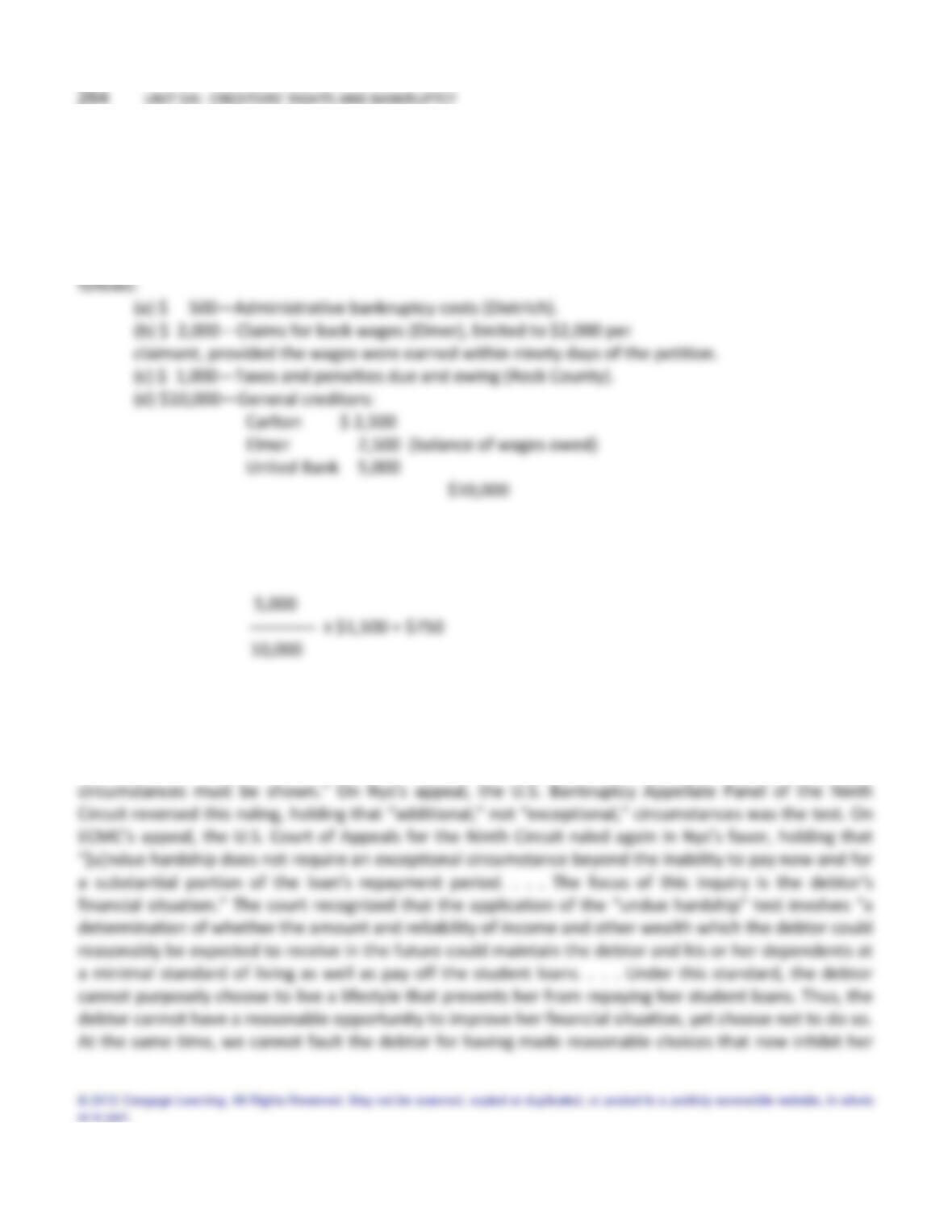
The Bankruptcy Code establishes a payment priority of claims from the debtor’s estate. Each class of
debt in this priority list must be fully paid before the next class in priority is entitled to any of the
proceeds. If insufficient funds remain to pay an entire class, the proceeds are distributed on a pro rata
basis to each creditor within that class. The order of priority for claims listed in this problem is as
Because the amount remaining is only $1,500, these creditors share on a pro rata basis. For example,
for United Bank it is:
30-4A. Exceptions to discharge
(Chapter 30—Pages 592–593)
The bankruptcy court ruled in ECMC’s favor, finding that Nys had not proved “undue hardship,” which is
required to obtain a discharge of student loans under Chapter 7. The court stated that “[e]xceptional
30-5A. Substantial abuse
(Chapter 30—Pages 587–588)
A trustee has the power to make a motion to dismiss a bankruptcy petition when the trustee believes
that allowing the debtor’s petition would be a substantial abuse of the bankruptcy code. Courts can and
usually do grant trustees’ motions, particularly when the circumstances indicate that the debtor has the
ability to repay some of the debts. Because in this situation the costs related to skating and home
schooling are high in proportion to the debtor’s income, the court should probably grant the trustee’s
motion. Even if Stout cannot continue his Chapter 7 case, however, he will be able to file a Chapter 13
30-6A. CASE PROBLEM WITH SAMPLE ANSWER: Discharge in bankruptcy
The court issued a judgment in Winyard’s favor. On Schroeder’s appeal, a state intermediate appellate
court affirmed this judgment. The appellate court explained that bankruptcy relief discharges the debtor
from all debts that arose before the date of the order for relief. “Debt is defined as liability on a claim.
The definition of claim includes the right to payment, whether or not such right is reduced to judgment.”
Of course, there are exceptions. Nondischargeable debts include debts “for willful and malicious
injury by the debtor to another entity or to the property of another entity.” To qualify for this exception,
30–7A. Discharge in bankruptcy
(Chapter 30—Pages 592–593 & 596–599)
266 UNIT SIX: CREDITORS’ RIGHTS AND BANKRUPTCY
Debtors who seek Chapter 13 relief commit to a three-to five-year period of repayment, after which
their remaining debts are discharged. Unlike Chapter 7 debtors, who are entitled to a discharge of debt
as soon as their estate is liquidated and distributed, Chapter 13 debtors are not entitled to a discharge of
debts unless and until they complete payments to creditors under the repayment plan. Student loans
are excepted from discharge unless the debtor can show “undue hardship.” A fundamental goal of bank–
30–8A. Discharge in bankruptcy
(Chapter 30—Pages 592–593)
30-9A. A QUESTION OF ETHICS: Discharge in bankruptcy
(a) The parties who might be considered at “ethical” fault for the investors’ losses in this case
include Edwards, ETS, the defendants, and the investors themselves. For obvious reasons—the scheme,
the fraud, and the funds transfer—Edwards should likely be held responsible. ETS, regardless of who
operated its business, is at fault for the same reasons. The defendants, assuming that they did what
Laddin accused them of—“ignoring the facts”—might have arguably violated their fiduciary duty to their
clients. The investors, too, might have failed to act in their own best interests if they allowed themselves
allowed to proceed with its case? Would this be compatible with the purposes of the law?
(b) The court granted the defendants’ motion to dismiss, concluding that the doctrine of in
pari delicto barred Laddin’s complaint. The court reasoned that the “legal and equitable interests of the
CHAPTER 30: BANKRUPTCY LAW 267
debtor” in bankruptcy were only as strong as the debtor’s claim against the defendants at the
commencement of the bankruptcy. Imputing Edwards’s wrongdoing to ETS undercut the debtor’s claim.
Laddin appealed to the U.S. Court of Appeals for the Eleventh Circuit, which affirmed the lower court’s
decision. The appellate court explained that a trustee “stands in the shoes of the debtor” and is subject
to whatever defenses are available against the debtor. In other words, “[i]f a claim of ETS would have
ANSWER TO VIDEO QUESTION NO. 30–10
Field of Dreams
(a) Before this scene, the movie makes clear that Ray (Kevin Costner) is unable to pay his
bills, but he has not filed a voluntary petition for bankruptcy. What would be required for Ray’s
creditors to force him into an involuntary bankruptcy? Ray is a farmer. Farmers cannot be
involuntarily petitioned into bankruptcy. Under Chapter 7 or Chapter 11, a corporate debtor or
an individual debtor or a partnership—but not a farmer or a charitable institution—with twelve
or more creditors can be forced into bankruptcy by three or more of them who collectively have
unsecured claims for at least a certain amount. (The amount is periodically increased.) The same
debtor—but still not a farmer or charitable institution—with less than twelve creditors can be
involuntarily petitioned into bankruptcy by one or more of them if the petitioner (or petitioners)
has a claim for at least a certain amount.
property that Ray might be able to exempt under the Bankruptcy Code is: equity in his residence
and burial plot (the homestead exemption); an interest in a motor vehicle; interests in household
funds, and education savings accounts; and the right to certain legal judgments. Each of these is
subject to varying dollar limits. As of this writing, the equity in the farm home that Ray could
268 UNIT SIX: CREDITORS’ RIGHTS AND BANKRUPTCY
claim would be limited to a maximum of $146,450 under the Bankruptcy Code if Ray chose to use
his state’s homestead exemption.
(c) What are the requirements for Ray to qualify as a family farmer under Chapter 12 of the
Bankruptcy Code? Under Chapter 12 of the Bankruptcy Code, Ray would qualify as a family
farmer if he were a farmer with gross income at least 50 percent farm dependent and debts at
least 50 percent farm related. But his total debt could not exceed, as of this writing, $3,792,650.
(d) How would the results of a Chapter 12 bankruptcy differ from those of a Chapter 7
bankruptcy for Ray? For a Chapter 12 bankruptcy, the farmer would have to qualify as a family