CHAPTER 30: BANKRUPTCY LAW 733
A committee of unsecured creditors is appointed to consult with the debtor (or the trustee) about administration
of the case or formulation of the plan. Additional committees may be appointed to represent special-interest
creditors. In most cases, orders affecting the estate are not entered without the committees’ input.
E. THE REORGANIZATION PLAN
2. Acceptance and Confirmation of the Plan
Once developed, a plan is submitted to each class of creditors, who must accept it unless the class is not
3. Discharge
A plan is binding on confirmation. Claims are not discharged if they would be denied in a liquidation
proceeding. An individual debtor is not discharged until a plan’s completion.
ENHANCING YOUR LECTURE—
WHAT CAN YOU DO TO PREPARE
FOR A CHAPTER 11 REORGANIZATION?
Chapter 11 of the Bankruptcy Code expresses the broad public policy of encouraging commerce. To this end,
Chapter 11 allows a financially troubled business firm to petition for reorganization in bankruptcy while it is still solvent
so that the firm’s business can continue. Small businesses, however, do not fare very well under Chapter 11. Although
some corporations that enter Chapter 11 emerge as functioning entities, very few smaller companies survive the
process. The reason is that Chapter 11 proceedings are prolonged and extremely costly, and whether a firm survives is
largely a matter of size. The greater the firm’s assets, the greater the likelihood it will emerge from Chapter 11 intact.
PLAN AHEAD
If you appear to have no choice but to file for Chapter 11 protection, try to interest a lender in loaning you funds to
734 INSTRUCTOR’S MANUAL TO ACCOMPANY BUSINESS LAW, TWELFTH EDITION
CONSULT WITH CREDITORS
Most important, you should form a Chapter 11 plan prior to entering bankruptcy proceedings. Consult with
creditors in advance to see what kind of a plan would be acceptable to them, and prepare your plan accordingly.
Having an acceptable plan prepared before you file will expedite the proceedings and thus save substantially on costs.
CHECKLIST FOR THE SMALL-BUSINESS OWNER
1. Try to negotiate workouts with creditors to avoid costly Chapter 11 proceedings.
2. If your business is a small corporation, see if a major investor will loan you funds to help you pay bankruptcy costs
3. Consult with creditors in advance, and have an acceptable Chapter 11 plan prepared before filing to expedite
bankruptcy proceedings and save on costs.
IV. Bankruptcy Relief under Chapter 13 and Chapter 12
A. INDIVIDUALS’ REPAYMENT PLANS
Individuals (not partnerships or corporations) with regular income who owe fixed unsecured debts or fixed
secured debts of less than certain statutorily specified amounts may use Chapter 13.
1. Filing the Petition
2. Good Faith Requirement
A debtor must act in good faith at the time of the filing of the plan and the filing of the petition.
3. The Repayment Plan
The text covers some of the details of Chapter 13 plans.
a. Filing the Plan
Only a debtor may file a plan. Subject to the means test for family median income, the time for
CHAPTER 30: BANKRUPTCY LAW 735
A plan will be confirmed in a hearing within twenty to forty-five days after the creditors’ meeting if—
c. Discharge
Most debts are dischargeable, except taxes, domestic-support obligations, student loans, fraudulently
incurred debt, claims resulting from malicious or willful injury, and others listed in the text. A
discharge can be revoked within one year if it was obtained by fraud.
CASE SYNOPSIS—
Case 30.3: United Student Aid Funds, Inc. v. Espinosa
Francisco filed for bankruptcy under Chapter 13. His plan proposed to pay only the principal on his student loan
and to discharge the interest. No party requested an undue hardship hearing. United Student Aid Funds, Inc. (the
creditor), had notice of the plan and did not object. The plan was confirmed. The creditor did not appeal. Later, United
asked the court to order that the confirmation was void. The court refused. On United’s appeal, a federal district court
reversed this ruling. On further appeal, the U.S. Court of Appeals for the Ninth Circuit reversed the district court’s
judgment. United appealed.
…………………………………………………………..……………………………………………………………………
Notes and Questions
Is a debtor’s failure to make a payment on a student loan or present inability to make payments sufficient to undue
hardship? No. Undue hardship does not exist simply because the debtor presently is unable to repay his or her student
loans. The inability to pay must be likely to continue for a significant time. There should be a certainty of hopelessness
that the debtor will ever be able to repay the loans within the repayment period.
A discharged debt is not treated as taxable income. If it were, how would a debtor’s situation be different? If a
discharged debt were treated as taxable income, a debtor would be required to pay income tax on the amount of the
discharged debt. Considering the lack of finances that most discharged debtors face, this would in effect trade one
nondischargeable debt for another. There might then be no point in many cases for debtors to file for discharges in
bankruptcy.
736 INSTRUCTOR’S MANUAL TO ACCOMPANY BUSINESS LAW, TWELFTH EDITION
Should a debtor be required to attempt to negotiate a repayment plan with a creditor to show good faith? Why or
why not? No. A debtor’s effort to negotiate a repayment plan certainly demonstrates good faith, but courts have
rejected a rule that a debtor’s failure to make such an attempt shows a lack of good faith. It is possible that, for
example, a debtor might not know about alternative repayment options. A better picture would emerge from a
debtor’s living conditions, ability or inability to work, and attempts to find work.
ANSWER TO “THE ETHICAL DIMENSION” QUESTION IN CASE 30.3
At one point, United argued that if the Court failed to declare the bankruptcy court’s order void, it would
encourage dishonest debtors to abuse the Chapter 13 process. How might such abuse occur? Discuss whether the
possibility of such abuse affect the Court’s decision. According to United, debtors could file plans proposing to
dispense with the undue hardship requirement in the hope that the bankruptcy court would overlook the proposal and
the creditor would not object. In the event the provision was discovered, the most that could happen is that the
debtor could withdraw the plan and file another without penalty. The Court was not persuaded that this concern was
ADDITIONAL CASES ADDRESSING THIS ISSUE —
Recent cases focusing on exceptions to discharge in bankruptcy proceedings include the following.
• In re Roach, __ Bankr. __, 2003 WL 115191 (E.D.La. 2003) (a debtor, a recovering alcoholic whose earning potential
as a nurse was somewhat limited by restrictions placed on her employment as result of her history of alcoholism, did
not show that her present inability, without undue hardship, to repay her student loan was likely to persist for a
significant portion of loan repayment period, and was not be relieved of the debt).
• In re Murphy, 282 F.3d 868 (5th Cir. 2002) (in holding that all of a debtor’s federally guaranteed student-loan debts
CHAPTER 30: BANKRUPTCY LAW 737
B. FAMILY FARMERS AND FISHERMEN
Chapter 12 is for a family farmer or fisherman, as defined in the Code. A Chapter 12 filing is similar to a Chapter
13 filing.
ADDITIONAL BACKGROUND—
Adequate Protection
Section 1205, a section of the Code providing for adequate protection under Chapter 12.
TITLE 11. BANKRUPTCY
CHAPTER 12—ADJUSTMENT OF DEBTS OF A FAMILY FARMER WITH REGULAR ANNUAL INCOME
SUBCHAPTER I—OFFICERS, ADMINISTRATION, AND THE ESTATE
§ 1205. Adequate protection
(a) Section 361 does not apply in a case under this chapter.
(b) In a case under this chapter, when adequate protection is required under section 362, 363, or 364 of this title of an
interest of an entity in property, such adequate protection may be provided by—
(1) requiring the trustee to make a cash payment or periodic cash payments to such entity, to the extent that the stay
property;
(2) providing to such entity an additional or replacement lien to the extent that such stay, use, sale, lease, or grant
(3) paying to such entity for the use of farmland the reasonable rent customary in the community where the property is
located, based upon the rental value, net income, and earning capacity of the property; or
(4) granting such other relief, other than entitling such entity to compensation allowable under section 503(b)(1) of this
title as an administrative expense, as will adequately protect the value of property securing a claim or of such entity’s
ownership interest in property.
(Added Pub.L. 99-554, Title II, § 255, Oct. 27, 1986, 100 Stat. 3107.)
REPEAL OF SECTION AND SAVINGS PROVISIONS
< Pub.L. 99-554, Title III, § 302(f), Oct. 27, 1986, 100 Stat. 3124, repealed this section on Oct. 1, 1993, and all cases

738 INSTRUCTOR’S MANUAL TO ACCOMPANY BUSINESS LAW, TWELFTH EDITION
under the laws applicable to such cases, matters, and proceedings as if such chapter had not been repealed. >
ANSWER TO VIDEO QUESTION LTR. C
What are the requirements for Ray to qualify as a family farmer under Chapter 12 of the Bankruptcy Code? Under
Chapter 12 of the Bankruptcy Code, Ray would qualify as a family farmer if he were a farmer with gross income at least
50 percent farm dependent and debts at least 50 percent farm related. But his total debt could not exceed, as of this
writing, $3,792,650.
CHAPTER 30: BANKRUPTCY LAW 739
SPECIAL EXHIBIT—
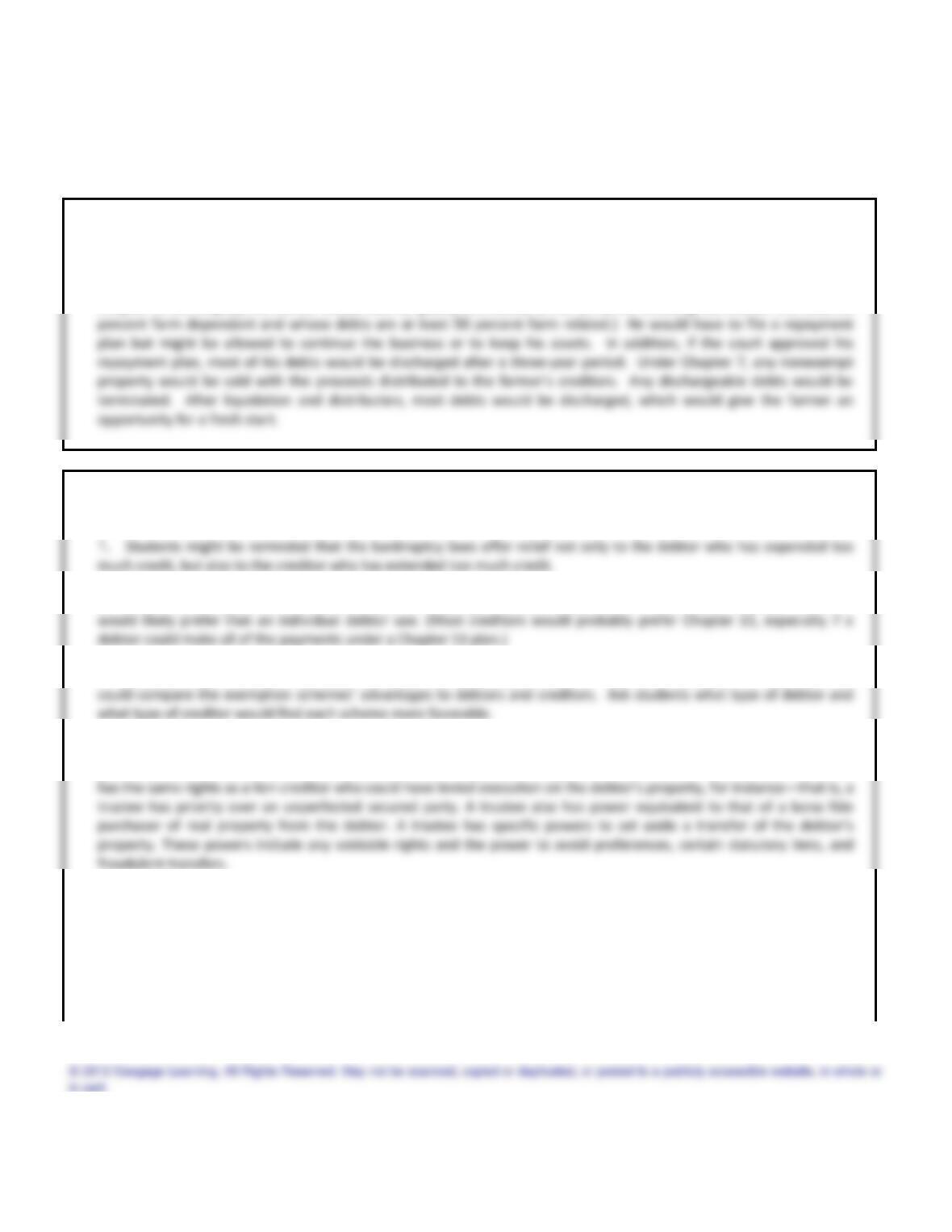
The Bankruptcy Process
The following illustration outlines the basic steps in the bankruptcy process for a non-business debtor.
BANKRUPTCY PETITION—MEANS TEST
• Certain expenses are exempted to determine whether a debtor can pay
25 percent of unsecured debt.
CHAPTER 7
With exceptions, assets are
liquidated to pay creditors.
CHAPTER 13
Under a court-approved five-year
plan, a debtor lives on a strict
budget.
CREDIT-COUNSELING
Debtor must meet with a counselor within six months before
filing for bankruptcy.
CREDITOR-APPROVED
DEBT-MANAGEMENT
PAYMENTS
NOT MADE
PAYMENTS
MADE
Filing is
converted to
Chapter 7
proceeding.
Hardship
discharge is
granted.
MONEY MANAGEMENT CLASS
• Debtor attends this class at the debtor’s expense.
• Debts are discharged as permitted under the applicable
Chapter.
OR
OR
OR
OR
740 INSTRUCTOR’S MANUAL TO ACCOMPANY BUSINESS LAW, TWELFTH EDITION
ANSWER TO VIDEO QUESTION LTR. D
How would the results of a Chapter 12 bankruptcy differ from those of a Chapter 7 bankruptcy for Ray? For a
Chapter 12 bankruptcy, the farmer would have to qualify as a family farmer (a farmer whose gross income is at least 50
TEACHING SUGGESTIONS
2. When discussing the differences and similarities among the Code’s chapters, ask students which chapter a creditor
3. Students could research their state’s exemptions and compare them to the federal exemptions. Hypotheticals
4. One way to outline the trustee’s powers for students is to note that a trustee has general and specific powers. The
general powers inhere in the trustee’s position, which is equivalent in rights to that of certain other parties. A trustee
5. One detail of the Code that often interests students is the status of student loans. Student loans that are not
dischargeable under Chapter 7 include certain loans due less than five years after the first installment payment. The
five-year period does not include temporary suspensions of payments. Ask students to imagine that Art borrows
$5,000 in September 2006 to finish graduate school. Art graduates in June 2007. The first installment payment comes
due in December, but Art has not found a job and obtains a one-time six-month suspension of payments. In June 2014,
Art files a petition to declare bankruptcy under Chapter 7. If repaying the loan would constitute undue hardship, is
Art’s loan dischargeable? The limitation on dischargeability of student loans that have been due less than five years
6. From a creditor’s point of view, there are several steps to take to assure the payment of a debt before a petition in
bankruptcy is filed. These include the following.
• Obtain personal and corporate guaranties in credit agreements.
• Obtain collateral for credit.
• Perfect a security interest according to UCC Article 9.
Once a petition has been filed, to try to recoup payment, a creditor might do the following.
• Stop the delivery of goods in transit (see UCC Article 2).
• File a proof of claim.
• Ask the court to lift the automatic stay.
• Object to plans and statements that are not proposed in good faith.
Cyberlaw Link
What role might the Internet play in the context of bankruptcy filings and proceedings?
DISCUSSION QUESTIONS
1. Who can use Chapter 7? Any debtor, which is defined as any “person,” including individuals, partnerships, and
2. What powers does a trustee have? A trustee has general and specific powers. The general powers inhere in the
trustee’s position, which is equivalent in rights to that of certain other parties (for example, a lien creditor who could have
levied execution on the debtor’s property—that is, a trustee generally has priority over an unperfected secured party). A
trustee can require persons holding a debtor’s property when a petition is filed to give the property to the trustee. A trustee
3. How are secured debts handled in a bankruptcy proceeding? Within thirty days of filing a petition or before the first
4. What is the essential difference between bankruptcy under Chapter 7 and bankruptcy under Chapter 11? Under
5. What consideration must a debtor give to a collective bargaining agreement in a Chapter 11 filing? A debtor may reject
6. Who is eligible for relief under Chapter 13? Individuals (not partnerships or corporations) with regular income who
7. Can a Chapter 13 proceeding be initiated by involuntary petition? No. Only a debtor can initiate a Chapter 13 case,
8. Do the automatic stay rules apply in Chapter 13 cases? The automatic stay rules apply in Chapter 13 cases to consumer
9. Who is eligible for relief under Chapter 12? Any family farmer, with gross income at least 50 percent farm dependent
10. Does the 2005 act adequately balances the interests of creditors and debtors? Why or why not? Possible responses are
CHAPTER 30: BANKRUPTCY LAW 743
ACTIVITY AND RESEARCH ASSIGNMENTS
1. Ask students to imagine that they are filing for bankruptcy. Have them make a list of their assets and a list of their
debts, and determine which assets they could choose to exempt. From a financial point of view, does declaring bankruptcy
appear to be a favorable alternative for them at this time? (The bankruptcy court in your district may be able to provide copies
2. If the bankruptcy court in your district is nearby, tell students to visit the court to see for themselves persons and
businesses involved in local filings. If the court is not nearby, perhaps a local trustee or someone from the trustee’s office could
visit the class and discuss bankruptcy procedures and current local rules in the community.
EXPLANATIONS OF SELECTED FOOTNOTES IN THE TEXT
Footnote 16: Keldric Mosley incurred student loans while attending Georgia’s Alcorn State University. Medical
problems from injuries received during training with the U.S. Army Reserve Officers’ Training Corps led him to quit school. He
left Alcorn to live with his mother in Atlanta. He worked briefly for several employers, but was unable to keep a job. By 2004, his
monthly income consisted primarily of $210 in disability benefits from the Veterans’ Administration. Homeless, under
medication, and in debt for $45,000 to Educational Credit Management Corp., Mosley obtained a discharge under Chapter 7 of
his student loans on the basis of undue hardship. Educational Credit appealed. In In re Mosley, the U.S. Court of Appeals for the
Is a debtor’s failure to make a payment on a loan or present inability to make payments sufficient to show good faith?
No. The court emphasized that “a debtor’s failure to make a payment, standing alone, does not establish a lack of good faith.”
The court also explained that “undue hardship does not exist simply because the debtor presently is unable to repay his or her
student loans; the inability to pay must be likely to continue for a significant time such that there is a certainty of hopelessness
that the debtor will be able to repay the loans within the repayment period.”
A discharged debt is not treated as taxable income. If it were, how would a debtor’s situation be different? If a
Should a debtor be required to attempt to negotiate a repayment plan with a creditor to demonstrate good faith? Why
or why not? Educational Credit argued in part that the good faith requirement obligated Mosley to attempt to negotiate a
repayment plan under the “Income Contingent Repayment Program.” The court disagreed. “While a debtor’s effort to negotiate
a repayment plan certainly demonstrates good faith, courts have rejected a per se rule that a debtor cannot show good faith
where he or she has not enrolled in the Income Contingent Repayment Program. . . . In this instance, it is questionable whether
Mosley even knew about alternative repayment options, and, in light of his dire living conditions and persistent inability to
744 INSTRUCTOR’S MANUAL TO ACCOMPANY BUSINESS LAW, TWELFTH EDITION
obtain steady work, the bankruptcy court had sufficient evidence from which to conclude that these options would not have
provided Mosley a realistic solution to his inability to pay.” The court also cited Mosley’s attempts to find work.
If this debtor were to relocate to a country with a lower cost of living than the United States, should his change in
circumstances be a ground for revoking the discharge? Explain your answer. No, this would not constitute a ground for a
revocation of the debtor’s discharge. A discharge may be revoked within a year if it is discovered that the debtor acted
TITLE 11. BANKRUPTCY
CHAPTER 11—REORGANIZATION
SUBCHAPTER I—OFFICERS AND ADMINISTRATION
§ 1112. Conversion or dismissal
* * * *
(b) Except as provided in subsection (c) of this section, on request of a party in interest or the United States trustee,
and after notice and a hearing, the court may convert a case under this chapter to a case under chapter 7 of this title or
may dismiss a case under this chapter, whichever is in the best interest of creditors and the estate, for cause,
including—
(1) continuing loss to or diminution of the estate and absence of a reasonable likelihood of rehabilitation;
(2) inability to effectuate a plan;
(3) unreasonable delay by the debtor that is prejudicial to creditors;
(4) failure to propose a plan under section 1121 of this title within any time fixed by the court;
(5) denial of confirmation of every proposed plan and denial of a request made for additional time for filing another
plan or a modification of a plan;
(6) revocation of an order of confirmation under section 1144 of this title, and denial of confirmation of another plan or
(7) inability to effectuate substantial consummation of a confirmed plan;
CHAPTER 30: BANKRUPTCY LAW 745
(8) material default by the debtor with respect to a confirmed plan;
(9) termination of a plan by reason of the occurrence of a condition specified in the plan; or
(10) nonpayment of any fees or charges required under chapter 123 of title 28.
(c) The court may not convert a case under this chapter to a case under chapter 7 of this title if the debtor is a farmer
or a corporation that is not a moneyed, business, or commercial corporation, unless the debtor requests such
conversion.
Footnote 21: In 2000, the Buises bought an air show business from the Hoskings for $275,000 to be paid in
installments. The Buises formed Otto Airshows. Later, the Army Aviation Heritage Foundation and Museum, Inc. (AAHF), won a
defamation suit against the Buises. While a determination of the amount of damages was pending, the Buises stopped doing
business as Otto Airshows, formed Prop and Rotor Aviation, Inc., leased the Otto equipment to the new firm, and filed for
bankruptcy under Chapter 13. AAHF filed a motion to dismiss the case. In In re Buis, the court dismissed the Buises’ petition. The
debtors had not included all of their assets and liabilities in their petition, and had timed its filing to avoid payment on the
judgment to AAHF. They also attempted to transfer interests in some of their assets in preference to certain creditors. These
actions constituted bad faith. In the bankruptcy filing, among other things the Buises did not list AAHF as a creditor. They did list
income from “[r]ent from personal property lease,” but did not list the Otto lease on the schedules or report the income in their
“statement of financial affairs,” and made other omissions. Also, the Chapter 13 petition was filed after the debtors were found
liable in the defamation suit. Finally, the Buises tried to grant interests in some of their assets to certain creditors.
If AAHF had lost its defamation suit against the Buises, would the result in this case have been the same? Why or why
not? The result in this case would not have been the same. Of course, without a judgment in AAHF’s favor, there would have
been no damages or related costs for the Buises to pay. Because this debt was their primary motivation for filing a petition
under Chapter 13, they might not have otherwise sought a discharge in bankruptcy at all. If they had, their omission of such a
746 INSTRUCTOR’S MANUAL TO ACCOMPANY BUSINESS LAW, TWELFTH EDITION
debt from the petition and accompanying schedules would not have been in bad faith and thus would not have served as a basis
on which to dismiss their case.
ANSWERS TO ESSAY QUESTIONS IN
STUDY GUIDE TO ACCOMPANY BUSINESS LAW, TWELFTH EDITION
BY HOLLOWELL & MILLER
1. Compare Chapters 7, 11, 12, and 13, discussing, for each chapter, the purpose or function, who is eligible for relief ,
whether proceedings can be initiated voluntarily or involuntarily, procedures leading to discharge, and the advantages.
Purpose. The purpose of Chapter 7 is liquidation, the purpose of Chapter 11 is reorganization, and the purpose of Chapters 12
and 13 is adjustment. Who Is Eligible for Relief. Under Chapter 7, any “person” (including partnerships and corporations)
except railroads, insurance companies, banks, savings and loan institutions, and credit unions is eligible for relief. Under
2. How are secured creditors protected from losing the value of their security as a result of an automatic stay? A secured
CHAPTER 30: BANKRUPTCY LAW 747
sonable market rental value has been based on the gross rental value of the farmland and its income potential, considering crop
requirements, government payments, and so on.
REVIEWING—
BANKRUPTCY LAW
Three months ago, Janet Hart’s husband of twenty years died of cancer. Although he had medical insurance, he
left Janet with outstanding medical bills of more than $50,000. Janet has worked at the local library for the past ten
years, earning $1,700 per month. Since her husband’s death, Janet also receives $1,500 in Social Security benefits, and
$1,100 in life insurance proceeds every month, giving her a monthly income of $4,300. After she pays the mortgage
payment of $1,500, and the amounts due on other debts each month, Janet barely has enough left over to buy
groceries for her family (she has two teenage daughters at home). She decides to file for Chapter 7 bankruptcy, hoping
for a fresh start. Ask your students to answer the following questions, using the information presented in the chapter.
1. What must Janet do prior to filing a petition for relief under Chapter 7? Under the 2005 bankruptcy reform, all
date of filing a petition in bankruptcy. Therefore, before Janet can file her petition, she needs to attend either an
2. How much time does Janet have after filing the bankruptcy petition to submit the required schedules? What
happens if Janet does not meet the deadline? Janet must file the required schedules within 45 days after filing her
3. Assume that Janet files a petition under Chapter 7. Further assume that the median family income in the state in
which Janet lives is $49,300. What steps would a court take to determine whether Janet’s petition is presumed to be
“substantial abuse” under the means test? To determine whether Janet’s petition is presumed to be “substantial
4. Suppose that the court determines that no presumption of substantial abuse applies in Janet’s case. Nevertheless,
the court finds that Janet does have the ability to pay a portion of the amount due on the medical bills out of her
disposable income. What would the court likely order in that situation? If a court found that Janet had an ability to pay
748 INSTRUCTOR’S MANUAL TO ACCOMPANY BUSINESS LAW, TWELFTH EDITION
DEBATE THIS:
Rather than being allowed to file Chapter 7 bankruptcy petitions, individuals and couples should always be forced
to make an effort to pay off their debts through Chapter 13. Every time that consumers deprive creditors of
repayment by successfully obtaining Chapter 7 protection, the creditors’ costs rise. Consequently, all business that
extend credit must raise the interest rates they charge to all borrowers to cover these increased costs. Therefore,
allowing consumers to simply walk away from bone fide debts imposes extra burdens on all other borrowers.
Not all borrowers default on their debt repayments just because they borrowed “too” much. Sometimes,
wants Chapter 7 to be abused, but means testing at least partially takes care of the problem of abuse in filing Chapter
7 plans.