
477
Chapter 20
Title, Risk, and Insurable Interest
See Separate Lecture Outline System
INTRODUCTION
Before the Uniform Commercial Code (UCC), title was a central concept in sales law. The party who had title bore the
risk of a loss of goods (and could thus buy insurance against it). It was often difficult to determine when title passed from seller
to buyer, however, and thus which party had title at the time of a loss. The UCC divorced the question of title from the question
of the rights and obligations of buyers, sellers, and others (subsequent purchasers, creditors). Title remains relevant under the
UCC in some situations, and the UCC has rules for locating title.
In most situations, however, the UCC replaces the concept of title with other concepts: identification, risk of loss, and
insurable interest. Generally, the UCC attempts to place a loss on a party who breaches a contract, the party who has physical
control of the goods, or the party who is most likely to have thought of obtaining insurance. Of course, the rules do not apply if
a different party caused the loss or if the parties allocated the risk in their contract. The last point is important: parties can agree
on who will bear the risk of loss.
478 INSTRUCTOR’S MANUAL TO ACCOMPANY BUSINESS LAW, TWELFTH EDITION
ADDITIONAL RESOURCES—
VIDEO SUPPLEMENTS
The following video supplements relate to topics discussed in this chapter—
PowerPoint Slides
To highlight some of this chapter’s key points, you might use the Lecture Review PowerPoint slides compiled for
Chapter 20.
Business Law Digital Video Library
The Business Law Digital Video Library at www.cengage.com/blaw/dvl offers a variety of videos for group or
individual review. Clips on topics covered in this chapter include the following.
• Drama of the Law
Risk of Loss—Warm Iceberg Lettuce—Delivery of goods are one thing; acceptance another. When a store is faced
CHAPTER OUTLINE
I. Identification
Before an interest in goods can pass from seller to buyer, the goods must exist, and they must be identified to the
contract [UCC 2–105(2)]. For passage of title, goods must be identified in a way that will distinguish them from all
similar goods. Identification gives a buyer the right to obtain insurance on goods and the right to recover from third
parties who damage goods. Sometimes, identification allows the buyer to take goods from the seller.
A. EXISTING GOODS
If a sale involves specific goods already in existence, identification occurs when the contract is made.
B. FUTURE GOODS
If a sale involves unborn animals to be born within twelve months, identification occurs when the animals are
conceived. If a sale involves crops to be harvested within twelve months, identification occurs when the crops are
planted or begin to grow. Identification of other future goods occurs when they are shipped, marked, or
otherwise designated as the contract goods.
C. GOODS THAT ARE PART OF A LARGER MASS
CHAPTER 20: TITLE, RISK, AND INSURABLE INTEREST 479
II. When Title Passes
A. SHIPMENT AND DESTINATION CONTRACTS
If the parties do not expressly agree to when and under what conditions title passes, it passes at the time and
place at which the seller delivers the goods [UCC 2–401(2)], according to the delivery terms. Under a shipment
contract, title passes at the time and place of shipment. Under a destination contract, title passes when goods
are tendered at the destination.
B. DELIVERY WITHOUT MOVEMENT OF THE GOODS
When a buyer is to pick up goods and a document of title is required, title passes when and where the document
is delivered. When a buyer is to pick up goods and a document of title is not required, title passes at the time and
place of contracting, if the goods have been identified; if they have not, title passes on identification [UCC 2–
401(3)].
C. SALES OR LEASES BY NONOWNERS
1. Void TItle
If a seller or lessor is a thief, his or her title is void, the buyer or lessee acquires no title, and the owner can
reclaim the goods.
2. Voidable TItle
If a seller or lessor obtained goods by fraud; with a check that is later dishonored; on credit, when the seller
or lessor was insolvent; or from a minor, the seller or lessor has voidable title.
3. The Entrustment Rule
Entrusting goods to a merchant who deals in goods of the kind gives the merchant power to transfer all
rights to a buyer or sublessee in the ordinary course of business [UCC 2–403(2), 2A–305(2)].
CASE SYNOPSIS—
Case 20.1: Lindholm v. Brant
In 1987, Kerstin Lindholm of Greenwich, Connecticut, bought a silkscreen by Andy Warhol titled Red Elvis from
for $2.9 million. Malmberg refused to provide a copy of an invoice between Lindholm and himself on the ground that
such documents normally and customarily are not disclosed in art deals. A search of reliable databases and other
sources revealed no problems with the title. Malmberg “sold” the work to Brant in April 2000. Lindholm filed a suit in a
Connecticut state court against Brant, alleging conversion. The court issued a judgment in Brant’s favor. Lindholm
appealed.
The Connecticut Supreme Court affirmed. The court pointed out that a person buys goods in good faith if there is
“honesty in fact and the observance of reasonable commercial standards of fair dealing” in the conduct or transaction
concerned under UCC 1–201(20). “[O]n the basis of all the circumstances surrounding this sale” Brant was a buyer in
…………………………………………………………..……………………………………………………………………
Notes and Questions
If the arrangement between Lindholm and Malmberg had been a consignment—that is, if Lindholm had authorized
Malmberg to sell Red Elvis rather than having authorized him only to arrange for its loan—how would the legal
relations among these parties have been different? The UCC views a consignment as a sale or return subject to UCC 2–
326. In that circumstance, if the consignee (Malmberg) sells the goods (Red Elvis), the consignee must pay the
ANSWER TO “THE ETHICAL DIMENSION” QUESTION IN CASE 20.1
How did the “usual and customary” methods of dealing in the art business help Malmberg deceive the other
parties in this case? What additional steps might those parties have taken to protect themselves from such deceit? The
apparently heavy reliance in the art industry on dealers and their representations significantly helped Malmberg to
deceive all of the parties in this case. As the Connecticut Supreme Court noted, “in the art industry, it was the ordinary
and customary practice that if an individual regularly worked with a particular art dealer or an art dealer was identified
on the identification label of a loaned work of art, inquiries about an art transaction would be presented to the art
dealer rather than directly to the principal. Buyers ordinarily and customarily relied on representations made by
CHAPTER 20: TITLE, RISK, AND INSURABLE INTEREST 481
evidence of ownership and other authority to sell.
ANSWER TO “THE GLOBAL DIMENSION” QUESTION IN CASE 20.1
Considering the international locales in this case, why was Lindholm able to bring an action against Brant in
Connecticut? A Connecticut state court could exercise personal jurisdiction in this case because both Lindholm and
Brant were residents of Greenwich.
ADDITIONAL CASES ADDRESSING THIS ISSUE —
Recent cases involving the passage of title in a sales contract include the following.
• Usinor Industeel v. Leeco Steel Products, Inc., 209 F.Supp.2d 880 (N.D.Ill. 2002) (title passed to the buyer at the
time and place at which the seller physically delivered the goods—steel—despite the seller’s reservation, in their
contract, of a security interest in the goods).
• Arcadia Financial, Ltd. v. Southwest-Tex Leasing Co., 78 S.W.3d 619 (Tex.App.—Austin 2002) (title to motor
vehicles did not pass to the buyer on the physical delivery of the goods because the parties had agreed that transfer of
title was contingent on the seller’s receipt of payment).
a security interest in the goods).
• Right Touch of Class, Inc. v. Superior Bank, FSB, 536 S.E.2d 181 (Ga.App. 2000) (title to motor vehicle passed to the
buyer on the physical delivery of the goods in a sale between used–car dealers for the express purpose of the vehicle’s
resale to a third party).
III. Risk of Loss
By agreement, parties can generally control when risk of loss passes from seller to buyer.
A. DELIVERY WITH MOVEMENT OF THE GOODS—CARRIER CASES
1. Shipment Contracts
Under a shipment contract, risk passes when goods are delivered to a carrier [UCC 2–509(1)(a), 2A–
219(2)(a)]. Generally, all contracts are assumed to be shipment contracts if nothing to the contrary is stated
in the contract.
Case 20.2: Spray-Tek, Inc. v. Robbins Motor Transportation, Inc.
Spray-Tek, Inc., contracted with Niro, Inc., for a customized dryer for $1,161,500. Niro agreed to ship the dryer
“F.O.B. points of manufacture in the U.S.A.” from its facility in Hudson, Wisconsin, to Spray–Tek’s facility in Bethlehem,
Pennsylvania. Niro arranged for Robbins Motor Transportation, Inc., to pick up the dryer. In transit, the dryer struck on
overpass and fell off Robbins’s truck. Niro made a replacement, delivered it, and billed Spray-Tek an additional
$233,100. Spray-Tek filed a suit in a federal district court against Robbins under a federal statute (“the Carmack
Amendment”) to recover the extra cost. The elements to recovery under the Carmack Amendment are: (1) delivery of
goods to a carrier in good condition; (2) their arrival in damaged condition; and (3) proof of the amount of damages.
Robbins argued that Spray-Tek was not entitled to recovery because it did not own the dryer during its transport.
…………………………………………………………...…………………………………………………………………..
Notes and Questions
Under what circumstance might Spray-Tek have been entitled to consequential damages as well as the
replacement cost of the dryer? In discussing this question, the court stated that Spray-Tek might have been entitled to
consequential damages if it had been clear to Robbins “that Niro was shipping a unique, one–of-a-kind object that was
ANSWERS TO QUESTIONS AT THE END OF CASE 20.2
1. Would the result have been different if the contract between Spray-Tek and Niro had specified “F.O.B. Bethlehem,
Pennsylvania”? Explain. This provision would have made the contract a destination contract. Title to the dryer and the
2. One of the elements to establish a carrier’s liability is showing that the goods arrived in damaged condition. Should
Robbins Motor Transportation have been absolved of liability in this case on the ground that the drying chamber never
arrived at its final destination? Why or why not? In fact, Robbins argued that Spray-Tek could not establish the second
CHAPTER 20: TITLE, RISK, AND INSURABLE INTEREST 483
ADDITIONAL CASES ADDRESSING THIS ISSUE —
Recent cases considering the passage of risk of loss in a shipment contract include the following.
• Jordan v. Kentshire Galleries, Ltd., 282 A.D.2d 319, 723 N.Y.S.2d 456 (1 Dept. 2001) (a sales contract was a
shipment contract, when the seller had not agreed to ship the item to its destination, so that the risk of loss passed
from the seller once the antique furniture that was the subject of the contract was picked up from its premises by an
art packer).
2. Destination Contracts
Under a destination contract, risk passes when goods are tendered to a buyer or lessee at the specified
destination [UCC 2–509(1)(b), 2A–219(2)(b)].
ANSWER TO VIDEO QUESTION LTR. A
Does Oscar have a right to refuse the shipment because the lettuce is wilted? Why or why not? What type of
contract is involved in this video? Oscar does not have the right to refuse the shipment of wilted lettuce because, in the
absence of any explicit contract terms to the contrary, all sales contracts are assumed to be shipment contracts [UCC
2–401(2)(a)]. In the video, Vinny confirms that the shipping form “doesn’t say anything.” This is therefore a shipment
the risk of loss.
B. DELIVERY WITHOUT MOVEMENT OF THE GOODS
1. Goods Held by the Seller
If a seller is a merchant, risk passes only on a buyer’s taking possession of the goods. If a seller is a
2. Goods Held by a Bailee
• If a bailee holds goods for a seller and the goods are to be delivered without being moved, risk passes
ADDITIONAL BACKGROUND—
Delivery and Bills of Lading
When a seller, a buyer, and the goods that serve as the subject of their contract are located in the same city,
delivery does not present many problems. The buyer will pick up the goods, or the seller will deliver them.
In many transactions, however, the seller, the buyer, and the goods are located in different cities. Distance can
complicate an otherwise simple transaction. The parties may agree in their contract as to which party will make
delivery arrangements and who will pay the costs. This can be stated in delivery terms in the parties’ contract. If the
parties do not expressly agree as to delivery obligations, the UCC will control. (Under the UCC, usage of trade, course
of dealing, or course of performance may be applicable. Otherwise, specific UCC provisions concerning delivery will
apply [UCC 2–307, 2–308, 2–309, 2–504].)
Most sellers are not in the delivery business. Generally, a seller uses independent, common carriers (trucking
companies, shipping companies, railroads, airlines) to deliver goods. When a carrier receives goods from a seller, the
the buyer is named as the consignee. A bill of lading serves as the seller’s receipt and as the contract between the
403]. To prevent this, the seller must deliver the original copy of the negotiable bill to the buyer before the buyer can
obtain the goods from the carrier.
Most deliveries are made under nonnegotiable bills of lading. A nonnegotiable bill (or straight bill) is also easily
recognizable. Normally, somewhere on the nonnegotiable bill is printed the words “straight bill of lading.” On a
nonnegotiable bill, goods are simply consigned to a party (rather than consigned to the order of a party). A

CHAPTER 20: TITLE, RISK, AND INSURABLE INTEREST 485
486 INSTRUCTOR’S MANUAL TO ACCOMPANY BUSINESS LAW, TWELFTH EDITION
C. CONDITIONAL SALES
1. Sale on Approval
2. Sale or Return
Under a sale or return, when the buyer receives possession of the goods, title and risk pass, and they remain
with the buyer until he or she returns the goods. If the buyer does not return the goods within a specified
time (because they are sold or lost), the sale is finalized.
D. CONSIGNMENTS
ADDITIONAL BACKGROUND—
Sale on Approval and Sale or Return Contract Forms
A sale on approval is not a sale until the buyer accepts (approves) the offer. A sale or return is a sale that can be
rescinded by the buyer without liability. The following are forms that a seller might use in one or the other transaction.
SALE ON APPROVAL
Date:_______________
To:______________________
Buyer
_____________________
Address
To whom it may concern:
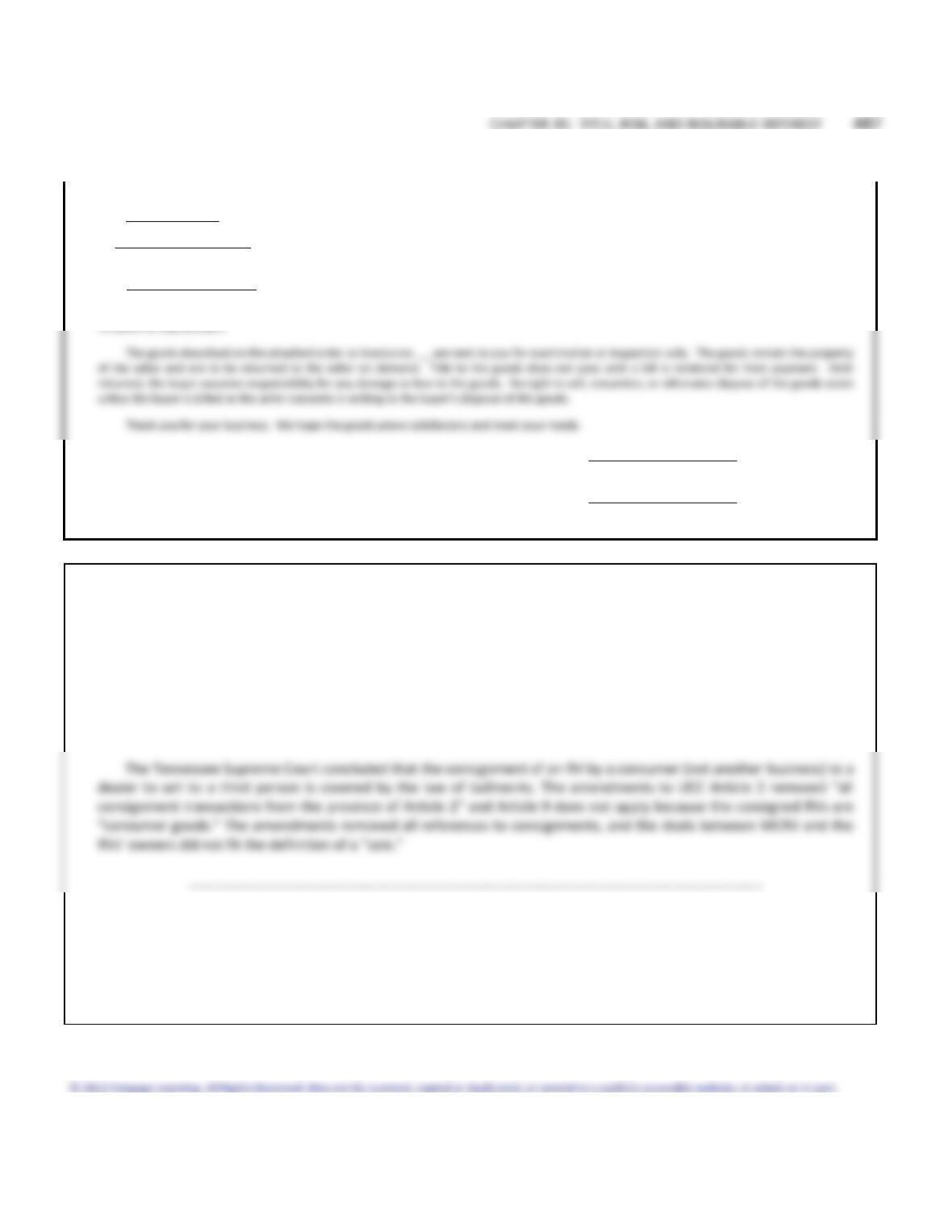
The seller acknowledges that the goods delivered as per the attached invoice or order no. ___ are sold on a sale on approval basis. If the buyer
is not satisfied with the goods after inspection, the buyer has the right to return the goods in merchantable condition at the seller’s expense within
SALE OR RETURN
Date:_______________
To:______________________
Buyer
_____________________
Address
To whom it may concern:
________________________
Seller
________________________
Address
CASE SYNOPSIS—
Case 20.3: In re Music City RV, LLC
Dudley King and others consigned their recreational vehicles (RVs) for sale on the lot of Music City RV, LLC (MCRV)
in Tennessee. While the RVs were still on the lot, MCRV’s creditors filed an involuntary bankruptcy petition against it.
The bankruptcy court asked the Supreme Court of Tennessee whether UCC Article 2 or Article 9 governed in these
circumstances.
Notes and Questions
Suppose that the agreements between the parties in this case had concerned a different product—not RVs but RV
accessories, for example. Would the result have been the same? Yes, the result would have been the same, assuming
that all of the other facts were the same. The particular product was not a key to the court’s decision.
488 INSTRUCTOR’S MANUAL TO ACCOMPANY BUSINESS LAW, TWELFTH EDITION
ANSWER TO “WHAT IF THE FACTS WERE DIFFERENT?” IN CASE 20.3
Suppose that the goods on consignment were not consumer goods but goods owned by a business enterprise.
How would that change in the facts affect the court’s decision? In that situation, Article 9 of the UCC would come into
ANSWER TO “THE ECONOMIC DIMENSION” QUESTION IN CASE 20.3
How does the answer to the question before the court affect the consignors? How the court answered this
question was important for the consignors. If the court had held that Article 2 governed the transaction as a sale or
return, it would mean that when MCRV received possession of the RVs, title and risk of loss would have passed to
MCRV. Therefore, in the bankruptcy proceeding, the RVs would be the property of the bankruptcy estate. That, in
1. Who Holds Title to Consigned Goods?
2. Creditors’ Claims to Consigned Goods
If the owner files a financing statement covering the goods, the owner’s creditors can assert claims against
E. RISK OF LOSS WHEN A SALES OR LEASE CONTRACT IS BREACHED
1. When the Seller or Lessor Breaches
If goods are so nonconforming that a buyer or lessee has the right to reject them, risk of loss will not pass