CHAPTER 2: COURTS AND ALTERNATIVE DISPUTE RESOLUTION 39
1. U.S. District Courts
Federal trial courts of general jurisdiction are called district courts. (A district may consist of an entire state
2. U.S. Courts of Appeals
U.S. courts of appeal hear appeals from the decisions of the district courts located within their respective
3. United States Supreme Court
The court at the top of the federal system is the United States Supreme Court to which further appeal is not
mandatory but may be possible.
a. Appeals to the Supreme Court
A party may ask the Court to issue a writ of certiorari, but the Court may deny the petition. Denying a
petition is not a decision on the merits of the case. Most petitions are denied.
IV. Alternative Dispute Resolution
The advantage of alternative dispute resolution (ADR) is its flexibility. Normally, the parties themselves can control
how the dispute will be settled, what procedures will be used, and whether the decision reached (either by themselves
or by a neutral third party) will be legally binding or nonbinding. Approximately 95 percent of cases are settled before
trial through some form of ADR.
A. NEGOTIATION
In a negotiation, the parties attempt to settle their dispute informally, with or without attorneys. They try to
reach a resolution without the involvement of a third party acting as mediator.
B. MEDIATION
In mediation, the parties attempt to come to an agreement with the assistance of a neutral third party, a
mediator. Mediation is essentially a form of “assisted negotiation.” The mediator does not make a decision on
the matter being disputed.
1. The Arbitration Process
Formal arbitration resembles a trial. The parties may appeal, but a court’s review is more restricted than an
2. Arbitration Clauses and Statutes
Virtually any commercial matter can be submitted to arbitration. Often, parties include an arbitration clause
in a contract. Parties can also agree to arbitrate a dispute after it arises. Most states have statutes (often
3. The Issue of Arbitrability
A court can consider whether the parties to an arbitration clause agreed to submit a particular dispute to
arbitration. The court may also consider whether the rules and procedures that the parties agreed to are
fair.
CASE SYNOPSIS—
Case 2.3: NCR Corp. v. Korala Associates, Ltd.
NCR Corp., which makes automatic teller machines (ATMs), contracted with Korala Associates, Ltd. (KAL) to
develop a software security upgrade for the ATMs. NCR loaned KAL a proprietary ATM that contained copyrighted
software called “APTRA XFS.” Later, NCR filed a suit in a federal district court against KAL, alleging that the defendant
“obtained access to, made unauthorized use of, and engaged in unauthorized copying of the APTRA XFS software.” The
court ordered the parties to arbitration under the terms of their contract. NCR appealed.
The U.S. Court of Appeals for the Sixth Circuit affirmed the judgment compelling arbitration of NCR’s claims
relating to direct copyright infringement of the APTRA XFS software. The contract clearly stated that any dispute
…………………………………………………………..……………………………………………………………………
Notes and Questions
Considering the relative bargaining power of the parties, was it fair to enforce the arbitration clause in this
contracts? Yes, because either party could have refused to agree to the contract when it contained the arbitration
clause. Of course, such clauses are likely to be ruled fair and enforceable when the parties are of equal bargaining
strength.
ANSWER TO “THE LEGAL ENVIRONMENT DIMENSION”
QUESTION IN CASE 2.3
Why did NCR not want its claims decided by arbitration? A party is typically reluctant to enter into a
ANSWER TO “THE ETHICAL DIMENSION” QUESTION IN CASE 2.3
Could NCR have a claim that KAL engaged in unfair competition because KAL had engaged in unethical
business practices? (Hint: Unfair competition may occur when one party deceives the public into believing
that his or her goods are the goods of another.) Why or why not? Of course, “unethical business practices” is not
an element of a claim for unfair competition, and thus NCR could not base a legal action on that allegation alone. Also,
ADDITIONAL CASES ADDRESSING THIS ISSUE —
Recent cases examining the validity of arbitration agreements include the following.
• Circuit City Stores, Inc. v. Ahmed, 283 F.3d 1198 (9th Cir. 2002) (an arbitration clause is not unconscionable,
and thus it is enforceable, when it contains a provision that grants an employee a meaningful opportunity to opt out of
binding arbitration).
• McCaskill v. SCI Management Corp., 285 F.3d 623 (7th Cir. 2002) (an arbitration clause invoked to compel the
arbitration of claims of sexual harassment and other employment discrimination is invalid, and thus unenforceable,
• Cash in a Flash Check Advance of Arkansas, L.L.C. v. Spencer, 348 Ark. 459, 74 S.W.3d 600 (2002) (in a
4. Mandatory Arbitration in the Employment Context
Generally, mandatory arbitration clauses in employment contracts are enforceable.
D. OTHER TYPES OF ADR
New types of ADR have emerged.
• In early neutral case evaluation, the parties select a neutral third party (generally an expert in the subject of
the dispute) to evaluate their positions. This forms the basis for negotiations.
CHAPTER 2: COURTS AND ALTERNATIVE DISPUTE RESOLUTION 43
• In a mini-trial, each party’s attorney argues the party’s case. Typically, a neutral third party (often an expert
in the disputed subject) acts as an adviser. If the parties fail to reach an agreement, the adviser renders an
ADDITIONAL BACKGROUND—
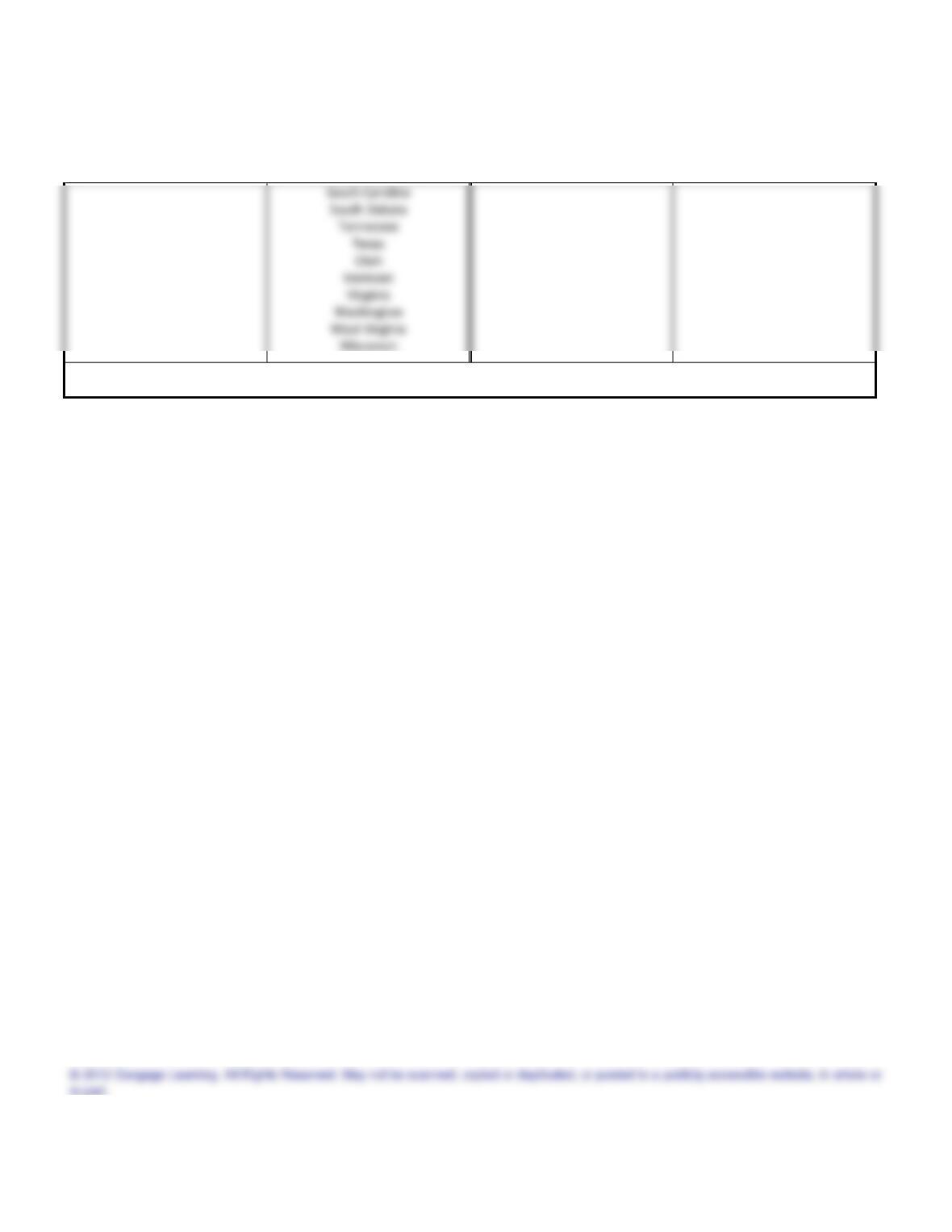
ADR and the Courts
States in which one or more
local state court has—
States in which one or more
federal court has—
Arbitration
Mediation
Arbitration
Mediation
Alabama
Alaska
Arizona
New Hampshire
New Jersey
New Mexico
New York
North Carolina
Alabama
Alaska
Arizona
Kentucky
Louisiana
Maine
Michigan
Minnesota
Oklahoma
Oregon
Pennsylvania
Rhode Island
Alabama
Arizona
California
Pennsylvania
Rhode Island
Texas
Utah
Washington
California
Delaware
Florida
Ohio
Oklahoma
Oregon
Pennsylvania
Rhode Island
44 INSTRUCTOR’S MANUAL TO ACCOMPANY BUSINESS LAW, TWELFTH EDITION
Source: Richard Reuben, “The Lawyer Turns Peacemaker,” ABA Journal (August 1996), p. 56.
CHAPTER 2: COURTS AND ALTERNATIVE DISPUTE RESOLUTION 45
E. PROVIDERS OF ADR SERVICES
A major provider of ADR services is the American Arbitration Association (AAA). Most of the largest law firms in
the nation are members of this nonprofit association, which settles nearly sixty thousand disputes a year.
Hundreds of for-profit firms around the country also provide dispute-resolution services.
F. ONLINE DISPUTE RESOLUTION
When outside help is needed to resolve a dispute, there are a number of Web sites that offer online dispute
V. International Dispute Resolution
Parties to international contracts may include forum-selection, choice-of-law, and arbitration clauses to protect
themselves if disputes arise. These clauses are defined in the text.
TEACHING SUGGESTIONS
1. Divide students into small groups and assign one of the text chapter’s end–of– chapter problems to each group.
Have each group determine whether or not the assigned problem is one that would lend itself to alternative dispute
resolution. If not, why not? If so, which form of alternative dispute resolution would the group recommend?
2. Obtain a standard arbitration agreement form from a national arbitration organization such as the American
3. Some students may find it enlightening to be reminded the law corresponds to the many ways in which people
4. In the courtroom, changes are being wrought by television. There is an increasing reliance on video testimony.
Children who allege physical or sexual abuse, for example, may give video testimony outside a courtroom to be shown
during trial proceedings. Lawyers who represent accident victims often commission videos to visually show the court
the impact of accident-related injuries on the daily lives of their clients. In criminal trials, judges have allowed juries to
see filmed reenactments of crimes. To further blur the line between simulation and reality is the increasing number of
cameras that videotape the commission of alleged crimes and other wrongs. What effect are these uses of
Cyberlaw Link
Ask your students to what extent those who send e-mail over the Internet should be liable for the content of their

46 INSTRUCTOR’S MANUAL TO ACCOMPANY BUSINESS LAW, TWELFTH EDITION
messages in states other than their own (or nations other than the United States). Is the existence of a Web site a
sufficient basis to exercise jurisdiction?
CHAPTER 2: COURTS AND ALTERNATIVE DISPUTE RESOLUTION 47
DISCUSSION QUESTIONS
1. If a corporation is incorporated in Delaware, has its main office in New York, and does business in California,
but its president lives in Connecticut, in which state(s) can it be sued? Delaware, New York, and California—a corporation
2. What is the difference between a court of general jurisdiction and a court of limited jurisdiction? A court with
3. What is the role of a court with appellate jurisdiction? Courts of appellate jurisdiction are reviewing courts—they
4. When may a federal court hear a case? Federal courts have jurisdiction in cases in which federal questions arise, in
cases in which there is diversity of citizenship, and in some other cases. When a suit involves a question arising under the
Constitution, a treaty, or a federal law, a federal question arises. When a suit involves citizens of different states, a foreign
5. When may the United States Supreme Court hear a case? The United States Supreme Court has original in only a
6. When may a court exercise jurisdiction over a party whose only connection to the jurisdiction is via the
Internet? One way to phrase the issue is when, under a set of circumstances, there are sufficient minimum contacts to give a
7. How does the process of negotiation work? In the process of negotiation, the parties come together informally,
8. What is the principal difference between negotiation and mediation? The major difference between negotiation
48 INSTRUCTOR’S MANUAL TO ACCOMPANY BUSINESS LAW, TWELFTH EDITION
9. What is arbitration? The process of arbitration involves the settling of a dispute by an impartial third party (other
than a court) who renders a legally binding decision. The third party who renders the decision is called an arbitrator.
10. What kinds of disputes may be subject to arbitration? The FAA requires that courts give deference to all voluntary
arbitration agreements in cases governed by federal law. Virtually any dispute can be the subject of arbitration. A voluntary
ACTIVITY AND RESEARCH ASSIGNMENTS
1. Have students prepare a chart showing the relationships between the various courts having jurisdiction in your state.
(There is a digest of each state’s courts in Martindale-Hubbell Law Directory, which might be placed on reserve in the library.)
Assign a few jurisdiction hypotheticals. For example—Through which of these courts could a divorce decree be
appealed? Which court(s) would have original jurisdiction in a truck accident involving out-of-state residents (does
the dollar amount of injuries and damage make a difference)? Which court(s) would have jurisdiction to render a
2. Ask the class to research the reasons behind the earlier hostility of the courts towards arbitration procedures. Were
they concerned solely with parties being divested of their rights or did they see arbitration as a challenge to their own
authority?
EXPLANATION OF SELECTED FOOTNOTES IN THE TEXT
Footnote 5: In International Shoe Co. v. State of Washington, 326 U.S. 310, 66 S.Ct. 154, 90 L.Ed. 95 (1945), the
state of Washington sought unemployment contributions from the International Shoe Company based on commissions paid to
its sales representatives who lived in the state. International Shoe claimed that its activities within the state were not sufficient
to manifest its “presence.” It argued that (1) it had no office in Washington; (2) it employed sales representatives to market its
product in Washington, but no sales or purchase contracts were made in the state; and (3) it maintained no inventory in
CHAPTER 2: COURTS AND ALTERNATIVE DISPUTE RESOLUTION 49
Washington. The company claimed that it was a denial of due process for the state to subject it to suit. The Supreme Court of
Washington ruled in favor of the state, and International Shoe appealed to the United States Supreme Court.
The United States Supreme Court affirmed the Washington Supreme Court’s decision—International Shoe had
sufficient contacts with the state to allow the state to exercise jurisdiction constitutionally over it. The Court found that the
activities of the Washington sales representatives were “systematic and continuous,” resulting in a large volume of business for
Footnote 9: In Zippo Manufacturing Co. v. Zippo Dot.Com, Inc., 952 F.Supp. 1119 (W.D.Pa. 1997), a federal
district court proposed three categories for classifying the types of Internet business contact: (1) substantial business conducted
online, (2) some interactivity through a Web site, and (3) passive advertising. Jurisdiction is proper for the first category,
improper for the third, and may or may not be appropriate for the second. Zippo Manufacturing Co. (ZMC) makes, among other
things, “Zippo” lighters. ZMC is based in Pennsylvania. Zippo Dot Com, Inc. (ZDC), operates a Web page and an Internet
subscription news service. ZDC has the exclusive right the domain names “zippo.com,” “zippo.net,” and “zipponews.com.” ZDC
Footnote 20: Buckeye Check Cashing, Inc., cashes personal checks for consumers in Florida. For each transaction, a
consumer signs a “Deferred Deposit and Disclosure Agreement,” which states that in a dispute of any kind, “either you or we or
third-parties involved can choose to have that dispute resolved by binding arbitration.” John Cardegna and others filed a suit in
a Florida state court against Buckeye, alleging that its “finance charge” represented an illegally high interest rate in violation of
state law. Buckeye filed a motion to compel arbitration. The court denied the motion. On Buckeye’s appeal, a state
intermediate appellate court reversed, but on the plaintiffs’ appeal, the Florida Supreme Court reversed again. Buckeye
appealed In Buckeye Check Cashing, Inc. v. Cardegna, the United States Supreme Court reversed and remanded. A
challenge to the validity of a contract as a whole, and not specifically to an arbitration clause contained in the contract, must be
ANSWERS TO ESSAY QUESTIONS IN
STUDY GUIDE TO ACCOMPANY BUSINESS LAW, TWELFTH EDITION
50 INSTRUCTOR’S MANUAL TO ACCOMPANY BUSINESS LAW, TWELFTH EDITION
BY HOLLOWELL & MILLER
1. What is jurisdiction? How does jurisdiction over a person or property differ from subject matter jurisdiction?
To consider a case, a court must have power over the person or the property involved in the action. Power over the person is
often referred to as in personam jurisdiction. In personam jurisdiction is required before a court can enter a personal
2. What permits a court to exercise jurisdiction based on contacts over the Internet? For a court to exercise
jurisdiction based on contacts over the Internet, generally the contacts must be with the court’s geographic jurisdiction. For a
court to compel any defendant to come before the court, there must be at least minimum contacts (an office within the
jurisdiction, for example, or a salesperson in the state, and so on). The issue in the context of cyberspace is whether there are
sufficient minimum contacts if the only connection to a jurisdiction is an ad on the Web originating from a remote location.
REVIEWING—
COURTS AND ALTERNATIVE DISPUTE RESOLUTION
Stan Garner resides in Illinois and promotes boxing matches for SuperSports, Inc., an Illinois corporation. Garner
created the concept of “Ages” promotion—a three-fight series of boxing matches pitting an older fighter against a
younger fighter. The concept had titles for each of the three fights, including “Battle of the Ages.” Garner contacted
George Foreman and his manager, who both reside in Texas, to sell the idea, and they arranged a meeting in Las Vegas,
Nevada. During negotiations, Foreman’s manager signed a nondisclosure agreement prohibiting him from disclosing
1. On what basis might the federal district court in Illinois exercise jurisdiction in this case? The federal district
court exercises jurisdiction because the case involves diversity of citizenship. Diversity jurisdiction requires that the
plaintiff and defendant be from different jurisdictions and that the dollar amount of the controversy exceed $75,000.
Here, Garner resides in Illinois, and Foreman and his manager live in Texas. Because the dispute involved the
promotion of boxing matches with George Foreman, the amount in controversy exceeded $75,000.
2. Does the federal district court have original or appellate jurisdiction? Original jurisdiction, because the case
CHAPTER 2: COURTS AND ALTERNATIVE DISPUTE RESOLUTION 51
the district courts are the trial courts, so the federal district court has original jurisdiction.
3. Suppose that Garner had filed his action in an Illinois state court. Could an Illinois state court exercise
personal jurisdiction over Foreman or his manager? Why or why not? No, because the defendants lacked
an Illinois state court would find sufficient minimum contacts to exercise jurisdiction.
4. Assume that Garner had filed his action in a Nevada state court. Would that court have personal
jurisdiction over Foreman or his manager? Explain. Yes, because the defendants met with Garner and formed a
DEBATE THIS:
In this age of the Internet with which people communicate via e-mail, instant text messaging, tweeting,
Facebook, and MySpace, is the concept of jurisdiction losing its meaning? Explain your answer. Many believe
that yes, the idea of determining jurisdiction based on individuals’ and companies’ physical locations no longer has
much meaning. Increasingly, contracts are formed via online communications. Does it matter where one of the
parties has a physical presence? Does it matter where the e-mail server or Web page server is located? Probably not.