CHAPTER 14: MISTAKES, FRAUD, AND VOLUNTARY CONSENT 353
argued, in the alternative, that he had proved that Waldrop had intentionally deceived him into executing the deed,
2. Recall from Chapter 1 that there are two types of remedies: equitable remedies and remedies at law. Is rescission
an equitable remedy or a remedy at law? Why is rescission an appropriate remedy in this case? At one time, the only
2. Negligent Misrepresentation
A misrepresentation is negligent if a person fails to use reasonable care in disclosing material facts or does
not use the skill and competence required by his or her business or profession.
C. RELIANCE ON THE MISREPRESENTATION
A deceived party must justifiably rely on the misrepresentation, and the misrepresentation must be an important
factor in inducing the party to contract, though it need not be the sole factor. Reliance is not justified if the inno-
cent party knows the truth or relies on obviously extravagant statements.
ANSWER TO CRITICAL ANALYSIS QUESTION IN THE FEATURE—
INSIGHT INTO ETHICS
Why would an employer risk the possibility of a lawsuit by providing a prospective employee with false
information? It’s possible that when the information was provided to the prospective employee, the employer actually
D. INJURY TO THE INNOCENT PARTY
A showing of injury may not be required in an action to rescind a contract, but in an action to recover damages,
proof of injury is universally required. The measure of damages is ordinarily equal to what the value of the
property would have been if it had been delivered as represented, less what it is actually worth. In actions based
on fraud, courts often award punitive damages.
354 INSTRUCTOR’S MANUAL TO ACCOMPANY BUSINESS LAW, ELEVENTH EDITION
SPECIAL EXHIBIT—
Misrepresentation
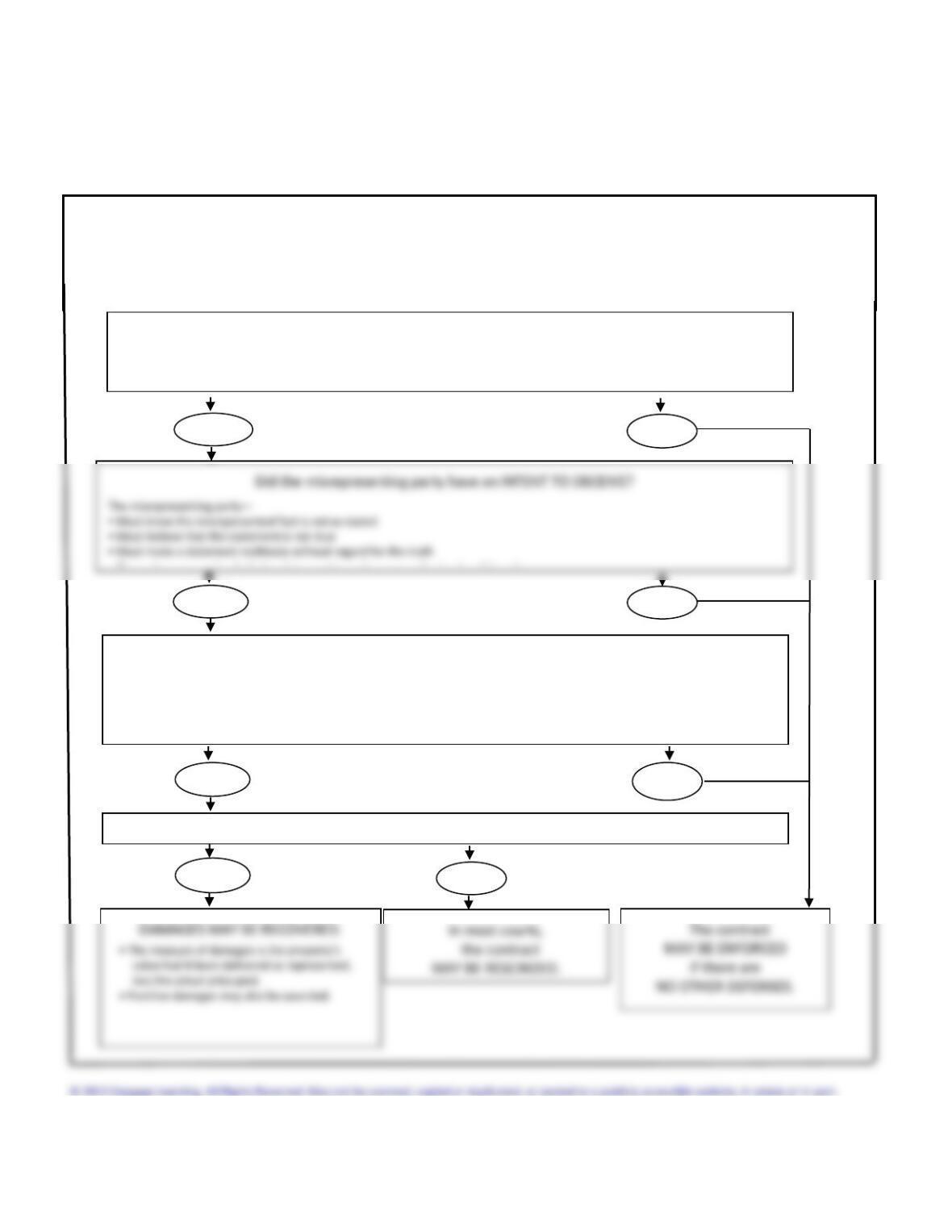
The following illustration summarizes the elements of misrepresentation discussed in the text.
Was there a MISREPRESENTATION of a MATERIAL FACT?
The misrepresentation—
• May take the form of words or action
• Must be a statement of fact, not of opinion
Did the deceived party JUSTIFIABLY RELY on the misrepresentation?
The deceived party—
• Must have a justifiable reason for relying on the misrepresentation
• Must have been induced to enter the contract by the misrepresentation
• Must not have known the true facts
• Must not have relied on obviously extravagant statements
Did the deceived party suffer an INJURY?
YES
NO
NO
NO
NO
YES
YES
YES
CHAPTER 14: MISTAKES, FRAUD, AND VOLUNTARY CONSENT 355
III. Undue Influence
Undue influence occurs in relationships in which one party can greatly influence another, thus overcoming the other’s
free will. A contract entered into under undue influence is voidable.
ADDITIONAL BACKGROUND—
Restatement (Second) of Contracts, Section 177
(1) Undue influence is unfair persuasion of a party who is under the domination of the person exercising the persuasion
(2) If a party’s manifestation of assent is induced by undue influence by the other party, the contract is voidable by the
victim.
(3) If a party’s manifestation of assent is induced by one who is not a party to the transaction, the contract is voidable
by the victim unless the other party to the transaction in good faith and without reason to know of the undue influence
either gives value or relies materially on the transaction.
A. HOW UNDUE INFLUENCE MAY OCCUR
Relationships in which one party may dominate another include fiduciary relationships—parent-child, trustee-
beneficiary, and guardian-ward, for example. The party unduly influenced must not act out of his or her free will.
B. THE PRESUMPTION OF UNDUE INFLUENCE
When a dominant party is enriched from a fiduciary relationship, undue influence is presumed.
B. ECONOMIC DURESS
Being in need is generally not a circumstance that will lead to a finding of duress, unless the party exacting the
price has created the need.
V. Adhesion Contracts and Unconscionability
An adhesion contract is written exclusively by one party and presented to the other party with no opportunity to
negotiate.
A. STANDARD-FORM CONTRACTS

356 INSTRUCTOR’S MANUAL TO ACCOMPANY BUSINESS LAW, ELEVENTH EDITION
CHAPTER 14: MISTAKES, FRAUD, AND VOLUNTARY CONSENT 357
B. UNCONSCIONABILITY AND THE COURTS
UCC 2–302, applying traditional fraud, undue influence, or duress instead.
TEACHING SUGGESTIONS
1. Often, students have difficulty with the concept of mistake. The concept can be reduced to two basic rules. First,
there are unilateral mistakes, which are mistakes of material fact attributable to only one of the parties. A unilateral
mistakes, which involve mistakes of material fact attributable to both parties. A mutual mistake may result in either
party being excused from performing. Requiring students to come up with specific examples of their own to illustrate
these rules can help to overcome the abstractness of the concept.
2. Ask students to suppose that in the Raffles v. Wichelhaus case, although there are two ships called Peerless, sailing
from Bombay in different months, both parties intend the same Peerless. Do the parties have a binding contract? Yes.
If both parties intend the same Peerless, they are bound to the contract. In that circumstance, it makes no difference
whether there are two ships called Peerless or whether the parties are aware of both ships. There is no mistake.
Ask students to imagine that although there are two ships called Peerless, sailing from Bombay in different
months, Raffles knows that Wichelhaus means the Peerless sailing in October, and Wichelhaus does not know that
there is another Peerless. Do they have a binding contract? If so, is the contract for the sale of goods on the Peerless
sailing in October? Yes, to both questions. If, under these circumstances, Raffles makes the contract intending not to
3. Students should be encouraged to note situations in which the common law alone applies and situations in which
the UCC applies. Also noteworthy are those principles on which the common law and the UCC diverge. To call
attention to the divergences, students might be asked whether they think the courts should use the UCC as a guide
even in non–UCC cases.
Part of the difficulty may arise from what is a common practice in business. Although a unilateral mistake is not
enough to permit rescission of a contract for lack of genuineness of assent, many businesses allow customers to get out
of contracts as a gesture of good will. Most people have come to expect this as a matter of right. Ask students
whether they think the law should be changed.
cases clear rules governing the effects of mistakes can be difficult. That is, the distinction between mistakes of fact and
mistakes as to market value or market conditions is not always as clear as it sounds. You might use the following
Suppose that Ann contracts to buy ten acres of land in Minnesota. Ann believes that Bob owns the land, but it
actually belongs to Carol. This is a mistake of fact, which could serve as grounds to avoid the contract. Suppose,
however, that Ann contracts to buy ten acres of land because she believes that she can resell the land at a profit to
358 INSTRUCTOR’S MANUAL TO ACCOMPANY BUSINESS LAW, ELEVENTH EDITION
Dan. Can Ann get out of the contract if it later turns out that Dan doesn’t want to buy the property? Probably not.
4. Spend some time discussing fraudulent misrepresentation. Cases involving avoidance of contracts because of
fraud are rare, but it is an important concept in the law and in daily business transactions. Perhaps the most important
proof is stricter than in other civil actions. In any state, of the elements of fraud, reliance and injury are easiest to
5. With a little imagination, the elements of fraudulent misrepresentation can be presented as the four “I’s”:
• mIsrepresentation of a material fact.
• Intent.
• Injured party’s justifiable reliance (or simply rel-I-ance).
• Injury to the innocent party (or simply Injury).
Cyberlaw Link
What preventive techniques might a party use to minimize harm due to such wrongs as fraud, undue influence,
and duress in cyberspace? How can anyone assure the authenticity of the parties (and their representations) with
whom he or she does business over the Internet?
DISCUSSION QUESTIONS
1. What is the legal significance of the difference between a mistake in judgment as to market conditions and a mistake of
fact? Mistakes in judgment as to market conditions involve believing something is worth more than it ultimately proves to be.
2. Does a unilaterally mistaken party have any right to relief? Generally, no, but there are exceptions. Relief may be
3. The elements of fraudulent misrepresentation include misrepresentation of a material fact. Discuss this element.
Misrepresentation can be in words (“this is a Warhol,” if the work is by another artist). Misrepresentation can occur through
conduct (concealment by showing samples that differ markedly from actual goods). All of us are expected to use care and
judgment when entering into contracts, however—predictions (“this land will be worth twice as much next year”) or statements
CHAPTER 14: MISTAKES, FRAUD, AND VOLUNTARY CONSENT 359
require greater knowledge of the law than a layperson possesses (realtors are expected to know the law governing land sales
and use). Disclosing some, but not all, of the facts can be deceitful. Nevertheless, normally, a contract cannot be set aside
4. In the context of fraudulent misrepresentation, when does a party evidence an intent to deceive? Scienter indicates
5. How important is a deceived party’s reliance on another’s misrepresentation to establishing a case against a deceiving
party? The deceived party must justifiably rely on the misrepresentation, and the misrepresentation must be an important
6. When does a deceived party have to show that he or she suffered an injury to recover on the basis of fraud? A showing
7. In what circumstance does undue influence occur? Undue influence occurs in relationships in which one party can
8. What is duress? Duress involves conduct of a coercive nature. Forcing a party to contract by threatening a wrongful or
illegal act (blackmail or extortion) is duress. Threatening to exercise a legal right (bring a civil suit) usually does not constitute
duress. Being in need is not usually a situation that will lead to a finding of duress, but duress may be found if the party exacting
the price has created the need. (An attorney tells a client, the day before the client’s trial, that unless the client agrees to pay a
higher fee, the attorney will quit the case. The client agrees; the agreement is unenforceable.) Duress is a defense to enforce-
ment of a contract and ground for rescission.
360 INSTRUCTOR’S MANUAL TO ACCOMPANY BUSINESS LAW, ELEVENTH EDITION
ACTIVITY AND RESEARCH ASSIGNMENT
Have students bring in standard form contracts (for example, residential leases, insurance policies, employment agency
agreements, loan agreements) and discuss whether the contracts are adhesion contracts and whether the contracts or their
clauses appear to be unconscionable. Ask the students to imagine that they are in a jurisdiction that does not recognize the
doctrine of unconscionability: under what circumstances might an adhesion contract that could otherwise be avoided on
grounds of unconscionability be avoided on grounds of fraud, undue influence, or duress?
EXPLANATIONS OF SELECTED FOOTNOTES IN THE TEXT
Footnote 8: Arthur Murray, Inc., operated dancing schools through local, franchised operators. At a “dance party” at
one of the schools, an instructor praised Audrey Vokes for her potential as “an excellent dancer.” The instructor sold her eight
Did the instructor misrepresent to Vokes any facts, as opposed to giving misleading statements of opinion? Some facts
may have been misrepresented, but the court does not consider whether misrepresentation of a material fact was necessary
because it concludes that the misleading statements of opinion were enough.
Fraud requires reasonable reliance on a misrepresentation. How could Vokes reasonably have relied on what she was
told? Surely, she must have been aware of her own limitations. This is a question of fact to be decided by the trial court on
remand. The question before the appellate court in this case arose from the trial court’s dismissal of Vokes’s complaint on
Arthur Murray’s motion to dismiss for failure to state a claim on which relief can be granted.
In the seventeenth century, in some of the new American colonies, the law prohibited professional performances of
music. By the time of the Revolutionary War, however, the bans had generally been lifted, and the nineteenth century saw the
If one of Vokes’s fellow students, rather than her instructor, had praised her ability and encouraged her to buy more
lessons, should the result in this case have been different? Explain. The result likely should have been different. In its opinion,
the court explained that a “statement of a party having . . . superior knowledge may be regarded as a statement of fact
although it would be considered as opinion if the parties were dealing on equal terms.” In the Vokes case, the instructor and the
school clearly appeared to be taking advantage of Vokes. This is not only illegal but unethical. Most likely, a student, rather than
an instructor, who praised Vokes’s ability and prompted her to buy more lessons, would have been a party “dealing on equal
terms” and the praise might not have been perceived as illegal or unethical.
CHAPTER 14: MISTAKES, FRAUD, AND VOLUNTARY CONSENT 361
Footnote 12: In 1995, Robert Sarvis was convicted of bank fraud and sentenced to prison. Two weeks after his
release in 1998, he applied for a teaching position at Community College of Vermont (CCV). On his resume, he stated that from
“1984–1998” he was “President and Chairman of the Board” of “CMI International Inc.” For a position as CCV’s Coordinator of
Academic Services, he submitted a second resume, on which he added, “1998-present. Semi-retired. Adjunct Instructor of
Sarvis also argued that he had been discharged without just cause because “neither law nor public opinion recognizes
termination for criminal history unrelated to the job as good cause for dismissal.” How did the court respond to this argument?
The court reasoned that Sarvis was misstating the basis for his discharge and said that it was not addressing this issue. “We
affirm the decision below because plaintiff misrepresented his past to create a false impression to persuade defendant to hire
him. As a matter of law, just cause existed to fire plaintiff under these grounds. We need not determine whether the mere fact
of a prior criminal history can support a just cause dismissal.”
Could Parlier have verified the nature of Foley’s business more thoroughly before moving to Texas? Yes, although at a
greater cost. For example, Parlier might have contacted Foley’s “customers” to determine the extent of the purported contracts,
work, and charges.
ANSWERS TO ESSAY QUESTIONS IN
STUDY GUIDE TO ACCOMPANY BUSINESS LAW, TWELFTH EDITION
BY HOLLOWELL & MILLER
1. Why are mistakes of value not accorded the same relief as mistakes of fact? At different times, the same thing may
2. What are the elements of fraudulent misrepresentation? Fraudulent misrepresentation refers to misrepresentation
362 INSTRUCTOR’S MANUAL TO ACCOMPANY BUSINESS LAW, ELEVENTH EDITION
REVIEWING—
MISTAKES, FRAUD, AND VOLUNTARY CONSENT
Chelene had been a caregiver for Marta’s eighty-year-old mother, Janis, for nine years. Shortly before Janis passed
away, Chelene convinced her to buy Chelene’s house for Marta. The elderly woman died before the papers were
signed, however. Four months later, Marta used her inheritance to buy Chelene’s house without having it inspected.
The house was built in the 1950s, and Chelene said it was in “perfect condition.” Nevertheless, one year after the
purchase, the basement started leaking. Marta had the paneling removed from the basement walls and discovered
that the walls were bowed inward and cracked. Marta then had a civil engineer inspect the basement walls, and he
found that the cracks had been caulked and painted over before the paneling was installed. He concluded that the
“wall failure” had existed “for at least thirty years” and that the basement walls were “structurally unsound.. Ask your
students to answer the following questions, using the information presented in the chapter.
1. Can Marta obtain rescission of the contract based on undue influence? If the sale to Janis had been completed
before her death, could Janis have obtained rescission based on undue influence? Explain. Yes, Chelene was in a
2. Can Marta sue Chelene for fraudulent misrepresentation? Why or why not? What element(s) might be lacking?
3. Now assume that Chelene knew that the basement walls were cracked and bowed and that she had hired
someone to install paneling prior to offering to sell the house. Did she have a duty to disclose this defect to Marta?
Could a court find that Chelene’s silence in this situation constituted misrepresentation? Explain. Chelene appears to
have lied because she said the house was in perfect condition and she covered up a known problem. Chelene knew of
4. If Chelene knew about the problem with the walls but did not know that the house was structurally unsound, could
she be liable for negligent misrepresentation? Why or why not? Chelene hid one problem but was not aware of the
other, so may not be responsible for that one. Chelene is likely responsible to Marta for defects she knew about and
5. Can Marta avoid the contract on the ground that both parties made a mistake about the condition of the house?
CHAPTER 14: MISTAKES, FRAUD, AND VOLUNTARY CONSENT 363
contract. If there is a bilateral (mutual) mistake of material fact, such as structural soundness, then the parties did not
know what they were really bargaining for and the contract could be rescinded.
DEBATE THIS:
The concept of caveat emptor (“let the buyer beware”) should be applied to all sales, including those for real
property. Buyers of personal and real property should take responsibility for obtaining enough information about
what they are buying so that they are not “surprised” after the purchase. In the case of real property, buyers should
pay for thorough inspections, rather than relying on the honesty of the real property seller. For consumer goods,