237
Chapter 10
Nature and Terminology
See Separate Lecture Outline System
INTRODUCTION
This chapter introduces the topic of contracts by defining a number of terms, giving an overview of the topic, and
looking at the judicial interpretation of contracts. At this point in a discussion of contracts, it may be advisable to point out that
learning the definitions of offer, acceptance, valid, voidable, and the other terms in this chapter are only a starting point.
Memorizing theses definitions will not provide a complete understanding of the concepts.
Contract law shows what promises or commitments our society believes should be legally binding. It shows what
excuses our society will accept for the breaking of promises. And it shows what kinds of promises will be considered to be
against public policy and therefore legally void. The use of contract principles to govern the relationships of those who make

238 INSTRUCTOR’S MANUAL TO ACCOMPANY BUSINESS LAW, TWELFTH EDITION
ADDITIONAL RESOURCES—
VIDEO SUPPLEMENTS
The following video supplements relate to topics discussed in this chapter—
PowerPoint Slides
To highlight some of this chapter’s key points, you might use the Lecture Review PowerPoint slides compiled for
Chapter 10.
Business Law Digital Video Library
The Business Law Digital Video Library at www.cengage.com/blaw/dvl offers a variety of videos for group or
individual review. Clips on topics covered in this chapter include the following.
• Ask the Instructor
contracts should be contrasted with bilateral contracts, which feature a promise in exchange for a promise.
CHAPTER OUTLINE
I. An Overview of Contract Law
A. SOURCES OF CONTRACT LAW
Contract law is common law. The common law governs all contracts except when statutory law or administrative
agency regulations have been modified or replaced it. Statutory law—particularly the Uniform Commercial Code
(UCC)—governs all contracts for the sale of goods. It should be stressed that it is essential to know when the UCC
applies.
B. THE FUNCTION OF CONTRACT LAW

CHAPTER 10: NATURE AND TERMINOLOGY 239
A contract is a promise for the breach of which the law gives a remedy or the performance of which the law
recognizes as a duty (in other words, an agreement that can be enforced in court). A contract may be formed
when two or more parties each promise to perform or to refrain from performing some act now or in the future.
A party who does not fulfill his or her promise may be subject to sanctions, including damages or, under some
circumstances, being required to perform the promise.
D. THE OBJECTIVE THEORY OF CONTRACTS
The intent to enter into a contract is important in the formation of a contract. The objective theory of contracts
II. Elements of a Contract
A. REQUIREMENTS OF A VALID CONTRACT
The four essential elements of a contract are—
• Agreement.
• Consideration.
• Contractual capacity.
• Legality.
B. DEFENSES TO THE ENFORCEABILITY OF A CONTRACT
Defenses to the formation or enforcement of a contract include —
• Voluntary consent.
• Form.
III. Types of Contracts
Each of these categories signifies a legal distinction regarding a contract’s formation, performance, or enforceability.
A. CONTRACT FORMATION
These contracts are based on how and when a contract is formed.
1. Bilateral v. Unilateral Contracts
Every contract involves at least two parties: an offeror and an offeree. The offeror promises to do or not to
do something. Whether a contract is unilateral or bilateral depends on what the offeree must do to accept.
a. Bilateral Contracts
A bilateral contract is a promise for a promise; if the offeree need only promise to perform, the
contract is bilateral.
ANSWER TO CRITICAL THINKING QUESTION IN THE FEATURE—
INSIGHT INTO ETHICS

240 INSTRUCTOR’S MANUAL TO ACCOMPANY BUSINESS LAW, TWELFTH EDITION
CHAPTER 10: NATURE AND TERMINOLOGY 241
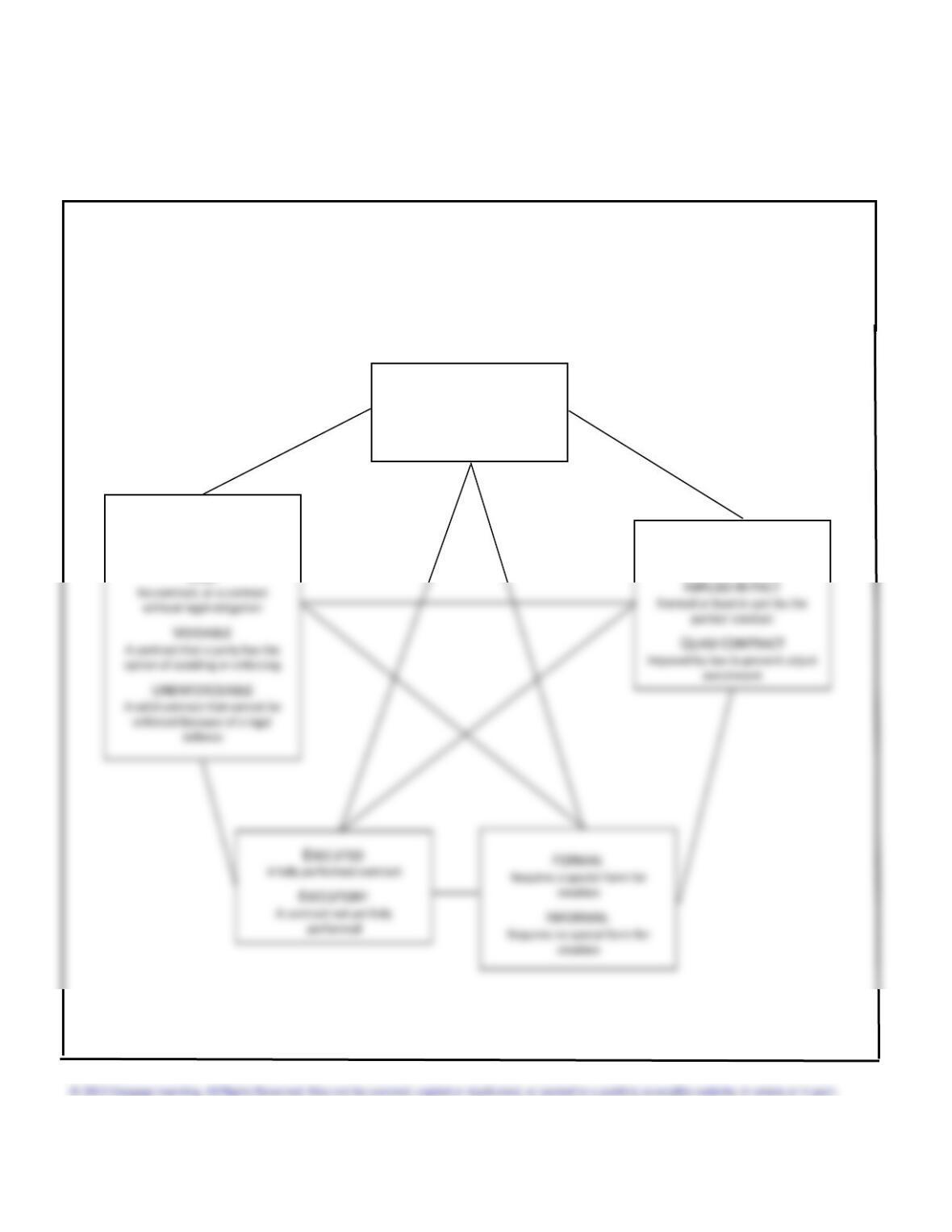
SPECIAL EXHIBIT—
Types of Contracts
The following illustration summarizes the types of contracts discussed in the text.
BILATERAL
A promise for a promise
UNILATERAL
A promise for an act
EXPRESS
Formed by words
VALID
A contract that has the necessary
elements
VOID
242 INSTRUCTOR’S MANUAL TO ACCOMPANY BUSINESS LAW, TWELFTH EDITION
b. Unilateral Contracts
A unilateral contract is a promise for an act; if an offeree can accept only by complete performance, a
contract is unilateral.
c. Revocation of Offers for Unilateral Contracts
A unilateral contract’s offer becomes irrevocable once substantial performance is completed.
2. Formal v. Informal Contracts
Formal contracts require a special form or method of formation to be enforceable. Formal contracts include
3. Express v. Implied Contracts
a. Express Contracts
An express contract is one in which the terms are expressed in words, oral or written.
(2) the plaintiff must have expected to be paid and the defendant knew or should have known that
payment was expected; and (3) the defendant had a chance to reject the service or property and did
not.
ENHANCING YOUR LECTURE—
AVOIDING UNINTENDED EMPLOYMENT CONTRACTS
Employers have learned many lessons from court decisions. In recent years, for example, the message has been
clear that employers should be cautious about what they say in their employment manuals.
EMPLOYMENT MANUALS AND IMPLIED–IN-FACT CONTRACTS
Promises made in an employment manual may create an implied-in-fact employment contract. If an employment
handbook states that employees will be fired only for specific causes, the employer may be held to that “promise.”
CHAPTER 10: NATURE AND TERMINOLOGY 243
liable for damages for breaching the contract.
TAKING PRECAUTIONS
Employers who wish to avoid potential liability for breaching unintended employment contracts should therefore
make it clear to employees that the policies expressed in an employment manual are not to be interpreted as
contractual promises. An effective way to do this is to inform employees, when initially giving them the handbook or
discussing its contents with them, that the handbook is not intended as a contract and to include a disclaimer to that
effect in the employment manual. The disclaimer might read as follows: “This policy manual describes the basic
personnel policies and practices of our Company. You should understand that the manual does not modify our
Company’s ‘at will’ employment doctrine or provide employees with any kind of contractual rights.”
off from the surrounding text by the use of larger type, a different color, all capital letters, or some other device that
CHECKLIST FOR THE EMPLOYER
2. Include a clear and prominent disclaimer to this effect in employment applications.
3. Avoid including in the handbook any definite promises relating to job security, and include a clear and prominent
disclaimer of contractual liability for any statements made within the handbook.
B. CONTRACT PERFORMANCE
Contracts are also classified according to their stage of performance. A contract that has been performed is an
C. CONTRACT ENFORCEABILITY
A valid contract results when all of the elements necessary to contract formation exist—when the parties agree,
through an offer and an acceptance, to form a contract; the contract is supported by consideration; the contract
is for a legal purpose; and the parties had legal capacity to contract.
1. Voidable Contracts
2. Unenforceable Contracts
244 INSTRUCTOR’S MANUAL TO ACCOMPANY BUSINESS LAW, TWELFTH EDITION
An unenforceable contract is a valid contract that cannot be enforced due to certain defenses. For example,
IV. Quasi Contracts
A quasi contract is not based on an express promise to pay for a benefit received or on conduct implying such a
promise. Quasi contracts, or contracts implied in law, are imposed by courts to avoid unjust enrichment—the theory
that individuals should not be allowed to profit or enrich themselves inequitably at the expense of others. The plaintiff
recovers in quantum meruit.
CASE SYNOPSIS—
Case 10.1: Scheerer v. Fisher
Jack Fisher, the manager of Renaissance Ventures, LLC, asked David Scheerer, a real estate agent, to negotiate
terms of sale with the owners of some properties that Fisher wished to develop. He promised Scheerer a 2-percent
commission. After negotiations, Fisher signed contracts to buy the properties for a combined price of $20 million. Later,
however, he rescinded the offers and arranged with Anthony Antonio to buy the properties for substantially less on
Fisher’s behalf. When Scheerer learned of the deal between Fisher and Antonio, he and his company filed a suit in a
…………………………………………………………..……………………………………………………………………
Notes and Questions
Is it ever ethical for a party to rescind an offer when a contract is nearly “final”—valid and enforceable? Because
there are many stakeholders to whom a contracting party, particularly a business, may owe a duty, there are many
circumstances in which a firm could act ethically in refusing to complete a deal, even if that ultimately leads to

CHAPTER 10: NATURE AND TERMINOLOGY 245
ANSWER TO “WHAT IF THE FACTS WERE DIFFERENT?” IN CASE 10.1
Suppose that Fisher had not ultimately obtained the properties (through Antonio and the assignment) and had
shown no further interest in the properties after he had rescinded the first contract. Would Scheerer still have had a
valid claim against Fisher for recovery in quantum meruit? Why or why not? Scheerer would still have a claim against
(3) the services were not given gratuitously. All of these elements existed at the moment that Fisher rescinded the
original contract with the sellers.
ANSWER TO “THE ETHICAL DIMENSION” QUESTION IN CASE 10.1
Was Fisher’s unethical behavior (in misleading Scheerer into believing that he was still interested in making a
subsequent offer on the properties) a factor in the court’s decision? Explain. Fisher, by rescinding the contract and
then acquiring it via Antonio’s purchase and subsequent assignment, clearly indicated that he wanted to obtain the
property for a lower price—and to avoid paying Scheerer his commission. By continuing to discuss a possible future
A. LIMITATIONS ON QUASI–CONTRACTUAL RECOVERY
There are situations in which the recipient of a benefit is not liable. People cannot normally be forced to pay for
benefits thrust on them, for example.
B. WHEN AN ACTUAL CONTRACT EXISTS
A quasi contract will not normally be imposed when there is a contract that covers the matter.
V. Interpretation of Contracts
The most important principle to keep in mind in considering these rules is that the law attempts not just to enforce a
contract but to enforce the contract the parties made.
Case 10.2: Wagner v. Columbia Pictures Industries, Inc.
Robert Wagner entered into an agreement with Spelling–Goldberg Productions (SGP over the rights to “Charlie’s
Angels.” The contract entitled Wagner to 50 percent of the net profits that SGP received “for the right to exhibit
photoplays of the series and from the exploitation of all ancillary, music and subsidiary rights.” SGP hired Ivan Goff and
Ben Roberts to write the episodes of the “Charlie’s Angels” television series under a contract that gave the writers the
right to make and market films based on the material. In 1995, Columbia bought the movie rights to the material from
the writers’ heirs. In 2000 and 2003, Columbia produced and distributed two “Charlie’s Angels” films. Wagner filed a
suit in a California state court against Columbia, claiming a share of the profits from the films. The court issued a
summary judgment in Columbia’s favor. Wagner appealed.
…………………………………………………………..……………………………………………………………………
Notes and Questions
This case can be used a springboard to explain the parol evidence rule, which is discussed more fully in a later
chapter. Under this rule, parol evidence of the negotiations underlying a contract is admissible to explain, but not to
contradict, the meaning of its terms. Did Wagner’s offered evidence of the “Love Song” agreement explain or
contradict the “Charlie’s Angels” contract? The court concluded, “The problem with Wagner’s extrinsic evidence is that
(1891)].’ ”
Under what circumstances might SGP have held the movie rights to “Charlie’s Angels” as “subsidiary” to its primary
“right to exhibit photoplays of the series”? The court explained that “if SGP held the motion picture rights to ‘Charlie’s
1. How might the result in this case have been different if the court had admitted the Wagners’ extrinsic evidence of
the Love Song contract? In this circumstances, the court might have construed the language of the Charlie’s Angels
2. Under what circumstance would the Wagners have been entitled to a share of the profits from the Charlie’s Angels
movies even though the evidence of the Love Song contract was irrelevant? The court explained that “if SGP held the
motion picture rights to ‘Charlie’s Angels’ from the beginning or if it acquired them by exercising its [five-year] right
. . . as producer to purchase the rights from Goff and Roberts, then it could be said to have acquired those rights by
exploiting its right to exhibit photoplays of the series,” which was the “unambiguous” meaning of the SGP contract with
the Wagners. In that circumstance, the Wagners would have been entitled to a share of the profits from the movies.
ADDITIONAL CASES ADDRESSING THIS ISSUE —
Recent cases applying the plain meaning rule include the following.
• The Offshore Drilling Co. v. Gulf Copper & Mfg. Corp., __ F.3d __ (5th Cir. 2010) (the owner of a mobile offshore
drilling rig that was damaged by fire while berthed at the shipyard owned by a contractor that was performing welding
on the vessel “controlled” the vessel, and thus under the parties’ contract was required to indemnify the contractor
against the loss).
• Dominic Wenzell, D.M.D. P.C. v. Ingrim, 228 P.3d 103 (Alaska 2010) (a covenant not to compete contained in a
purchase agreement for a private dental clinic was intended to prevent only competition with the clinic by the seller,
for a certain period of time within a certain distance, not to prevent all practice of dentistry).
room by a student).
not ambiguous as to its purpose, but clearly notified the property owner that the lot was to be used for residential
B. OTHER RULES OF INTERPRETATION
2. A contract will be interpreted as a whole; individual clauses will be considered subordinate to the contract’s
general intent. All writings that are part of the same transaction will be interpreted together.
4. A word will be given its ordinary, commonly accepted meaning, and a technical word or term will be given
its technical meaning, unless the parties clearly intended something else.
6. Written or typewritten terms prevail over printed ones.
8. When evidence of usage of trade, course of dealing, and course of performance is admitted, what each of
the parties does in pursuance of the contract will be interpreted as consistent with what the other does and
with any relevant usage of trade and course of dealing and performance. In these circumstances, express
CASE SYNOPSIS—
Case 10.3: U.S. Bank, N.A. v. Tennessee Farmers Mutual Insurance Co.
Jessica Robbins bought a house in Humboldt, Tennessee. U.S. Bank, N.A., financed the purchase. Tennessee
Farmers Mutual Insurance Co. issued the homeowner’s insurance policy. The policy included a “standard mortgage
clause” that promised payment to the bank unless the house was lost due to an “increase in hazard” that the bank
knew of but did not tell the insurer. When Robbins fell behind on her mortgage payments, the bank started
foreclosure. No one told the insurer. Robbins filed for bankruptcy, which postponed foreclosure. Meanwhile, the house
was destroyed in a fire caused by chemicals used to make methamphetamine. The bank filed a claim under the policy.
The insurer refused to pay. The bank filed a suit in a Tennessee state court against the insurer on the ground of breach
of contract. The insurer argued that it had not been told by the bank of an “increase in hazard”—the foreclosure. The
court ruled in favor of the bank, an appellate court reversed, and the bank appealed.
The Tennessee Supreme Court reversed and remanded. The phrase “increase of hazard,” by its ordinary meaning,
does not include foreclosure. Thus, the failure to notify the insurer of the foreclosure did not breach the policy. In other
…………………………………………………………..………………………………………………………..………….
CHAPTER 10: NATURE AND TERMINOLOGY 249
Notes and Questions
Should the court have read into this policy an obligation to notify the insurer of the commencement of
foreclosure? Why or why not? No, at least not according to the rules of contract interpretation stated in the text.
Adding such an obligation would effectively remake the parties’ insurance contract or arguably amount to the making
of a new contract in accord with what the insurer claimed it should have said—i.e., what its intent was when it wrote
the policy.
relate to interpretation. But any applicable statute must also be considered. The terms of an insurance policy must
meet any statutory requirements, which supersede any conflicting policy provisions and become part of the insurance
requirement would have been part of the policy, and in the facts of this case, the policy would have been breached
ANSWER TO “THE ETHICAL DIMENSION” QUESTION IN CASE 10.3
Is it ethical for an insurer to refuse to pay a claim under the terms of a policy that the insurer drafted? Discuss.
Because there are many stakeholders to whom an insurer, or any other business, may owe a duty, there are many
circumstances in which a firm could act ethically in refusing to pay, or maintaining any position, even if that ultimately
leads to litigation and the position is “weak” in its truth or rightness. A business’s owners are owed a return on their
investment, its employees are owed jobs and payment for their work, communities are owed vibrant economies, and
so on. None of this would be possible if the business at the core did not make a profit.
ANSWER TO “WHAT IF THE FACTS WERE DIFFERENT?” IN CASE 10.3
Suppose that Tennessee Farmers’s policy had provided that foreclosure proceedings either voided the coverage or
required notification to continue it. Would the result have been different? Explain. Yes, the result would have been
foreclosure proceedings voided the policy or required notification of the proceedings. In those cases, the courts held
that the commencement of foreclosure proceedings did constitute an “increase in hazard.”
Recent cases applying rules of contract interpretation include the following.
250 INSTRUCTOR’S MANUAL TO ACCOMPANY BUSINESS LAW, TWELFTH EDITION
handwritten notes and cross outs, is not a model of clarity. . . . A number of fill-in spaces are left blank . . . . Whole
sections are deleted by hand with the notation ‘VOID’ and the parties’ initials. Some sections . . . are written entirely
by hand and squeezed into what little white space existed between typed sections. It is no wonder that ambiguity and
inconsistency is the result.”)
• BP Amoco Chemical Co. v. Flint Hills Resources, LLC, __ F.Supp.2d __ (N.D.Ill. 2010) (a provision of in an asset
purchase and sale agreement (PSA) for the sale of a chemical plant setting forth a production-capacity warranty was
ambiguous, and thus the buyer and seller could submit extrinsic evidence to the jury to support their respective
interpretations of the warranty language).
• Belager-Price v. Lingle, 28 So.3d 706 (Miss.App. 2010) (“fair interpretation” of a residential subdivision’s covenant,
which stated that the property could only be used to build and construct one single-family residence and
appurtenances but was ambiguous as to when the residence must be built in relation to any appurtenances, was that
the four acres but such an interpretation would be an unreasonable restraint on alienation).
ADDITIONAL BACKGROUND—
Restatement (Second) of Contracts, Sections 201, 202, 203, and 206
The terms of an agreement or promise generally define the obligation. When the parties to a contract have
adopted a writing as the final expression of all or part of their agreement, interpretation focuses on the writing. In the
Restatement (Second) of Contracts, Sections 201, 202, 203, and 206, general rules are provided concerning the
determination or effect that the meaning of the promise or agreement may have on the scope of contractual
obligations. The following is the text of those sections with Comments.
§ 201. Whose Meaning Prevails
(1) Where the parties have attached the same meaning to a promise or agreement or a term thereof, it is interpreted in
(2) Where the parties have attached different meanings to a promise or agreement or a term thereof, it is interpreted
in accordance with the meaning attached by one of them if at the time the agreement was made
(a) that party did not know of any different meaning attached by the other, and the other knew the meaning attached
(3) Except as stated in this Section, neither party is bound by the meaning attached by the other, even though the
result may be a failure of mutual assent.
Comment:
a. The meaning of words. Words are used as conventional symbols of mental states, with standardized meanings
based on habitual or customary practice. Unless a different intention is shown, language is interpreted in accordance
with its generally prevailing meaning. See § 202(3). Usages of varying degrees of generality are recorded in
dictionaries, but there are substantial differences between English and American usages and between usages in
different parts of the United States. Differences of usage also exist in various localities and in different social,
c. Mutual understanding. Subsection (1) makes it clear that the primary search is for a common meaning of the parties,
not a meaning imposed on them by the law. To the extent that a mutual understanding is displaced by government
interpretation in the general law of contracts is to carry out the understanding of the parties rather than to impose
ently by statute or administrative regulation. But parties who used a standardized term in an unusual sense obviously
Illustrations:
1. A and B agree that A will sell goods to B “f.o.b.” the place of destination. Prior correspondence shows that the price
2. A signs a negotiable promissory note payable to B’s order, and C signs his name on the back without more. Under
Uniform Commercial Code § 3-402, C’s signature is an indorsement, and evidence of a contrary understanding is not
know the meaning attached by the first party.
3. A agrees to sell beer to B at a specified price per barrel. At the time of the agreement both parties and others in
their trade use as standard barrels wooden barrels which originally hold 31 gallons and hold less as they continue in
use. A statute defines a barrel as 31 1/2 gallons. The statute does not prevent interpretation of the agreement as
referring to the barrels in use.
Illustrations:
4. A agrees to sell and B to buy a quantity of eviscerated “chicken.” A tenders “stewing chicken” or “fowl”; B rejects on
fail.
5. A orders goods from B, using A’s standard form. B acknowledges the order, using his own standard form. Each form
provides that no terms are agreed to except those on the form and that the other party agrees to the form. One form
contains an arbitration clause; the other does not. The goods are delivered and paid for. Later a dispute arises as to
their quality. There is no agreement to arbitrate the dispute.
§ 202. Rules in Aid of Interpretation
(2) A writing is interpreted as a whole, and all writings that are part of the same transaction are interpreted together.
(3) Unless a different intention is manifested,
(a) where language has a generally prevailing meaning, it is interpreted in accordance with that meaning;
(4) Where an agreement involves repeated occasions for performance by either party with knowledge of the nature of
the writing.