CHAPTER 1: INTRODUCTION TO LAW AND LEGAL REASONING 15
N.Y.S.2d 341, 263 App.Div. 882 —Saari v. State,
119 N.Y.S.2d 507, 203 Misc. 859—Schmidt v.
State, 100 N.Y.S.2d 504, 198 Misc. 802.
No. 1015, P. of H., 109 N.Y.S.2d 374.
ADDITIONAL BACKGROUND—
State Codes:
Pennsylvania Consolidated Statutes
State codes may have any of several names—Codes, General Statutes, Revisions, and so on—depending on the
preference of the states. Also arranged by subject, some codes indicate subjects by numbers. Others assign names.
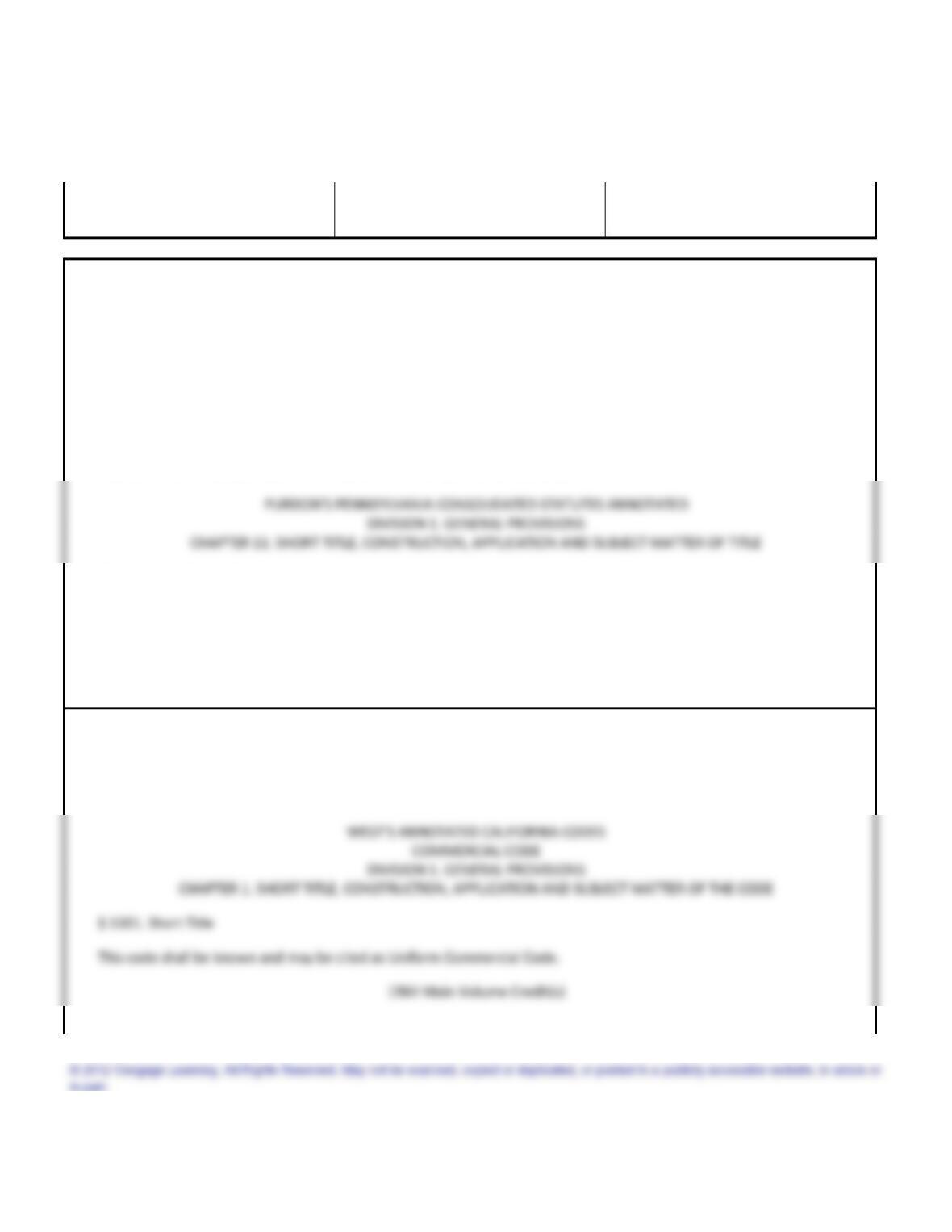
The following is the text of one of the state statutes whose citations are explained in the textbook—Section 1101 of
Title 13 of the Pennsylvania Consolidated Statutes (13 Pa. C.S. § 1101).
§ 1101. Short title of title
This title shall be known and may be cited as the “Uniform Commercial Code.”
1984 Main Volume Credit(s)
1979, Nov. 1, P.L. 255, No. 86, § 1, effective Jan. 1, 1980.
California Commercial Code
The text of another of the state statutes whose citations are explained in the textbook follows—Section 1101 of
the California Commercial Code (Cal. Com. Code § 1101).
§ 1101. Short Title
This code shall be known and may be cited as Uniform Commercial Code.
(Stats.1963, c. 819, § 1101.)
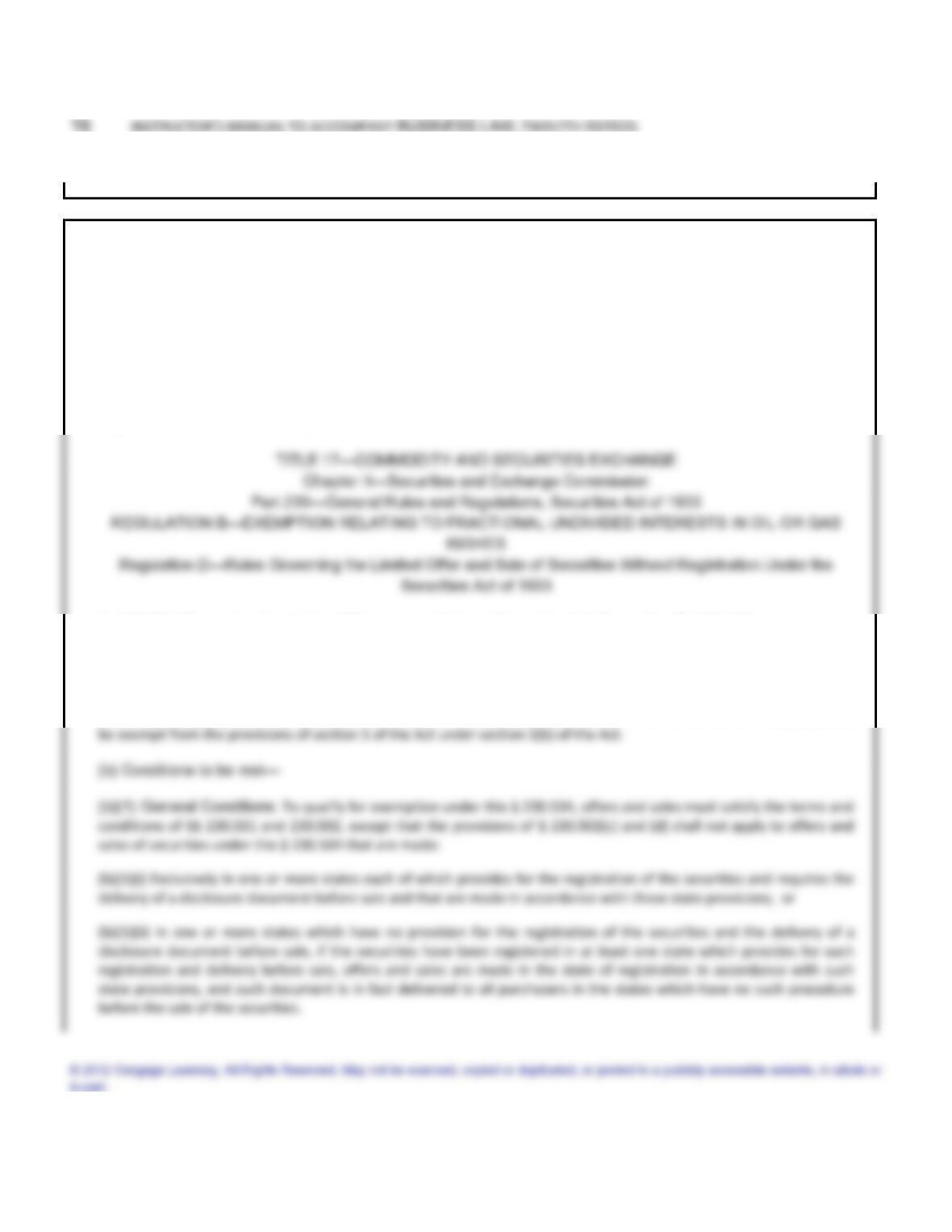
be exempt from the provisions of section 5 of the Act under section 3(b) of the Act.
conditions of §§ 230.501 and 230.502, except that the provisions of § 230.502(c) and (d) shall not apply to offers and
state provisions, and such document is in fact delivered to all purchasers in the states which have no such procedure
ADDITIONAL BACKGROUND—
Code of Federal Regulations
Created by Congress in 1937, the Code of Federal Regulations is a set of softcover volumes that contain the
regulations of federal agencies currently in effect. Items are selected from those published in the Federal Register and
arranged in a scheme of fifty titles, some of which are the same as those organizing the statutes in the United States
Code (discussed above). Each title is divided into chapters, parts, and sections. The Code of Federal Regulations is
completely revised every year. The following is the text of Section 230.504 of Title 17 of the Code of Federal
Regulations (17 C.F.R. § 230.504).
§ 230.504 Exemption for Limited Offerings and Sales of Securities Not Exceeding $1,000,000.
(a) Exemption.
Offers and sales of securities that satisfy the conditions in paragraph (b) of this Section by an issuer that is not subject
to the reporting requirements of section 13 or 15(d) of the Exchange Act and that is not an investment company shall
CHAPTER 1: INTRODUCTION TO LAW AND LEGAL REASONING 17
(b)(2) Specific condition—
(b)(2)(i) Limitation on aggregate offering price. The aggregate offering price for an offering of securities under this §
230.504, as defined in § 230.501(c), shall not exceed $1,000,000, less the aggregate offering price for all securities sold
within the twelve months before the start of and during the offering of securities under this § 230.504 in reliance on
any exemption under section 3(b) of the Act or in violation of section 5(a) of the Act, provided that no more than
Note 1.—The calculation of the aggregate offering price is illustrated as follows:
Example 1. If an issuer sells $500,000 worth of its securities pursuant to state registration on January 1, 1988 under this
§ 230.504, it would be able to sell an additional $500,000 worth of securities either pursuant to state registration or
without state registration during the ensuing twelve-month period, pursuant to this § 230.504.
230.504 until December 1, 1988. Until then the issuer must count the December 1, 1987 sale towards the $1,000,000
limit within the preceding twelve months.
Note 2.—If a transaction under this § 230.504 fails to meet the limitation on the aggregate offering price, it does not
affect the availability of this § 230.504 for the other transactions considered in applying such limitation. For example, if
Note 3.—In addition to the aggregation principles, issuers should be aware of the applicability of the integration
principles set forth in § 230.502(a).
(b)(2)(ii) Advice about the limitations on resale. Except where the provision does not apply by virtue of paragraph (b)(1)
of this section, the issuer, at a reasonable time prior to the sale of securities, shall advise each purchaser of the
limitations on resale in the manner contained in paragraph (d)(2) of § 230.502.
[53 FR 7869, March 10, 1988; 54 FR 11372, March 20, 1989]
78o(d), 78w(a), 79t(a), 77sss(a), 80a-37.
Source: Sections 230.490 to 230.494 contained in Regulation C, 12 FR 4076, June 24, 1947, unless otherwise noted.
18 INSTRUCTOR’S MANUAL TO ACCOMPANY BUSINESS LAW, TWELFTH EDITION
ADDITIONAL BACKGROUND—
United States Code Annotated
Published by West Publishing Company, the United States Code Annotated contains the complete text of laws
enacted by Congress that are included in the United States Code (discussed above), together with case notes (known as
annotations) of judicial decisions that interpret and apply specific sections of the statutes. Also included are the text of
presidential proclamations and executive orders, specially prepared research aids, historical notes, and library
references. The following are excerpts from the materials found at Section 1 of Title 15 of the United States Code
Annotated (15 U.S.C.A. § 1), including the historical notes and selected references.
§ 1. Trusts, etc., in restraint of trade illegal; penalty
Every contract, combination in the form of trust or otherwise, or conspiracy, in restraint of trade or commerce among
the several States, or with foreign nations, is declared to be illegal. Every person who shall make any contract or
engage in any combination or conspiracy hereby declared to be illegal shall be deemed guilty of a felony, and, on
(July 2, 1890, c. 647, § 1, 26 Stat. 209; Aug. 17, 1937, c. 690, Title VIII, 50 Stat. 693; July 7, 1955, c. 281, 69 Stat. 282.)
(As amended Dec. 21, 1974, Pub.L. 93-528, § 3, 88 Stat. 1708; Dec. 12, 1975, Pub.L. 94-145, § 2, 89 Stat. 801.)
HISTORICAL AND STATUTORY NOTES
Effective Date of 1975 Amendment. Section 4 of Pub.L. 94–145 provided that: “The amendments made by sections 2
and 3 of this Act [to this section and section 45(a) of this title] shall take effect upon the expiration of the ninety-day
period which begins on the date of enactment of this Act [Dec. 12, 1975].”
Short Title of 1984 Amendment. Pub.L. 98–544, § 1, Oct. 24, 1984, 98 Stat. 2750, provided: “That this Act [enacting
sections 34 to 36 of this title and provisions set out as a note under section 34 of this title] may be cited as the ‘Local
Government Antitrust Act of 1984’.”
CHAPTER 1: INTRODUCTION TO LAW AND LEGAL REASONING 19
Legislative History. For legislative history and purpose of Act July 7, 1955, see 1955 U.S. Code Cong. and Adm.News, p.
2322.
For legislative history and purpose of Pub.L. 93-528, see 1974 U.S. Code Cong. and Adm. News, p. 6535. See, also,
Pub.L. 94-145, 1975 U.S. Code Cong. and Adm. News, p. 1569.
REFERENCES
CROSS REFERENCES
Antitrust laws inapplicable to labor organizations, see § 17 of this title.
Carriers relieved from operation of antitrust laws, see § 5(11) of Title 49, Transportation.
Combinations in restraint of import trade, see § 8 of this title.
Conspiracy to commit offense or to defraud United States, see § 371 of Title 18, Crimes and Criminal Procedure.
Discrimination in price, services or facilities, see § 13 of this title.
Fishing industry, restraints of trade in, see § 522 of this title.
Misdemeanor defined, see § 1 of Title 18, Crimes and Criminal Procedure.
Monopolies prohibited, see § 2 of this title.
Trusts in territories or District of Columbia prohibited, see § 3 of this title.
Compliance with state milk marketing orders, see 16 CFR 15.154.
Guides and trade practice rules for particular industries, see 16 CFR subd. B, parts 17 to 254.
Abolishing the act of state doctrine. Michael J. Bazyler, 134 U.Pa.L.Rev. 325 (1986).
FEDERAL PRACTICE AND PROCEDURE
1990 Pocket Part Federal Practice and Procedure
Adding new parties, see Wright & Miller: Civil § 1504.
Adequacy of representation of members in class actions instituted under sections 1 to 7 of this title, see Wright, Miller
& Kane: Civil 2d § 1765.
Answers to interrogatories with respect to justification for unlawful activity, see Wright & Miller: Civil § 2167.
Applicability of rule relating to summary judgment, see Wright, Miller & Kane: Civil 2d § 2730.
Applicability of standards developed by federal courts under sections 1 to 7 of this title to certain intrastate
Authority of district court to award injunctive relief in actions to restrain antitrust violations, see Wright & Miller: Civil
§ 2942.
Capacity of unincorporated association to sue and be sued, see Wright & Miller: Civil § 1564.
Discretion of court in taxing costs, see Wright, Miller & Kane: Civil 2d § 2668.
Elements of offense to be alleged directly and with certainty, see Wright: Criminal 2d § 126.
Joinder of claims, see Wright & Miller: Civil § 1587.
* * * *
CODE OF FEDERAL REGULATIONS
1973 Main Volume Code of Federal Regulations
Advisory opinions and rulings of particular trade practices, see 16 CFR 15.1 et seq.
Common sales agency, see 16 CFR 15.46.
1. Common law
Congress did not intend text of sections 1 to 7 of this title to delineate their full meaning or their application in
concrete situations, but, rather, Congress expected courts to give shape to their broad mandate by drawing on
common-law tradition. National Society of Professional Engineers v. U.S., U.S.Dist.Col.1978, 98 S.Ct. 1355, 435 U.S.
679, 55 L.Ed.2d 637.
This section has a broader application to price fixing agreements than the common law prohibitions or sanctions. U.S.
v. Socony-Vacuum Oil Co., Wis.1940, 60 S.Ct. 811, 310 U.S. 150, 84 L.Ed. 1129, rehearing denied 60 S.Ct. 1091, 310 U.S.
658, 84 L.Ed. 1421.
Effect of §§ 1 to 7 of this title was to make contracts in restraint of trade, void at common law, unlawful in positive
sense and created civil action for damages in favor of injured party. Denison Mattress Factory v. Spring-Air Co.,
C.A.Tex.1962, 308 F.2d 403.
Combinations in restraint of trade or tending to create or maintain monopoly gave rise to actions at common law.
Rogers v. Douglas Tobacco Bd. of Trade, Inc., C.A.Ga.1957, 244 F.2d 471.
Federal statutory law on monopolies did not supplant common law but incorporated it. Mans v. Sunray DX Oil Co.,
D.C.Okl.1971, 352 F.Supp. 1095.
Common-law principle that manufacturer can deal with one retailer in a community or area and refuse to sell to any
other has not been modified by §§ 1 to 7 of this title or any other act of Congress. U.S. v. Arnold, Schwinn & Co.,
F.Supp. 564, 567.
CASE SYNOPSIS—
A Sample Case: Singer v. Raemisch
Kevin Singer is a player of Dungeons and Dragons (D&D). While incarcerated in Wisconsin, Singer tried to get other
inmates to play. Prison officials were informed that Singer was recruiting a “gang.” The authorities searched his cell,
confiscated his D&D materials, and banned the game’s play. Singer filed a suit in a federal district court against the
prison, alleging violations of his “free speech” rights. The court issued a judgment in the defendant’s favor. Singer
Affecting commerce test: The aftermath of McLain. Richard A. Mann, 24
22 INSTRUCTOR’S MANUAL TO ACCOMPANY BUSINESS LAW, TWELFTH EDITION
appealed.
The U.S. Court of Appeals for the Seventh Circuit affirmed the lower court’s judgment. “Prison regulations that
restrict inmates’ constitutional rights are nevertheless valid if they are reasonably related to legitimate penological
interests.” Here, “the D&D ban bears a rational relationship” to those interests. The ban promotes prison security
…………………………………………………………..…………………………………………….……………………..
Notes and Questions
Could the ruling in this case be applied to other “co–operative” activities among prison inmates? Yes. The
general principle is ““prison regulations that restrict inmates’ constitutional rights are nevertheless valid if they are
reasonably related to legitimate penological interests.” If inmates’ activities threaten prison security, as perceived in
this case, those activities could be legitimately curtailed.
TEACHING SUGGESTIONS
1. Emphasize that the law is not simple—there are no simple solutions to complex problems. Legal principles are
presented in this course as “black letter law”—that is, in the form of basic principles generally accepted by the courts
or expressed in statutes. In fact, the law is not so concrete and static. One of the purposes of this course is to acquaint
2. Point out that the law assumes everyone knows it, or, as it’s often phrased, “Ignorance of the law is no excuse.” Of
business people to make better business decisions.
3. As Oliver Wendell Holmes noted, “The life of the law has not been logic”—that is, the law does not respond to an
internal logic. It responds to social change. Emphasize that laws (and legal systems) are manmade, that they can, and
do, change over time as society changes. To what specific social forces does law respond? Are the changes
always improvements? (These questions can also be discussed in connection with Chapter 5.)
4. One method of introducing the subject matter of each class is to give students a hypothetical at the beginning of
5. You might want to remind your students that the facts in a case should be accepted as given. For example, under
some circumstances, an oral contract may be enforceable. If there is a statement in a case about the existence of oral
contract, it should be accepted that there was an oral contract. Arguing with the statement (“How could you prove
that there was an oral contract?” for instance) will only undercut their learning. Once they have learned the principle
for which a case is presented, then they can ask, “What if the facts were different?”
Cyberlaw Link
Ask your students, at this early stage in their study of business law, what they feel are the chief legal issues in
DISCUSSION QUESTIONS
1. If justice is defined as the fair, impartial consideration of opposing interests, are law and justice the same
thing? No. There can be law without justice—as happened in Nazi-occupied Europe, for example. There cannot be justice
2. What is jurisprudence? Jurisprudence refers to the study of law and the ethical values used in defining what the law
should be. Which of the schools of jurisprudential thought matches the U.S. system? None of the approaches mentioned
3. What is the common law? Students may most usefully understand common law to be case law—that is, the body of
4. Define and discuss the sources of American law: What is the supreme law of the land? The federal
constitution is the supreme law of the land. What are statutes? Laws enacted by Congress or a state legislative body. What
are ordinances? Laws enacted by local legislative bodies. What are administrative rules? Laws issued by administrative
5. What is the Uniform Commercial Code? A uniform law drafted by the National Conference of Commissioners on
6. Discuss the differences within the classification of law as civil law and criminal law. Civil law concerns rights and
7. Discuss the differences between remedies at law and in equity. Remedies at law were once limited to payments
of money or property (including land) as damages. Remedies in equity were available only when there was no adequate
8. Identify and describe remedies available in equity. Three are discussed briefly in the text Specific performance is
available only when a dispute involves a contract. The court may order a party to perform what was promised. An injunction
CHAPTER 1: INTRODUCTION TO LAW AND LEGAL REASONING 25
ACTIVITY AND RESEARCH ASSIGNMENTS
1. Have students research the laws of other common law jurisdictions (England, India, Canada), other legal systems (civil
2. Assign specific cases and statutes for students to find. If legal materials are not easily available, assign a list of citations
for students to decipher.
3. Ask students to read newspapers and magazines, listen to radio news, watch television news, and surf the World Wide
Web for developments in the law—new laws passed by Congress or signed by the president, laws interpreted by the courts,
proposals for changes in the law. The omnipresent effect of law on society should be easy to see.
EXPLANATIONS OF SELECTED FOOTNOTES IN THE TEXT
Footnote 4: In Plessy v. Ferguson, the United States Supreme Court adopted the doctrine of separate but equal.
A Louisiana state statute required that all railway companies provide separate but equal accommodations for black and white
passengers, imposing criminal sanctions for violations. Plessy, who alleged his ancestry was seven-eighths Caucasian and one-
eighth African, attempted to use the coach for whites. The Court said that the U.S. Constitution’s Thirteenth and Fourteenth
Amendments (the Civil War Amendments) “could not have been intended to abolish distinctions based on color, or to enforce
social . . . equality, or a commingling of the two races upon terms unsatisfactory to either.” According to the Court, laws
1. What is the primary function of law? To simultaneously maintain stability and permit change. The law does this by
2. What is stare decisis? Why is it important? Stare decisis is a doctrine that prescribes following earlier judicial
decisions in deciding a current case if the facts and questions are similar. Courts attempt to be consistent with their own prior
decisions and with the decisions of courts superior to them. Stare decisis is important because part of the function of law is to
maintain stability. If the application of the law was unpredictable, there would be no consistent rules to follow and no stability.
REVIEWING—
INTRODUCTION TO LAW AND LEGAL REASONING
Suppose that the California legislature passes a law that severely restricts carbon dioxide emissions from
automobiles in that state. A group of automobile manufacturers file suit against the state of California to prevent the
enforcement of the law. The automakers claim that a federal law already sets fuel economy standards nationwide,
and that fuel economy standards are essentially the same as carbon dioxide emission standards. According to the
automobile manufacturers, it is unfair to allow California to pass more stringent regulations than those set by the
federal law. Ask your students to answer the following questions, using the information presented in the chapter.
1. Who are the parties (the plaintiffs and the defendant) in this lawsuit? The automobile manufacturers are the
2. Are the plaintiffs seeking a legal remedy or an equitable remedy? Why? The plaintiffs are seeking an
3. What is the primary source of the law that is at issue here? This case involves a law passed by the California
4. Where would you look to find the relevant California and federal laws? Federal statutes are found in the
United States Code, and California statutes are published in the California Code. You would look in these sources to
find the relevant state and federal statutes.
DEBATE THIS:
Under the doctrine of stare decisis, courts are obligated to follow the precedents established in their
jurisdictions unless there is a compelling reason not to. Should U.S. courts continue to adhere to this
common law principle, given that our government now regulates so many areas by statute? Both England and
the U.S. legal systems were constructed on the common law system. The doctrine of stare decisis has always been a
major part of this system—courts should follow precedents when they are clearly established, excepted under