Johnson, Organizational Ethics, 5e
SAGE Publishing, 2022
Instructor’s Manual
Organizational Ethics: A Practical Approach
5th Edition
Craig E. Johnson
George Fox University
2
Table of Contents
Note to the Instructor…………………………………………………………….page 3
3
A Note to the Instructor
Organizational Ethics: A Practical Approach equips readers to put their ethical
knowledge and skills to work in organizational settings. The text takes an applied or practical
perspective based on the premise that ethical competence can be developed. Students can expand
their ethical abilities. To do so, they need to draw upon the insights of ethical experts and
practice their skills. Organizational Ethics blends theory and application for that reason. It draws
information–application format. Key concepts and research findings are introduced followed by
suggestions and strategies for applying that knowledge. The Takeaways section summarizes
important implications to be drawn from each chapter.
4
—moral elevation
—humanistic management
—spiritual disciplines
—incivility
—ethical leadership theory
—ethical self-leadership
—team defensive routines
—constructive controversy
1. Personal responsibility. Every person, no matter how humble his or her status or role,
should try to improve the ethical climate of their organization. That goes for students in their first
2. Choice. Choice flows out of personal responsibility. Individuals always have a choice
about how they will respond. Even the smallest decision can have an impact, for good or ill, on
3. Ethical Realism. Misbehavior is all too common in modern organizations.
Organizational members must confront the reality of deception, bullying, aggression, fraud,
4. Multiple causes. Moral or immoral behavior is the product of individual, relational,
social, and situational factors. All of these elements must be addressed to promote ethical
5. Prescription and description. The study of ethics is both prescriptive (outlining what
6
Organizational Ethics: A Practical Approach is designed to serve as the primary source
in an ethics course but could also be used as a supplemental resource in other classes, such as
organizational behavior, public administration, management, organizational communication, and
college in government, education, the military, religious institutions, and social service agencies
rather than in the corporate sector. Even those employed by businesses will also belong to a
variety of other organizations like neighborhood associations, religious congregations, and sports
leagues.
I have deliberately written in an informal style to make the topic of ethics (which can
7
Organizational layers or levels serve as the organizing framework for the book. This
structure incorporates the multiple causes of the ethical behavior described earlier. Part I
examines organizational ethics at the individual level. After introducing the field of
Teaching Strategies
Classroom activities should reflect the balance of principles and practice that
characterizes the book. Lecture should be used to clarify and expand on important concepts and
theories. However, the majority of class time should be devoted to application and interaction,
8
—individual and group project presentations
—interviews with students and professionals
Emphasis on classroom interaction means that instructors act as facilitators who ask
questions, keep the discussion on track, encourage everyone to participate, and summarize.
Resist the temptation to express your opinion (which will stifle sharing). Focus instead on
hearing the ideas and opinions of class members. There are no right or wrong answers to many of
the case study questions, for example. These are designed to engage students and to serve as a
springboard for reflection and critical thinking.
You may decide to supplement the text with other books that explore particular chapter
topics in more depth. For example, Forged in Crisis and The Road to Character detail the
9
Take All and She Said address economic inequality and sexual harassment. You might ask
students to select their own book for analysis.
Major Assignment Descriptions
You can choose from among a variety of major assignments when designing the
organizational ethics/business ethics course. These include the following:
Contemporary Cases
This assignment asks students to identify and analyze ethical problems from their
Case Analyses
Chapter cases can be assigned to individuals or teams and evaluated. You may want to
Self-Assessment Log
Each chapter contains two self-assessments that promote personal reflection and analysis.
It requires students to complete a certain number of these instruments. High quality entries report
10
Personal Ethics Statement
To help students chart their personal ethical development, ask them to write a 6-7-page
Book Analysis
Have students select a book related to one of the topics covered in the text and write a
Ethical Organizational Analysis
Ask teams of students to conduct an ethical culture analysis of an organization of their
choice. To complete the assignment, group members will need to read on line and printed
On-line Discussion
In this option, post a discussion thread on-line every week and award points for student
11
Ethics Debate
This assignment helps students sharpen their skills at formulating, presenting, and
Profession Analysis Assignment
This project introduces students to the ethical issues they can expect to face in their
chosen field of study. Group class members according to their major. Each team identifies key
Exams/Quizzes
Knowledge of text material can be tested either through major examinations or quizzes. I
Sample Syllabus: Academic Semester
Organizational Ethics
Course Description
This course is designed to prepare students to meet the ethical challenges facing employees in
modern business and nonprofit organizations. The class will address moral issues at every
12
organizational level—personal, interpersonal, group and system wide. Topics include ethical
Text: Johnson, C. E. (2022). Organizational ethics: A practical approach (5th ed.).
Thousand Oaks, CA: Sage.
Course Objectives and Assessments
1. Students will demonstrate knowledge of ethical concepts and theories.
Assessment: multiple-choice exams
3. Students will internalize the motivations and expectations to prepare them to act ethically
both individually and collectively.
Assessment: personal ethics statement, profession analysis, post-test
Policies
1. All paper assignments should be computer written and reflect proper spelling, punctuation,
grammar, and so on.
3. No penalty for the first two unexcused absences. The attendance portion of your grade will
4. Active participation. Experts say that ethics is best learned through discussion and
reflection. Be prepared to interact with classmates about cases and ethical issues both in
13
Evaluation
1. Attendance 30
2. Individual Assignments 330
Individual Papers 110
Personal ethical reflection paper
Ethics book analysis
3. Group Assignments 140
Ethics Debate 60
Your team will be assigned a position to advocate on a contemporary ethical
organizational issue. Your group will need to gather information and present
your position in the class in front of outside judges.
Grading Scale
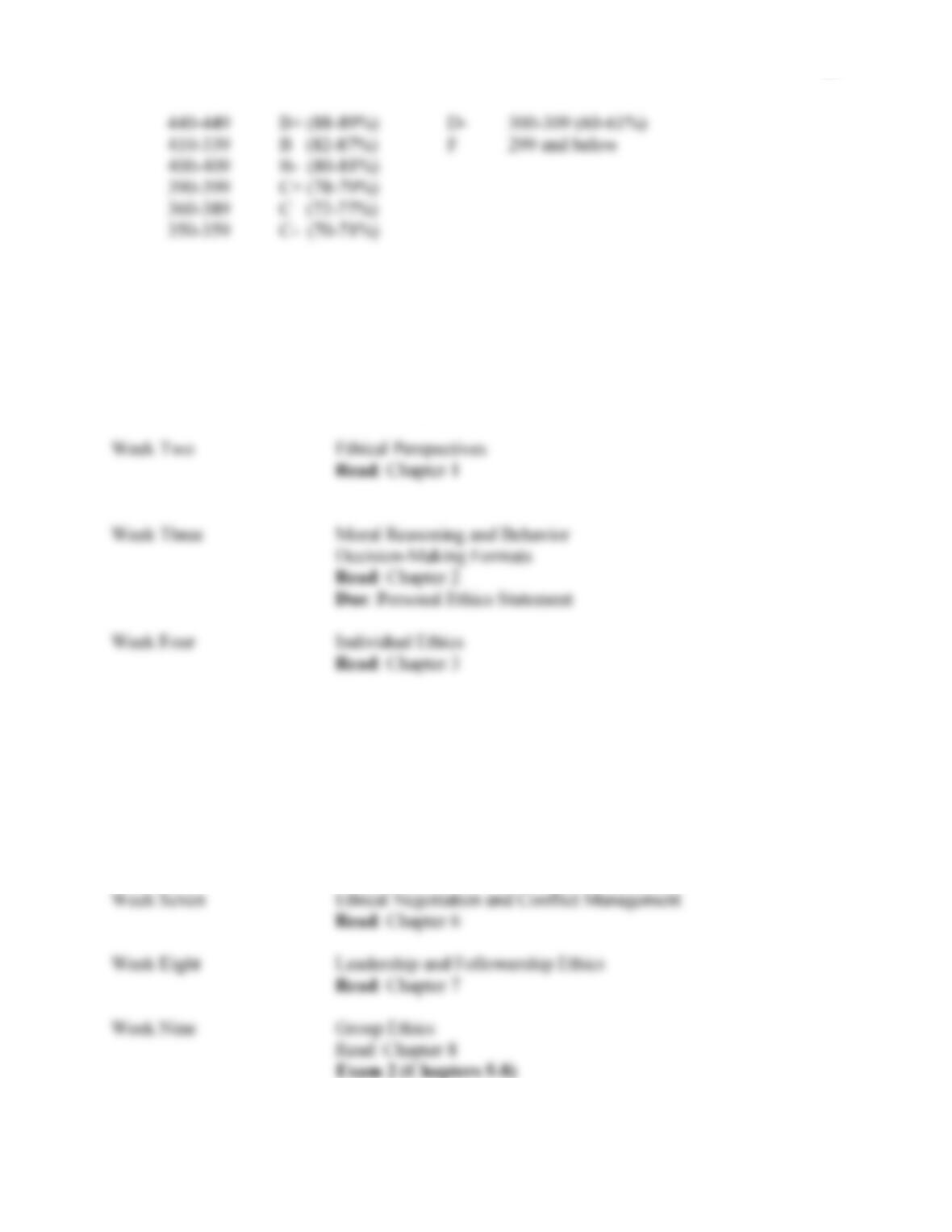
460-500 A (92-100%) D+ 340-349 (68-69%)
450-459 A- (90-91%) D 310-339 (62-67%)
14
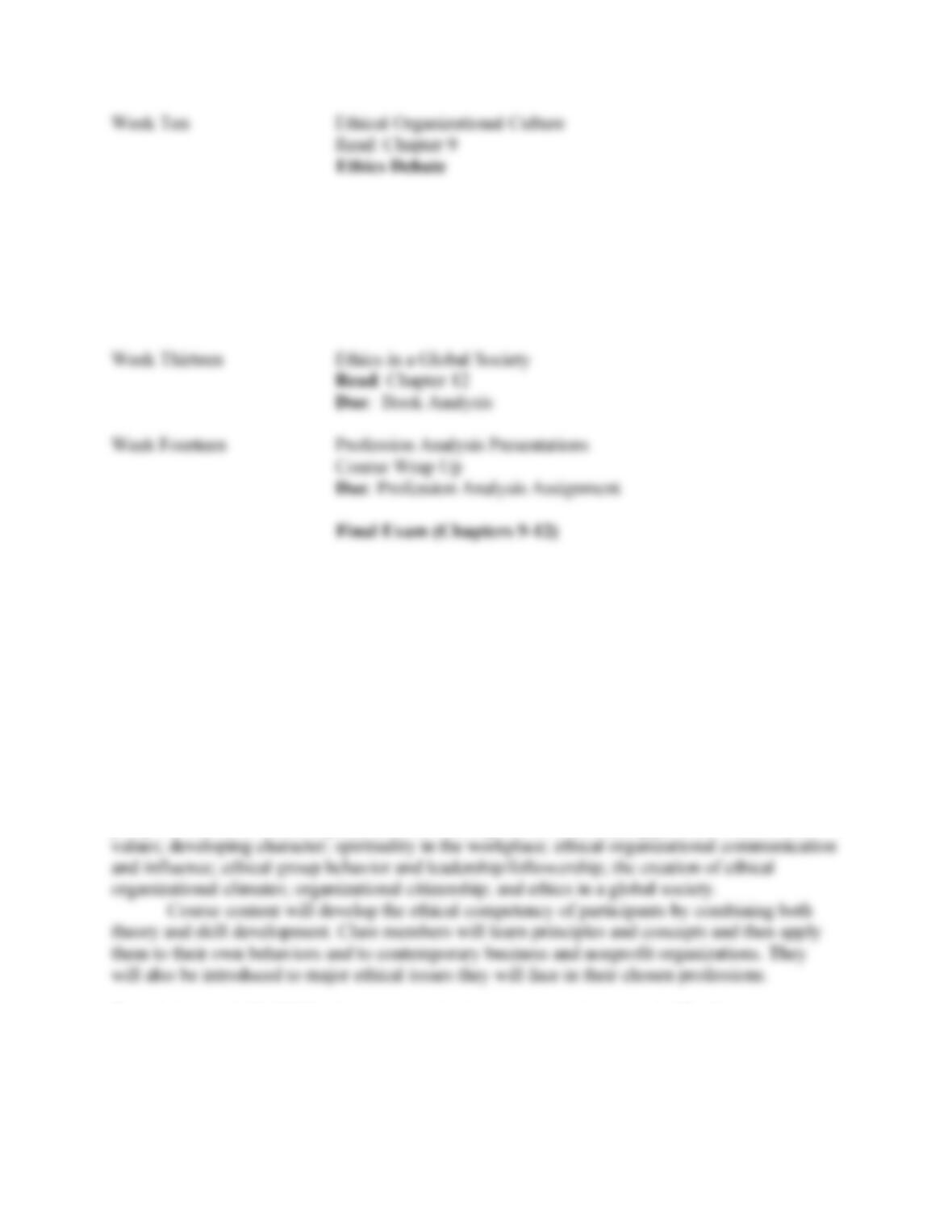
Tentative Schedule
Week One Preview of the Course
Mapping the Terrain
Read: Introduction
Chapter 1
Week Five Ethical Interpersonal Communication Skills
Read: Chapter 4
Exam 1 (Chapters 1-4)
Week Six Power
Influence Tactics
Read: Chapter 5
15
Week Eleven Ethical Hotspots: Marketing, Finance/Accounting and
Human Resource Management
Read: Chapter 10
Week Twelve Organizational Citizenship
Read: Chapter 11
Sample Syllabus: Academic Quarter
Organizational Ethics
Course Description
This course is designed to prepare students to meet the ethical challenges facing employees in
modern business and nonprofit organizations. The class will address moral issues at every
organizational level—personal, interpersonal, group and system wide. Topics include ethical
perspectives; moral reasoning and decision-making formats; identifying personal mission and
Text: Johnson, C. E. (2022). Organizational ethics: A practical approach (5th ed.).
Thousand Oaks, CA: Sage.
Course Objectives and Assessments
16
1. Students will demonstrate knowledge of ethical concepts and theories.
Assessment: multiple-choice exams
2. Students will demonstrate the abilities to recognize, understand, make and
3. Students will internalize the motivations and expectations to prepare them to act ethically
both individually and collectively.
Assessment: personal ethics statement, profession analysis, post-test
4. Students will recognize, take responsibility for, and help create positive moral
Policies
1. All paper assignments should be computer written and reflect proper spelling,
punctuation, grammar, and so on.
3. No penalty for the first two unexcused absences. The attendance portion of your grade will
decline by five points for every unexcused absence beyond two up to a maximum of 30
points.
Evaluation
Attendance 30
No penalty for the first TWO unexcused absences. Five points deducted for every
absence after that, up to 30 points.
Ethics Issue Discussion 20
You and a partner will lead a 10-minute class discussion on a contemporary ethical
organizational issue drawn from the news. To complete this assignment, you will need to
17
Individual Papers 130 points
These 6-7-page papers will ask you to engage in personal ethical reflection and
analyze a book of your choice related to one our class topics.
Exams 180
There will be a mid-term and final exam given during the course.
Group Assignments
Ethics Debate 60
Extra Credit
You can earn up to 10 points extra credit by analyzing ONE of the cases from the text
that we do NOT cover in the class. Answer the questions provided. These will be
evaluated based on the quality of your answers.
Grading Scale
460-500 A (92-100%) D+ 340-349 (68-69%)
450-459 A- (90-91%) D 310-339 (62-67%)
Tentative Schedule
18
Week One Preview of the Course
Ethical Perspectives
Read: Introduction
Chapter 1
Week Five Leadership and Followership Ethics
Read: Chapter 7
Week Six Workgroup Ethics
Read: Chapter 8
Ethics Debate
Week Seven Ethical Organizational Culture
Read: Chapter 9
Week Ten Profession Analysis Presentations
Course Wrap Up
Due: Profession Analysis Assignment
Extra Credit Analysis
Final Exam (Chapters 7-12)