Instructor Resource
Collins, Business Ethics 3e
SAGE Publishing, 2022
• Treating others with respect means understanding how other people prefer to
communicate.
• In Success Signals, Rhonda Hilyer, president and CEO of Agreement Dynamics, has
developed a very useful tool of four communication styles, each symbolized by a
DISCUSSION ACTIVITY
Have students review the four communication styles in Table 8.6, Communication Styles, and
complete the following steps.
Step 1: Ask them to determine with of the four communication styles represents (a) their own,
(b) their boss/teacher, (c) a peer, and (d) someone they struggle with a lot.
Step 2: Take a poll on each person’s communication style color (how many browns?), and the
Instructor Resource
Collins, Business Ethics 3e
SAGE Publishing, 2022
Chapter 8 QUESTIONS ANSWERED
Chapter Question 1: What are the four diversity dimensions and which ones do you most
strongly identify with?
Diversity is a complex concept. Respecting the diverse aspects of people goes beyond the factors
that fall under the purview of the EEOC.
• Diversity can be conceptualized in terms of four unique dimensions: permanent,
PERMANENT DIMENSION
• The permanent dimension refers to physical attributes or inclinations people are born
EVOLVING DIMENSION
• Evolving dimensions include age, height, weight, religion, education, physical ability,
marital status, income level, and geographic location. These can change over time.
PERSONALITY DIMENSION
• As discussed in Chapter 4, personality theorists and researchers have reached a general
ORGANIZATIONAL DIMENSION
Instructor Resource
Collins, Business Ethics 3e
SAGE Publishing, 2022
Chapter Question 2: How has ethnic and religious diversity evolved in the United States
beginning with Christopher Columbus?
COLUMBUS TO 1790
• When Christopher Columbus arrived on the shores of the Dominican Republic in 1492
the land mass eventually named the United States served as home to an estimated 10
1800s TO 2017
• Beginning 1830, the federal government welcomed more British, Germans, and French
immigrants to help settle the expanding nation.
Instructor Resource
Collins, Business Ethics 3e
SAGE Publishing, 2022
Syrians.
• The annexation of Texas, New Mexico, and Arizona added many Mexicans to the
American ethnic mosaic.
Chapter Question 3: What are the most common types of workplace discrimination and
which laws govern them?
GENDER DISCRIMINATION: Gender discrimination refers to treating an employee differently
because of his or her gender.
Instructor Resource
Collins, Business Ethics 3e
SAGE Publishing, 2022
RACE AND ETHNICITY DISCRIMINATION ISSUES: Racial and ethnic discrimination refers
to treating an employee differently because of his or her race or ethnicity.
Chapter Question 4: What are some of the best operational practices for managing
diversity?
In 1998, the EEOC Task Force published examples of the “best” diversity policies, programs,
and practices in the private sector. Integrating these best practices in diversity management
throughout organizational operations can ensure long-term continuous success.
• Diversity officer/committee/office. Assign organizational responsibility for diversity
Instructor Resource
Collins, Business Ethics 3e
SAGE Publishing, 2022
• Personnel policies. Provide flexible personnel policies reflecting the needs of diverse
populations. Areas for flexibility include the use of personal days, cafeteria-style
benefits plans, and work schedules.
• Dispute resolution mechanisms. Be receptive to diversity-related grievances and
• Performance appraisals. Link bonuses to achieving diversity goals. Include a
performance appraisal scale measuring behaviors that demonstrate respect for diverse
coworkers and customers.
• Termination and downsizing. The two best criteria for determining layoffs are job
requirements and past performance. When organizations use seniority as a layoff
Chapter Question 5: Which of the diversity workshops do you think is most meaningful
and how would you conduct it?
WORKSHOP OPTIONS
• This book section contains several diversity training exercises.
o The first four diversity exercises foster self-awareness: Who Are You, Dominant
Instructor Resource
Collins, Business Ethics 3e
SAGE Publishing, 2022
o The next two diversity exercises explore what it was like being prejudged, and how
everyone is unique, yet shares things in common with others.
CHAPTER 8 ANALYSIS FOR “WHAT WOULD YOU DO?” OPENING DILEMMA
CHAPTER 8: Sexual Harassment Advice
Summary
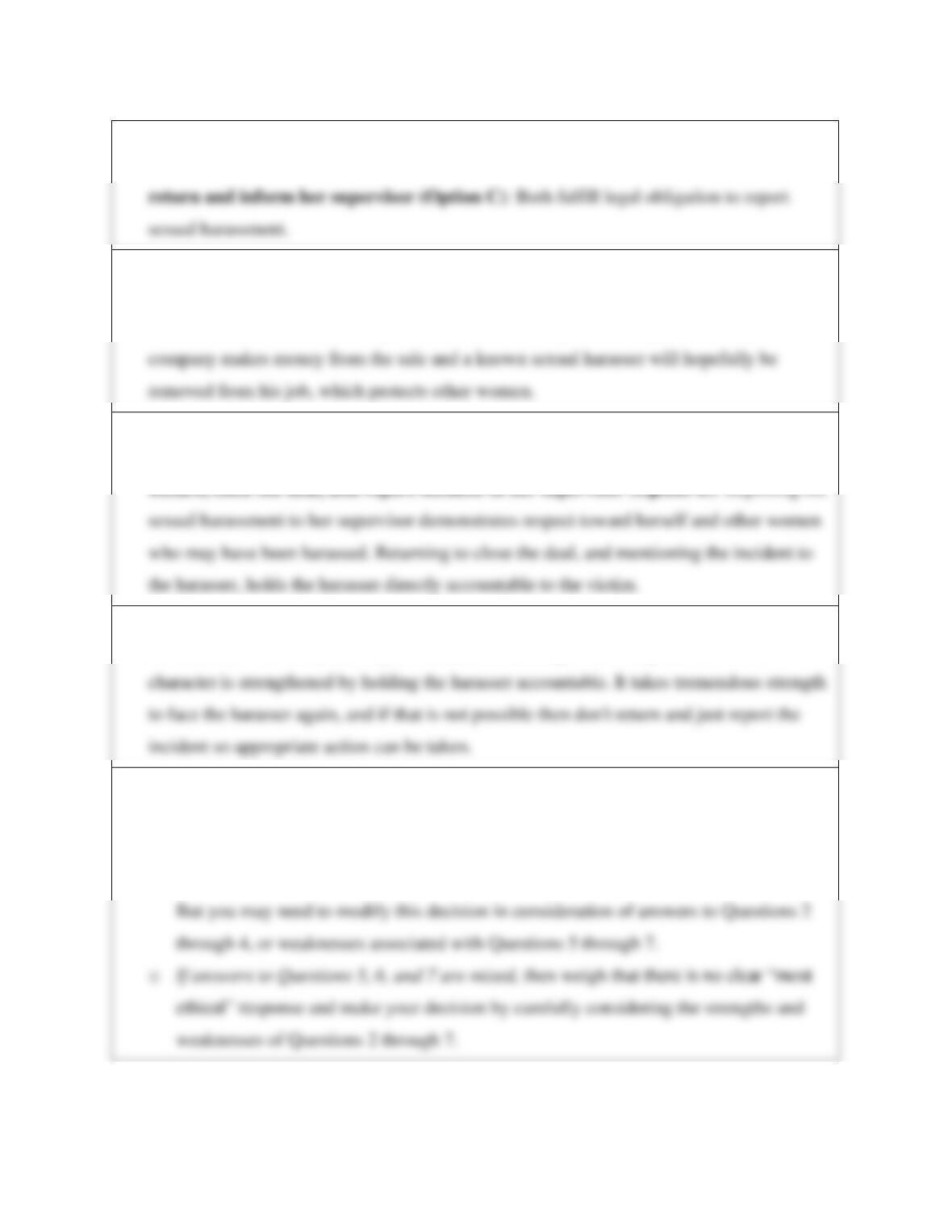
• You are a sales representative with a large advertising agency.
• Firm has assigned partners for moral support.
Table 6.3 Systematic Rational Ethical Decision-Making Process
1. Who are all the people affected by the action?
You (a sales rep), partnered sales rep being sexually harassed, your company, client firm
2. What option benefits me the most (egoism)? Why?
3. What option does my social group support (social group relativism)? Why?
Instructor Resource
Collins, Business Ethics 3e
SAGE Publishing, 2022
4. What option is legal (cultural relativism)? Why?
Return, close the deal, and report incident to her supervisor (Option B) or Don’t
5. What option is the greatest good for the greatest number of people affected
(utilitarianism)? Why?
Return, close the deal, and report incident to her supervisor (Option B): Your
6. What option is based on truthfulness and respect/integrity toward each stakeholder
(deontology)? Why?
7. What option would a virtuous person do (virtue ethics)? Why?
Return, close the deal, and report incident to her supervisor (Option B): Moral
Note
• If answers to Questions 2 through 7 are all the same option, then do that option.
• If answers to Questions 2 through 7 are mixed, then:
o If answers to Questions 5, 6, and 7 are the same option, this option is the most ethical.
Instructor Resource
Collins, Business Ethics 3e
SAGE Publishing, 2022
Option
Option Strengths Based on
Application of Ethical Theories
Option Weaknesses Based on
Application of Ethical Theories
A: Return, close the
deal, and say
nothing about the
sexual harassment.
This holds minimum
complications.
Option doesn’t result in legal
issues.
Silence is the most common
response.
Sexual harasser is not held
accountable.
Silence puts other women at threat.
D: Other?
Option Chosen
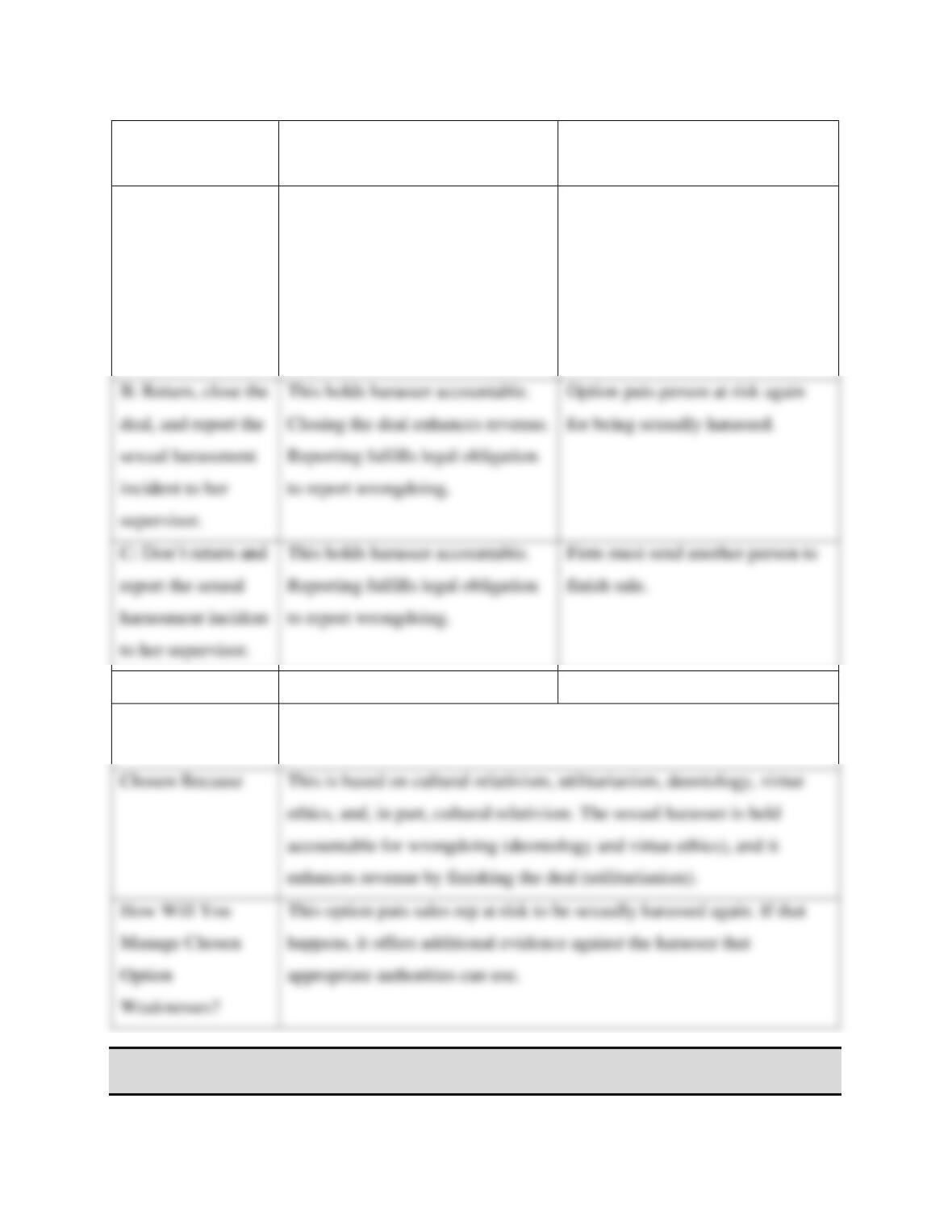
Option B: Return, close the deal, and report the sexual harassment
incident to her supervisor.
Chosen Because
This is based on cultural relativism, utilitarianism, deontology, virtue
accountable for wrongdoing (deontology and virtue ethics), and it
enhances revenue by finishing the deal (utilitarianism).
How Will You
Option
This option puts sales rep at risk to be sexually harassed again. If that
appropriate authorities can use.
CHAPTER 8 ANALYSIS FOR UP FOR DEBATE
supervisor.
Instructor Resource
Collins, Business Ethics 3e
SAGE Publishing, 2022
Up for Debate: Affirmative Action
Affirmative action programs reflect formal efforts by organizations to improve employment
opportunities for qualified members of groups that have been historically discriminated against
due to their race, such as African Americans, or gender. Some people maintain that affirmative
action programs are necessary to overcome historical hiring and promotion biases, such as the
Up for Debate: Affirmative Action—Are affirmative action programs ethical?
Yes
• Affirmative action plans help qualified
members of previously discriminated
groups (social group relativism,
deontology).
• Affirmative action programs are
No
• Affirmative action is a form of reverse
discrimination against Caucasian
males (social group relativism,
utilitarianism, deontology).
• The idea of a meritocracy is destroyed
Instructor Resource
Collins, Business Ethics 3e
SAGE Publishing, 2022
advancing (social group relativism,
utilitarianism).
• Programs promotes equality for all
• True minority achievement is
demeaned (deontology).
• It can be condescending to minorities