Chapter 6: Marketing and Operations
Sample Discussion Answers
1. What is marketing with and without ethics? Why do many people see ethics and
marketing as in tension? (p. 166)
Marketing without ethics is associated with the kind of thinking that emerges when one
considers only short-term profits for shareholders and follows marketing trends without
considering their consequences on other stakeholders. It tends to coincide with a belief
that marketing is amoral and exempt from any standards of ethics.
For those who imagine marketing with ethics, it seems silly to separate the two. Business
serves to fulfill stakeholder wants and needs, particularly (in this chapter) to create value
for consumers. As we have argued throughout the text, business has ethical content
through and through, and marketing is no exception. The question is only what
2. As you think about STP, what are some of the central ethical questions that
emerge for you? (p. 167)
Individual students reading through this section each may find themselves asking
different questions. Some of the central questions they might touch on may concern
questions of content, moral questions concerning the method of segmentation, and
questions concerning the social consequences of STP.
3. How should ethics play a role in shaping marketing strategy? Why? (p. 171)
Many transactions that seem like they should be straightforward procedures in marketing
do invariably encounter ethical issues. A company’s ability to act ethically in the long
4. What are operations with and without ethics? How different are they? (p. 173)
It should be fairly easy to imagine operations without ethics: grinding employees like
cogs in a machine until all vestiges of job satisfaction and love for the company are worn
away, treating suppliers like potential rivals to be beaten down should they threaten the
5. How does ethics relate to the core elements of operations? (p. 174)
The way a manager runs operational tasks carries with it implicit assumptions about
business ethics. Throughout the book, we have seen the reoccurring theme of a
shareholder-derived view of business and the stakeholder view of business. The last
For example, when the company seeks to measurement consumer tastes, will it conduct
its tests in a manner that respects the consumer? Will the company view its employees as
6. How does ethics relate to the supply chain and many of the challenges posed there
for companies? What kind of practical guidance would you offer managers of
operations? (p. 179)
This question is intended to elicit student responses about operations and their own take
on the material of the chapter.
In terms of the chapter material, there is an emphasis on seeing the human dimension to
supply chain issues, particularly the role for stakeholder relationships and the value
proposition of the firm. Maintaining good relations with workers and supply chain
Fingerhut’s Pricing Strategy
Teaching Notes
Synopsis
Jane Johnson is director of Communications at Fingerhut Company. The firm, based in
Minnetonka, Minnesota, is a direct marketing company that sells consumer goods –
clothing, housewares, furniture, electronics, appliances, and more – through an array of
specially targeted catalogs. In November of 1996, an unfavorable article appeared in the
Star Tribune, a major Minneapolis newspaper. The story drew attention to a class action
lawsuit pending against Fingerhut that suggests the firm made its profits by exploiting the
poor. Several civil rights groups rallied around the suit and submitted amicus curiae in
favor of the litigation.
Johnson believes that Fingerhut’s pricing strategy offers customers and affordable method
of obtaining valued consumer goods on credit. She recognizes that the lawsuit and its
related publicity could damage Fingerhut’s image as an ethical, socially conscious
company. The firm’s CEO was renowned for his philanthropy and environmental
awareness. Yet the lawsuit portrays Fingerhut as a predatory company that used unfair
and deceptive marketing techniques. Although the company’s advertizing and credit
policies might be legal, are they moral?
Objectives
Was Fingerhut Company engaging in unethical marketing? Or were they providing a key
service to economically disadvantaged citizens that they highly valued and no one else
would offer? The discussion of this case will require the class to investigate a variety of
issues including those related to:
Questions for Discussion
1. Was Fingerhut’s marketing strategy unethical? Why or why not?
3. What are the arguments for and against, or the strengths and weaknesses of the
framework you used to answer the last question?
4. Fingerhut’s practices have been condemned. Yet the Grameen Bank (which extends
microloans in developing countries), despite also having high interest rates, has been
praised. What accounts for this discrepancy?
Suggested Lesson Plan (85 minutes)
1. Question 1 (5 minutes): With a show of hands, ask the students to indicate
2. Question 1 continued (20 minutes): Discuss with the students why they think
Fingerhut’s policy was unethical or not unethical.
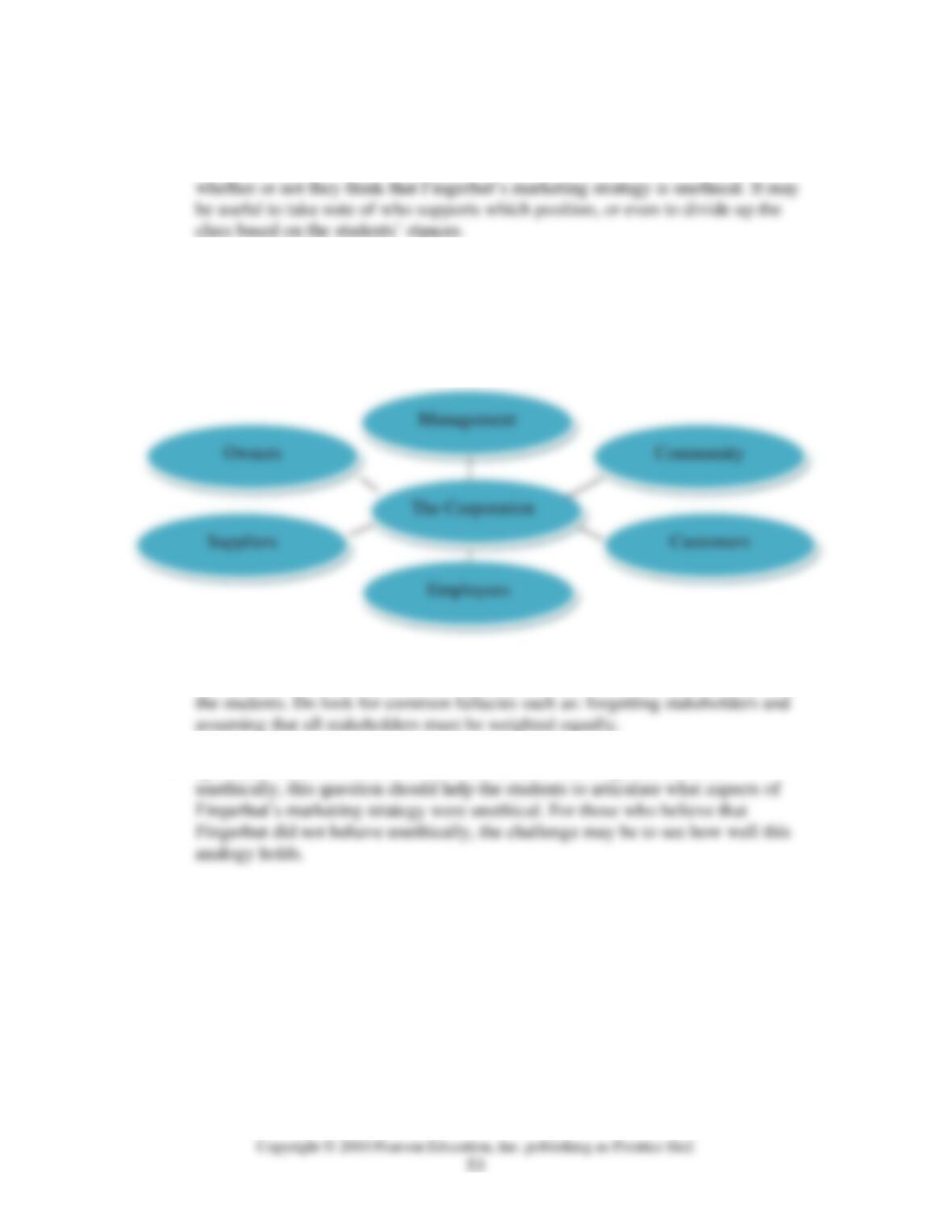
3. Question 2 (20 minutes): It may be useful to try to draw this out as a diagram. For
example, we could start off with something like this:
4. Question 3 (20 minutes): Answers will depend on the frameworks developed by
5. Question 4 (20 minutes) For those who believe that Fingerhut behaved
Wal-Mart in 2005
Teaching Notes
Synopsis
By 2005, Wal-Mart had become the largest employer in the U.S. and the largest
corporation in the world. Its achievements in efficiency and cutting prices were
legendary. Overall, the company was hailed as an innovator and widely admired for its
success. At the same time, the end of the 20th century also saw a rise in Anti-Wal-Mart
sentiment. The company, fairly and unfairly, became associated with all that Americans
despised about large corporations. It was accused of paying employees wages that were
too low, of suppressing unions, of outsourcing jobs, employing sweatshop and child
labor, destroying mom and pop shops and local economies, giving insufficient benefits,
not compensating employees for overtime, and participating in sexual and racial
discrimination. How did Wal-Mart gain such a reputation and what can it do to combat
the negative publicity?
Objectives
Wal-Mart’s publicity woes present us with an opportunity to evaluate several kinds of
Questions for Discussion
1. How has Wal-Mart been so successful? What has it done well?
2. What problems face Wal-Mart? Are the criticisms of Wal-Mart fair? Would Wal-Mart
have received this kind of attention if it were a much smaller company?
3. Do you feel that Wal-Mart changed after the death of Sam Walton? If so, in what ways
has it changed?
4. If you were made CEO of Wal-Mart, what changes would you make? Where would
you start in trying to “fix” Wal-Mart? Why?
5. How would you handle the company’s negative public relations? What does it need to
do differently on this front?
Suggested Lesson Plan (85 minutes)
1. Class Poll (5 minutes): Ask for a show of hands to see how many students love or
2. Question 1 (15 minutes): There must be reasons behind Wal-Mart’s success
despite its bad P.R. Have students consider what aspects of Wal-Mart’s marketing
3. Question 2 (25 minutes): This can potentially be a long discussion. The issues
mentioned in this chapter include:
Low Wages
Wal-Mart pays low wages and employs almost 2 million people. It could certainly
increase wages, but after some point, that would likely result in Wal-Mart having
to fire workers. So the choice that is presented to workers is one of having low-
paying jobs or having no jobs at all. We now have to ask which stakeholders are
being presented with that choice and what they would chose to do in this
situation. A useful example for a country that has chosen the second option is
Effect on Economy and Social Programs
Some argue that Wal-Mart, because it does not pay its employees enough, drives
them to drain welfare, Medicare, and other public services. This argument
assumes that Wal-Mart made its employees poor. We can consider two
explanations for this: 1) because Wal-Mart pays low wages, it makes its
employees poor, and 2) because Wal-Mart causes its competitors to go out of
business, those who have lost employment become poor and in need of social
services. We will examine the first explanation here and the second one in the
next paragraph. First, is it that case that Wal-Mart makes its employees poor, or
do poor people tend to seek employment at Wal-Mart? If the former is true, then
one should be concerned for those almost 2 million employees. However, if the
latter is true, then Wal-Mart is actually helping to take people out of poverty,
rather than causing it. The real question is whether or not those people would be
better of if there were no Wal-Mart in their community. Would the absence of
Wal-Mart mean that there would be more higher paying jobs and less
unemployment, or would it mean higher unemployment and reduced real
discretionary incomes (from higher prices)?
Mom and Pop Shops
Wal-Mart has been accused of causing smaller mom and pop shops to go out of
business. While it does appear to be the case that some small shops went out of
business upon the arrival of Wal-Mart, some shops have actually benefited from
Outsourcing
Some contend that Wal-Mart, in its attempts to lower costs, has forced suppliers
to move operations overseas. It is not certain how much of a role Wal-Mart in
particular played in the decision of companies to relocate overseas. Regardless,
Sweatshop Labor and Child Labor
Perhaps one of the most evocative criticisms of Wal-Mart has been its association
Poor Health Benefits
It is interesting to see this criticism because it seems to be a uniquely American
Contributing to sprawl
Poor Treatment of Employees
Fighting against Unionization
Whereas accusations that Wal-Mart’s low wages are tearing down the middle
class are probably fallacious, there may be some merit to the accusation that Wal-
4. Question 3 (10 minutes): Is there a difference between the old Wal-Mart and the
Wal-Mart post Walton? Students could point to policies, such as profit-sharing, as
5. Question 4 (15 minutes): Responses to this question are limited only by the
creativity of the students. The previous questions should have helped students to
be?
6. Question 5 (15 minutes): It may be useful to remind students that there is no
guarantee that public opinion will improve even if one resolves all of the