
Instructor Resource
Collins, Business Ethics 3e
SAGE Publishing, 2022
o Value chain social impacts that significantly affect a company’s activities in the
DISCUSSION ACTIVITY
Have students determine an optimal community organization partner that would benefit both the
nonprofit and their employer (or business school at the university).
Who was their chosen recipient? Why?
Next, form a three-person small group and have students discuss their answers. If all students are
doing this for the college or university, have the small group reach consensus on one recipient.
Then present the group’s chosen recipient with the entire class.
COMMUNITY INVOLVEMENT MANAGEMENT PROCESS AND EMPLOYEE TRAINING
BENEFITS
• Similar to ethics, corporate citizenship endeavors can be incorporated as part of the
company’s vision and mission rather than as an afterthought done to please local
Instructor Resource
Collins, Business Ethics 3e
SAGE Publishing, 2022
o Companies become innovative by brainstorming solutions, planning programs,
and developing metrics that measure impacts.
o Next, organizations create coherence among their initiatives by integrating them
under a common theme which enables the company to brand its efforts.
WORK–LIFE BALANCE
• Americans work many hours a week, and 25 percent more hours annually compared
with their European counterparts, amounting to 258 hours of work per year
DISCUSSION ACTIVITY
Instructor Resource
Collins, Business Ethics 3e
SAGE Publishing, 2022
The World Happiness Report 2017 assesses 155 countries using a 1 to 10 scale that measures
national happiness. Norway (7.53) has the highest score and Central African Republic (2.69) has
the lowest score. The United States is ranked 14th (6.99).
Ask students: Why is the United States ranked only 14th? In small groups, discuss if you agree
with this assessment and why, or why not?
• Similarities exist between the World Happiness Report correlation factors and
Aristotle’s conceptualization of happiness.
DISCUSSION ACTIVITY
Have students complete Survey 13.1, Aristotle Happiness Survey, for themselves and their
employer.
In small groups, share their scores and strategies for improving their own, and their
organization’s, lowest scored item.
• The developmental psychologist Erik Erikson complemented Aristotle’s conception
DISCUSSION ACTIVITY
Instructor Resource
Collins, Business Ethics 3e
SAGE Publishing, 2022
Work–life balance advocates maintain that every workday should consist of 8 hours of work, 8
hours of personal/family/community (“play”) time, and 8 hours of sleep. Ask students the
following questions:
CHAPTER QUESTION 6: WHAT ARE THE DIFFERENT PHASES OF ISSUES-
DRIVEN MULTI-STAKEHOLDER DIALOGUE?
MULTIPLE STAKEHOLDER DEMANDS
• It is very challenging for managers to respond appropriately to multiple stakeholders
making simultaneous demands. All stakeholders matter. But from a practical
• Secondary stakeholders are those who indirectly affect or are affected by the
company’s activities, such as community members, nonprofits, the media, and the
government.
• Key Stakeholder Attributes, categorizes stakeholders and issues based on three
Instructor Resource
Collins, Business Ethics 3e
SAGE Publishing, 2022
STAKEHOLDER DIALOGUES
• Companies can pursue three different strategies for managing stakeholders: reactive,
proactive, or interactive. Managers can:
o Wait for problems to arise (reactive).
• The most difficult, yet possibly the most meaningful, approach is interactive dialogue
with stakeholder groups.
• To begin this process, managers must reach an understanding that unilateral decision
making, which excludes stakeholder input and dialogue, can generate more intense
Instructor Resource
Collins, Business Ethics 3e
SAGE Publishing, 2022
problem. At this point, some stakeholders may disengage from further
deliberations because important demands are not being addressed.
o Implementation phase: This phase begins by recognizing that every stakeholder,
including the business, may have sacrificed something in reaching the agreement.
The channels of communication must remain open to ensure commitments are
upheld.
fair, and be held accountable for ensuring that the dialogue succeeds.
COMMUNITY REPUTATION ASSESSMENT
• It is important to assess key constituents to ensure a key intended benefit of
community involvement—a better reputation— is being accomplished.
• The Council on Foundations has created a Corporate Philanthropy Index (CPI) for
SOCIAL PERFORMANCE REPORTING
Instructor Resource
Collins, Business Ethics 3e
SAGE Publishing, 2022
• A company can also demonstrate respect for the community by being transparent
about its operations and impacts.
• In 2018, 86 percent of Standard & Poor’s 500 companies reported on their economic,
environmental, social, and governance performance.
DISCUSSION ACTIVITY
Have students, or a team of students, explore the following social reporting websites, summarize
what they like and don’t like about one social report, and share answers in small groups or with
the entire class.
1. Global Reporting Initiative reports, available at http://database.globalreporting.org/
2. Ben & Jerry’s, Social Environmental Assessment Reports, available at

Instructor Resource
Collins, Business Ethics 3e
SAGE Publishing, 2022
Instructor Resource
Collins, Business Ethics 3e
SAGE Publishing, 2022
Chapter 13 QUESTIONS ANSWERED
Chapter Question 1: Describe three primary ethical risks associated with conducting
international business.
• Political and regulatory norms, particularly in host nations that have unstable and
frequently changing governments.
Chapter Question 2: What is the intent and content of the United Nations Global
Compact?
• The compact aims to eliminate double standards, where companies adopted one set of
UNITED NATIONS GLOBAL COMPACT PRINCIPLES
• The United Nations (UN) has developed guiding principles for conducting business
anywhere in the world.
Instructor Resource
Collins, Business Ethics 3e
SAGE Publishing, 2022
Chapter Question 3: What are the competitive advantages of community involvement?
• Table 13.1, Company Benefits From Community Outreach, helps show how a
company’s reputation as a good citizen favorably impacts employee, customer,
community, and investor relations in the following ways:
o Benefits to employee relations
▪ Attracts and retains employees
o Benefits to community relations
▪ Recognition as a responsible neighbor of choice
▪ Community goodwill and support
NETWORKING: Community involvement provides many opportunities for networking with
other businesses and community leaders.
Chapter Question 4: What are three different types of business opportunities to address
poverty?
Instructor Resource
Collins, Business Ethics 3e
SAGE Publishing, 2022
1. Price floor: Buyers guarantee a reasonable minimum price for the product (e.g., $1.40 per
pound or the market price, whichever is higher).
2. Institutional structure: Producers are encouraged to join cooperatives.
Social Entrepreneurship
• Social entrepreneurship—entrepreneurs with a social mission—is another way that
business people can contribute their skills.
Bottom of the Pyramid
• Provide partnerships and opportunities for those in poverty
Chapter Question 5: How would you administer a highly effective community involvement
process?
• An integrative approach that involves all three approaches situates a company as a
community leader and enhances employee satisfaction. Managers can:
1. Reactively give on a first-come first-serve basis.
Instructor Resource
Collins, Business Ethics 3e
SAGE Publishing, 2022
• Approaches to community involvement
o Give money, products, skills, job opportunities.
Chapter Question 6: What are the different phases of issues-driven multi-stakeholder
dialogue?
• Julia Roloff highlights phases of issues-driven multi-stakeholder dialogues.
o Initiation phase: Representatives include prominent stakeholders; independent
third-party facilitator accepted by both sides of issue.
o Implementation phase: This phase begins by recognizing that every stakeholder,
including the business, may have sacrificed something in reaching the agreement.
The channels of communication must remain open to ensure commitments are
upheld.
Instructor Resource
Collins, Business Ethics 3e
SAGE Publishing, 2022
CHAPTER 13 ANALYSIS FOR “WHAT WOULD YOU DO?” OPENING DILEMMA
CHAPTER 13: International Arrangements
Summary
• You are a manager at a growing small food company and is assigned to manage the
company’s account in Kenya.
• You mentioned to the Kenyan agency that you cannot approve of these methods, but the
agent replies that everyone in Kenya pays bribes as a way of business. The agent tells
that, if you terminate the contract, you will lose business in Kenya and he will report
previous bribes paid by your company to the U.S. authority.
• You mentioned your ethical concerns to your company’s co-founders and it’s clear they
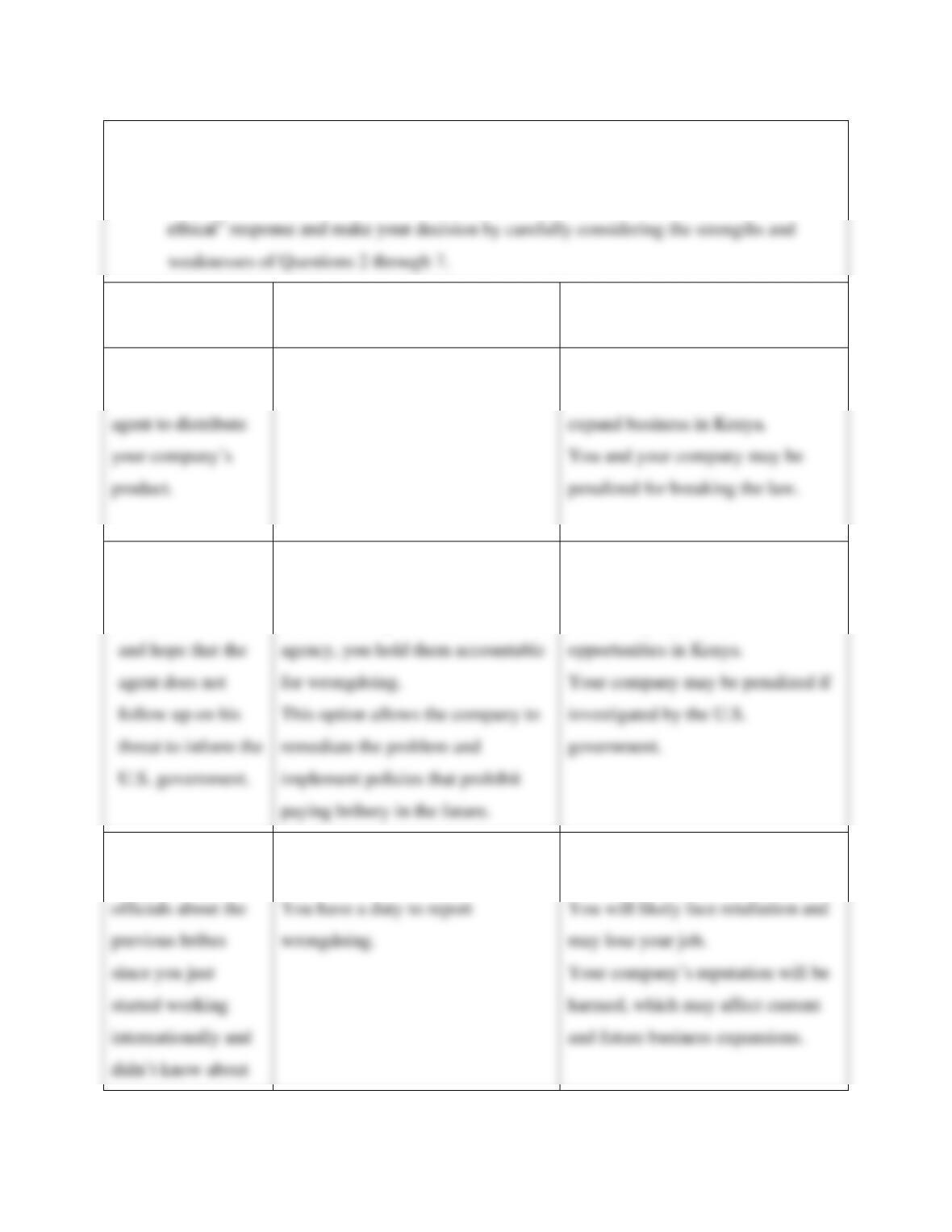
Table 6.3 “Systematic Rational Ethical Decision-Making Process”
1. Who are all the people affected by the action?
2. What option benefits me the most (egoism)? Why?
Instructor Resource
Collins, Business Ethics 3e
SAGE Publishing, 2022
Continue to contract with the agent (Option A): This option avoids trouble and allows you
3. What option does my social group support (social group relativism)? Why?
Mixed: Some managers may argue that paying bribery in certain countries is a common
4. What option is legal (cultural relativism)? Why?
Both: Terminate the contract (Option B) and inform U.S. government officials about the
5. What option is the greatest good for the greatest number of people affected
(utilitarianism)? Why?
6. What option is based on truthfulness and respect/integrity toward each stakeholder
(deontology)? Why?
Terminate the contract (Option B): This option complies with the FCPA and avoids legal
7. What option would a virtuous person do (virtue ethics)? Why?
Terminate the contract (Option B): Moral character is strengthened by complying with
Note
• If answers to Questions 2 through 7 are all the same option, then do that option.
Instructor Resource
Collins, Business Ethics 3e
SAGE Publishing, 2022
But you may need to modify this decision in consideration of answers to Questions 2
through 4, or weaknesses associated with Questions 5 through 7.
o If answers to Questions 5, 6, and 7 are mixed, then weigh that there is no clear “most
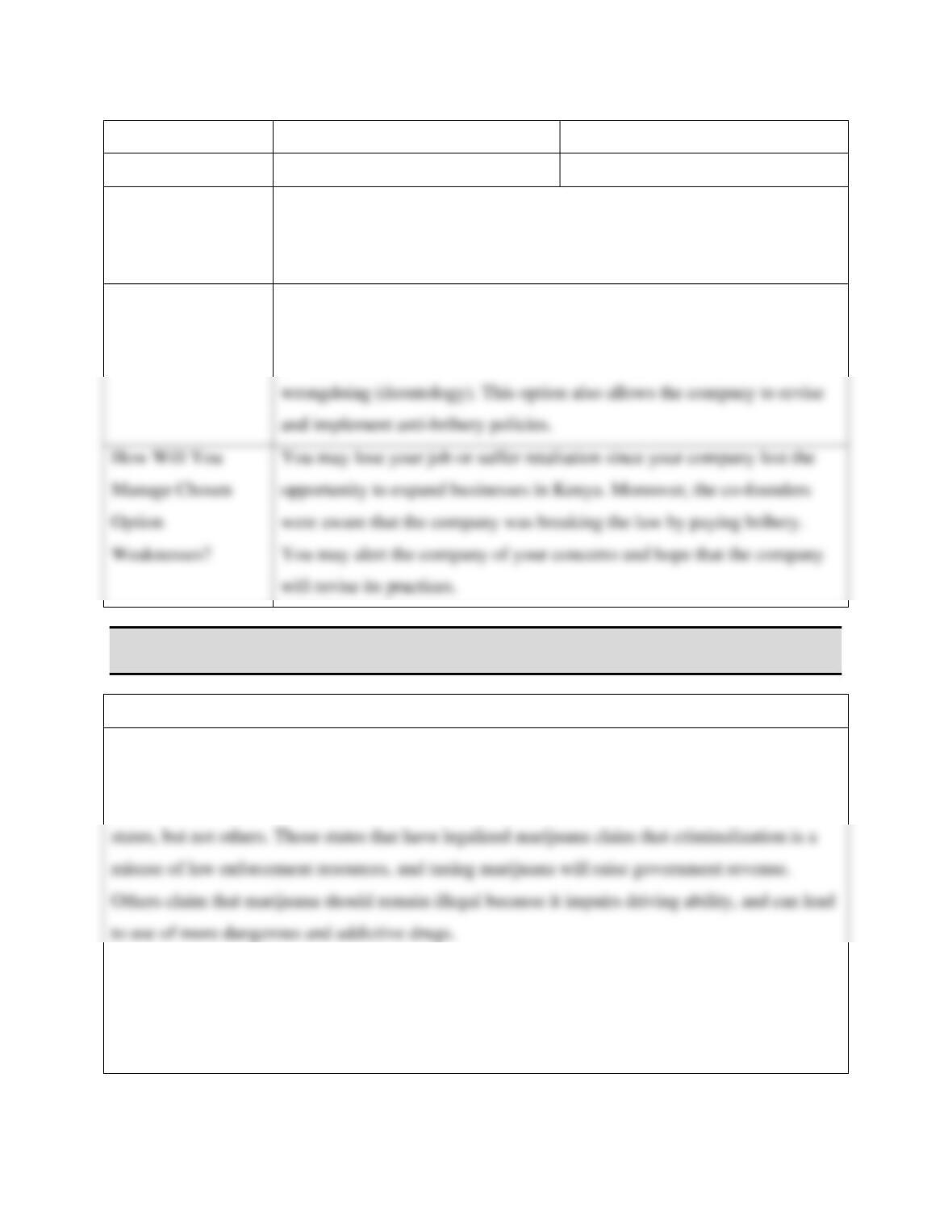
Option
Option Strengths Based on
Application of Ethical Theories
Option Weaknesses Based on
Application of Ethical Theories
A: Continue to
contract with the
This option avoids trouble and
allows you to continue work.
This option implies that the agent
will continue to pay briberies to
B: Terminate the
contract, lose the
Kenyan business,
Paying bribery directly or through
intermediaries is illegal.
By terminating the contract with the
You may lose your job or suffer
retaliation.
Your company will lose business
C: Inform the U.S.
government
Paying bribery directly or through
intermediaries is illegal.
You show lack of consideration to
the co-founders of the company.
Instructor Resource
Collins, Business Ethics 3e
SAGE Publishing, 2022
it.
C: Other?
Option Chosen
Terminate the contract, lose the Kenyan business, and hope that the agent
does not follow up on his threat to inform the U.S. government (Option
B).
Chosen Because
This option is based on cultural relativism, deontology, and virtue ethics.
By terminating the contract with the agency, you avoid breaking the law
in the future (cultural relativism) and hold the agent accountable for
CHAPTER 13 ANALYSIS FOR UP FOR DEBATE
Up for Debate: Legalizing Marijuana
Marijuana is a psychoactive recreational drug that creates a sense of euphoria when smoked or
digested. According to a 2015 Pew Research Center survey, 49 percent of Americans had tried
marijuana, and 12 percent had used it during the past year. Marijuana use is legal in several
Critical Thinking Questions
1. Should the federal government legalize marijuana?
will revise its practices.
Instructor Resource
Collins, Business Ethics 3e
SAGE Publishing, 2022
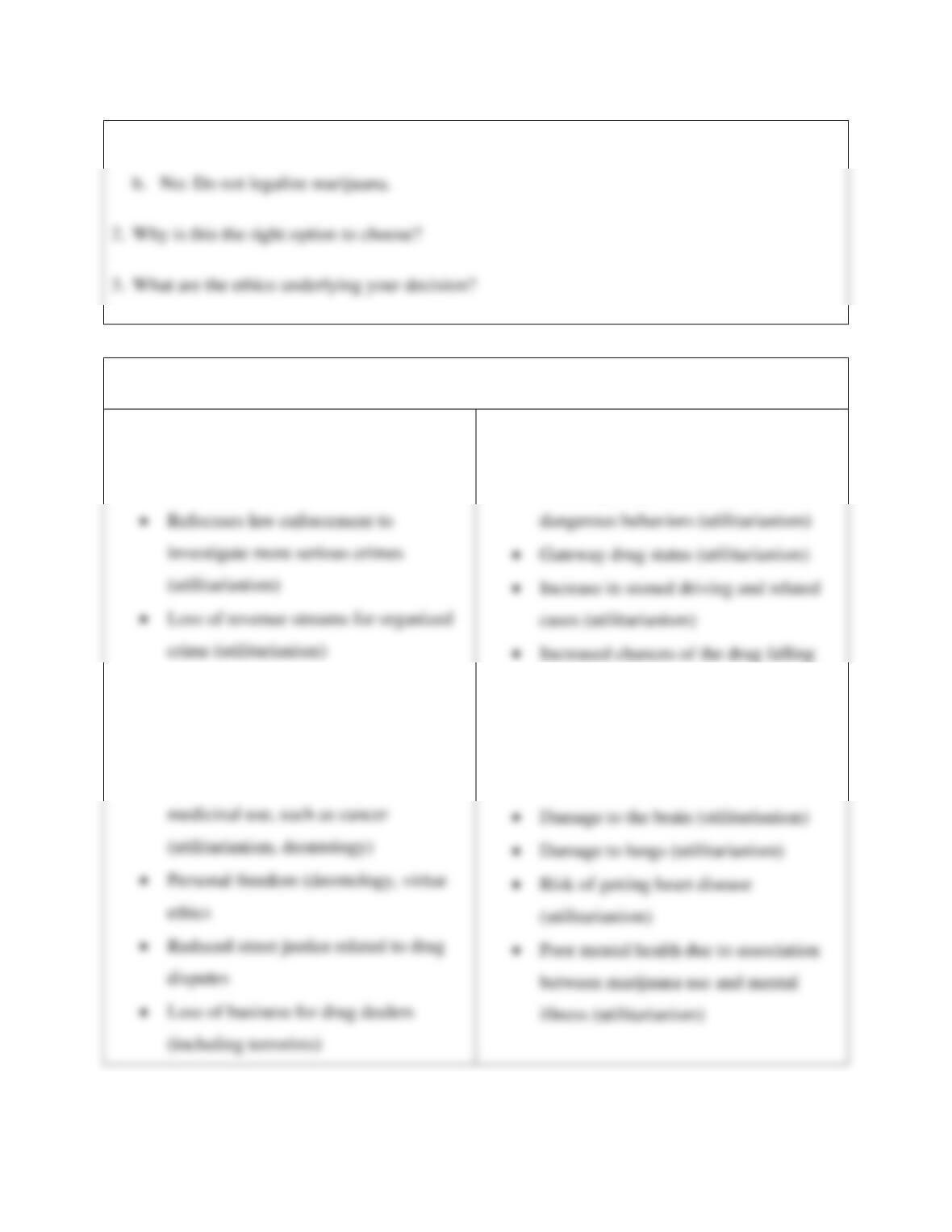
a. Yes: Legalize marijuana.
Up for Debate: Legalizing Marijuana—Should the federal government legalize marijuana?
Yes
• Increase in tax revenue for government
(utilitarianism)
• More safety controls since product
comes under government regulatory
bodies (utilitarianism)
• Wider access, and easier to obtain, for
No
• Addictive nature (utilitarianism)
• Altered perceptions can lead to more
into the hands of children
(utilitarianism)
• Danger of second-hand smoke to
bystanders (utilitarianism)

Instructor Resource
Collins, Business Ethics 3e
SAGE Publishing, 2022
i Kaveh, “Corporate Social Responsibility,” available at