Instructor Resource
Collins, Business Ethics 3e
SAGE Publishing, 2022
goals in alignment with organizational objectives, are appropriately
rewarded.
o Design performance appraisals, and gather relevant data, that address four
prominent ethical performance issues:
UNETHICAL BEHAVIORS
• The seven-item survey in Survey 9.2, Practicing Unethical Behaviors Survey, highlights
unethical behaviors that might publicly embarrass an employee. Modify the items to fit
LIVING UP TO THE CODE OF ETHICS PERFORMANCE APPRAISALS
• Annually appraise how well employees perform according to the organization’s code of
ethics.
• Appraise employee performance for all ethics-based initiatives. These items can be added
IDEAL EMPLOYEE ATTITUDES AND BEHAVIORS PERFORMANCE APPRAISALS
Instructor Resource
Collins, Business Ethics 3e
SAGE Publishing, 2022
• Employee performance appraisals can be used to benchmark the distance an employee
still needs to travel in the direction of becoming an ideal employee.
DISCUSSION ACTIVITY
Have students complete the “Ideal Employee Performance Appraisal” in Survey 10.2 as a self-
assessment for a work experience, college, school of business, or student organization. Ask the
COLLECTION AND EVALUATION ISSUES
• How employee performance appraisal information is collected and evaluated raises
ethical issues.
• Poorly managed performance appraisals are detrimental to employee development,
• Fairness dictates that employees receive evaluation scores that are related to their actual
job performance.
o Some managers give poor performers average ratings to avoid difficult discussions
Instructor Resource
Collins, Business Ethics 3e
SAGE Publishing, 2022
o The phrase 360 degrees refers to a circle with the person being evaluated in the
• Employees can be rated in comparison to an absolute standard of performance or ranked
in comparison to each other.
o A rating system is more ethical than a ranking system in that an employee earns a
o Some executives (Jack Welch when CEO of General Electric) prefer a ranking system
because it forces managers to determine which employees are the top performers and
DISCUSSION ACTIVITY
Have students discuss/debate the following: If you were a professor, would you evaluate students
PERFORMANCE APPRAISAL FEEDBACK
• The purpose of a performance appraisal feedback session is to praise an employee’s good
behaviors and accomplishments and develop strategies for improving weaknesses.
Instructor Resource
Collins, Business Ethics 3e
SAGE Publishing, 2022
o On a regular basis, provide positive feedback immediately after a praiseworthy
behavior and constructive feedback immediately after a blameworthy behavior.
o Prior to the meeting, compare the employee’s self-assessment with the 360-degree
performance appraisal results.
▪ First, begin the meeting by discussing areas that both the employee and the raters
DISCUSSION ACTIVITY
Have students list the behaviors of an ideal student in terms of class participation. Use this list
for the following activity.
Put students in pairs and have them assess their own class participation and that of their partner
using the list generated in class. Have one of the paired students role play the boss, and the other
CHAPTER QUESTION 6: HOW WOULD YOU COACH TO DISCIPLINE AND
FORGIVE EMPLOYEES WHO HAVE BEHAVED UNETHICALLY?
DISCIPLING ETHICAL VIOLATIONS
Instructor Resource
Collins, Business Ethics 3e
SAGE Publishing, 2022
• Ethical leadership does not mean never disciplining or firing anyone. Poor performers
who fail to improve need to be dismissed for the benefit of the work unit and
organization, and sometimes downsizing is unavoidable.
MAJOR INFRACTIONS
• Employees define major and minor ethical infractions based on the type of punishment
determined by managers.
• Any behavior punished harshly is typically considered a major infraction and gets the
attention of employees. Employee theft and drug and alcohol violations are usually
MINOR INFRACTIONS
• Many workplace violations are relatively minor, such as being late for work or playing
solitaire on the computer during work time.
Instructor Resource
Collins, Business Ethics 3e
SAGE Publishing, 2022
• The following is a continuum of potential punishments, beginning with the most lenient
and ending with the harshest, for managing workplace violations.
1. Talk to, and coach, the employee about the problem.
2. Give an oral warning.
3. Issue a written warning.
• The severity of the violation dictates where on the continuum to begin.
• The goal of discipline is to rehabilitate employees who violate work rules, not to fire
them.
• Guilty parties need to acknowledge the wrongdoing, apologize, and then change
behavior.
DISCUSSION ACTIVITY
Have students think of a time when they were punished by a boss, teacher, parent, or some other
authority person. What was the situation? Was the punishment appropriate? Why? If the student
was the person in authority, how would he or she have managed the situation?
FORGIVING UNETHICAL EMPLOYEES
• Violated trust between and among managers and employees needs to be repaired.
Instructor Resource
Collins, Business Ethics 3e
SAGE Publishing, 2022
FORGIVENESS PROCESS
• Robert Enright of the International Forgiveness Institute defines forgiveness as a gift
• Enright offers a four-phase model that ethical managers can apply to guide employees
through the forgiveness process. The process begins with personal awareness of the
negative impacts stemming from the harm-generating behavior.
o Phase 1: Uncovering phase. The violated person recognizes that the unjust situation
has created unhealthy anger and emotional pain.
DISCUSSION ACTIVITY
Instructor Resource
Collins, Business Ethics 3e
SAGE Publishing, 2022
Have students respond to the following:
The greatest injustice (harm) done to you occurred
Instructor Resource
Collins, Business Ethics 3e
SAGE Publishing, 2022
Chapter 10 QUESTIONS ANSWERED
Chapter Question 1: What are the five sources of power available to managers?
EXERCISE OF POWER
• Power refers to the ability to act, create an effect, or wield force.
• Social psychologists John French and Bertram Raven differentiated among five types of
power bases individuals can have in relationship to others:
1. Legitimate power is power formally assigned to an individual, such as a title or
position; “I’m going to do what that person says because the person is my boss!”
Chapter Question 2: Describe the ethical issues related to authoritarian and participatory
leadership styles.
AUTHORITARIAN LEADERSHIP STYLE
• Authoritarian refers to demanding blind submission to someone in authority.
Authoritarian managerial power has a long history that includes the institution of slavery
in ancient Greece and Rome, and pre-Civil War United States.
• An authoritarian management style raises several ethical issues.
Instructor Resource
Collins, Business Ethics 3e
SAGE Publishing, 2022
PARTICIPATORY LEADERSHIP STYLE
• Theory X: a management approach detailed by Douglas McGregor that represented the
traditional perspective—people were lazy, disliked work, avoided responsibilities, and
SITUATIONAL LEADERSHIP STYLE
• Paul Hersey and Ken Blanchard fine-tuned the differences between authoritarian and
participative leadership styles by noting that there is no one best way to manage
everybody.
o A manager’s leadership style needs to fit the type of employee being managed.
Blanchard further developed a Situational Leadership II Model that categorizes four
• But delegation will only work if an employee has the appropriate competencies and
confidence. Delegating work to an employee with low competence or low commitment
will result in failure.
Instructor Resource
Collins, Business Ethics 3e
SAGE Publishing, 2022
Chapter Question 3: What are the components of ethical leadership and how can it be
measured?
ETHICAL LEADERSHIP
• Whether a situation calls for an authoritarian or participatory leadership style, one aspect
• In a series of articles, Michael Brown, Linda Trevino, and their colleagues provide an
expansive understanding of what it means to be an ethical leader. They maintain that a
manager’s reputation for being an ethical leader is based on two factors, being a moral
person and being a moral manger.
• A manager’s private life affects the way employees and other key stakeholders perceive
the manager’s ethics.
o A manager who encourages and reinforces ethical behaviors at work, but engages in
Chapter Question 4: How do you develop holistic organizational goals and SMART work
goals?
HOLISTIC ORGANIZATIONAL GOALS
• The balanced scorecard is a technique that provides ethical leaders with more holistic
goals and measurements for evaluating organizational performance.
Instructor Resource
Collins, Business Ethics 3e
SAGE Publishing, 2022
o In addition to relevant financial performance numbers, the balanced scorecard
GOAL SETTING
• SMART goals have five attributes. The SMART acronym stands for goals that are:
1. Specific—The outcome is clearly identifiable.
2. Measurable—The outcome can be measured.
Chapter Question 5: How can performance appraisals be designed to encourage ethical
behaviors?
• An employee performance appraisal evaluates factors that are directly or indirectly
related to achieving organizational and employee goals.
o Include an ethics component in employee performance appraisals.
Instructor Resource
Collins, Business Ethics 3e
SAGE Publishing, 2022
Chapter Question 6: How would you coach to discipline and forgive employees who have
behaved unethically?
Ethical leadership does not mean never disciplining or firing anyone. Poor performers who fail to
improve need to be dismissed for the benefit of the work unit and organization, and sometimes
downsizing is unavoidable.
• Ethics, however, suggests that a poor performer be given an opportunity to improve
• The following is a continuum of potential punishments, beginning with the most lenient
and ending with the harshest, for managing workplace violations.
1. Talk to, and coach, the employee about the problem.
2. Give an oral warning.
Instructor Resource
Collins, Business Ethics 3e
SAGE Publishing, 2022
FORGIVENESS PROCESS
• Robert Enright of the International Forgiveness Institute defines forgiveness as a gift
person may feel with goodwill, a process that increases the forgiver’s self-esteem.
• Enright offers a four-phase model that ethical managers can apply to guide employees
through the forgiveness process. The process begins with personal awareness of the
negative impacts stemming from the harm-generating behavior.
o Phase 1: Uncovering phase—The violated person recognizes that the unjust situation
CHAPTER 10 ANALYSIS FOR “WHAT WOULD YOU DO?” OPENING DILEMMA
CHAPTER 10: Work Credit
Summary
• You are a financial specialist for growing bank in mid-size city
Instructor Resource
Collins, Business Ethics 3e
SAGE Publishing, 2022
• Branch manager takes credit for your report, replacing your name on it with the branch
manager’s name.
Table 6.3 Systematic Rational Ethical Decision-Making Process
1. Who are all the people affected by the action?
2. What option benefits me the most (egoism)? Why?
3. What option does my social group support (social group relativism)? Why?
4. What option is legal (cultural relativism)? Why?
5. What option is the greatest good for the greatest number of people affected
(utilitarianism)? Why?
6. What option is based on truthfulness and respect/integrity toward each stakeholder
(deontology)? Why?
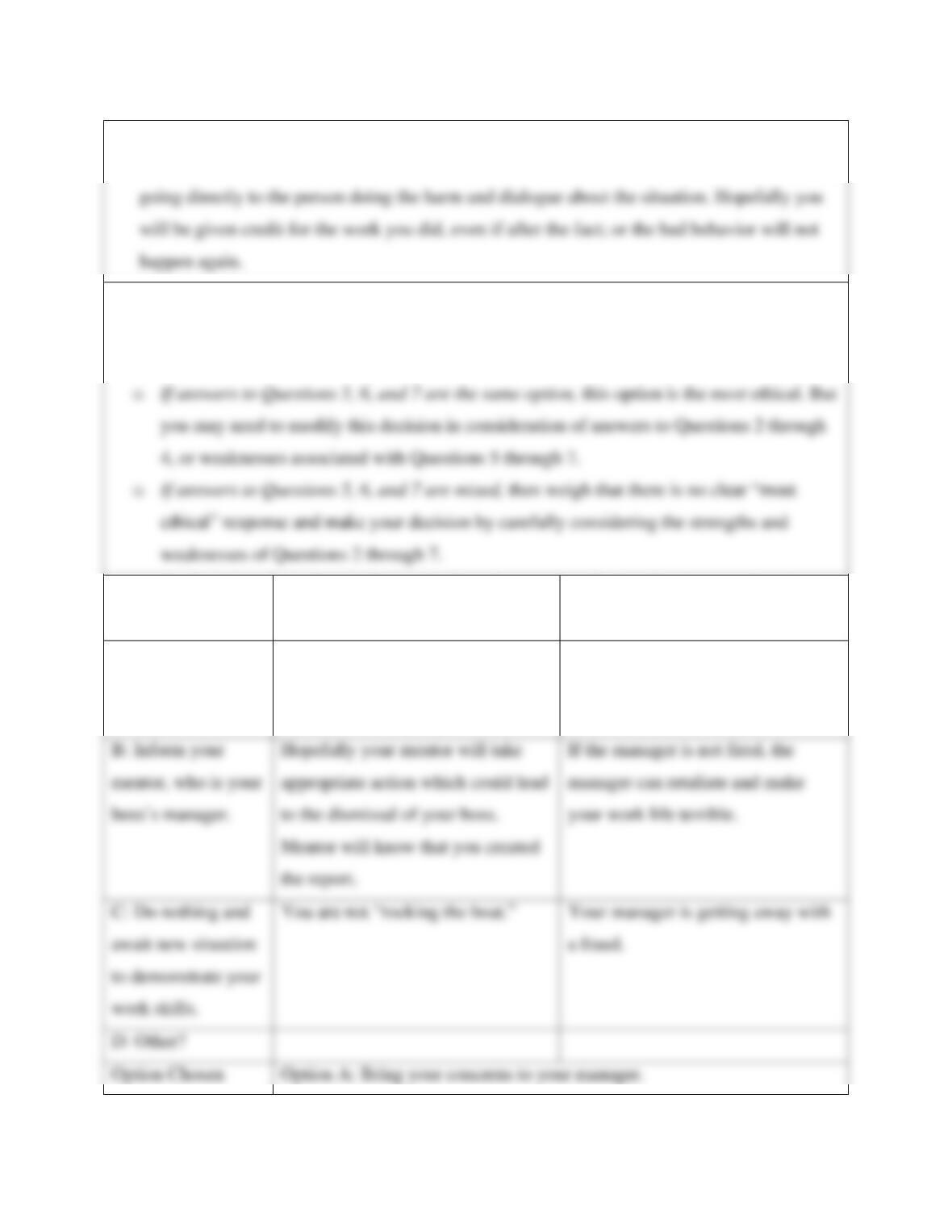
Bring your concerns to your manager (Option A): Demonstrating respect for everyone
Instructor Resource
Collins, Business Ethics 3e
SAGE Publishing, 2022
7. What option would a virtuous person do (virtue ethics)? Why?
Bring your concerns to your manager (Option A): Moral character can be strengthened by
Note
• If answers to Questions 2 through 7 are all the same option, then do that option.
• If answers to Questions 2 through 7 are mixed, then:
Option
Option Strengths Based on
Application of Ethical Theories
Option Weaknesses Based on
Application of Ethical Theories
A: Bring your
concerns to your
manager.
This allows your manager to
explain taking credit for your work
in hopes of it not happening again.
You may get fired for raising the
issue.
Option Chosen
Option A: Bring your concerns to your manager.
Instructor Resource
Collins, Business Ethics 3e
SAGE Publishing, 2022
Chosen Because
This is based on deontology and virtue ethics. You are allowing the
manager who took credit for your work to explain why (deontology), and
to take responsibility for what he had done (virtue ethics).
CHAPTER 10 ANALYSIS FOR UP FOR DEBATE
Up for Debate: A Captured Market
In August 2015, Turing Pharmaceuticals bought the rights to a 62-year-old standard drug for
people with a life-threatening infection; at that time, it sold at $13.50 a tablet. Overnight, the
company increased the price to $750 a tablet. For some patients, this would result in an annual
Critical Thinking Questions
1. Should government regulate the pricing of pharmaceutical drugs?
2. Why is this the right option to choose?
3. What are the ethics underlying your decision?
Up for Debate: A Captured Market—Should government regulate the pricing of
pharmaceutical drugs?
Instructor Resource
Collins, Business Ethics 3e
SAGE Publishing, 2022
Yes
• Poor people should have access to life-
saving drugs and that requires some
price controls (social group relativism,
utilitarianism, deontology).
No
• Free market system is better that strict
regulations in achieving higher quality
of life, so let the market determine
pricing points (utilitarianism).