Instructor Resource
Collins, Business Ethics 3e
SAGE Publishing, 2022
Everyone has the potential to be kind or cruel to others. Harvard psychologist Lawrence
Kohlberg (1927–1987), influenced by the writings of Jean Piaget, analyzed how children
DISCUSSION ACTIVITY
Have students independently read and answer the Heinz Dilemma. Sort students into groups
based on answering “yes” or “no” to the question “Should the husband have done that?” Within
the group, have students share the reasons why Heinz’s stealing the drug is right or wrong. Then
have representatives from the two opposing viewpoints try to persuade the opposite side.
• Based on extensive research, patterns emerged in terms of how people reasoned through
the ethical dilemmas.
• According to Kohlberg, people sequentially progress through a continuum of six stages
Preconventional level: Moral reasoning is based on what benefits the individual. Only my
interests exist and matter. Moral determination is based on my own needs and wants.
Stage 1: Obedience-and-punishment orientation. Right is determined by obeying rules
from a superior authority and avoiding punishment.
Instructor Resource
Collins, Business Ethics 3e
SAGE Publishing, 2022
Conventional level: Moral reasoning is based on applying a social role or group membership
analysis. The interests of other people must be considered. Moral determination is based on
performing good or right roles, pleasing others, and maintaining societal order.
Stage 3: “Good Boy–Nice Girl” Orientation. Right is determined by winning the
Postconventional level: Moral reasoning is based on applying abstract universal principles.
There are societal and beyond societal perspectives that matter. Moral determination is based on
abiding by abstract principles applied to society.
Stage 5: Social contract orientation. Right is determined by preserving mutually agreed
upon human rights and changing unjust laws for the sake of community welfare.
An individual’s sequential passage through the six stages of moral development is influenced by
three factors: age, respect for people at the next higher stage, and moral discomfort.
First, progression is somewhat dependent on age because the mind becomes more capable of
Instructor Resource
Collins, Business Ethics 3e
SAGE Publishing, 2022
Third, moral discomfort plays a key factor in explaining why some adults never progress beyond
the preconventional level (stages one and two), and most adults stop moral reasoning progress at
being a good group member (stage three) or law-abiding citizen (stage four).
LIES AND CHEATING
• “Do not lie” and “do unto others as you want done to you” are two moral imperatives,
principles compelling people to action, found in all cultures and major world
religions.
• Despite these often repeated moral messages, children and adults conceal and falsify the
truth on a daily basis and lie when it is to their advantage.
Table 1.4 provides results of a nationwide adult telephone survey:
• 91 percent lied regularly.
• 35 percent stole office supplies.
• 33 percent lied on a job application.
Instructor Resource
Collins, Business Ethics 3e
SAGE Publishing, 2022
ALTRUISM
Moral imperfection, however, is just a small aspect of human activity. If adults lie once a
day, then they are honest and truthful hundreds or thousands of times every day. At any
given moment, hundreds of millions of acts of kindness take place around the world.
CHAPTER QUESTION 6: WHY DO GOOD PEOPLE BEHAVE UNETHICALLY?
• Ethics would be easy to manage if it were simply a matter of detecting and dismissing
evil people. But that is not the nature of life in organizations.
DISCUSSION ACTIVITY
Ask students if they have ever lied to a boss, customer, or coworker. How did they justify their
actions? Have them tell stories in small groups about these situations.
UNINTENDED UNETHICAL BEHAVIORS
• Sometimes the unethical outcome was not intended. The person may have good motives,
Instructor Resource
Collins, Business Ethics 3e
SAGE Publishing, 2022
CHOOSING BETWEEN COMPETING VALUES
• Sometimes ethical dilemmas arise and the decision maker must choose between two
competing values, both of which are morally appropriate. But in choosing one set of
moral values over another, those not benefitted from the decision can claim the choice
was unethical.
• Rushworth Kidder notes that “The really tough choices, then, don’t center upon right
versus wrong. They involve right versus right.”
INTENTIONAL UNETHICAL BEHAVIORS
• The most basic justification for behaving unethically, as suggested by Kohlberg’s theory
of moral development, is to avoid punishment and receive praise.
• On a broad contextual level, some good people attribute their occasional unethical
misbehaviors on an organizational culture that either encourages or tolerates them.
Instructor Resource
Collins, Business Ethics 3e
SAGE Publishing, 2022
3. Helping the organization to survive (40 percent)
4. Meeting schedule pressures (35 percent)
5. Wanting to be a team player (27 percent)
• Stanley Milgram, a professor of social psychology, conducted a series of troubling social
experiments demonstrating how good people are capable of physically harming others if
• Behaving unethically to be a team player highlights the importance of an employee’s
sense of belongingness.
• Lastly, a good person may behave unethically because the end goal is so essential that the
ends justify the means.
FAILURE TO REPORT UNETHICAL BEHAVIORS
Based on in-depth interviews with employees, researchers found that 85 percent had not raised
an important issue or concern to their bosses on at least one occasion. The top reasons for not
informing a manager about unethical behaviors were:
• Fear of being labeled or viewed negatively by others, such as being considered a
Instructor Resource
Collins, Business Ethics 3e
SAGE Publishing, 2022
General Motors Ignition Switch Problem
• 2001 GM engineers first detect an ignition switch defect during preproduction testing.
• 2005 Engineer recommended redesigning the switch; upper management said no due to
extra costs.
DISCUSSION ACTIVITY
Ask students if they have ever observed someone behaving unethically at work (or in school).
Then have them reflect on a situation where someone behaved unethically at work and they: (a)
Instructor Resource
Collins, Business Ethics 3e
SAGE Publishing, 2022
Chapter 1 QUESTIONS ANSWERED
Chapter Question 1: What are the most common types of unethical behaviors in
organizations?
Table 1.1 Five Most Common Unethical Behaviors
1. Misuse of Company Time. Altering time sheets, covering up for someone who shows up
late, and conducting personal business on company time.
2. Abusive Behavior. Using one’s position or power to mistreat others and create a hostile
work environment.
In 2014 Institute of Leadership & Management survey of 1,600 managers listed the following as
the top misbehaviors:
• Taking shortcuts or performing low quality work: 72 percent
• Lying to hide mistakes: 72 percent
• Badmouthing colleagues: 68 percent
Chapter Question 2: How do unethical behaviors increase organizational costs?
1. Legal Costs
Instructor Resource
2. Employee Theft Costs
3. Monitoring Costs
4. Reputation Costs
• VW emissions scandal
5. Abusive Treatment Costs
• Costs in terms of absenteeism, health care costs, and lost productivity have been
estimated to be $23.8 billion annually.
6. Recruitment and Turnover Costs
• The lack of loyalty between an unethical organization and its key constituents is
Chapter Question 3: What are the competitive advantages of creating and sustaining an
ethical organization?
• Attract and retain high quality employees
Instructor Resource
Collins, Business Ethics 3e
SAGE Publishing, 2022
• There are a host of performance benefits that ethical organizations achieve because they
attract high-quality employees and are trusted by customers, suppliers, investors, and
government officials:
o Greater trustworthy information for decision making
Chapter Question 4: What are the four beliefs about human nature as related to ethics at
the time of birth?
1. Born with prior knowledge of right and wrong
• Among the ancient Greek philosophers were Socrates (469–399 BC) and Plato
(427–347 BC).
2. Born good
3. Born with inherited sin
• Due to inherited sin, a morally damaged soul joins the body at birth and needs to be
healed.
4. Born morally neutral
Instructor Resource
Collins, Business Ethics 3e
SAGE Publishing, 2022
• Aristotle (384–322 BC) disagreed with his teacher Plato’s view that infants
Chapter Question 5: What are the six stages of moral development?
STAGES OF MORAL DEVELOPMENT
Everyone has the potential to be kind or cruel to others. Harvard psychologist Lawrence
Preconventional level: Moral reasoning is based on what benefits the individual. Only my
interests exist and matter. Moral determination is based on my own needs and wants.
Stage 1: Obedience-and-punishment orientation. Right is determined by obeying rules
Conventional level: Moral reasoning is based on applying a social role or group membership
analysis. The interests of other people must be considered. Moral determination is based on
performing good or right roles, pleasing others, and maintaining societal order.
Stage 3: “Good Boy–Nice Girl” orientation. Right is determined by winning the
Instructor Resource
Collins, Business Ethics 3e
SAGE Publishing, 2022
Postconventional level: Moral reasoning is based on applying abstract universal principles.
There are societal and beyond societal perspectives that matter. Moral determination is based on
abiding by abstract principles applied to society.
Stage 5: Social contract orientation. Right is determined by preserving mutually agreed
upon human rights and changing unjust laws for the sake of community welfare.
An individual’s sequential passage through the six stages of moral development is influenced by
three factors: age, respect for people at the next higher stage, and moral discomfort.
Chapter Question 6: Why do good people occasionally behave unethically?
1. Unintended unethical behaviors
2. Choosing between competing values
• Rushworth Kidder notes that “The really tough choices, then, don’t center upon right
3. Intentional unethical behaviors
• A survey conducted by the Society for Human Resource Management and the Ethics
Resource Center found that 24 percent of the respondents were pressured to
Instructor Resource
Collins, Business Ethics 3e
SAGE Publishing, 2022
2. Meeting overly aggressive business or financial objectives (48 percent)
4. Failure to report unethical behaviors
• The top reasons for not informing a manager about unethical behaviors were:
o Fear of being labeled or viewed negatively by others, such as being considered a
troublemaker, tattletale, or complainer
CHAPTER 1 ETHICAL DILEMMA ANALYSIS
Each chapter contains two real-life ethical dilemmas: (a) What would you do? (all stories
provided by my students, and (b) Up for Debate.
Have students apply Table 6.3 Systematic Rational Ethical Decision-Making Process to analyze
these ethical dilemmas (instructions below). By doing so, students develop a habit for analyzing
decisions that take into consideration ethical concerns.
Step 1: Write the decision options in the appropriate column below.
Step 2: Apply the seven “Applying Ethical Theories to Decision Making” questions to the
decision to obtain relevant ethical information.
Instructor Resource
Collins, Business Ethics 3e
SAGE Publishing, 2022
weaknesses associated with the option chosen.
NOTE ON ETHICAL DILEMMA ANALYSES AND AUTHOR RECOMMENDATION—The
“author” (me) is stating his best judgment. All the ethical dilemmas are difficult and involve
CHAPTER 1 ANALYSIS FOR “WHAT WOULD YOU DO?” OPENING DILEMMA
Chapter 1: Billing for Services Rendered
Summary
• You are assigned to work in the billing department of a prestigious hospital.
• You overhear a patient saying that she/he cannot afford to pay for the medicine out
of pocket. The doctor tells the patient not to worry as she can work around the
problem.
Instructor Resource
Collins, Business Ethics 3e
SAGE Publishing, 2022
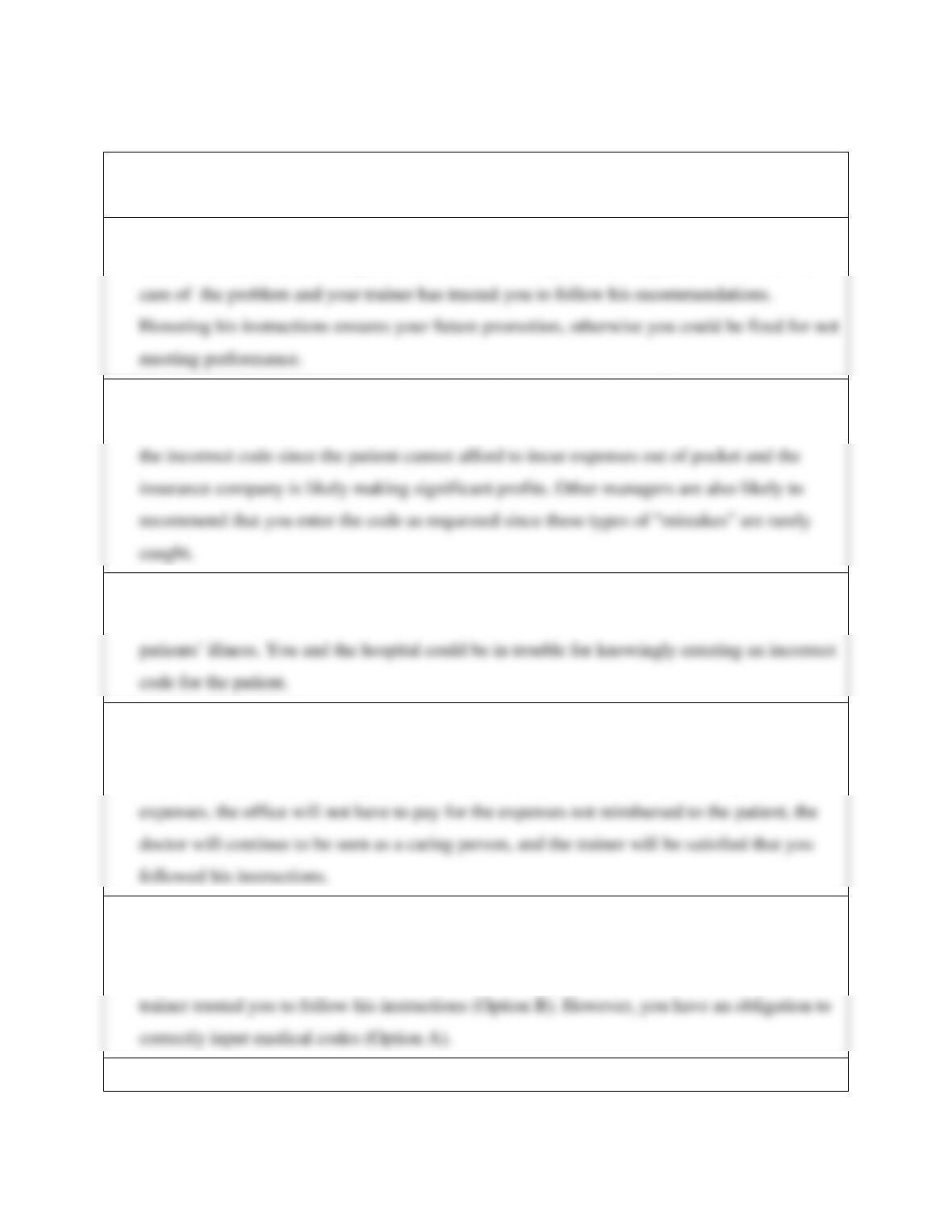
Table 6.3 Systematic Rational Ethical Decision-Making Process
1. Who are all the people affected by the action?
You (medical office trainee), trainer, patient, doctor, insurance company, hospital
2. What option benefits me the most (egoism)? Why?
Enter the incorrect code (Option B): The doctor has promised the patient she would take
3. What option does my social group support (social group relativism)? Why?
Enter the incorrect code (Option B): Your friends are most likely to suggest that you enter
4. What option is legal (cultural relativism)? Why?
Enter the correct code (Option A): You have an obligation to correctly document the
5. What option is the greatest good for the greatest number of people affected (utilitarianism)?
Why?
Enter the incorrect code (Option B): The patient will not be billed for out-of-pocket
6. What option is based on truthfulness and respect/integrity toward each stakeholder
(deontology)? Why?
Mixed: The doctor promised the patient she would take care of the bill (Option B). The
7. What option would a virtuous person do (virtue ethics)? Why?
Instructor Resource
Collins, Business Ethics 3e
SAGE Publishing, 2022
Mixed: Moral character can be strengthened by expressing compassion for the patient’s
difficult financial situation and suffering (Option B). Moral character can also be
strengthened by following the rules (Option A).
Note
• If answers to Questions 2 through 7 are all the same option, then do that option.
• If answers to Questions 2 through 7 are mixed, then:
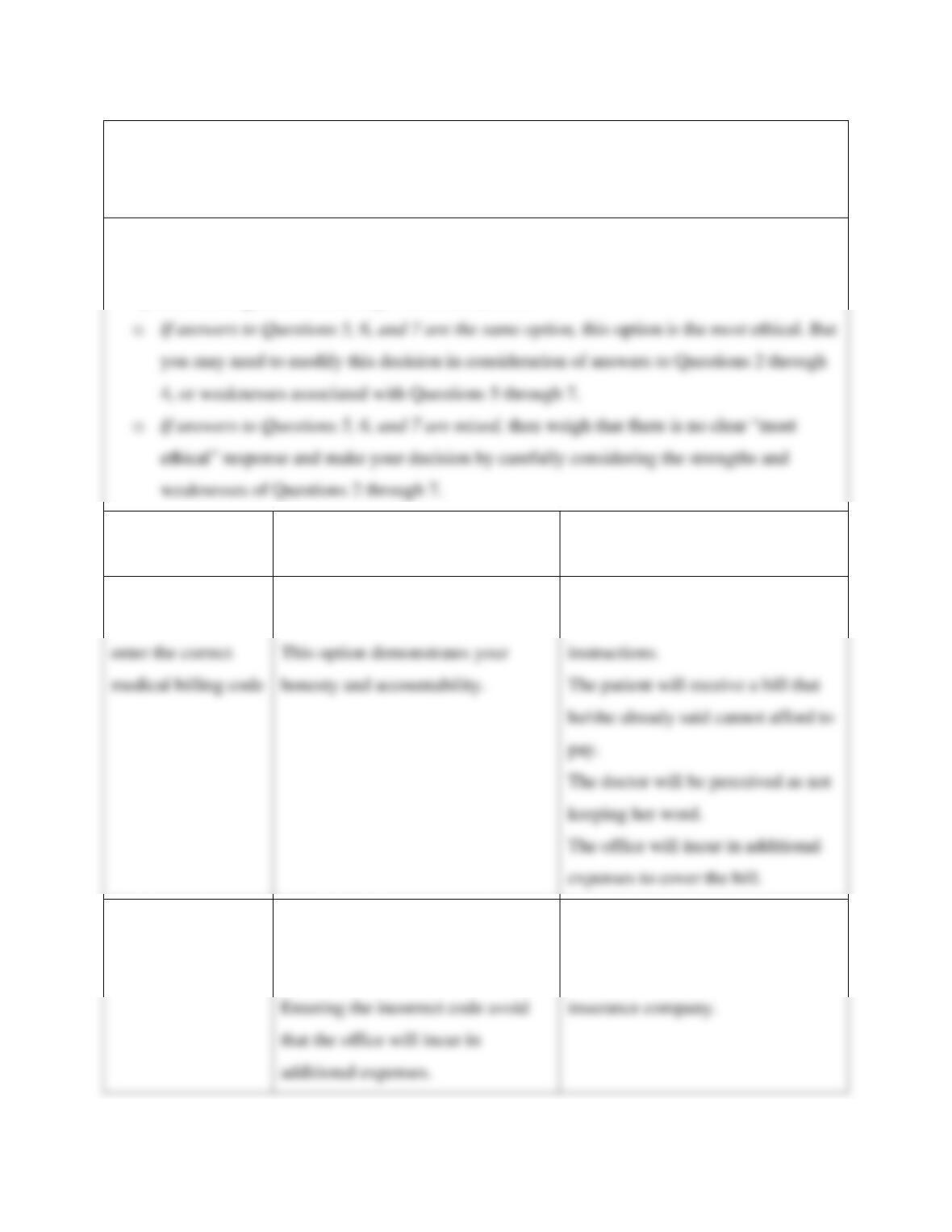
Option
Option Strengths Based on
Application of Ethical Theories
Option Weaknesses Based on
Application of Ethical Theories
A: Break the
confidence and
You will follow the rules.
You can avoid potential trouble.
You could get fired for not
following your trainer’s
B: Enter the
incorrect billing
code.
Entering the incorrect code
expresses compassion for the
patient.
This may violate rules.
There may be potential lawsuits.
This option is not fair to the
Instructor Resource
Collins, Business Ethics 3e
SAGE Publishing, 2022
Doctor will be able to keep her
promise to the patient.
Insurance companies make enough
profits.
You will be able to keep your job.
C. Other?
Option Chosen
Option B: Enter the incorrect billing code as instructed by your trainer.
Chosen Because
This choice is based on egoism, social group relativism, utilitarianism, and
in part by deontology and virtue ethics. Your trainer trusts you will follow
organization.
How Will You
Manage Chosen
You are likely breaking the rules by knowingly entering an incorrect
billing code. Your decision puts you and the hospital at risk of potential
CHAPTER 1 ANALYSIS FOR UP FOR DEBATE
Up for Debate: Honesty and Lying—Should individuals always tell the truth?
Yes
• Honesty helps individuals mature
No
• Sometimes telling the truth might cause
Instructor Resource
Collins, Business Ethics 3e
SAGE Publishing, 2022
(deontology, virtue ethics).
• Lying damages your reputation and
self-esteem (deontology, virtue ethics).
• Lying can be addictive (egoism).
• Lying to regulators, customers, etc. can
have negative legal ramification
(cultural relativism).
• By lying, sometimes you are more
likely to get what you want (egoism,
utilitarianism).
• Sometimes lying is necessary to
maintain another person’s
confidentiality (virtue ethics).
• On average, an individual lies 1 or 2