Chapter 9 – Information Systems and Supply Chain Management
09–13
C. Radio Frequency Identification Devices
• Radio frequency identification devices are
tags that transmit identifying information
and are attached to individual items,
shipping cartons, and containers.
See PPT 9-37, 9-38
• High costs are the major obstacle to the
adoption of RFID systems.
D. Supply Chain for Fulfilling Catalog and Internet
Orders
• The supply chain and information systems
for supporting catalog and Internet
channels tend to be distinct from those that
support the traditional store channel
• The information system for supporting a
store channel focuses on products—making
Chapter 9 – Information Systems and Supply Chain Management
09–14
E. Drop Shipping
• Drop shipping, or consumer direct
fulfillment, is a system in which retailers
receive orders from customers and relay
these orders to vendors; the vendors then
ship the merchandise ordered directly to
the customer.
Ask students when drop shipping orders would
make the most sense for product-related
purchases. Which retailers could utilize drop
shipping? Could this be a sustainable competitive
advantage? Why or why not?
F. Customer Store Pickup
• Rather than shipping orders directly to
customers, retailers can enable them to
make a purchase online and then pick up
the merchandise in stores.
Chapter 9 – Information Systems and Supply Chain Management
09–15
G. Reverse Supply Chain
• Reverse supply chain is the process of
capturing value from and/or properly
disposing of merchandise returned by
customers and/or stores.
V. Summary
• Supply chain management and information
systems have become important tools for
achieving sustainable competitive
advantage. Developing more efficient
methods of distributing merchandise
creates an opportunity to reduce expenses
and improve customer service levels.
• A retailer’s information system tracks the
flow of merchandise through distribution
centers to retail stores and from fulfillment
Chapter 9 – Information Systems and Supply Chain Management
09–16
• Many retailers are adopting a quick
response inventory system that is
characterized by smaller, more frequent
shipments from manufacturers.
• In designing their supply chain management
systems, retailers make decisions about
Chapter 9 – Information Systems and Supply Chain Management
09–17
ANSWERS TO “GET OUT AND DO IT!” QUESTIONS
1. CONTINUING ASSIGNMENT Interview the store manager working for the retailer you have
selected for the Continuing Case assignment. Write a report that describes and evaluates the
retailer’s information and supply chain systems. Use this chapter as a basis for developing a
set of questions to ask the manager. Some of the questions might be these: Where is the
store’s DC? Does the retailer use direct store delivery from vendors? How frequently are
deliveries made to the store? Does the merchandise come in ready for sale? What is the
store’s percentage of stockouts? Does the retailer use a push or pull system? Does the store
get involved in determining what merchandise is in the store and in what quantities? Does
the retailer use VMI, EDI, CPFR, or RFID?
2. INTERNET EXERCISE Go to Barcoding Incorporated’s web page at
this company using technology to support retailers with information systems and supply
chain management?
Some of the information students will find on this homepage…
“If inefficiencies throughout the system could be eliminated, from the stockroom to the shelf to
the point of sale, it eases the pressures faced at the register, and unlocks even greater profit
Talent Shortage
They also foresee a talent shortage in robotics that will result in 35 percent of robotics jobs
sitting vacant in 2020. At the same time, the average salary for workers in this field is expected
to grow by 60 percent or more.
Chapter 9 – Information Systems and Supply Chain Management
09–18
Better Efficiency
Robotic deployments are expected to become more collaborative, and just under a third of new
deployments will be smart collaborative varieties that can function three times faster than the
search for supply chain in the current issue. Summarize one of the recent articles, and
explain how the key concept(s) described could make the shopping experience better for
consumers and improve efficiency in the supply chain.
Students’ answers will vary depending on the article they search. The website has an entire
Chapter 9 – Information Systems and Supply Chain Management
09–19
ANSWERS TO DISCUSSION QUESTIONS AND PROBLEMS
1. Retail system acronyms include DSD, VMI, EDI, CPFR and RFID. What do these terms
means and how are they related to one another?
Each of these terms describes a system designed to enhance the efficiency of supply chain
management. DSD, direct store delivery, bypasses the retailer’s distribution center and
2. Explain how an efficient supply chain system can increase a retailer’s level of product
availability and decrease its inventory investment.
By eliminating the need for paper transactions, an efficient supply chain management
system reduces lead-time. Shorter lead-time reduces the need for safety stock because the
3. This chapter presents some trends in supply chain and information systems that benefit
retailers. How do vendors benefit from these trends?
Vendors benefit from collaboration in supply chain management just as retailers do. As
Chapter 9 – Information Systems and Supply Chain Management
4. What type of merchandise is most likely to be cross-docked at retailers’ DCs? Why is this
often the case?
Merchandise prepackaged by vendors for specific stores is crossdocked because it is ready
for sale. No further processing and no storage at the distribution center are required. This
5. Why haven’t more fashion retailers adopted an integrated supply chain system similar to
Zara’s?
Zara’s integrated supply chain management system depends on two major factors for its
success. The first is the technological connections between the sales floor and the design
center in Spain. Such technology requires higher capital investments and employee
Chapter 9 – Information Systems and Supply Chain Management
09–21
6. Explain the differences between pull and push supply chains.
A pull distribution strategy is when orders for merchandise are generated at the store level
based on demand data captured by point of sale (POS) terminals. A push distribution
7. Consumers have five key reactions to stockouts: buy the item at another store, substitute
a different brand, substitute the same brand, delay the purchase, or do not purchase the
item. Consider your own purchasing behavior, and describe how various categories of
merchandise would result in different reactions to a stockout.
A stockout occurs when an SKU a consumer wants is not available. Students’ answers will
vary widely here. This question allows for discussion of factors such as brand loyalty, and
8. Abandoned purchases as a result of stockouts can mean millions of dollars a year in lost
sales. How are retailers and manufacturers using technology to reduce stockouts and
improve sales?
Retailers are turning to investments in information technology and supply chain
management systems to help reduce stockouts. Some retailers are turning to CPFR systems
9. What is a universal product code (UPC)? How does this code enable manufacturers,
distributors and retailers to track merchandise throughout the supply chain?
“Universal Product Codes (also known as GTIN-12) appear as lines (bars) of varying widths
Chapter 9 – Information Systems and Supply Chain Management
09–22
10. Why are some retailers switching from UPC codes to RFID?
RFID devices have two advantages over traditional bar codes. First, they can hold more data
and update the data stored. For instance, the device can keep track of where an item has
Chapter 9 – Information Systems and Supply Chain Management
09–23
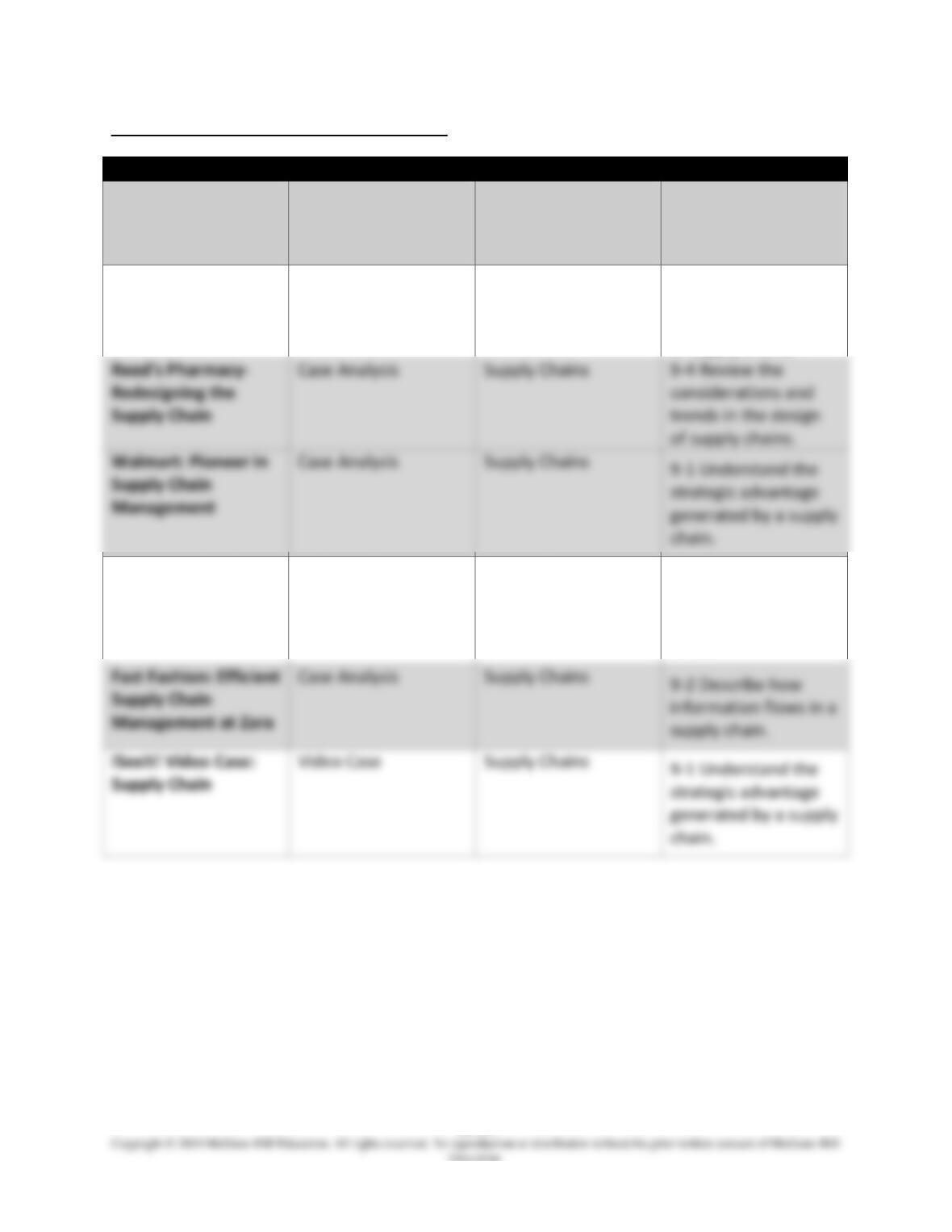
CONNECT ACTIVITIES FOR CHAPTER 9
Activity Title
Activity Type(s)
Topic
Learning Objective
Merchandise and
Information Flow
Drag and Drop;
Matching (accessible
version)
Supply Chains
9-2 Describe how
information flows in a
supply chain.
H&M Innovations in
Supply Chain
Management
Case Analysis
Supply Chains
9-4 Review the
considerations and
trends in the design
of supply chains.
Management
Understanding the
Distribution Center
Click and Drag;
Matching (accessible
version)
Supply Chains
9-1 Understand the
strategic advantage
generated by a supply
chain.
generated by a supply